
Germany Job Seeker Visa 2026: Complete Guide for Indian Students
The Germany job seeker visa can be a useful way for international graduates and skilled professionals who are seeking employment and building a bright career in Germany. However the rules differ as per your qualification, recent residence status and the route you opt for. This write up explain briefly the 2026 job seeker visa and Opportunity Card, including eligibility, duration, work rights, financial need, application steps, documents and available options after getting a job briefly. You will also read practical tips and answers to common questions to assist you in knowing the process clearly and prepare your application with confidence.

Summarise with AI
Choose your AI Assist



Table of Contents

1. How Do I Apply for a Germany Job Seeker Visa?
2. What Are The Requirements For a Germany Job Seeker Visa?
3. Who is Eligible For a Germany Job Seeker Visa?
4. How Much Bank Balance Is Required For a Germany Job Seeker Visa?
5. Can I Work in Germany on a Job Seeker Visa?
6. How Long is the Germany Job Seeker Visa Valid?
7. What Documents Are Required For a Germany Job Seeker Visa Application?
8. Can I Convert My Germany Job Seeker Visa Into a Work Visa After Getting a Job?
9. Is IELTS Required For a Germany Job Seeker Visa?
10. What Are The Chances Of Getting a Job In Germany On a Job Seeker Visa?
Understanding Germany Job Seeker Visa 2026 and Key Facts
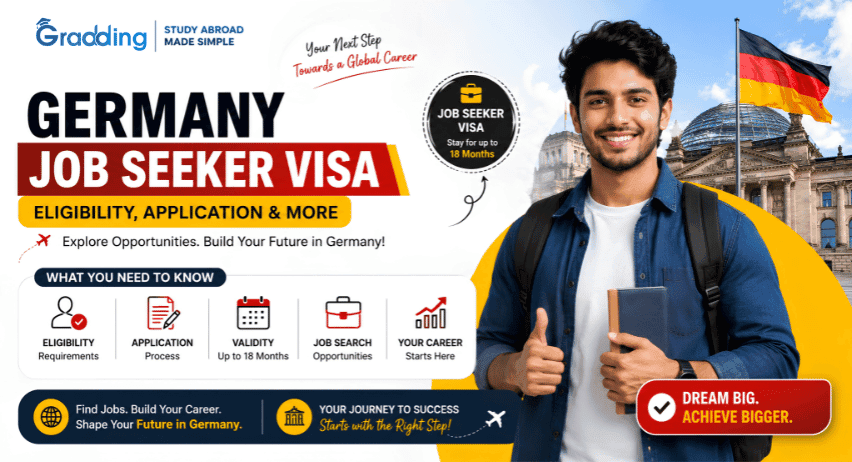
The Germany job seeker visa allows international graduates to stay after completing their studies and search for qualified employment. German job seeker visa is valid for up to 18 months and cannot be renewed. During this period one has to find qualified work and switch to a suitable residence permit like the EU Blue Card or a skilled worker permit.
However your new job does not have to match your exact degree field but it must need degree level or equivalent skills. But professions like medicine, nursing, law and teaching still require the respective licence.
Job Seeker Visa Vs Opportunity Card: Which One Is For You?
Choosing between Germany’s job seeker visa and Opportunity Card (Chancenkarte) Germany for Indian students mainly depends on your education, work experience, eligibility and whether you have already graduated from a German University.
| Feature | Post-Study Permit | Opportunity Card |
| Who it is for? | International students who graduated from a German university | Skilled professionals applying from abroad |
| Duration | Up to 18 months | Up to 12 months |
| Eligibility | Proof of graduation from a recognised German university | Points-based system; at least 6 points required |
| Work while searching | Full-time or part-time work in any job | Up to 20 hours per week |
| Financial proof | Proof of enough money to support yourself | €1,091 per month or €13,092 for one year |
Who is Eligible for the Germany Job Seeker Visa?
To apply for Germany’s Opportunity Card, you need to be a non-EU/EEA/Swiss national with a recognised academic degree or vocational qualification. Here are the eligibility requirements for the Germany job seeker visa for Indian in brief:
A. Core Requirements
- Education: A degree from a recognised university or vocational qualification that meets Germany’s requirements.
- Financial Support: You must prove that you can cover your living expenses usually via a blocked account Germany or a declaration of commitment. In 2026, the blocked account is €1,091 per month.
- Health Insurance: You all need valid health insurance coverage for your stay in Germany.
- Language Skills: You need German A1 or English B2 for language proficiency.
B. Point Based Route
If your qualification is not completely recognised in Germany, you can still apply through the Opportunity Card points system. You need at least 6 points on the basis of factors like professional experience, language skills, age, qualification recognition and previous links to Germany.
How to Apply For The Germany Job Seeker Visa: Step-By-Step Process
As soon as you complete your graduation, you should request official confirmation of your degree from your university. The 18 month period starts from your graduation date not the date your permit is approved.
Here is the step-by-step process for the Germany job seeker visa requirements application:
Step A: Submitting the Application
As per your city you are required to apply online by email or by post. Cities like Berlin, Hamburg, Leipzig and Munich along with many others now provide online application portals, making online applications increasingly common. At this stage, prepare all essential supporting documents including financial proof, German accommodation and degree/graduation proof.
Step B: Submit Bio Metrics & Pay The Fee
After submitting your application, the immigration authority will review your documents and mainly contact you by email if the application is complete. Later you will receive an appointment to visit the office in person.
At the appointment you will usually need to:
- Sign the required documents
- Provide your fingerprints
- Present your passport
- Submit a biometric photograph
- Pay the application fee
The fee for the electronic residence permit is usually around €100, though the actual amount can vary from city to city. If you apply via an online portal like Berlin’s you may be able to pay online by PayPal or pay online. However offices which collect payment in person may accept EC card or cash.
Step C: Receive Your Residence Permit
After the collection of biometric data and the fee has been paid, you are required to receive a Fiktionsbesceinigung, which is a temporary document which allows you to remain in Germany while your residence permit card is being produced.
It normally reflects that your residence permit card will be valid for around three months. As per the type issued, it can also allow you to work and make limited trips abroad. Now you must check with your local immigration office before travelling as travel rights can vary.
You will be informed whether your electronic residence permit card will be sent by post or collected in person.
After this processing for the application typically takes around 4 to 6 weeks after your biometric data is submitted and the fee is paid, instead of from the date you first submit your application. Though the processing time can be longer in large cities like Berlin and Munich because of backlogs.
Documents Required For Germany Job Seeker Visa In 2026
Preparing the suitable documents in advance can make your Germany job seeker visa application smoother and help avoid unnecessary delays. So make sure your documents are valid, complete and ready before submitting your application.
- A valid passport with sufficient validity remaining.
- Degree certificates or official proof of course completion.
- Proof of financial resources like a blocked account, sponsor letter or bank statements.
- A valid health insurance covering your stay in Germany.
- Proof of accommodation in Germany.
- Biometric passport photos.
Completed application form from your local Ausländerbehörde or the VIDEX form if applying from India. CV and Motivation statement, if required explaining your qualifications and job search plans.
Can I Work on a Germany Job Seeker Visa?: Work Rights Explained Clearly
The work rules mainly depend on the type of permit you have. Below is a simple breakdown:
- Post Study Permit: If you graduated from a German university you can then work full time or part time in any job, even if it is not related to your degree along with seeking a qualified job.
- Opportunity Card: You have the right to work up to 20 hours per week while searching for a suitable full time job.
- Regulated Professions: Forjobs like medicine, nursing, teaching and law, you need to have a professional licence before you can work in that profession.
Post Job Search Options and Visa Pathways in Germany
After finishing your job search,Germany provides multiple pathways as per your job offer, qualification or career plans. It includes the EU Blue Card for Indian Engineering graduates, a skilled worker permit, self employment and other residence options.
| Option | Key Requirement / Benefit |
| EU Blue Card | Requires a job matching your qualification and a minimum gross annual salary of €50,700 or €45,934.20 for shortage occupations and recent graduates (2026). |
| Skilled Worker Residence Permit | Suitable for qualified jobs that do not meet the EU Blue Card salary requirement. |
| Self-Employment Permit | Allows you to stay in Germany if you decide to start your own business. |
| Family Reunification | Your spouse and children may be able to join you once you hold a valid work-based residence permit, depending on your situation. |
5 Practical Tips To Maximise Your 18 Months
Your 18 months can be a valuable opportunity to build your career and establish yourself in Germany. Below are the practical tips that will help you improve your opportunities and avoid unnecessary delays.
- Apply Immediately after Graduation: The 18 months actually begin from your graduation date not when your permit is approved. Here any delays reduce your available time.
- Start Working Early: A part time job can help you manage your finances better while you look for a job in your profession.
- Get Early Recognition of your Qualification: This is vital for regulated professions as the process can take time.
- Navigate German Job Platforms: One should use LinkedIn Germany, StepStone, Xing and the Federal Employment Agency’s Jobbörse. Do not rely only on international job sites.
- Learn Basic German: German can improve your chances in interviews even for English-speaking jobs and make everyday life much easier.
As of now you have the full idea for the Germany job seeker visa, but in any case you need assistance regarding how to get into German public universities in 2026, you can navigate the university finder tool at Gradding.com. It is a AI based tool help you get the suitable institution as per your academic qualifications and future targets.
FAQs:
1. How Do I Apply for a Germany Job Seeker Visa?
Indian students can apply for the suitable German national visa via the Consular Services Portal. After this complete the application form by uploading the essential documents, pay the fee, and attend the required appointment.
2. What Are The Requirements For a Germany Job Seeker Visa?
Applicants usually need a recognised university degree or vocational qualification, relevant professional background where required, appropriate funds for the stay and suitable health insurance. Though the exact requirements depend on the job search route and individual circumstances.
3. Who is Eligible For a Germany Job Seeker Visa?
The traditional job seeker visa is available to qualified foreign graduates seeking employment options in Germany. Germany also provides the opportunity card to recognised skilled workers or applicants who meet its point system requirements.
4. How Much Bank Balance Is Required For a Germany Job Seeker Visa?
For the opportunity card in 2026, applicants usually need to show at least €1,091 net per month to support themselves. And this can be through a declaration of commitment. However the financial requirements for other job search routes can differ.
5. Can I Work in Germany on a Job Seeker Visa?
The traditional job seeker visa is mainly for finding employment. So its work conditions might differ from those of the opportunity card. Opportunity card holders can undertake secondary employment for up to 20 hours per week along with searching for a suitable job.
6. How Long is the Germany Job Seeker Visa Valid?
The traditional job seeker visa permits qualified applicants to stay for up to six months to look for employment. The new opportunity card can usually allow job searching for up to one year subject to its specific conditions.
7. What Documents Are Required For a Germany Job Seeker Visa Application?
The following are the essential documents required for a German job seeker visa application:
- Valid passport
- Visa application
- Proof of application
- Proof of sufficient fund
- Health Insurance
Besides you are require to submit any supporting documents as the responsible German mission provides the accurate checklist for your case.
8. Can I Convert My Germany Job Seeker Visa Into a Work Visa After Getting a Job?
Yes, once you secure suitable employment, you can usually apply for the suitable German residence permit for employment as per your qualification and job. Eligible applicants may qualify for routes like skilled worker residence permits or an EU Blue Card.
9. Is IELTS Required For a Germany Job Seeker Visa?
IELTS is not a universal requirement for the Germany Job seeker visa. Language requirements mainly depend on the particular route and situation. For the Opportunity Card point route, German and English language skills can contribute to eligibility, but IELTS itself is not mandatory.
10. What Are The Chances Of Getting a Job In Germany On a Job Seeker Visa?
There is no official percentage or guaranteed success rate. Your chances mainly depend on your qualifications, professional experience, German language ability, occupation and demand. Moreover the German official job portal lists vacancies, but student must research their sector before travelling to Germany.
0 comments


Hand Picked Courses
Get Scholarship Assistance
Get Offer in 15 Days*
Finance/Loan Assistance
I want FREE assistance with





Secure your study visa with expert guidance!