
Studienkolleg in Germany: Guide for Indian Students 2026
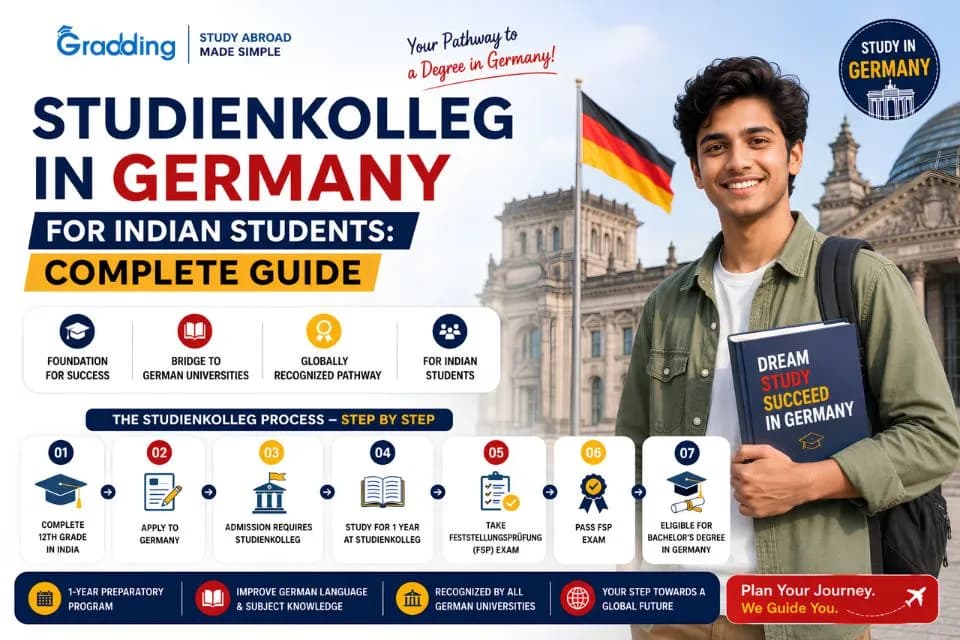
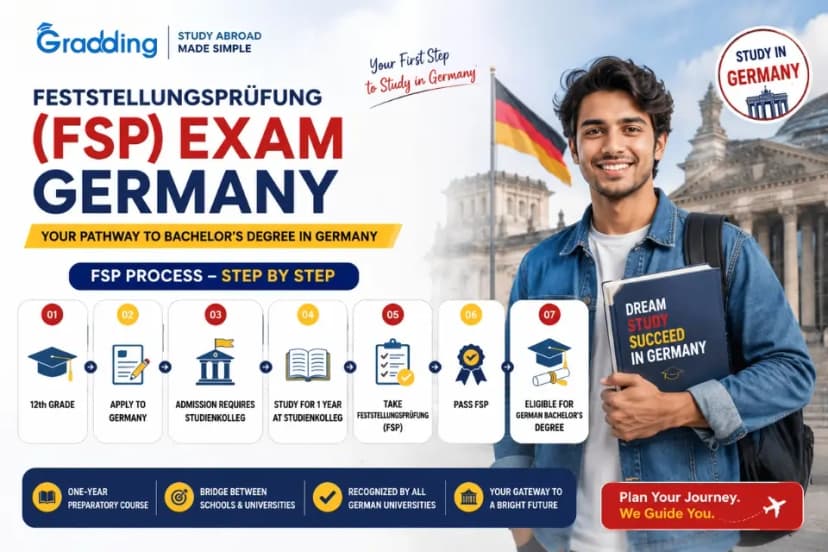
So you have completed your Class 12th with solid marks and are planning to pursue your bachelor’s in a German university. Before you move further, let us tell you that there is a catch. Indian schooling runs for 12 years, whereas Germany’s Abitur runs for 13 years. And this one-year gap means that you can not get direct admission. And this is where Studienkolleg in Germany comes in. It is a one-year bridge program which is designed specifically to close that gap and get you university-ready. Once you clear the final exam, which is the Feststellungsprüfung (FSP), the doors for German universities are going to open up for you. Read more about how it works below.

Summarise with AI
Choose your AI Assist



Table of Contents

Step 1: Check anabin / DAAD Database
Step 2: Start German (Immediately)
Step 3: Get APS certificate
Step 4: Apply to Studienkolleg
Step 5: Sit the Entrance Exam (Aufnahmeprüfung)
Step 6: Apply for German Student Visa
Step 7: Attend Studienkolleg (2 Semesters)
Step 8: Pass the Feststellungsprüfung
Step 9: Apply to German Universities
1. Do all Indian Students Need Studienkolleg to Study in Germany?
2. What is the Total Cost of Studienkolleg for Indian Students?
3. Can I Choose Any Studienkolleg or Does It Depend On My Subject?
4. Can I Apply To Multiple Studienkollegs at Once?
5. Can I Switch Studienkollegs Mid-Program?
6. Can I Work While Studying at Studienkolleg?
7. Is a Private Studienkolleg Certificate Accepted Everywhere?
What is Studienkolleg in Germany?
To put it simply, Studienkolleg in Germany is a one-year preparatory program which is designed for international students whose school-leaving or the high-school certificate is not considered as equivalent to the German Abitur (The qualification that German students get after 13 years of schooling.) Since there are a lot of countries, along with India, that follow a 12-year schooling system, having a Class 12th certificate alone is most of the time not enough to get direct admission to a German bachelor’s degree.
You can think of Studienkolleg as a bridge year. It does not just teach your German, but it also covers subject-specific coursework like math, physics, economics, or humanities. This program usually lasts for one to two semesters and ends with a final exam called Feststellungsprüfung (FSP). Once you pass this exam, you will get a subject-restricted university entrance qualification, which will let you apply to any institution, including Germany public universities in your chosen field.
Here are some quick facts that you should know upfront:
- Duration: This usually lasts for one academic year (two semesters) and can sometimes be shortened to one semester.
- Language of Instruction: The Studienkolleg in Germany for international students is taught in German regardless of whether your eventual degree program is taught in German or not.
- Who Needs it: This is mainly needed by students whose high school graduation certificate is classified as “conditionally equivalent” in the anabin database (Germany’s official system for evaluating foreign qualifications)
- What You Get at the End: In the end, you will get a Feststellungsprüfung certificate, which is recognised by public universities across all 16 German states.
Why Do Indian Students Need Studienkolleg?
German education system runs for 13 years before university, whereas India’s runs for only 12 years. This one-year gap is one of the core reason why most Indian students can not just get a direct admission in German bachelor’s program after their Class 12th.
Most German universities check foreign qualifications against the Anabin database, which is maintained by the Central Office for Foreign Education (ZAB). And the Indian Class 12th certificate is only partially equivalent to the German Abitur. This makes giving the Studienkolleg in Germany and passing FSP an important requirement.
There have been some important updates and exceptions to this:
- New 70% Rule (Winter Semester 2026/27 onward): Indian students now need a minimum overall score of 70% in Class 12th for going for either the Studienkolleg pathway or direct subject-restricted admission.
- JEE Advanced Exception: Students who have an exceptional rank in JEE Advanced, typically the top 7,000 scorers, can qualify for direct entry into technical programs at some universities.
- One Year of University in India: If you have already completed one full academic year of a bachelor’s degree at a recognised Indian institution in a related field, then you can become eligible for direct, subject-restricted admission.
- International Qualifications: Lastly, students who have an IB Diploma or British A-Levels are also exempt from going through the Studienkolleg program.
One thing you should note here is that for a vast majority of Indian students who are straight coming from their 12th, Studienkolleg is not optional. It is a standard pathway to a German University.
What Should I Pay Attention to When Choosing a Studienkolleg?
There are more than 40 Studienkollegs across Germany, and they are not interchangeable. If you pick the wrong one, then it can cost you an application cycle or unnecessary money. Here are some things that actually matter when you are comparing options:
1. Does it Offer Your Course Type?
Keep in mind that not every Studienkolleg runs all the Kurs. There are some that only offer T and W, whereas there are some that offer all five: T, W, M, G, S. So, always make sure to check the specific Studienkolleg’s website before you apply.
2. Public or Private?
The Public Studienkolleg in Germany will charge you a little more than a registration fee and will issue you a state-recognised certificate. The private ones, on the other hand, are going to charge you real tuition (sometimes several thousand euros a semester), and their certificate are not always accepted at every university.
3. Which University is it Affiliated with?
Every Studienkolleg is attached to a specific university and that university a lot of the times give priority to its own Studienkolleg graduates during admissions.
4. City and Cost of Living
The location of Studienkolleg in Germany for international students is going to affect their monthly budget far more than most students expect. Living in Munich, Hamburg, and Frankfurt can cost you around 900-1,300 EUR per month in living costs. While there are cities like Halle, Nordhausen, or Zittau that can be closer to 500-700 EUR per month.
5. Language Level Required for Entry
There is a list of public Studienkolleg in Germany which expect B1-B2 German at the entrance exam stage. So, if your German is not there yet, then you can either commit to intensive language prep for a few months. Or look for private options that build language training into the first part of the program.
Studienkolleg Course Types — Which One for Your Subject?
Studienkolleg is not a one-size-fits-all program. You will be placed into a specific course track (Kurs) based on which course you are planning to study in Germany. Each one of these tracks also has its own subject combination. And choosing the right one is very important because your Kurs is going to determine both your entrance exam and your final Feststellungsprüfung.
When we specifically talk about Indian students, the T-Kurs is by far one of the most popular choices. This is because engineering and computer science are the most sought-after fields and the T-Kurs is the direct pathway into both.
Course Types for University (Universität)
| Kurs | Focus | Typical Subjects | Leads To |
| T-Kurs | Technical/Mathematical-Scientific | German, Math, Physics, Chemistry | Engineering, Computer Science, Natural Sciences |
| W-Kurs | Business/Economics | German, Math, Economics, English | Business Administration, Economics, Social Sciences |
| M-Kurs | Medical/Biological | German, Biology, Chemistry, Physics | Medicine, Pharmacy, Biology, Dentistry |
| G-Kurs | Humanities/German Studies | German, History, Literature, Social Studies | German Studies, Humanities, Law, Linguistics |
| S-Kurs | Language-focused | German, English/French, History | Language & Cultural Studies, Translation |
Course Types for University of Applied Sciences (FH/Fachhochschule)
Fachhochschule or the Universities of Applied Sciences actually follow the same T/W/M/G/S naming convention. But their coursework tends to be a little more applied and practice-oriented, as it helps in matching the hands-on and career-focused nature of FH degree programs.
So, if you are aiming for an FH instead of a traditional university, then make sure that the specific Studienkolleg that you are applying to is affiliated with an FH.
Another important distinction to know about is that a Studienkolleg that is affiliated with a full university will generally let you apply to either a university or an FH after passing the FSP. But if the Studienkolleg in Germany is only affiliated with an FH, then it can restrict your FSP certificate to FH admissions.
Here is a Quick way you can follow to decide your Kurs:
- Want to study engineering, CS, or natural sciences? → T-Kurs
- Want to study business, economics, or management? → W-Kurs
- Want to study medicine, pharmacy, or biology? → M-Kurs
- Want to study humanities, law, or German studies? → G-Kurs
- Want to study languages or translation? → S-Kurs
Public vs Private Studienkolleg — Which Is Better?
Choosing between a public or private Studienkolleg in Germany is one of the first big decisions you are going to make. Let us clear this out beforehand: Neither option is universally “better”, and it completely depends on your German level, your budget, and how much risk you are comfortable taking with the entrance exam.
| Public Studienkolleg | Private Studienkolleg | |
| Cost | Registration fee only (~€100–€400/semester) | Tuition-based, often €5,000–€8,000/semester (some run higher) |
| Certificate recognition | State-recognized, accepted at all public universities | Not always accepted everywhere — must be verified per university |
| Entrance exam | Competitive, especially in major cities | Generally less competitive to get in |
| Language of instruction | German only | Some offer English-taught tracks with built-in German support |
| Best for | Students with B1–B2 German and confidence in a competitive exam | Students who need more flexibility, English-medium support, or missed a public intake |
Public Studienkolleg
The public Studienkolleg in Germany are generally funded by the German government or federal states. This is the main reason why the cost is next to nothing beyond a small studienkolleg fees in Germany for registration. In addition to this, their FSP certificate is state-recognised and accepted at public universities nationwide and not just the university they are affiliated with.
However, the trade-off for this is competition. The seats here are very limited, and the entrance exam can be genuinely tough. Especially if it is at a well-known Studienkolleg in big cities.
Private Studienkolleg
Private Studienkolleg in Germany for international students on the other hand are generally much easy to get into and a lot of the times they move faster though the admission process. There are also some which provide English-taught instruction that can help you if your German is not yet at B1-B2.
But the catch with this is that the certificates that you will get from private Studienkollegs are not always automatically accepted everywhere in Germany. So before you commit to a program, you should contact your target university directly and then confirm that they will accept the FSP certificate from that specific private Studienkolleg in Germany.
Requirements for Studienkolleg — German, Marks, and Entrance Exam
There are three boxes that you need to tick before you can even sit in the entrance exam. These are your academic marks, your German level, and your documentation. And here is exactly what is expected:
Academic Requirement
You will need to have a Class 12th certificate from a recognised board. But from Winter Semester 2026/27 onward, you will need a minimum overall score of 70% of the maximum achievable marks in Class 12th.
Additionally, if your marks lie somewhere below 70%, then Studienkolleg admission is not really currently an option for you through the standard route. So it would be great to double-check your percentage calculation against the specific marking system of your boards.
German Language Requirement
Your classes in Studienkolleg will mostly be taught entirely in German even if your bachelor’s program will be in English. And because of this, you will need to have a solid foundation in German before you can even apply.
- The German Language B1/B2 Certification is typical minimum for the entrance exam
- Recommended for a better chance: B2 and is backed by a certificate like Goethe-Zertifikat B2, telc B2, or TestDaF 4x4
- There are some public Studienkolleg in Germany which list B2 as a formal prerequisite and not just a recommendation.
Other Documents Typically Required
Most of the Studienkollegs will ask you for your academic and language credentials, and:
- Original and attested copies of Class 10th and Class 12th certificates and mark sheets
- Passport copy
- APS certificate Germany
- Passport-size photographs
- Proof of German language level (certificate or equivalent)
- Application form specific to the Studienkolleg
- Letter of motivation or statement of purpose
Total Cost of Studienkolleg Germany for Indian Students 2026
Studying at a Studienkolleg is not really expensive if we look at it by German standards. But the total first-year cost can surprise you because it can include multiple one-time Studienkolleg in Germany fees. Here is a realistic breakdown of the total cost you can expect to pay:
| Expense | Approximate Cost (EUR) | Approximate Cost (INR) | Notes |
| APS Certificate | ~€225 | ~₹18,000–20,000 | One-time, mandatory for Indian applicants |
| Studienkolleg tuition (public) | Registration fee only | ~₹8,000–35,000/semester | Public institutions don't charge real tuition |
| Studienkolleg tuition (private) | €5,000–8,000/semester | ~₹4.5–7.5 lakh/semester | Varies widely by institution |
| Blocked Account (Sperrkonto) | €11,904/year | ~₹13 lakh | Required to prove you can support yourself |
| Student visa fee | ~€75 | ~₹6,500 | Paid at VFS Global |
| Health insurance | ~€110–120/month | ~₹10,000–11,000/month | Mandatory from day one in Germany |
| Living costs (varies by city) | €500–1,300/month | ~₹45,000–1,15,000/month | Depends heavily on which city your Studienkolleg is in |
Feststellungsprüfung (FSP) — The Final Exam You Must Pass
Your one-year Studienkolleg will build towards the Feststellungsprüfung or the FSP exam. This exam will help you unlock admission to a German university, and your FSP result will go on your final certificate and get evaluated by universities.
You can think of this exam as equivalent to Abitur for international students. This is a combination of a German language exam and 2 to 3 subject exams, which will be matched to your Kurs and is graded on Germany’s 1 to 5 scale, where 1 is best.
What the FSP Exam Tests?
Feststellungsprüfung, or the FSP exam in Germany, actually mirrors what you have been studying throughout the year. And the exact subject is going to depend on your course type:
- T-Kurs: German, Mathematics, Physics, Chemistry
- W-Kurs: German, Mathematics, Economics
- M-Kurs: German, Biology, Chemistry, Physics
- G-Kurs: German, History/Social Studies, plus one subject-specific paper
- S-Kurs: German, a second language, History
How It's Graded and How Much It Counts Toward Your HZB
One thing you need to note is that the FSP exam is not simply about just passing or failing. The grades you are going to get in this are going to become a permanent part of your German university application. Its grades are going to make up around 50% of your overall Hochschulzugangsberechtigung (HZB) score. Whereas the other 50% comes from the evaluation of your original Class 12th certificate.
To put it simply, your FSP performance is going to directly affect which universities and programs you are competitive for later. Especially for programs with a Numerus Clausus (grade cutoff). Having a strong FSP result is going to genuinely widen your options.
How to Apply for Studienkolleg from India — Step-by-Step 2026
The full process of Studienkolleg in Germany, from your first German lesson to sitting in a Studienkolleg classroom, usually takes around 6 to 12 months. So your timing is going to matter as much as your individual steps. Here is how it is going to break down exactly.
Step 1: Check anabin / DAAD Database
Before you do anything else, make sure that you confirm your Class 12th certificate status in the anabin database (anabin.kmk.org), which is maintained by Germany’s Central Office for Foreign Education (ZAB). This will tell you whether you actually need to go through the Studienkolleg route at all, or whether you qualify for direct or subject-restricted admission. You can easily cross-check this against the DAAD admission database, or verify through uni-assist, which is going to evaluate your credentials on behalf of a lot of German universities.
Step 2: Start German (Immediately)
Do not wait for the rest of your paperwork to begin your German lessons. Most of these Studienkolleg in Germany for international students expect B1-B2 level German for the entrance exam. And reaching this level realistically takes 6-12 months of consistent study. Starting this parallel with Step 1 and 3 is going to keep your overall timeline to a year instead of two.
Step 3: Get APS certificate
If you are an Indian applicant, then you are going to need to get an APS Certificate Germany for Indian Students from the German Embassy before you can apply to a Studienkolleg or university. This is going to help you verify that the academic documents you have are genuine.
The processing for this is typically going to take you around 8 to 12 weeks and sometimes even longer. So, make sure to start this 4 to 5 months before your application deadline at the latest. This certificate is going to cost you around ₹18,000 (~€225), and once it is issued, it is going to stay valid for 3 years.
Step 4: Apply to Studienkolleg
Once your German language skills are on track and your APS is in hand, you can directly apply to your shortlisted Studienkollegs. Because Germany has no central clearing system, each of these institutes actually runs its own independent admission process.
And this is the reason why applying to 3 to 5 Studienkollegs rather than just one is going to significantly improve your overall odds of getting in for your intended intake.
Step 5: Sit the Entrance Exam (Aufnahmeprüfung)
Next, sit for the Aufnahmeprüfung exam, which is going to test both your German language proficiency and your subject knowledge in your chosen Kurs. If you end up not passing this exam, then you are going to typically need to wait for the next semester’s sitting to retry.
This is another reason why multiple applications are going to matter a lot at this stage. Rejection from one Studienkolleg does not have to derail your whole timeline if you have applied elsewhere too.
Step 6: Apply for German Student Visa
Once you get an admission offer, you should immediately apply for your Germany Student Visa through Gradding.com. The ideal timeline for this is 3 to 4 months before your intended departure. You are also going to need to show your Sperrkonto (blocked account) with at least €11,904, proof of admission, your APS certificate, and standard visa documentation.
The processing time for this can vary, so make sure that you build in buffer time here rather than applying at the last minute.
Step 7: Attend Studienkolleg (2 Semesters)
Once you are in Germany, you will have to attend classes 28-32 hours a week from Monday to Friday and have mandatory attendance of a minimum of 85%. There are also going to be regular exams throughout both semesters.
This is pretty intensive and closer to a structured school schedule than a typical university life. So treat it as a full academic commitment and not just a language course.
Step 8: Pass the Feststellungsprüfung
Once you are done with your two semesters of Studienkolleg, you are going to have to give the FSP exam. The exam is going to cover the full year’s coursework in German plus your subject-specific papers.
Step 9: Apply to German Universities
In the end, once you get your FSP certificate in hand, you can now apply to any German university in your field of choice and not just the one your Studienkolleg is affiliated with.
From this, the process is going to run through platforms like Hochschulstart or direct university applications, and your FSP grade (which makes up roughly 50% of your HZB score) is going to play a real role in which programs you are competitive for.
Conclusion
Summing up, Studienkolleg in Germany for international students can feel like a long detour. But for a lot of Indian students, it is a standard, well-trodden path into German Higher education and not a setback. With the right course type, a realistic timeline, and consistent German practice from day one, most of the students clear the entrance exam and FSP without major surprises. But that said, the actual process of studying at a Studienkolleg in Germany includes a lot of moving parts like anabin checks, APS timelines, choosing between dozens of Studienkollegs, and visa documentation. This is where Gradding can help you. As one of the top study abroad consultancies in India, Gradding’s counsellors are going to guide you through each step. From shortlisting the right Studienkolleg, managing APS and visa paperwork, to preparing for entrance exams.
FAQs
1. Do all Indian Students Need Studienkolleg to Study in Germany?
No, not all Indian students need to go through the Studienkolleg route to study in Germany. There are some exceptions which includes students who have IB/A-Levels, great JEE Advanced ranks, or have completed one year of related bachelor’s degree in India.
2. What is the Total Cost of Studienkolleg for Indian Students?
You can expect to pay around ₹12–15 lakh for the first year for public Studienkolleg including APS fees, the Sperrkonto, visa costs, and living expenses. But for private Studienkollegs, you can expect to add ₹4.5–7.5 lakh more per semester in tuition.
3. Can I Choose Any Studienkolleg or Does It Depend On My Subject?
You can not choose any Studienkolleg and does depend on your subject. You need to pick a Studienkolleg which offers your specific Kurs (T, W, M, G, Or S) that are matching your intended degree. Also note that not every institution actually offers all five course types.
4. Can I Apply To Multiple Studienkollegs at Once?
Yes, it is actually recommended to apply to multiple Studienkollegs at once since there is no central clearing system. Applying to 3–5 Studienkollegs can significantly improves your chances of admission.
5. Can I Switch Studienkollegs Mid-Program?
It is possible but uncommon and depends on individual institution policies and state rules. It usually involves reapplying and may affect your timeline. So it is best treated as a last resort rather than a plan.
6. Can I Work While Studying at Studienkolleg?
Yes. Studienkolleg students can work up to 120 full days or 240 half days per year same as regular students. Typical student jobs pay €12–14/hour which helps in offsetting monthly living costs
7. Is a Private Studienkolleg Certificate Accepted Everywhere?
Private Studienkolleg are not automatically accepted everywhere and the recognition varies by university. So always confirm directly with your target university that they will accept a specific private Studienkolleg's FSP certificate before enrolling or paying tuition.
0 comments


Hand Picked Courses
Get Scholarship Assistance
Get Offer in 15 Days*
Finance/Loan Assistance
I want FREE assistance with


Discover best courses as per your needs.