I will definetly shre this blog with my friends planning to choose polytechnic courses after 12th.

The Polytechnic courses after 12th are skill based diploma courses that focus on useful technical training and train students for industry jobs in a short time. These courses are a good option for students who want an early job or have a plan to pursue engineering via lateral entry into B.Tech. It has fields such as Mechanical, Civil, Electrical, Computer Science, IT and other modern technical areas, available in both government and private colleges. The blog underlines eligibility criteria, admission process, course fees, top streams and best career options in government and private sectors. Students from Science, Commerce, or Arts grounds can use these details to know their options and make better and more educated career choices.
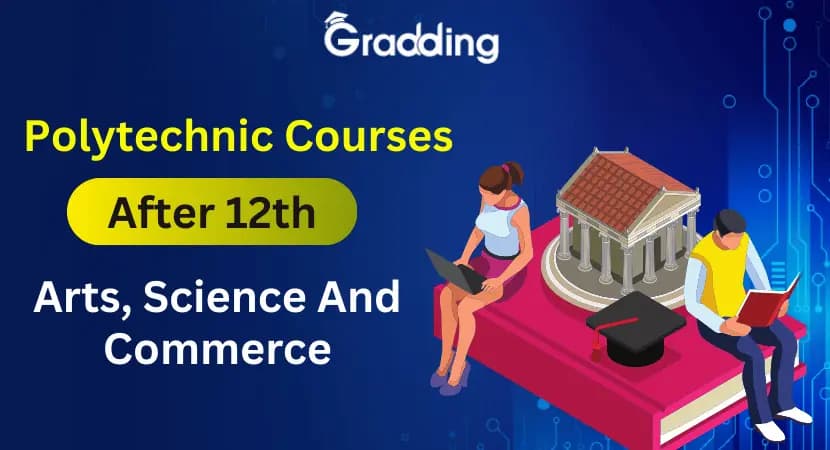





Table of Contents
1. Can I get a Government Job After Polytechnic?
2. What Are the Minimum Marks Required For Polytechnic After 12th?
3. Which is The Highest Salary Polytechnic Course In India?
4. Is Polytechnic Better Than BSc After 12th?
5. What Are The Entrance Exams For Polytechnic After 12th?
6. What is the Difference Between Polytechnic And ITI?
7. Can I Do Polytechnic After 12th Without Maths?
8. Is Polytechnic Better Than B.Tech After 12th?
The courses in Polytechnic after 12th are structured to deliver organised technical schooling with strong usable exposure, helping students in building job-ready skills in a short time. These courses follow a structured scholarly format that combines laboratory training with classroom learning and industry-based projects.
The courses in Polytechnic after 12th are structured to offer organised technical schooling with strong functional exposure, assisting students in building job-ready skills in a short time.
| Aspect | Details |
| Duration | 3 years (6 semesters) |
| Entry Requirement | After 10th or 12th (based on course/state rules) |
| Course Pattern | Semester system with regular assessments |
| Learning Method | Theory classes + practical labs + workshops |
| Industrial Training | Included in the final year in many institutes |
| Evaluation System | Internal exams, semester exams, practicals, projects |
| Final Outcome | Diploma in engineering or technical specialisation |
Taking Polytechnic courses after 12th is an intelligent option for learners seeking practical skills, quick job possibilities, and a cost-effective way into technical and engineering careers. These courses are generally shorter and more budget-friendly than traditional degrees, assisting students in starting their careers at an early age. Overall, it offers an effective path into technical and engineering fields.
Preferring between B. Tech and Polytechnic after 12th mostly relies on your career objectives. Polytechnics deliver quick and helpful job-oriented skills, whereas B.Tech offers deeper knowledge, higher studies options, and better long-term career development.
| Factor | Polytechnic (Diploma) | B.Tech (Engineering Degree) |
|---|---|---|
| Duration | 3 years | 4 years |
| Entry After 12th | Direct diploma course | Entrance exam (JEE/State exams) |
| Focus | Practical + skill-based training | Theoretical + technical + research |
| Cost | Low (₹15k–₹1 lakh total in govt colleges) | Higher (₹2–10 lakh+) |
| Job Entry | Early job opportunities after a diploma | Better core engineering jobs after a degree |
| Starting Salary | ₹2.5–5 LPA | ₹4–10 LPA |
| Growth Scope | Good with experience or after B.Tech (lateral entry) | Strong long-term career growth |
| Higher Studies | Lateral entry to B.Tech (2nd year) | M.Tech, MBA, research opportunities |
| Best For | Quick job, practical skills, budget-friendly option | Long-term engineering career, high-level roles |
On the one hand, a BSc is more scholarly and suited for research or higher studies, and on the other hand, a Polytechnic is skill-based and job-oriented.
| Factor | Polytechnic (Diploma) | BSc (Bachelor of Science) |
|---|---|---|
| Course Type | Technical diploma | Academic degree |
| Duration | 3 years | 3 years |
| Focus | Practical + industry skills | Theoretical + scientific knowledge |
| Entry After 12th | Direct admission | Direct admission |
| Cost | Low (govt: ₹15k–₹1 lakh approx.) | Moderate (₹20k–₹3 lakh approx.) |
| Job Orientation | Skill-based, job-ready | Research + teaching + analytical roles |
| Starting Salary | ₹2.5–5 LPA | ₹2–4.5 LPA |
| Job Sectors | Engineering, IT, manufacturing, PSUs | Labs, research, education, pharma, IT |
| Higher Studies | B.Tech (lateral entry), advanced diplomas | MSc, MBA, PhD |
| Best For | Technical jobs & early career start | Academic growth & research careers |
For pursuing Polytechnic courses after 12th, students must meet the following specific eligibility conditions set by colleges or state rules.
If you do not want to start from scratch, then Polytechnic lateral entry is the best option for you. It allows stduents directly get into the second year of a diploma course. It helps save your precious time and makes it easier to continue your studies without repetition.
Students must meet the following criteria to apply for lateral entry:
The application process is very simple and follows these steps, here are these:
Now, explore the complete stream-wise polytechnic courses list after 12th, like options for science, commerce and arts students across varied fields. Each field offers varied specializations, helping you choose a course that aligns with your scholarly background, skills and future career targets. This helps one easily get the course that matches your background, interests and career goals.
The Polytechnic courses after 12th class science stream offer multiple diploma options in technology, healthcare and applied fields for PCM and PCB students: These are as follows:
| Category | Polytechnic Courses After 12th Science (PCM/PCB) |
|---|---|
| Mechanical & Core Engineering | |
| Civil & Construction | Diploma in Civil Engineering |
| Electrical & Electronics | |
| Computer & IT | |
| Chemical & Applied Science | |
| Medical & Health (PCB) | |
| Biotechnology |
The Polytechnic courses after 12th commerce stream highlight practical skills and career enthusiasm and offer varied diploma choices in business, management, IT, and service sectors. It helps students excel in personal and professional spaces:
| Category | Polytechnic Courses After 12th Commerce |
|---|---|
| Business & Management | |
| Accounting & Finance | |
| Computer & IT | |
| E-Commerce & Digital | |
| Hospitality & Tourism | |
| Office & Administration |
The Polytechnic courses after 12th arts focus on creative skills and practical career opportunities with a diploma in design, media, hospitality and administration.
| Category | Polytechnic Courses After 12th Arts |
|---|---|
| Design & Creative | |
| Media & Communication | |
| Hospitality & Tourism | |
| Social & Human Services | |
| Office & Administration | |
| Computer & IT |
Moreover, the course finder on our platform helps you quickly discover and cross-compare the best courses after 12th that align with your interests and career goals. It suggests the most suitable options to make the right choice easily.
The Polytechnic courses after 12th offer strong career options in technical streams, like engineering, IT, and emerging technologies, focusing on useful skills.
| Course Category | Polytechnic Course | Career Roles | Average Salary (India) | Top Recruiters |
|---|---|---|---|---|
| Computer & IT | Diploma in Computer Science Engineering | Software Support, IT Technician, Web Developer | ₹3–8 LPA | TCS, Infosys, Wipro, HCL, Tech Mahindra |
| Computer & IT | Diploma in Information Technology | Network Support, System Admin, IT Assistant | ₹3–7 LPA | Accenture, Cognizant, IBM, Capgemini |
| AI & Emerging Tech | Diploma in AI & Machine Learning | AI Technician, Data Assistant, ML Support | ₹4–10 LPA | IBM, Google, partners, Accenture, Siemens |
| Mechanical | Diploma in Mechanical Engineering | Junior Engineer, Production Supervisor | ₹3–7 LPA | Tata Motors, Mahindra, Maruti Suzuki, L&T |
| Electrical | Diploma in Electrical Engineering | Electrical Technician, Maintenance Engineer | ₹3–7 LPA | Siemens, ABB, Schneider Electric, NTPC |
| Civil | Diploma in Civil Engineering | Site Engineer, Construction Supervisor | ₹3–6 LPA | L&T, Shapoorji Pallonji, NCC Ltd |
| Automobile | Diploma in Automobile Engineering | Service Engineer, Workshop Technician | ₹3–6.5 LPA | Hero MotoCorp, Honda, TVS, Bosch |
| Chemical | Diploma in Chemical Engineering | Plant Operator, Quality Technician | ₹3–6 LPA | Reliance, ONGC, BPCL, GAIL |
The polytechnic courses after 12th fees structure largely depends on the type of institution. Government colleges are highly affordable, whereas private institutes charge higher fees because of better infrastructure and facilities. The comparative analysis of fee for both government and private institution are given in following section.
Government polytechnic colleges are budget-friendly and supported by state funding, making them accessible to almost every student.
Private polytechnic colleges offer modern facilities but come with higher fees compared to government institutes.
The admission process for polytechnic courses after 12th differs by state and institution, but it mainly includes a mix of merit-based selection and entrance exams. Students must follow the official guidelines to secure admission in government or private diploma colleges.
Here are the simple steps to follow:
State-wise entrance exams help pupils secure admission into diploma courses through competitive or merit-oriented selection across different states in India.
| State | Entrance Exam | Conducting Body |
|---|---|---|
| Uttar Pradesh | JEECUP (UP Polytechnic) | Joint Entrance Examination Council UP |
| Telangana | TS POLYCET | State Board of Technical Education & Training |
| Andhra Pradesh | AP POLYCET | State Board of Technical Education & Training |
| Maharashtra | MSBTE / DTE Polytechnic Admission (based on merit) | Directorate of Technical Education |
| West Bengal | JEXPO (now replaced by merit-based admission in many cases) | WBSCTE |
| Karnataka | DCET / Diploma Admission Process | DTE Karnataka |
| Tamil Nadu | DOTE Diploma Admission | Directorate of Technical Education |
| Bihar | DCECE | BCECE Board |
| Rajasthan | Rajasthan Polytechnic Admission / RPET (older) | Directorate of Technical Education |
| Madhya Pradesh | MP PPT / Merit-based admission | RGPV / DTE MP |
| Haryana | HSTES Polytechnic Admission | Haryana State Technical Education Society |
| Punjab | Punjab JET / Merit-based admission | PSBTE & IT |
The topmost polytechnic colleges in India offer quality education, practical training, and strong placement opportunities across engineering, technology and skill-based fields.
| College Name | Location | Type | Key Highlights |
|---|---|---|---|
| IIT Madras (Skill/Diploma Programs) | Chennai | Government | Top-tier institute, strong technical foundation |
| VJTI (Veermata Jijabai Technological Institute) | Mumbai | Government | Excellent placements, very low fees |
| Jamia Millia Islamia (JMI) | New Delhi | Government | Strong academics, entrance-based admission |
| Institute of Chemical Technology (ICT) | Mumbai | Government | Best for chemical & technical diplomas |
| Aligarh Muslim University (AMU) | Aligarh | Government | Affordable fees, good academic reputation |
| Government Polytechnic Mumbai | Mumbai | Government | Oldest institute, strong local placements |
| WCE Sangli (Diploma Section) | Maharashtra | Government-Aided | Strong engineering reputation |
| LPU (Lovely Professional University) | Punjab | Private | Modern infrastructure, higher fees |
| GH Raisoni College of Engineering (Polytechnic) | Maharashtra | Private | Decent placements, industry training |
| MPSTME (NMIMS Pathway) | Mumbai | Private | Premium institute, high fees, strong exposure |
For more information, our college finder helps you easily find and compare the best colleges based on your course, place, and budget.
Career scope after Polytechnic courses has diverse job possibilities, higher studies options, and skill-oriented roles in engineering, IT, manufacturing and state fields.
| Category | Career Opportunities After Polytechnic | Salary Scope | Top Recruiting Companies |
|---|---|---|---|
| Government Jobs | Junior Engineer (JE), Technician, Assistant Engineer in Railways, PWD, Electricity Boards, PSUs | ₹3–8 LPA | Indian Railways, PWD, BHEL, NTPC, ONGC, GAIL, DRDO |
| Manufacturing Industry | Production Supervisor, Machine Operator, Quality Inspector | ₹2.5–6 LPA | Tata Motors, Mahindra & Mahindra, Bajaj Auto, Ashok Leyland, Maruti Suzuki |
| Electrical & Power Sector | Maintenance Engineer, Electrical Technician, Site Supervisor | ₹3–7 LPA | Siemens, ABB, Schneider Electric, L&T Electrical & Automation |
| Construction & Infrastructure | Site Supervisor, Civil Engineer Assistant, Draftsman | ₹3–6 LPA | L&T (Larsen & Toubro), Shapoorji Pallonji, NCC Limited, Afcons |
| IT & Computer Field (CS/IT Diploma) | IT Support, Network Technician, Software Support Executive | ₹2.5–6 LPA | TCS, Infosys, Wipro, HCL, Tech Mahindra |
| Automobile Industry | Service Engineer, Workshop Supervisor, Automotive Technician | ₹2.5–6.5 LPA | Hero MotoCorp, Honda, TVS, Bosch, Toyota |
| Higher Education Route | B.Tech/B.E. (Lateral Entry), Advanced Diplomas | ₹5–12+ LPA (after degree) | IITs (via lateral entry options), Private Engineering Colleges, Skill Institutes |
| Skill-Based Careers | CAD Designer, Draftsman, Data Technician, AI/ML Support Roles | ₹4–10 LPA | IBM, Accenture, Capgemini, Cognizant, Siemens |
To conclude, pursuing Polytechnic after 12th is the best way for early career prospects. It balances affordability with industry-relevant training, IT, and technical sectors across different government and private industries. You can either start working after completing the diploma or continue higher education via lateral entry. Overall, it develops a strong foundation for a stable technical career and long-term professional development, and guidance from study abroad consultants at Gradding.com can further expand your global options.
Yes, polytechnic diploma holders can apply for different government jobs, like railway, technical posts, electricity boards and PWD.
The criteria vary from one state to another; generally, 35%-50% in 10th or 12th grade are needed on the basis of the state and college.
The following are the highest-salaried Polytechnic courses:
Polytechnic is now more job-oriented and technical; on the other hand, BSc is more theory-based and academic. However, the last choice depends on your career choices and interests.
The following are the state-level exams, like
Basically, Polytechnic is a 3-year diploma focusing on engineering, whereas ITI is a 1-2 year skill-based vocational training course.
Yes, some streams allow admission without Math streams, like diploma courses, etc. So if you are not good at Maths, you will still have the option to pursue it.
It depends on your career choices and other factors. B.Tech offers higher-level studies and better long-term career growth, whereas Polytechnic is faster and more job-focused.
I will definetly shre this blog with my friends planning to choose polytechnic courses after 12th.


I want FREE assistance with
Confused About Your Next Academic Step?
Connect With Us!