googleNewIconwhatsapp iconTwitterIconinstagramIcon
  1. Home
  2. Blogs
  3. EXAMS
  4. Sat Exam Information
EXAMS

SAT Exam 2026: Full Form, Dates, Fees, Syllabus, Score & Complete Guide for Indian Students

Last updated: Apr 17, 2026

If you are in class 11 or 12 and planning to study abroad, especially in the USA, Canada, UK or Singapore, then the SAT is likely one of the first things on your checklist. And if you have not started preparing yet, this write-up will guide you everything you need, what the SAT actually is, how the Digital SAT 2026 format works, what fees you will pay in rupees, when the exams are scheduled in India, what score you need for which colleges, how to register step by step, and how a strong SAT score can unlock scholarships worth lakhs. The important note before you read any other SAT details online is that the SAT changed dramatically in 2023. Most blogs still describe the old three-section, paper-based SAT with an essay section. That exam no longer exists. The 2026 SAT is fully digital, shorter, adaptive, and scored differently. So everything in this guide reflects the current Digital SAT format.

Learn All About SAT Exam to Study Abroad | Gradding.com
Sparkle Icon
Summarise with AI
Choose your AI Assist


ai-agent-iconai-agent-iconai-agent-icon

Table of Contents

What Is the SAT Exam?- Full Form, Purpose & Overview

SAT stands out as the Scholastic Assessment Test and is a standardised undergraduate admission test conducted by the College Board, which is a US-based non-profit organisation. The SAT is designed to assess a student's readiness for college-level work by testing their writing, reading and Math skills. For Indian students, the SAT is primarily taken when applying to:

  • Universities in the USA
  • Universities in Canada, the UK, Singapore, and Australia
  • Opt Indian universities through the India Global Alliance, like Ashoka University, Shiva Nadar University, O.P. Jindal Global University, FLAME University, and Krea University.

Over 4,000 universities in more than 85 countries accept SAT scores. The exam is conducted 7-8 times a year in India, offering you significant flexibility in choosing your test date.

SAT Exam Quick Facts 2026

Here is a quick overview of the SAT exam in brief:

Parameter

Details

Full Form

Scholastic Assessment Test

Conducted By

College Board (USA)

Exam Mode

Fully Digital (Bluebook™ App)

Total Duration

2 hours 14 minutes (+ optional 10-min break)

Number of Sections

2 (Reading & Writing, and Math)

Total Questions

98

Score Range

400 – 1600

Score Validity

5 years

Registration Fee (India)

~$111 USD (approx. ₹9,500–₹12,300 incl. taxes)

Exam Frequency

7–8 times per year in India

Eligibility

No age limit; typically taken in Class 11 or 12

Results

13–14 days after the exam

Negative Marking

No

Digital SAT 2026: The Format Has Changed Completely

The important thing you must understand is that the SAT moved to a completely digital format globally from March 2023. So if you have been reading the previous details that express a three-section SAT, an essay section or "SAT" with essay vs "SAT without essays", those details are now outdated. The essay was discontinued in 2021, and the whole exam format has since been redesigned.

What Is the Digital SAT?

The digital SAT can be taken on a laptop or tablet with the help of the Bluebook™ application, which is developed by the College Board. You have to take it at an authorised test centre in India, as you cannot take the digital SAT from home. The exam uses Multistage Adaptive Testing(MST), and each section has two modules. The difficulty level of your second module is determined by your performance in the first. It means the test adapts to your ability level in real time.

Digital SAT 2026 Exam Pattern

The digital SAT 2026 exam format reflects a modern approach to standardised testing, featuring an adaptive format, shorter sections, and digital tools to assess students' reading, writing, and mathematical reasoning skills properly.   

Section

Questions

Time

Format

Reading and Writing (Module 1)

27

32 minutes

Adaptive

Reading and Writing (Module 2)

27

32 minutes

Difficulty based on Module 1

10-minute break

10 minutes

Optional

Math (Module 1)

22

35 minutes

Adaptive

Math (Module 2)

22

35 minutes

Difficulty based on Module 1

Total

98 questions

2 hrs 14 min


Here are the key features of the digital SAT 2026:

  1. Built-in Desmos graphing calculator available for the entire Math section, you don’t need to bring your own.
  2. Shorter test passages in reading and writing as compared to the old format.
  3. No penalty for wrong answers, so attempt every question.
  4. Scratch paper is offered at the test centre.
  5. Score released 13-14 days after the exam.

SAT Exam Syllabus 2026: Section-Wise- Section

The SAT exam syllabus 2026 is conducted in different sections, including reading, writing and mathematics. Each section evaluates particular skills, assisting students in understanding the structure and focus areas for effective preparation.

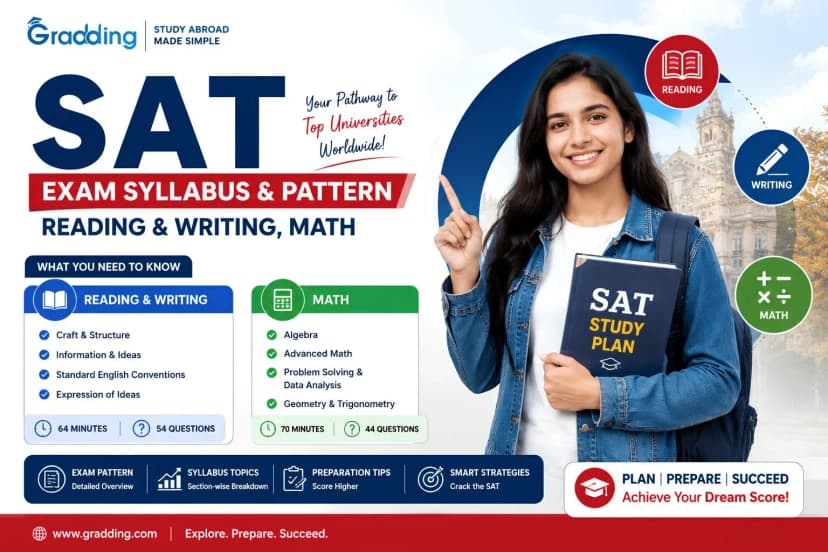
Reading and Writing (RW) Section: 54 Questions, 64 Minutes

The RW section tests your ability to understand written passages and apply language rules. It is divided into four skill areas:

  1. Craft and Structure (28% of RW): Questions that evaluate your understanding of vocabulary in context, like how texts are structured, and how an author's purpose shapes meaning. You will analyse short passages and identify what words mean on the basis of context.
  2. Information and Ideas (26% of RW): Knowing the central ideas of a passage, supporting details and making inferences. Some questions include charts or data alongside text, so you need to interpret both together.
  3. Standard English Conventions (26% of RW): Sentence boundaries, Grammar, punctuation and how standard written English works. These are the more rules on the basis of questions in this section.  
  4. Expression of Ideas (20% of RW): Editing and revising to improve clarity, cohesion and precision in writing. So you will make choices about word selection and rhetorical strategy.

Math Section: 44 Questions, 70 Minutes

The SAT Math section covers topics taught in Indian high schools till class 10-12. A built-in calculator is available for all Math questions.

  1. Algebra (35% of Math): Linear equations and systems, and interpreting linear functions in context. This is the target topic area in SAT Math.
  2. Advanced Math (35% of Math): Equivalent expressions, nonlinear functions and equivalent expressions, like quadratics, polynomials and exponential functions.
  3. Problem Solving and Data Analysis (15% of Math): Percentage, ratios, rates, proportions, scatterplots, and interpreting statistical data from charts and tables.
  4. Geometry and Trigonometry (15% of Math): Area, volume, angles, triangles, circles and basic trigonometry. These topics have consistent representation across every SAT.

Indian students typically find the Math section more manageable, as the topics align closely with CBSE/ICSE curricula till class 10.  The RW section tends to be more challenging for Indian students, because it requires analytical reading and passage-level inference, not rote recall. 

SAT Exam Dates 2026 in India

The SAT is conducted 7-8 times a year in India across hundreds of test centres. Below are the confirmed and anticipated dates for the 2026-27 testing cycle:

Test Date

Registration Deadline (Approx.)

Late Deadline (Approx.)

May 2, 2026

April 4, 2026

April 21, 2026

June 6, 2026

May 8, 2026

May 26, 2026

August 15, 2026

July 17, 2026

August 4, 2026

September 12, 2026

August 14, 2026

September 1, 2026

October 3, 2026

September 4, 2026

September 22, 2026

November 7, 2026

October 9, 2026

October 27, 2026

December 5, 2026

November 6, 2026

November 24, 2026

Late registration fee: $38 extra (approximately ₹3,200), and always aim to register by the regular deadline to avoid this charge and to secure your preferred test centre.

Which SAT Date Should You Choose?

The following are the SAT dates that all students should choose:

  1. Applying for Early Decision/Action (October-November University Deadlines): Take the SAT in May or June 2026, as this leaves time for a retake in August if needed.
  2. Applying Regular Decision (January Deadlines): October toNovember 2026 is ideal for regular decision.
  3. Class 12 Students: Avoid dates that clash with board exam preparation. Most of the students schedule the SAT in class 11 specifically to avoid this conflict.
  4. Retake Planning: You can take your first SAT in May or June, and use August or October for a second attempt if your first score required improvement.

SAT Exam Fees in India 2026

The SAT registration fee for Indian students in 2026 consists of two components:

Fee Component

Amount (USD)

Approx. INR

Base Registration Fee

$68

~₹5,700

International (Regional) Fee

$43

~₹3,600

Total Registration Fee

~$111

~₹9,300–₹12,300

Additional SAT Fee Charges

Extra SAT fee charges may apply for services, such as late registration, test centre changes, or score reports, based on student needs:

Service

Fee (USD)

Approx. INR

Late Registration

+$38

~₹3,200

Score Report (beyond 4 free)

$13 per report

~₹1,100

Cancellation/Date Change

$25–$40

~₹2,100–₹3,400

Score Verification Request

$55 per section

~₹4,600

SAT Fee Waiver for Indian Students

If your family income makes the SAT fee a financial burden, you may be eligible for a significant fee reduction through the College Board Indian Scholars Program:

  • 90% fee waiver: Annual family income below ₹8 lakh
  • 50% fee waiver: Annual family income between ₹8–₹15 lakh
  • Apply at com/collegeboard before registering

Income-eligible students who score more than 13000 also become eligible for the College Board India Scholars merit-cum-need scholarships, full tuition coverage at India Global Alliance member institutes.

SAT Registration 2026: Step-by-Step Guide for Indian Students

Registering for the SAT takes hardly 30 minutes online. So, this is how exactly you can do it:

  1. Step 1: Create a College Board Account: Go to satsuite.collegeboard.org and click "Sign Up." Use a personal email address (not a school address, as you'll use this account for years). And now enter your full legal name exactly, which is similar to your name on your passport or Aadhaar card.
  2. Step 2: Complete Your Profile:Now, enter your date of birth, gender, grade level, school name, and address. Here, accuracy is critical, and mismatches between your registration and your ID can cause serious issues on exam day.
  3. Step 3: Click "Register for the SAT": From your dashboard,just click the registration button. If you have a fee waiver code from the India aid program, enter it at this stage.
  4. Step 4: Select Your Test Date and Centre: Choose your preferred date from available options, and search for nearby test centres. In India, centres are located in more than 44 cities across the country. So, search early, as the metro city centres fill up weeks before the deadline.
  5. Step 5: Upload Your Photo: Upload a clear, recent photograph in the format .jpg, .gif, or .png. The maximum size should be up to 2 MB. The photo must match the one you will present at the test centre.
  6. Step 6: Review and Pay: Check all your details carefully before paying the fee. It accepts various payment methods, like Credit card (Visa, Mastercard, Amex), Debit card, or PayPal. You are required to pay the full payment at registration, as there is no EMI option available.
  7. Step 7: Save Your Admission Ticket: Lastly,after payment, download and print your admission ticket. You will need this plus a valid photo ID (passport or Aadhaar) on exam day.

What Is a Good SAT Score in 2026?

This is the most searched question by Indian students, the possible answer lies in where you are applying for:

SAT Score Range

What It Means

Suitable For

Below 1050

Below average

Below-average selectivity colleges

1050 – 1200

Average

Many colleges with open admissions

1200 – 1350

Competitive

Good universities in the USA, UK, and Canada

1350 – 1450

Strong

Top-50 US universities, merit scholarships

1450 – 1550

Excellent

Top-20 US universities, strong scholarship eligibility

1550 – 1600

Elite

Ivy League, MIT, Stanford, Caltech

University-Specific SAT Score Benchmarks

University-oriented SAT score benchmarks vary across institutions, showing different admission standards. Knowing these benchmarks helps students set realistic goals and target colleges where their scores align with expected scholarly needs.

University

Typical Middle 50% SAT Score

MIT

1510 – 1590

Stanford University

1500 – 1570

Harvard University

1490 – 1580

UC Berkeley

1310 – 1530

University of Michigan

1340 – 1530

Purdue University

1200 – 1430

Arizona State University

1150 – 1380

Canada (top universities)

1200 – 1400

UK universities

Often test-optional; 1300+ strengthens application

SAT Scholarships for Indian Students 2026

SAT scholarships for Indian students in 2026 offer financial support on the basis of academic performance and scores. These options assist in reducing costs and encourage talented students to pursue higher studies abroad.

1. College Board India Scholars Program: Domestic Scholarships

The College Board, in cooperation with the India Global Alliance, provide merit-cum requires scholarships at participating Indian colleges:

  • Eligibility: Score more than 1300 on the SAT and family income below ₹8 lakh/year.
  • Award: Full tuition coverage through graduation at India Global Alliance member universities
  • Participating universities are: Ashoka University, Shiv Nadar University, O.P. Jindal Global University, Krea University, FLAME University, and others.
  • Application: Apply when submitting your university application, as you don't apply separately for this scholarship.
  • SAT India Top Performer: Scoring 1300+ also earns you this distinction, which strengthens all applications

2. Merit-Based Scholarships at International Universities

Most of the US and Canadian universities offer automatic merit scholarships based on your SAT score, which means you don't need to submit a separate scholarship application:

  1. Score 1300+: Opens scholarship eligibility at most often at US state universities, typically  $5,000–$10,000 per year.
  2. Score 1400+: Eligible for substantial merit scholarships, and$10,000–$20,000 per year at many universities.
  3. Score 1500+: Presidential and Chancellor-level scholarships, and offer up to $25,000 per year (approximately ₹22 lakh) at several institutions.

3. SAT Registration Fee Waiver

Indian students from low-income backgrounds can get up to 90% off the registration fee via the College Board India Scholars Program. You can apply through Buddy4Study before registration, and every eligible applicant who applies receives a voucher.

SAT vs ACT: Which Should Indian Students Choose?

Most of the Indian students who are considering the SAT also encounter the ACT. Below is a clear comparison to help you decide:

Parameter

SAT

ACT

Conducting Body

College Board

ACT Inc.

Duration

2 hrs 14 min

2 hrs 55 min

Sections

2 (Reading & Writing, Math)

4 (English, Math, Reading, Science)

Science Section

No

Yes

Format

Computer-adaptive (digital)

Paper or computer

Math Calculator

Allowed entire section

Allowed only on certain questions

Negative Marking

No

No

Score Scale

400–1600

1–36

Fee (India, approx.)

~₹9,300–₹12,300

~₹10,500–₹14,000

  • Choose SAT if: The SAT's shorter duration suits the students who prefer focused and efficient testing. So if you are strong in algebra and prefer adaptive digital testing, SAT Math aligns more closely with the Indian school curriculum.  
  • Choose ACT if: You are comfortable with a separate Science reasoning section and prefer longer, non-adaptive testing. So, ACT is also globally accepted at all US colleges.
  • Most Indian students take the SAT: Majorly because of the India Scholars Program, the strong alignment with Indian high school math, and the shorter overall test duration. So, both exams are equally accepted at virtually every US, Canadian, and UK university. 

Top Colleges Accepting SAT Scores in India and Abroad

Top universities accepting SAT scores in India and abroad provide diverse scholarly courses and global exposure. Knowing these institutions helps students identify the right options and plan admissions on the basis of SAT performance.  

1. Indian Universities Accepting SAT

University

Minimum SAT Score (Approx.)

Ashoka University

1200+

Shiv Nadar University

1100+

O.P. Jindal Global University

1100+

FLAME University

1100+

Krea University

1050+

Christ University (Bangalore)

1000+

2. Global Universities Accepting SAT

Country

Top Universities

USA

MIT, Stanford, Harvard, Yale, Columbia, UPenn, UC Berkeley, Purdue, NYU

Canada

University of Toronto, McGill, UBC, University of Waterloo

UK

UCL, King's College London, University of Edinburgh (test-optional)

Singapore

NUS, Nanyang Technological University

Australia

ANU, University of Melbourne (check requirements)

SAT Score Reporting: Superscoring and MyBest Scores

If you take the SAT more than once, as most students do, here is what you need to know about how scores are reported:

  1. Superscoring: Most of the US universities practise super scoring, which means they take your highest Reading and Writing score from one attempt and your highest Math score from another attempt, combining them into a single "super score." This always results in a more effective score than any single sitting.
  2. MyBest Scores: The College Board automatically reports your MyBest Scores when you send your official score report. So, you don't need to do anything special to enable this.
  3. Sending Scores: You receive 4 free score reports at registration. To send scores to additional universities, it costs $13 per report. Score reports are sent directly from the College Board; you cannot send unofficial score copies.
  4. Score Cancellation: If you feel an attempt went poorly, you can cancel your scores within a specific window. However, cancelled scores are not visible to universities, and cancellation is permanent.
  5. How Many Times Can You Take the SAT? There is no limit. Most students take it 2–3 times. The College Board recommends taking it in Class 11 for the first time, leaving room for a retake in Class 11 or early Class 12.

How to Prepare for the SAT in 2026?: Tips for Indian Students

The following are certain tips that you can follow for the best results:

1. Start with a Diagnostic Test

Before studying anything, take a full-length official practice test from the College Board's Bluebook app. This gives you exactly where you stand and which sections require the most work.

2. Recommended Preparation Timeline

Timeline

Preparation Level

Expected Improvement

1 month intensive

Strong English base

50–100 points

2–3 months structured

Average preparation

100–200 points

3–6 months comprehensive

Serious target (1400+)

200–300 points

3. Free SAT Preparation Resources

  • College Board Bluebook App: Official practice tests that mirror the exact Digital SAT format — the most important resource.
  • Khan Academy (khanacademy.org/sat): Free, personalised SAT prep in partnership with the College Board. So, it takes your diagnostic results and builds a custom study plan.
  • College Board SAT Practice Tests: 8 full-length free practice tests available on the official site.

Section-Specific Tips

Here are the section-wise tips for maximizing the best scores with great efficiency:

  1. For Reading and Writing:
  • Practice reading short, dense passages and identifying the main idea quickly. The Digital SAT uses shorter passages than the old format
  • Build vocabulary in context, and the SATs what words mean in specific passages, not isolated definitions
  • Focus on grammar rules for Standard English Conventions questions; these are the most pattern-based questions in the section
  1. For Math:
  • Master the built-in Desmos calculator, knowing how to graph equations efficiently can save significant time
  • Focus on linear algebra and systems of equations; these form the largest portion of the Math section
  • Practice data interpretation questions, including charts, tables, and scatterplots, appear regularly and require careful reading.

SAT Eligibility 2026: Who Can Take the SAT?

The SAT has minimal eligibility requirements:

  • No minimum age: students as young as Class 8–9 can register, though most take it in Class 11–12
  • No stream requirement: Arts, Commerce, and Science students are all eligible
  • No minimum percentage: there is no academic minimum set by the College Board
  • Students who have completed Class 12 (gap year students) are fully eligible and often take the SAT to strengthen their applications

Final Thought: Is the SAT Worth It for Indian Students?

Absolutely, and it's more valuable than most students realize. The SAT is not just a checkbox for US university applications. It's a financial lever,a score of 1300+ can make you eligible for full tuition scholarships at Indian universities through the India Scholars Program. A score of 1400+ can save you $40,000–$100,000 (₹33 lakh–₹83 lakh) over a 4-year US degree through automatic merit scholarships without a separate application.

So, plan your test date carefully, prepare with official materials (Bluebook and Khan Academy), take a diagnostic test first, and give yourself 2–3 months of structured preparation. Most of the Indian students with a solid Class 10–12 foundation can achieve a 1300–1400 SAT score with consistent practice.

Frequently Asked Questions — SAT Exam 2026

Q: What is the Full Form of the SAT Exam?

SAT stands for Scholastic Assessment Test, and is a standardized test conducted by the College Board, USA, for undergraduate admissions at universities globally.

Q: Is SAT Compulsory For Studying in the USA?

Not always, most of the US universities went test-optional during and after COVID-19, meaning SAT scores are not necessary for admission. However, submitting a strong SAT score almost always strengthens your application and can unlock significant merit scholarships. So always check the university's current test policy.

Q: What is the SAT Exam Fee In India for 2026?

The 2026 SAT fee for Indian students is around $111 USD (base fee $68 + international fee $43), which will be around ₹9,300–₹12,300 depending on the exchange rate and GST in INR. Moreover, late registration costs an additional $38.

Q: How Many Times Can I Take the SAT in India in 2026?

Well, there is no limit on how many times you can take the SAT. In 2026, the exam can be attempted 7-8 times in India, around March, May, June, August, October, November and December. So most of the students take it 2-3 times.

Q: Is the SAT Easier Than JEE For Indian Students?

Yes, for most of the students, the SATs general reasoning and foundational skills, whereas JEE requires advanced technical knowledge in Physics, Chemistry, and Math at a very high level of difficulty. Students who can clear JEE Mains typically have the academic foundation to score well on the SAT Math section with focused preparation on the Reading and Writing sections.

Q: What is a Good SAT Score for Indian Students In 2026?

A score of 1300+ is considered best for most international institutes and unlocks scholarship eligibility, and 1400+ is strong for the top 50 US universities. Moreover, 1500+ is the best enough for Ivy League, MIT, and Stanford. Scores are relative to where you are applying, always check your target university's middle 505 score range.

Q: Can I Get a Scholarship Based On My Sat Score?

Yes, the College Board India Scholars courses offer full tuition scholarships at India Global Alliance Universities for eligible students who usually score more than 1300. At International universities, merit scholarships of $5,000–$25,000 per year are widely available on the basis of SAT scores, often without a separate application.

Q: What Documents Do I Need on SAT Exam Day?

You are required to carry a digital admission ticket and a printed ticket along with a government-issued photo ID (Passport or Aadhaar card). No paper sheet is required, as scratch paper is given at the centre. The Bluebook app is pre-installed on the test centre's devices.

Q: How Long is a SAT Score Valid?

SAT scores are basically valid for 5 years from the test date, according to the College Board. However, college typically reviews scores from the last 2-3 years. So check your specific college's score validity requirements.

Q: What is Superscoring in the SAT?

Superscoring explains that a university takes your highest reading and writing score from one SAT attempt and your highest MATH score from another attempt, combining them into a single composite score. It almost always gives you a higher effective score. Most of the top US colleges practice super scoring, so always check each college's policy before deciding how many times to take the exam.  

0 comments

exams-offer
mostTrusted
Hand Picked Courses
Get Scholarship Assistance
Get Offer in 15 Days*
Finance/Loan Assistance

I want FREE assistance with

Finding Universityarrow
Finding Coursesarrow
Study Abroad Loansarrow
Test Prep (IELTS, PTE, etc.)arrow

Gradding Blogs

Want to read more?

explore blogs

Get the top strategies to ace the exams.

disclaimer:logos and other registered trademarks of universities used on this platform are held by their respective owners. Gradding does not claim ownership or association on them, and their use is purely for informational and illustrative purposes.

Copyrights ©2026 Gradding. All rights reserved.
Gradding Rated 4.3/5 based on 12638Reviews