


Summarise with AI
Choose your AI Assist



Table of Contents

1. Which 5 Countries Are Known to Have the Hardest Exams in the World?
2. What is the pass rate of the Gaokao exam?
3. What Tests Are Needed to Apply for a Master's Degree in Universities in the USA and Canada?
4. Can Citizens of Other Countries Apply for the UPSC Exam in India?
5. What Is the Toughest Exam in Asia?
6. What Is the Toughest Exam in India?
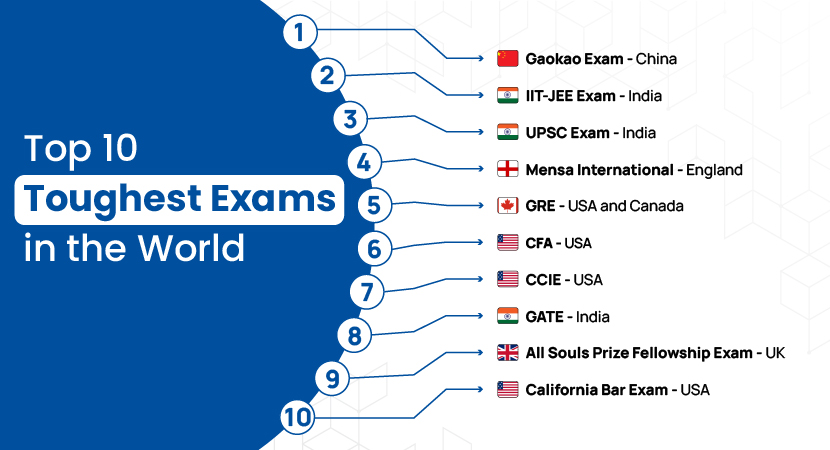
What Are the 10 World's Toughest Exams?
As you know, every country has exams that are considered tough to pass in one go. In this section, you will learn about the most challenging tests in the world and the country or the conducting body to which they belong. The following table compares the world's toughest exams by pass rate, number of candidates, and difficulty level (Updated 2026):
| Exam Name | Country | Annual Candidates | Pass Rate | Duration | Difficulty Level | |
|---|---|---|---|---|---|---|
| 1 |
Gaokao Exam
| China |
13.42 million
2025 figure
|
0.03%
Top university entry
|
2 days
9 hours total
| Extremely Hard |
| 2 |
IIT-JEE Exam
| India |
1,80,200
2025 figure
|
11%
Qualifying only
|
1 day
6 hours total
| Extremely Hard |
| 3 |
UPSC Exam
| India |
10,00,000
2025 figure
|
0.1%
Final selection rate
|
1 year
3-stage process
| Extremely Hard |
| 4 |
Mensa International
| England |
200,000
Worldwide per year
|
2%
Top 2 percentile
|
2 hours
Supervised test
| Very Hard |
| 5 |
CFA (All 3 Levels)
| USA / Canada |
350,000
Across all levels
|
10%
Pass all 3 levels
|
4–5 years
900+ study hours
| Extremely Hard |
| 6 |
GRE
| USA / Canada |
600,000
Per year globally
|
43%
Score 160+ (V/Q)
|
3 hrs 45 min
Single sitting
| Very Hard |
| 7 |
CCIE Lab Exam
| USA |
15,000
Lab attempts/year
|
26%
2025 figure
|
8 hours
Practical lab
| Extremely Hard |
| 8 |
GATE
| India |
8,00,000
2025 figure
|
15%
Overall pass rate
|
3 hours
Computer-based
| Very Hard |
| 9 |
All Souls Prize Fellowship
| United Kingdom |
100–150
Per year
|
1–2%
Only 2 awarded
|
2 days
Essay + interview
| Extremely Hard |
| 10 |
California Bar Exam
| USA |
13,000
Per year
|
34%
2025 first-timers
|
2 days
14+ hours total
| Very Hard |
As per the above table, China has the world's most difficult exam. At the same time, India and the USA have the majority of the rigorous and bothersome exams globally. In the upcoming sections, you will learn about the top 5 toughest exams in the world in detail.
1. Gaokao Exam - China
The Gaokao, which means higher exam, is the abbreviation of the Nationwide Unified Examination for Admissions to General Universities and Colleges. This test is the national undergraduate admission exam for China. It is the most difficult exam in the world.
About the Exam
The Gaokao test is held by the provincial government under the order of the Ministry of Education in early June every year. The exam is conducted over two days when the nation comes to a standstill. The first Gaokao exam was held on 15-17 August 1952.
Purpose of the Test
The Gaokao test is not just an exam; it's a gateway to all the higher education institutes in China. It's a crucial requisite for undergraduate admissions, marking the end of a high school journey and the beginning of a new academic chapter.
Format and Duration of the Exam
The Gaokao exam is conducted in Mandarin Chinese. It consists of subjects such as Science, Mathematics, Languages, and Social Sciences. It is held annually in early June, typically on June 7–9 and is scored out of 750 points, though this can vary slightly by province. The test takes approximately 9 hours.
Number of Applicants and Pass Rate
Every year, a staggering 13.35 million students registered for the Gaokao exam in 2025 — up from just 10.31 million in 2019 — making the pass rate quite low. The 2024 Gaokao set a record high of 13.42 million participants, the highest since the exam was reintroduced in 1977.
Eligibility Criteria
The eligibility criteria for the Gaokao exam are as follows:
- The student applying for the exam must have Chinese citizenship. Those who do not have Chinese citizenship are not eligible to take this test.
- The students should have completed at least 12 years of education. This must include 9 years of compulsory education as well as 3 years of high school.
2. IIT-JEE Exam - India
IIT-JEE exam stands for the Indian Institute of Technology - Joint Entrance Examination. It is the 2nd hardest exam in the world. This is a national-level engineering entrance test that is held in India. The exam is conducted under the guidance of the Joint Admission Board (JAB), India.
About the Exam
The first IIT-JEE exam was conducted in the year 1961. The IIT-JEE comprises two stages: JEE Main and JEE Advanced. JEE Main acts as the screening exam, and only top performers qualify for JEE Advanced — the gateway to India's premier Indian Institutes of Technology (IITs). The JEE Advanced is the final stage of examination for admission into IITs.
Purpose of the Test
The test is conducted by one of the 23 zonal IITs under the guidance of the Joint Admission Board in a round-robin rotation pattern to select students for admission into these IITs.
Format and Duration of the Exam
The exam pattern for IIT-JEE consists of topics from the CBSE Board's curriculum for classes XI and XII. These subjects include Mathematics, Physics, and Chemistry. The test lasts 3 hours.
Number of Applicants and Pass Rate
The number of applicants for the IIT-JEE exam is around 187,223 candidates yearly and is increasing rapidly. Out of which, around 54,000 students qualify for admission. Thus, the pass rate of this test is around 30%. Eventually, this makes it the 2nd most difficult exam in the world.
Eligibility Criteria
The eligibility criteria for the IIT-JEE exam are as follows:
- The students who are applying for this test must have appeared for their class XII or equivalent examination in the same year or the previous year.
- The minimum percentage required for the exam application must be 75% or above.
3. UPSC Exam - India
Union Public Service Commission, or UPSC, is a central government agency that conducts India's Civil Services Examination (CSE) for students. The UPSC exam is ranked third among the top five toughest exams in the world.
About the Exam
This exam is India's most difficult, competitive, and meticulous. Students spend years preparing for this century-old test. However, the number of attempts is limited. These limits are made according to the student's caste category.
Purpose of the Test
The UPSC exam is conducted to recruit people to higher civil services for the government of India. These services include the Indian Administrative Service (IAS), the Indian Police Service (IPS), as well as Indian Foreign Service (IFS).
Format and Duration of the Exam
The format for this test consists of three stages: Prelims, Mains, and Interview. Prelims has two objective papers (2 hours each, 400 total marks), while Mains consists of nine descriptive papers (3 hours each, 1750 total marks) held over 5-7 days, followed by a personality test.
Number of Applicants and Pass Rate
Every year, around 10 lakh applicants appear for the UPSC exam. Out of these, a very small number of students qualify after attempting all the stages of the test. Thus, the overall pass rate of this exam is 0.1%. Therefore, the UPSC test is the hardest exam in the world.
Eligibility Criteria
The eligibility criteria for the UPSC exam are given below:
- The age limit for the students to apply for this exam is 21-32 years old.
- The student should have a bachelor's degree recognised by the Government of India.
- For IAS and IFS, only students with Indian citizenship can apply for the exam.
- For other services, citizens of India, Nepal, or Bhutan can apply for the test. Also, people who originated in India and migrated from other nations to settle permanently in India can apply for this exam.
- Also, Tibetan refugees who permanently settled in India before 1 January 1962 can apply for the UPSC test.
4. Mensa International - England
Mensa International is not an exam. It is a society of members with higher IQs and intelligence. The society was founded in 1946 in England. The society believes in non-political among the aspirants and is free from all kinds of discrimination based on race, religion, or nationality.
About the Exam
The test offered by this society is one of the toughest exams in the world. It is conducted in approximately 90 countries, such as the US, the UK, India, Ireland, and Germany. The test is based on IQ and intelligence.
Purpose of the Test
The main purpose of this society is to identify and nurture human intelligence so that it benefits humanity and its characteristics and encourages research into nature. It offers its members a stimulating intellectual and social environment.
Format and Duration of the Exam
The famous IQ exams and their Mensa cutoff score are as follows:
- Stanford-Binet - 132 and above
- Cattell - 148 and above
To qualify for Mensa membership, candidates must score in the top 2% of the general population, which typically means a score of 130 or above on standard IQ tests. The standard Mensa test session takes approximately two hours to complete. The Culture Fair test — a language-free, pattern-based alternative preferred by non-native English speakers — takes between two and three hours, and includes three sections with only one being timed. The Mensa IQ Challenge involves solving 35 puzzles within 25 minutes, with questions getting progressively more difficult as you move through the test.
Number of Applicants and Pass Rate
There are around 1,50,000 Mensans in about 90+ countries in the world. The competition to get into this society is very high. The society is open only to those who gain scores within the top 2% of the general population, and currently has 48 national groups with active organisations on every continent except Antarctica. Thus, the pass rate of these exams is 2%. Hence, it is widely regarded as one of the hardest and most exclusive intelligence-based exams in the world.
Eligibility Criteria
Mensa India tests only children over 10 years of age. However, there is no such age limit for joining this society. Thus, if a child below 10 years gives the results of the authorized intelligence tests that meet the score criteria, are eligible to get recruited in Mensa.

Study in the UK(England) without IELTS!

5. GRE - USA and Canada
The GRE, or Graduate Record Examination, is considered the fifth most difficult exam in the world. This test evaluates an applicant's ability to pursue a master's in foreign institutes, mainly in the USA and Canada. Earlier, this exam was targeted at US-based universities, but now it is recognized by institutes in over 90 nations.
About the Exam
The GRE test was established in 1936 and is owned by the Educational Testing Service (ETS). This exam is responsible for measuring a student's verbal reasoning, logical reasoning, quantitative ability, critical thinking, and analytical writing.
Purpose of the Test
The sole purpose of the GRE test is to offer admission to master's and doctoral degree programs in various universities, especially in the USA and Canada.
Format and Duration of the Test
The computer-based GRE General Test now consists of 5 sections in total — 1 Analytical Writing section, 2 Verbal Reasoning sections, and 2 Quantitative Reasoning sections. The Analytical Writing section contains just 1 "Analyze an Issue" essay task, lasting 30 minutes. The two Verbal Reasoning sections together take 41 minutes — the first has 12 questions (18 minutes) and the second has 15 questions (23 minutes). The two Quantitative Reasoning sections take 47 minutes combined — 12 questions (21 minutes) in the first and 15 questions (26 minutes) in the second. The total duration of the GRE is now 1 hour and 58 minutes, with no scheduled breaks between sections.
Number of Applicants and Pass Rate
The number of applicants taking the GRE every year has reached approximately 2,56,215 candidates globally in 2023–24, and this number continues to shift as more universities adopt test-optional policies. The competition level remains high due to the large number of international applicants, particularly from India and the US. 81% of GRE test takers are accepted into a graduate program where they submit their scores, and 87% of applicants who submit GRE scores to test-optional programs are accepted. Therefore, while the acceptance rate appears high overall, admission into top-ranked universities remains highly competitive, with far lower acceptance rates. This makes the GRE one of the most widely taken and challenging graduate entrance exams in the world.
Eligibility Criteria
As per the Educational Testing Service (ETS), there are no rules for eligibility for taking the GRE. Students from any academic background are allowed to appear for the exam.
There are a few difficult tests that are accepted worldwide. One such exam is the GRE, which is accepted by the institutes of the USA and Canada for applying for a master's degree. Thus, students must get the right guidance to excel in this test and get enrolled in their dream universities. Therefore, overseas education consultants offer coaching for this test preparation and help aspirants ace it.
Also Read: What Are the Different Entrance Exams for Studying Abroad?
6. CFA - USA
If you are looking forward to joining the workforce in the field of investment or finance, here's an exam for you. Passing this exam is the dream of many finance professionals. Hence, several students attempt this exam every year.
About the Exam
The CFA stands for Chartered Financial Analyst. Students take it from a business or economics background. You can go to their official website and check out the valid dates, your exam centre, etc.
Purpose of the Exam
After clearing this exam, the scholars get the positions of executives and senior managers. These job roles revolve around economics, finance, assets, and risk management.
Format and Duration of Exam
It is one of the world's toughest exams with 3 levels. All three levels are now conducted in a Computer-Based Testing (CBT) format at designated test centres worldwide.
Here is the updated level-wise breakdown:
Level 1: It has 2 sessions of 2 hours and 15 minutes each, taken on the same day with an optional break in between. Each session contains 90 multiple-choice questions (MCQs), for a total of 180 MCQs. Questions have 3 answer options (A, B, C) with no negative marking.
Level 2: This level has 2 sessions of 2 hours and 12 minutes each, with an optional break in between. It contains 88 MCQs grouped into 22 item sets (vignettes), with 4 questions per vignette. These are scenario-based multiple-choice questions.
Level 3: The last level also has 2 sessions of 2 hours and 12 minutes each. It includes 11 item sets and 11 essay (constructed response) sets. This section combines vignette-supported essays and multiple-choice questions, testing real-world portfolio management skills.
Number of Applications and Pass Rate
Last year, in 2023, more than 60,000 people took the CFA exam. However, the recent level 1, 2, and 3 CFA exams were conducted in February 2024. In level 1, 17,000 people took the exam and the pass rate was around 44%. The level 2 had a similar turnout as the first level. Moreover, level 3 had 14,000 people who appeared for the exam, yet, 49% of the people managed to pass it.
Eligibility Criteria
To appear for the level 1 exam:
1. Firstly, you have to fulfill at least one of the two criteria:
- You must have a certain work experience of 4000+ hours in a related field. You must use analytical thinking and business-related skills.
- However, you may also be an undergraduate or a degree holder (UG or PG).
2. Secondly, you must have an international travel passport.
3. Thirdly, you must know English and take the test in English.
4. Lastly, there are certain countries where CFA institutes don't work. Therefore, your country should be on the list of participating countries.
To appear for the level 2 exam, you must have cleared the level 1 exam. Likewise, you must have cleared the level 2 exam to appear for the level 3 exam. Let us now discuss another exam.
7. CCIE - USA
These are a bunch of certifications provided by Cisco. These exams are tough to crack and the people taking the tests have to go through hard learning and marking strategies.
About the Exam
The CCIE exam stands for Cisco Certified Internetwork Expert. It is a series of exams related to networking professionals. These programs are designed to test people's development and troubleshooting skills.
Purpose of the Exam
The purpose of these exams is to certify individuals with global credibility for their skills. There are several different exams under the CCIE for testing various skill sets. They include network architecture, design, and other IT-related projects.
Format and Duration of Exam
The CCIE exam consists of two parts. The Written (Core) Exam lasts 120 minutes and includes 90–110 questions in multiple-choice and simulation formats. The Lab Exam is a rigorous 8-hour hands-on practical test, completed within a single day. Previously, the CCIE Lab Exam spanned two consecutive days, but Cisco reduced it to one day by removing certain testing measures.
The current Lab Exam is divided into three modules: the Troubleshooting module, the Diagnostic module, and the Configuration module. Results for the lab exam are communicated within 48 hours. To pass, a candidate must meet two conditions: their total score across both modules must exceed the aggregated pass score, and their score on each individual module must clear that module's minimum required score. This means a candidate can fail the entire exam by underperforming on just one module, even if their overall score is high.
Number of Applicants and Pass Rate
There are approximately 69,000 CCIE-certified professionals globally since the program launched in 1993. However, not all certifications are active — industry estimates place the number of currently active CCIEs at around 45,000 to 50,000 worldwide. CCIE holders account for less than 3% of all Cisco-certified personnel and less than 1% of global network practitioners. The pass rate for the CCIE exam is estimated to be between 10% and 26%, making it one of the most difficult and exclusive IT certifications in the world.
Eligibility Criteria
The only criterion for appearing for the CCIE exam is that you must have passed 10+2 from a recognized board. The minimum percentage you must have is 55%.
8. GATE - India
GATE is an exam held in India and is only accepted within the nation. However, it is one of the toughest exams in the world. This national-level examination is also one of the most applied for.
About the Exam
The GATE exam is for Indian students who wish to pursue their postgraduate degree in IITs or NITs and other top engineering institutes in India.
Purpose of the Test
The purpose of the GATE exam is to test the students who wish to secure a seat for studying in the most prominent colleges in India. However, the GATE exam is only for those who want to study ME and M tech in their PG degree. Moreover, there are many recruiters who hire those who score well in this exam.
Format and Duration of Exam
The GATE exam pattern 2025 is going to be 3 hours. Moreover, the test will be computer-based. It is held across 4 dates in two shifts — 9:30 AM to 12:30 PM and 2:30 PM to 5:30 PM. The exam contains a total of 65 questions for 100 marks, divided into three types: MCQs (Multiple Choice Questions), MSQs (Multiple Select Questions), and NATs (Numerical Answer Type) questions. There are 30 one-mark questions and 35 two-mark questions in the paper.
The paper is divided into three sections: General Aptitude (GA) carrying 15 marks, Engineering Mathematics carrying 13 marks (for selected papers), and Subject-Specific questions carrying the remaining 72–85 marks, depending on the chosen subject.
Negative marking applies only to MCQs — 1/3 mark deducted for wrong answers to 1-mark questions, and 2/3 mark deducted for wrong answers to 2-mark questions. There is no negative marking for MSQs and NATs.
Number of Applicants and Pass Rate
In the year 2022, more than 8,00,000 people applied for the exam, and only 15% passed the exam. The GATE exam is highly competitive and hard to crack considering the country's size.
Eligibility Criteria
In GATE 2025, 9,36,019 candidates registered and 7,47,319 candidates appeared for the exam. GATE 2026 saw approximately 8 lakh registered applicants, continuing the strong upward trend in participation. The competition is highly intense due to the large number of candidates competing for a limited number of seats. IITs offer approximately 13,000+ seats for M.Tech programmes, while NITs and IIITs together offer around 22,000+ seats through GATE. The qualifying cutoff varies by branch and category — for example, in GATE 2023, the CSE cutoff was 32.5 marks for General, 29.2 for OBC-NCL, and 21.6 for SC/ST/PwD candidates. With only a fraction of total applicants securing seats in top institutes, the GATE exam remains one of the most competitive and difficult postgraduate entrance exams in the world.
Also Read: Is IIT Better than MIT?
9. All Souls Prize Fellowship Exam - UK
All Souls College, Oxford University students can apply for this fellowship exam. This prize is for those who are up for researching under senior scholars. The amount given to those who pass this exam depends on how many hours they dedicate to the research field.
About the Exam
This exam assesses the overall knowledge of the students on topics like classical studies, law, history, and literature. There is no key rule to clearing this exam. Yet, it would help if you only wrote scripts that describe you the best. There is also a viva segment, which is held on the last Saturday of October. This viva lasts for around 25 minutes.
Purpose of the Test
Upon clearing these fellowship exams, students are expected to serve as teachers in the university itself. The purpose of this exam is to cream out the most talented scholars of the college.
Format and Duration of Exam
The All Souls Prize Fellowship Exam consists of four written papers spread over two days, each lasting 3 hours. Candidates must answer three essay questions per paper, chosen from a long list of options. One of the papers includes the famous "One Word Essay", where candidates are given a single word — such as Revolution, Mercy, or Hope — and must compose a complete essay on it. There is no fixed syllabus. The exam tests reasoning, creativity, and broad intellectual engagement across disciplines.
After the written papers, shortlisted candidates are invited to a viva voce (oral examination). The viva is held on the last Saturday of October, and the election result is announced on the first Saturday of November. If elected, a candidate becomes a Fellow from the very next day. The written exam is held over two days in late September or early October, the week before the Oxford autumn term begins.
Number of Applicants and Pass Rate
Every year, between 80 to 150 Oxford graduates and graduate students sit for the All Souls exam. The college normally elects just two Examination Fellows annually, and the success rate hovers under 2%. This makes it approximately a one-in-a-million chance when considered against the broader eligible population, and it is widely regarded as the hardest exam in the world. Academic merit in the examination is the sole criterion for selection — no interviews, no prior recommendations, and no exceptions.
Eligibility Criteria
Stated below are the eligibility criteria for applying for the All Souls Prize Fellowship Exam:
- Firstly, if you are enrolled for a degree at Oxford University.
- Secondly, you should be pursuing a degree related to social sciences or Humanities.
- Thirdly, you must have passed all the exams held during your BA or a similar degree from the University of Oxford or elsewhere.
- Lastly, if you are applying for the 2025 exam, your degree should not be older than Summer 2022.
10. California Bar Exam - USA
The California Bar Exam is conducted twice a year. This exam is one of the toughest exams in the world. It is for those who wish to pursue a career in law in California, USA.
About the Exam
This exam has an enrollment fee of $ 500. Candidates are assessed on their knowledge of the US law and the law of the state of California. Moreover, upon unsuccessful payment of the enrollment fees, they will not register you for the exam.
Purpose of the Test
This exam licenses the attorneys by assessing their basic knowledge and understanding. Moreover, this exam also judges the candidates on the basis of their analytical thinking. In addition to this, this is the minimum criteria to enroll for studying law in the state.
Format and Duration of Exam
The California Bar Exam is administered twice a year- in February and July, over two full days, entirely in person at designated testing sites across California. The exam has the following components:
- Morning Session (Day 1): Three one-hour essay questions
- Afternoon Session (Day 1): Two one-hour essay questions and one 90-minute Performance Test (PT)
- Day 2 (Morning + Afternoon): Two sessions of 200 multiple-choice questions (MCQs) in total — 100 per session — using the Multistate Bar Examination (MBE) format.
For the July 2026 California Bar Exam, the State Bar has returned to using the Multistate Bar Examination (MBE) by NCBE for the multiple-choice sessions. The locally drafted MCQ used in the February 2025 exam is no longer in use. The minimum passing scaled score is 1390. Written responses for the essay and performance test sections are submitted using personal laptops via ExamSoft's Examplify software. MBE multiple-choice responses are answered on a Scantron sheet using a No. 2 pencil.
Number of Applicants and Pass Rate
In July 2025, a total of 7,362 applicants completed the California General Bar Examination (GBX), out of which 4,032 passed. The overall pass rate for July 2025 was 54.8%, higher than the July 2024 rate of 53.8% and the July 2023 rate of 51.5%. Of those who appeared, 73.9% were first-time takers, with a pass rate of 69.7%. The remaining 26.1% were repeat takers, with a significantly lower pass rate of just 12.4%. California is widely regarded as one of the hardest bar exams in the United States due to its high cut score and state-specific subject requirements.
Eligibility Criteria
If you want to practice law in California, you must have the following:
- You must have finished your 2 years of studies (at least) at the college level.
These were some of the toughest exams in the world in 2026. However, there are more hard-to-crack exams in the world apart from these. The next section will talk about the exam preparation tips for candidates.
You May Also Read: Top 10 Largest & Biggest Universities in the World
Tips for Exam Preparation
The scholars or applicants of these exams struggle with a lot of things while preparing for the exams. However, experts suggest the following 7 ways to maintain a constant focal point:
- Maintain a Separate Space to Study
- Follow a Strict Timetable
- Take Mock Tests if Available
- Use Diagrams and Flowcharts in Notes
- Adhere to Professional Study Plans
- Stay Aware of Your Strengths and Weaknesses
- Plan to Initiate Revision Early
The above pointers have a detailed explanation below:
Maintain a Separate Space to Study
Firstly, try to get a segregated space where you can study without unnecessary distractions. Now, a room that has a TV and a game station can work too if you can control it well. However, if you are the type of person who can't study with visible distractions, then change the room. Moreover, you may also try to get away from people, including family and friends. Seek a quiet place to study.
Follow a Strict Timetable
Secondly, it is vital to make a timetable before following it religiously. Moreover, keep in mind that you cannot make a timetable in hyperactivity and expect yourself to follow it without a hitch. However, you should build a practical list of things you need to do and be consistent. Dedicate hours or minutes to these tasks and try to abide by them. If you expect to study for hours with a 15-minute break in an entire day, it won't go as planned. You must understand your body, its sleep cycle, and its capacity.
Take Mock Tests if Available
Thirdly, take a good look at the internet for available sample tests and mock exams. It would be wise to practice them before sitting for the actual paper. If, in case, the format and question type do not change this year, then you would have an advantage!
Use Diagrams and Flowcharts in Notes
Fourthly, there are several ways to enhance your note-taking skills. If you use diagrams, flowcharts, and colours, you will get a better understanding of the concepts. Moreover, you will also be able to remember the key points and words while taking the exam.
Adhere to Professional Study Plans
Fifthly, several experts on the internet can help you build a study plan for any exam. You can contact them and hire them for the same. Moreover, you can also get it personalised by sharing your requirements with them.
Stay Aware of Your Strengths and Weaknesses
Furthermore, you should study yourself before studying for the exam. You must be aware of where you can excel easily and where there would be more effort is required.
Plan to Initiate Revisions Early
Lastly, it is best to finish the syllabus and main topics of the exam and start revising them way before the exam. The timetable or the study plan must have a slot for revision as well. It keeps you in the habit of studying and helps you memorise things well.
In this blog, you will learn about some of the toughest exams in the world with their details. This information consists of the purpose of these tests, their eligibility, pass rate, format and other essential data. You also learned about the criteria used to determine which exam is the toughest in the world. These criteria involve the level of difficulty, the competition level, scope, coverage, impact, and other crucial information needed to determine the same.
Also Read: Everything About Toughest Branch in Engineering
Frequently Asked Questions (FAQs)
1. Which 5 Countries Are Known to Have the Hardest Exams in the World?
The 5 countries that are known to have the hardest exams in the world are China, India, South Korea, Japan, and Singapore.
2. What is the pass rate of the Gaokao exam?
The overall Gaokao pass rate for any college admission is approximately 75–85%. However, for top-tier universities like Tsinghua and Peking University, the effective acceptance rate drops to less than 0.1%, making it one of the most competitive exams in the world.
3. What Tests Are Needed to Apply for a Master's Degree in Universities in the USA and Canada?
The tests needed for applying for a master's degree in universities of the USA and Canada are GRE as well as a language proficiency test such as IELTS. Various education consultants provide online IELTS classes to study abroad. They also offer coaching for GRE preparation.
4. Can Citizens of Other Countries Apply for the UPSC Exam in India?
No, citizens of other countries cannot apply for the UPSC exam in India. The only exception is the Tibetan refugees who permanently settled in India before 1st January 1962.
5. What Is the Toughest Exam in Asia?
The Gaokao exam is the toughest in Asia. It is conducted by the Government of China for final-year high school students to get admission to graduation in higher educational institutes in the country.
6. What Is the Toughest Exam in India?
The UPSC exam is the toughest in India. This exam is conducted to recruit aspirants for various civil services for the government of India. These services include IAS, IPS, and IFS. It is one of the most competitive exams among Indians.
0 comments


Hand Picked Courses
Get Scholarship Assistance
Get Offer in 15 Days*
Finance/Loan Assistance
I want FREE assistance with








Get the top strategies to ace the exams.