
SAT Exam Syllabus 2026: Reading, Writing & Math Pattern
The SAT exam 2026 follows a modern digital format which is designed to better evaluate the skills required for University admissions. As compared to previous versions, the exam is shorter, adaptive and conducted completely on a computer via the Bluebook app. For this reason understanding the latest SAT syllabus 2026 is the first step towards suitable preparation. Knowing the exam sections, topics and question types in advance will help you create a focused study plan and enhance your performance and approach the test with greater confidence.

Summarise with AI
Choose your AI Assist



Table of Contents

Overview of the SAT Exam 2026 Syllabus
The SAT exam 2026 is an entirely digital test conducted through the College Board’s Bluebook app. It is shorter than the previous version and uses an adaptive format that reflects the difficulty of questions in the second module largely depends on your performance in the first. The exam no longer comprises of an essay, and calculators are allowed throughout the Math section.
| Details | Specification |
| Total Sections | 2 (Reading & Writing, Math) |
| Total Duration | 2 hours 14 minutes |
| Total Questions | 98 |
| Score Range | 400–1600 |
| Test Format | Digital Adaptive Test |
| Essay | Not Included |
| Calculator | Allowed in Math Section |
The test starts with the reading & writing section which is followed by a short break and then the Math section. Since the exam is manageable, knowing the SAT exam 2026 syllabus and practising the suitable topics can assist you in preparing more effectively and achieving a better score.
SAT Exam Reading & Writing Syllabus 2026
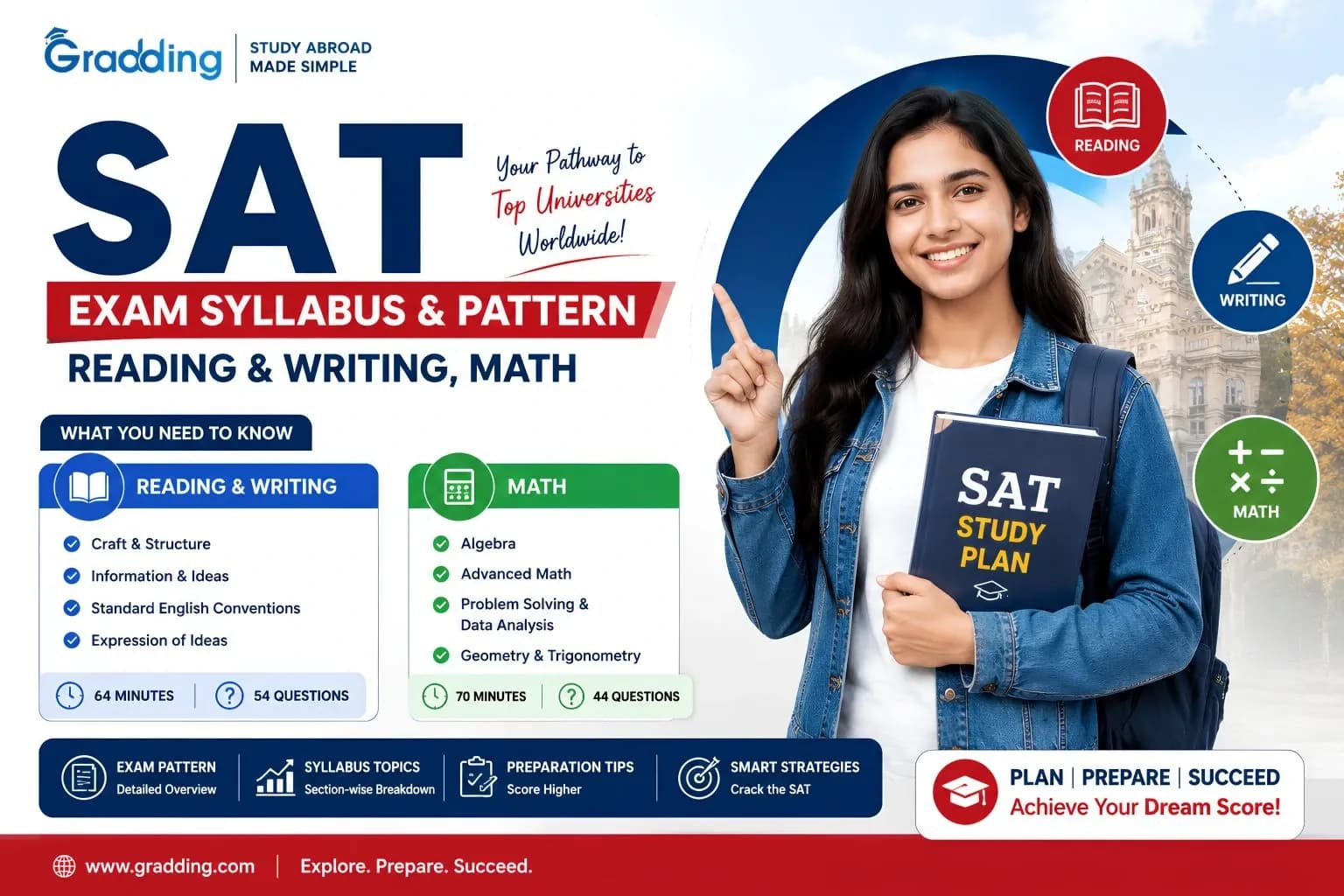
The reading & writing section of the SAT exam 2026 comprises of 54 questions which need to be finished in 64 minutes. This section is further divided into two modules of 32 minutes each. Each question is based on a short passage from fields like literature, history, social science, humanities and science.
| Domain | Approx. Weight | Approx. Questions |
| Craft and Structure | 28% | 13–15 |
| Information and Ideas | 26% | 12–14 |
| Standard English Conventions | 26% | 13–15 |
| Expression of Ideas | 20% | 8–12 |
Craft and Structure
This section assesses your ability to know word meanings, analyse passages and figure out the purpose behind the writing of author. It comprises:
- Words in Context: Opting for the current word or phrase based on the meaning and tone of the passage.
- Text Structure & Purpose: Understanding the correct phrase based on the meaning and tone of the passage.
- Cross Text Connectivity: Compare the two related passages and know the network between them.
Information and Ideas
This domain of SAT exam pattern stresses reading comprehension and analysing details from passages. It comprises:
- Central Ideas & Details: Figuring out the main idea and crucial supporting points.
- Command of Evidence: Selecting the evidence which supports a claim or conclusion.
- Inferences: Knowing the implied meanings and drawing logical conclusions.
Standard English Conventions
This section checks your knowledge of grammar, sentence structure and punctuation. This includes:
- Boundaries: Right use of commas, colons, semicolons and sentence endings.
- Form, Structure & Sense: Testing subject verb agreement, pronouns and verb usage.
Expression of Ideas
This domain assesses how effectively you can improve written content and organise ideas. This includes:
- Rhetorical Synthesis: Blends details to build clear and effective sentences.
- Transitions: Selecting the right words to connect ideas logically.
SAT Math Syllabus 2026
The SAT Math section 2026 comprises 44 questions which requires to be completed in 70 minutes. SAT Math is divided into two modules of 35 minutes each and 22 questions in each module. The section comprises both multiple choice and student produced response questions. Moreover a calculator including the built-in Desmos graphing calculator is also allowed throughout the Math section.
| Domain | Approx. Weight | Approx. Questions |
| Algebra | 35% | 13–15 |
| Advanced Math | 35% | 13–15 |
| Problem-Solving & Data Analysis | 15% | 5–7 |
| Geometry & Trigonometry | 15% | 5–7 |
Algebra
Algebra is one of the most important sections of SAT Math and focuses on solving equations, inequalities and mathematical relationships. Key topics include:
- Linear equations in one and two variables
- Linear functions
- Systems of equations
- Linear inequalities
Advanced Math
This section evaluates your understanding of more difficult concepts and functions.
Below are the important topics included:
- Equivalent expressions and factoring
- Nonlinear equations and systems
- Quadratic, exponential, polynomial and rational functions.
Problem Solving & Data Analysis
This domain focuses on applying math concepts to real world situations and interpreting data. It comprises:
- Ratio, rates and percentages
- Data interpretation through tables and graphs
- Mean, median and data distributions
- Probability and statistical analysis
- Understanding claims based on data
Geometry & Trigonometry
This segment evaluates your ability to solve problems with respect to shapes, measurements and formulas. Topics include:
- Area and volume calculations
- Lines, angles and triangles
- Similarity and congruence
- Right triangles and basic trigonometry
- Circles and properties
Besides a strong understanding of these topics and regular practice can help students enhance their accuracy and time management for the SAT Math section in 2026.
Digital SAT vs Old SAT Syllabus: Key Changes
The digital SAT introduces multiple changes compared to the old paper based exam, including a shorter test duration, adaptive question format and updated section structure.
Understanding these differences can help students prepare more effectively for the SAT exam 2026:
| Feature | Old (Paper) SAT | Digital SAT (2026) |
| Format | Paper-and-pencil, linear test | Fully digital, adaptive test |
| Total Duration | About 3 hours | 2 hours 14 minutes |
| Reading & Writing | Separate Reading and Writing/Language sections | Combined Reading & Writing section |
| Passage Length | Long passages (500–750 words) with multiple questions | Short passages (25–150 words) with one question each |
| Math Calculator | Calculator allowed only in one section | Calculator allowed throughout the Math section |
| Math Questions | 58 questions | 44 questions |
| Reading & Writing Topics | Reading, Information & Ideas, Rhetoric, Synthesis, Writing & Language | Craft and Structure, Information and Ideas, Standard English Conventions, Expression of Ideas |
| Essay | Optional essay available | Essay removed |
| Score Range | 400–1600 | 400–1600 (No change) |
To conclude SAT syllabus 2026 is created to evaluate the reading, writing and mathematical skills required for UG access at prestigious global academic institutions. Having a thorough idea about the latest exam structure and focusing on the main topics in every section can help you prepare more actually and maximize your score.
Regular practice with official study materials and mock tests will further enrich your confidence and time management. If you need personalized guidance for the SAT exam, college selection or the study abroad admission process, can connect with study abroad experts at Gradding for end-to-end support and expert counselling.
Frequently Asked Questions
Q: What are the Main Topics In the Sat Exam 2026?
Reading & writing includes craft and structure, information and ideas, standard English conversation and expression of ideas. Math includes Algebra, Advanced Math, problem solving 7 data analysis and geometry & trigonometry.
Q: How Many Questions Are In Each SAT Section In 2026?
Reading & writing has 54 questions for which you are given 64 minutes. Math has 44 questions in 70 minutes. Thus you will have to attempt 98 questions total in 2 hours 14 minutes.
Q: Is a Calculator Allowed in SAT Math 2026?
Yes, a calculator including a bult-in Desmos graphing calculator, is permitted for the entire Math section.
Q: Is There a Science Section In the SAT Syllabus?
No there is no standalone science section because it appears only as passage content within the Reading & Writing section and as real world context in some Math word problems.
Q: What is the Difference Between Algebra And Advanced Math In SAT?
Algebra covers linear equations, functions, inequalities and systems of linear equations. Advanced Math includes nonlinear content including quadratics, exponential, polynomials and other nonlinear functions that is usually more challenging.
0 comments


Hand Picked Courses
Get Scholarship Assistance
Get Offer in 15 Days*
Finance/Loan Assistance
I want FREE assistance with



Get the top strategies to ace the exams.