
An Ultimate Guide To The Four German Cases Explained
The German cases is one of the trickiest aspects of learning the language, especially if you are a native English speaker. Besides, putting together a sentence in German gets tough. However, there are a few ways by which you can drastically increase your fluency in the language, and it all starts with getting a better understanding of the German cases. Well, look no further! Read the blog and master all four cases in German. So, let’s begin!


Summarise with AI
Choose your AI Assist



Table of Contents

What are German Cases?
One of the main reasons why learning German cases might seem challenging is that people aren’t clear about cases. Hence, read this section to understand what German cases are.
A case (Kasus/Fall) refers to the form a noun or pronoun takes depending on its grammatical function within a sentence. It essentially shows how a noun or pronoun is used. These could be the subject, direct object, indirect object, or possessive. In Layman's terms, German cases tell you about the role of a noun or a pronoun in a sentence.
Explore Top Courses to Study in Germany
Options of a Wide Variety of Courses in germany


What is the German Case System?
The German case system refers to a set of rules that help you determine how German pronouns, nouns, and articles change form in a sentence. In German, words take different endings or forms depending on whether they are the subject, direct object, indirect object, or possessive. These different forms are known as cases. There are four cases in the German language:
- Nominative Case (Nominativ) - Subject
- Accusative Case (Akkusativ) - Direct Object
- Dative Case (Dativ) - Indirect Object
- Genitive Case (Genitiv) - Possessive
Besides, understanding German cases is an essential factor, when learning German as they will determine the meaning of your sentences.
Also Read: German Tenses
How Do Cases Work in English vs in German?
English cases are quite different from those of cases in German. If you compare them, you may find that English has a pretty fixed word order. A typical English sentence structure follows a pattern where the subject comes first, then the verb, and lastly the object. However, in German, the most basic rule is that the verb always comes second. Besides, the usage of the subject in German is flexible, unlike in English.
| German Cases | English Cases |
|---|---|
| There are four cases in German language - nominative (subject), accusative (direct object), dative (indirect object), and genitive (possessive). | In English, there are three cases - nominative (subject), accusative (object), and genitive (possessive). |
| Nouns, articles, and German adjectives change their endings depending on the case. | Nouns and articles do not inflect for case, except for personal pronouns. |
| German sentence structure is more flexible due to the case system, allowing variations in word order. | English language follows a typical word order which is vital for determining grammatical function. |
| For example: Both ‘Der Hund beißt den Mann.’ and ‘Den Mann beißt der Hund.’ mean the same. | For example: The dog bites the man. This can not be written otherwise. |
Wondering how many cases does German has? Read the section ahead and learn all about it.
What are the Four Cases in German?
There are four cases in German i.e. nominative, accusative, dative, and genitive. Look at the German cases chart below for a better understanding.
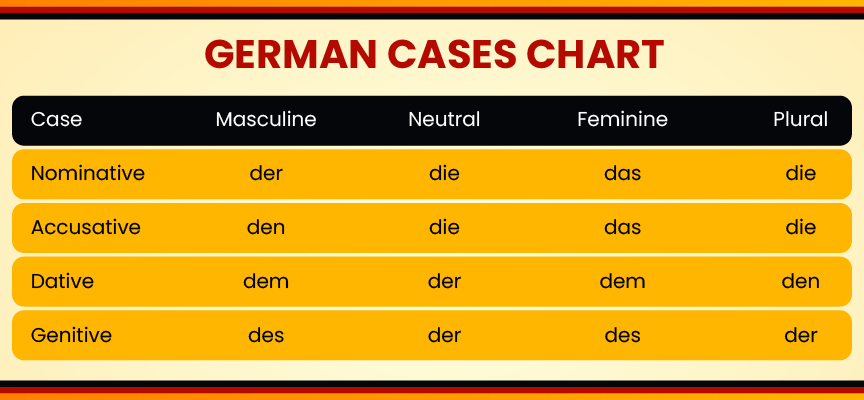
Now let's understand each of the German case in detail.
Nominative Case
The nominative case in German is used to identify the subject of the sentence (the person or thing doing the action). It answers the question who or what? in a sentence. You can see the examples of the nominative German cases chart below:
| Gender | Definite Article | Indefinite Article |
|---|---|---|
| Masculine | der | ein |
| Neutral | das | ein |
| Feminine | die | eine |
| Plural | die | - |
The nominative case describes the subject of a sentence, no matter what. Besides, it is the most basic German case.
Examples of Nominative Case
Here are German cases example below that show the nominative case being used.
- Masculine - Ein Vogel singt im Baum. (A bird is singing in the tree.)
- Neutral - Das Auto steht vor dem Haus. (The car is parked in front of the house.)
- Feminine - Die Blume ist wunderschön. (The flower is beautiful.)
- Plural - Die Blumen blühen im Garten. (The flowers are blooming in the garden.)
Accusative Case
The accusative case in German describes the direct object of a sentence (person or thing that receives the action).
| Gender | Definite Article | Indefinite Article |
|---|---|---|
| Masculine | den | einen |
| Neutral | das | ein |
| Feminine | die | eine |
| Plural | die | - |
In the accusative case, only the masculine articles change, the rest all stay the same.
Examples of Accusative Prepositions
Here are German cases example below that show the accusative case being used.
- Masculine - Ich sehe den (I see the man.)
- Neutral - Ich trinke das (I drink the water.)
- Feminine - Sie trägt die (She carries the flower.)
- Plural - Wir hören die (We hear the songs.)
Common Accusative Prepositions
Some prepositions that always pair with the German accusative case are:
- durch (through)
- für (for)
- ohne (without)
- bis (until)
- um (around)
- entlang (along)
- gegen (against)
- wider (against/contrary to)
Also read: Greetings in German
Dative Case
The dative case in German describes the indirect object of a sentence (to or for whom action is taken). In German dative case, all of the articles change and plural words sometimes get an ‘n’ added to the end.
| Gender | Definite Article | Indefinite Article |
|---|---|---|
| Masculine | dem | einem |
| Neutral | dem | einem |
| Feminine | der | einer |
| Plural | den | -/+ n |
Examples of Dative Case
Here are dative case examples below. The indirect objects are underlined in these examples.
- Masculine - Ich gebe dem Mann einen Kaffee. (I give the man a coffee.)
- Neutral - Das Kind gehört dem (The child belongs to the father.)
- Feminine - Ich schreibe der Lehrerin einen Brief. (I write a letter to the teacher.)
- Plural - Wir chicken den Freunden eine Einladung. (We send an invitation to the friends.)
Common Dative Prepositions
Some prepositions that always pair with the German dative case are:
- aus (out of, from)
- außer (except for, besides)
- bei (at, near, by)
- mit (with, by means of)
- nach (after, to, according to)
- seit (since, for)
- von (from, of, by)
- zu (to, at)
- gegenüber (opposite, across from)
Genitive Case
The genitive case in German describes possession in a sentence. It is used to indicate ownership of something or someone. It's often considered the odd one out in German.
| Gender | Definite Article | Indefinite Article |
|---|---|---|
| Masculine | des | eines |
| Neutral | des | eines |
| Feminine | der | einer |
| Plural | der | - |
Examples of Genitive Case
Here are German cases examples below that show genitive cases being used.
- Masculine - Der Hut des Mannes liegt auf dem Tisch. (The man's hat is on the table.)
- Neutral - Die Größe des Hauses überrascht mich. (The size of the house surprises me.)
- Feminine - Die Blüten der Blume duften herrlich. (The flower's blossoms smell delightful.)
- Plural - Die Bücher der Studenten liegen auf dem Tisch. (The students' books are on the table.)
Common Genitive Prepositions
Some prepositions that always pair with the German genetive case are:
- während (during)
- trotz (despite, in spite of)
- wegen (because of)
- an statt (instead of)
- innerhalb (within)
- außerhalb (outside of)
- jenseits (beyond)
- oberhalb (above)
- unterhalb (below)
- diesseits (on this side of)
Tips to Learn German Cases
Here are a few tips that will help you learn German cases effectively.
- Start with understanding the basics - all four German cases.
- Practicing regularly using exercises, speaking and writing will help you understand cases better.
- Focus on key elements: nouns, articles, prepositions, and verbs.
- Read German texts, watch German videos, and listen to German audios.
Main Reasons Why you should Study in Germany
Conclusion
Wrapping up, the blog covered everything about the German cases along with examples. To learn German, it is vital and essential to know about all four cases and their usage. Thus, every student or individual should learn these as they not only help you build conversations with ease but also help you understand the language clearly. For this, you may seek professional help from Gradding.com as our experts provide excellent German online coaching in this domain.
FAQ’s
Why Does German Have Four Cases?
The German language has cases because it is the grammatical function of German noun cases and allows for flexible word order. Thus, regardless of their position in the sentence, the meaning can be conveyed.
How Many Cases Does German Have?
In German, there are four cases, that must be used appropriately every time. German cases are used to indicate the grammatical function of nouns, pronouns, and adjectives within a sentence.
- Nominative
- Accusative
- Dative
- Genitive
Are German Cases Hard?
German cases are considered quite challenging for English speakers as it has a complex system. In German, nouns, pronouns, and adjectives change their endings depending on the case, making it a little difficult to understand.
Why Are German Cases Important?
Cases are extremely important in German because they indicate the role each noun plays in a sentence by changing word endings. Moreover, it is vital as it helps in clearly communicating.
0 comments


Hand Picked Courses
Get Scholarship Assistance
Get Offer in 15 Days*
Finance/Loan Assistance
I want FREE assistance with








Looking for Expert Guidance? Contact Us Today!
Call Now