
How to Prepare for the PTE Exam at Home: Step-by-Step Guide
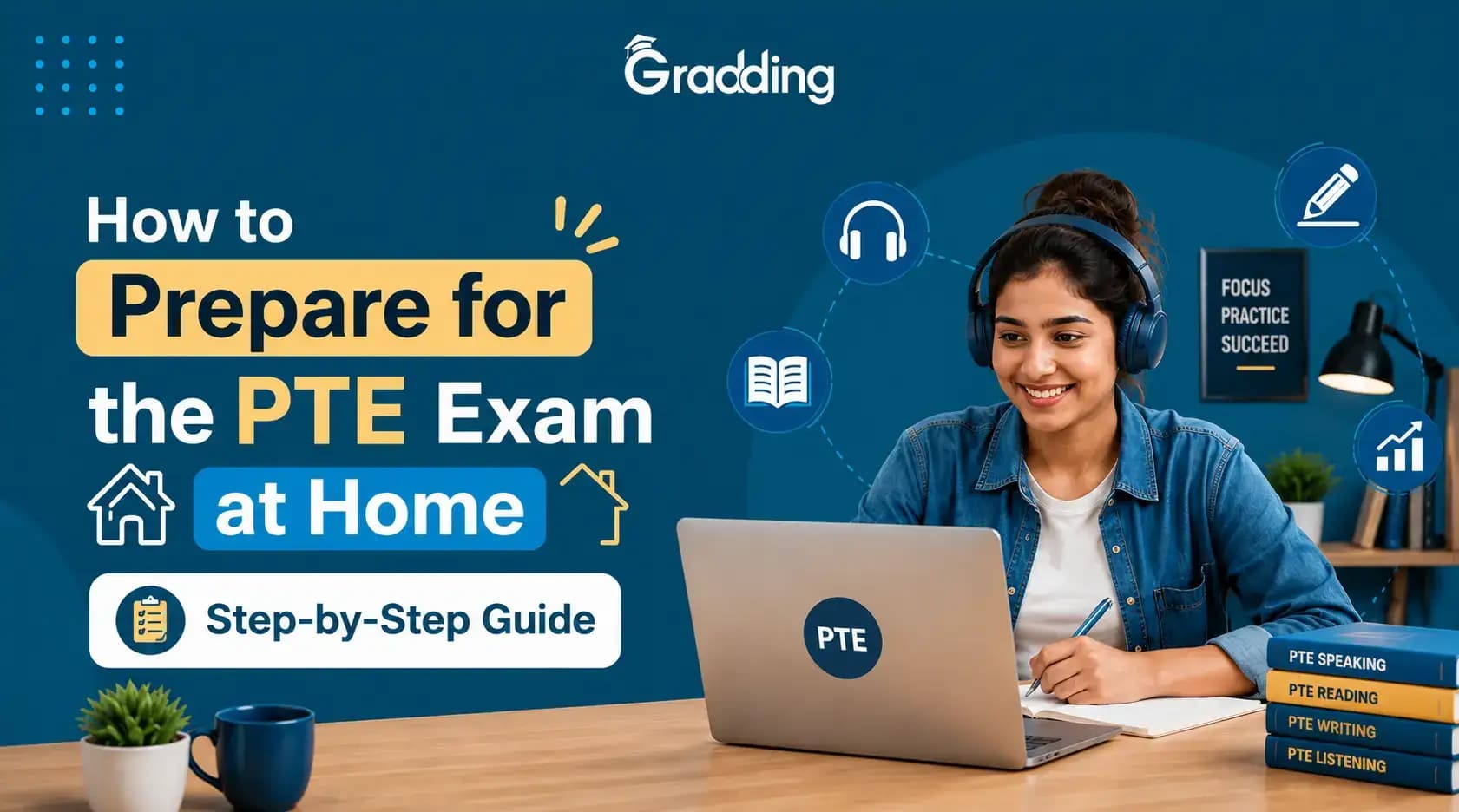
The PTE exam assesses English skills which are required for study or work abroad as it subsequently opens doors for global opportunities. Even without formal coaching one can effectively prepare for the exam through self study. By understanding the proper exam format, a structured plan and practising speaking, writing, reading and listening regularly, you can build confidence and achieve your target score successfully. Through the below write up you can get an idea of a step-by-step guide to mastering PTE easily.

Summarise with AI
Choose your AI Assist



Table of Contents

Understand the PTE Exam
Before you begin your preparation, it is important to understand the exam you are taking. Familiarizing yourself with its format and scoring criteria will help you prepare more effectively, allowing you to study smarter rather than harder.
What Is the PTE Exam?
PTE Academic is a computer-based English proficiency test accepted by universities, colleges, and immigration authorities globally, such as Australia, the UK, Canada, and New Zealand. It evaluates your Speaking, Writing, Reading, and Listening skills in a single two-hour session.
PTE Exam Format
The test comprises three main sections:
- Speaking & Writing (54-67 minutes) comprises read aloud, repeat sentence, describe image, essay writing, and more.
- Reading (29-30 minutes) comprises multiple-choice questions, re-ordering paragraphs, and filling in the blanks.
- Listening (30-43 minutes) includes summarising spoken text, highlighting the correct summary, and dictation.
How Does the PTE Scoring System Work?
As per the Global Scale of English (GSE), PTE scores range from 10 to 90. The scoring pattern is entirely AI-based, which removes human bias and delivers results within 48 hours. Each section contributes to your total score, but many questions are also cross-scored. It is because of this reason that understanding question types matters, similar to practicing individual skills.
Set Up Your Study Space and Schedule
As of now, we have established the exam structure and scoring criteria; it's time to plan your study schedule. With 2-3 hours of focused practice daily helps you can gain related skills. Here is the weekly glimpse of how you can schedule your study plan:
| Day | Focus Area | Duration | Activities | Goal |
|---|---|---|---|---|
| Monday | Speaking | 2 hrs | l Read aloudI repeat the sentencel Describe image practicel recording review | Build fluency and reduce hesitation |
| Tuesday | Writing | 2 hrs | l Essay writingl Summarise the written textGrammar review | Improve structure and sentence variety |
| Wednesday | Reading | 2 hrs | l Multiple-choiceI reorder paragraphsl Fill in the blanks | Increase speed and accuracy |
| Thursday | Listening | 2 hrs | l Summarise spoken textl dictationl Highlight correct summary | Train your ear for accents and pace |
| Friday | Mixed Practice | 2.5 hrs | Combined study for all sections | Simulate real exam pressure |
| Saturday | Mock Test | 3 hrs | l Full-length mock testscore review | Track progress and identify weak areas |
| Sunday | Rest / Light Review | 1 hr | Review mistakes | Recharge and consolidate learning |
Best Free and Paid Resources for Home Prep
For PTE preparation, the right mix of free and paid resources can make self-study far more effective. Below is the breakdown of resource types to help you prepare without missing key practice areas.
1. Mock Test
Full-length mock tests simulate actual exam conditions like timing, question order, and interface. So taking one early in your prep helps you identify gaps, and repeating them every week or two lets you track improvement and get comfortable with the exam pressure before test day.
2. Practice Tests
Besides full mock test Pte practice tests, focus on particular question types or the section itself. Practice tests are useful for targeted drilling, and at Gradding, you can access the practice tests that are designed under the guidance of an expert.
3. Mobile Apps
Another tool is a mobile app that helps you practice in short bursts during commutes or breaks. With a mobile app, you can avail AI-based speaking feedback, timed reading and listening drills, and progress tracking. Thus, this practice fits into daily life without an entire study session.
4. YouTube Channels
For the PTE exam, there are several YouTube channels available at no cost or a nominal charge. These are particularly helpful for understanding scoring criteria, seeing real response examples, and picking up techniques for tricky question types. On Gardding's YouTube channel, one can watch multiple exam-oriented videos on different question types and master exam techniques.
5. Grammar and Vocabulary Resources
Strong grammar and vocabulary directly affect your Writing, speaking, and Reading scores. You can use grammar guides to fix the repeating mistakes via articles, tenses, and subject-verb agreement, and build vocabulary via word lists, flashcards, or reading scholarly articles regularly to widen your range of expression.
Master Each Section: Speaking, Writing, Reading, Listening
Each section of the PTE exam tests specific skills via particular question types. So understanding each task's demands helps you practice with purpose rather than guessing what actually matters.
Speaking: Read Aloud, Repeat Sentence, Describe Image
Read Aloud assesses pronunciation, fluency, and intonation, here you need to read at a natural pace and focus on keywords correctly. In Repeat the Sentence, your memory and accuracy are assessed, so focus on capturing the sentence structure apart from every single word. And in the described image task, awards will be based on the basis of clear structure including the overview, key trends, and a brief conclusion within 40 seconds.
Writing: Summarise Text, Essay Writing
In the summarised text task of the writing section, you are required to compress the given passage into one grammatically correct sentence of 5-75 words without extra details. Furthermore, in the essay writing task, test takers test your ability to build an argument for an introduction, 2-3 body paragraphs with examples, and a short conclusion.
Reading: Fill in the Blanks, Multiple Choice
Fill in the blanks in the reading section, which evaluates your vocabulary and grammar in context. Here you are required to read the full sentence first before choosing a word, as the context often changes the expected answer. Moreover, in multiple choices careful reading of the passage to avoid choices that sound correct but are not directly supported by the text.
Listening: Summarise Spoken Text, Highlight Correct Summary
Summarise spoken text demands that you write a concise summary of an audio clip, capturing the main points in one paragraph. Furthermore, correct summary tests comprehension under pressure, in which you need to listen to the core message and eliminate summaries that add details not mentioned in the related audio.
Track Your Score and Identify Weak Areas
Tracking your progress is not just about the marks; rather, it reflects exactly where to focus next. It helps you focus further on your target clearly.
Using Score Reports to Guide Study Focus
Students often skip analysis of mock tests that cost in the actual exam. After each mock test, it becomes your first responsibility to review your score report and see which skills are weakest. Students can also use Gradding's PTE overall score calculator to evaluate their overall score and understand which sections require more attention before their next attempt.
Setting Milestone Targets
Next, you can break down your target score into smaller milestones, such as a 5-point improvement every two weeks. This makes progress measurable and keeps you motivated instead of only focusing on the final number.
Common Mistakes to Avoid While Self-Studying
Although PTE exam preparation can be done by sitting at home, self-study comes with common traps that slow progress without you realising it. So spotting these mistakes early saves time and keeps your preparation on the right track.
Over-relying on One Resource
In digital time over relaying on a single app, website, or PTE practice material often limits exposure to different question styles. Try to include multiple resources to get an all-round understanding of the exam.
Ignoring Time Management During Practice
Practice without a timer leads to poor pacing on exam day. So always practice in a timed environment to match the real exam conditions. To get command over the test, one must attempt practice and full-length mock tests in sequence.
Tips to Stay Motivated and Exam Ready
Last-minute pressure is huge on every student; despite having good preparation, students often make mistakes. Therefore, a positive mindset for the exam day is equally important to win the test.
Joining Study Groups or Forums
You must connect with other test-takers as this helps you share important exam-oriented tips and learn from others’ mistakes and experiences.
Simulating Real Exam Conditions Before Test Day
Take at least one full mock test in exam-like conditions, such as the same timing, without pauses, and in a quiet room to reduce exam anxiety and build familiarity before the actual test.
Preparing for the PTE exam at home is not all about studying harder; instead, it is about studying smart, staying consistent, and tracking what actually works. Thus, with the right format knowledge, a structured schedule, focused skill building, and honest self-assessment with paid or PTE mock tests free online, you are actually preparing yourself to perform your best on test day.
FAQs
1. Can I Prepare For The PTE Exam at Home Without Joining a Coaching Institute?
Yes, one can easily prepare for the PTE exam at home with:
- Structured study plan
- Official practice materials
- Regular mock tests
- Consistent practice
2. How Many Hours Should I Study Each Day To Prepare Effectively for the PTE exam?
2 to 4 hours regularly is usually sufficient, but the ideal duration largely depends on your current English proficiency, target score, and the amount of time available before your exam.
3. What are the Best Resources for PTE Exam Preparation at Home?
Here are the best resources for PTE exam preparation at home:
- Official PTE practice tests
- Mobile apps
- Mock tests
This is how one can create familiarity with the exam format and improve performance.
4. How Can I Improve My PTE Score In Speaking, Writing, Reading, and Listening?
You can improve PTE scores in each section by focusing on:
- Focus on pronunciation
- Grammar
- Vocabulary
- Reading speed
- Listening accuracy
- Timed mock tests
5. How Do I Know If I am Fully Prepared To Take The PTE Exam?
You are completely ready when you achieve your target score in mock tests, and you are completing all the sections within the time limit and feel confident handling every question type.
0 comments

Practice Makes a Man Perfect!Take FREE pte Mock Tests
Start FREE Mock Test


Get Unlimited Access with
PTE Prep Boost

Mock Tests

Practice Questions

Study Material

Recorded Classes
What is your Target PTE Score?






Get Familiar with the Updated PTE Exam
Start Free Mock Test