
MS in USA 2026: Top Universities, Fees & All You Need to Know
Every year, more than 250,000 Indian students apply to US universities for a master's degree. And of all the courses they choose, MS programs — especially in Computer Science, Data Science, and Engineering — sit right at the top. There's a good reason for that. A master's degree from the USA doesn't just give you a qualification. It puts you inside the world's most active hiring ecosystem for technology, business, and research. But navigating the entire process — choosing universities, understanding fees, figuring out eligibility, knowing what happens after graduation — can be genuinely overwhelming. This guide pulls everything together in one place. Whether you're in your final year of undergrad or working a job and considering a career switch, this is the most complete picture of what pursuing an MS in USA actually looks like in 2026.

Summarise with AI
Choose your AI Assist



Table of Contents

Why Do Students Choose the USA for MS?
Before getting into fees and universities, it helps to understand why the USA is so dominant as a study destination — because 'everyone goes there' isn't really an answer. There are some concrete, practical reasons.
1. The job market is enormous and accessible
The US tech and engineering job market is the largest in the world. Companies like Google, Amazon, Microsoft, Meta, and hundreds of funded startups are all actively recruiting from US university campuses. An on-campus placement cell in the USA isn't just a formality — it's genuinely connected to hiring pipelines. That proximity to the industry is hard to replicate anywhere else.
2. STEM OPT gives you three years to work
This is one of the biggest practical advantages that gets overlooked by students in the early stages of planning. If your MS program qualifies as a STEM course — and most CS, Data Science, and Engineering programs do — you're entitled to 12 months of OPT (Optional Practical Training) immediately after graduation, plus a 24-month STEM OPT extension. That's three full years of work authorisation in the USA without needing an H-1B visa immediately.
3. Research infrastructure is genuinely world-class
If you're interested in research — whether in AI, semiconductors, biotech, or climate tech — US universities have labs, funding, and faculty that are genuinely at the frontier. MIT's CSAIL, Stanford's AI Lab, Carnegie Mellon's robotics labs — these aren't just brands. They produce work that defines where technology goes next.
4. Flexibility in course structure
Unlike UK or European programs that follow a rigid curriculum, US MS programs typically let you choose electives and even specialise within a broader field. You can do an MS in Computer Science with a concentration in Machine Learning, or mix in business courses if your program allows. That flexibility is something students really value.
Top Universities in USA for MS —2026 Rankings
Here are the top universities for MS programs in the USA, ranked by the QS World University Rankings 2026 (by subject). Fees shown are approximate annual tuition for international students. Always check official university websites for the most current figures.
| University | QS CS Rank 2026 | Annual Tuition (USD) | Acceptance Rate | Notable For |
| Massachusetts Institute of Technology (MIT) | #1 | $57,500 | 3–4% | AI, Robotics, CS Theory |
| Stanford University | #2 | $62,484 | 4% | Silicon Valley proximity, AI/ML |
| Carnegie Mellon University (CMU) | #3 | $53,530 | 11% | CS, Robotics, HCI |
| University of California, Berkeley (UCB) | #4 | $29,026 (in-state) / $44,066 | 11% | EECS, AI, Systems |
| University of Illinois – Urbana-Champaign | #5 | $31,564 | 18% | Systems, Data Science |
| Cornell University | #6 | $32,164 | 10% | Distributed Systems, ML |
| Princeton University | #7 | $54,756 | 5% | Theory, Algorithms |
| Harvard University | #8 | $54,000 | 5% | Cross-disciplinary CS |
| Georgia Institute of Technology | #12 | $14,064 (online) / $33,794 | 25% | Affordable, Strong CS |
| University of Washington | #15 | $22,764 | 17% | NLP, Systems, AI |
| University of Texas – Austin | #18 | $20,998 | 15% | Data Science, Systems |
| Arizona State University (ASU) | #30 | $20,000 | 35% | Online + campus options |
Best Courses for MS in USA in 2026
MS in Computer Science gets most of the attention, but there are several other specialisations that offer equally strong career outcomes. Here's a look at the most popular and high-value MS courses in the USA.
| MS Course | Duration | Avg. Annual Fees (USD) | Avg. Starting Salary (USD) |
| MS in Computer Science | 1.5–2 years | $25,000–$60,000 | $110,000–$130,000 |
| MS in Data Science | 1.5–2 years | $25,000–$55,000 | $100,000–$120,000 |
| MS in Electrical & Computer Engineering | 1.5–2 years | $20,000–$50,000 | $95,000–$115,000 |
| MS in Mechanical Engineering | 1.5–2 years | $20,000–$48,000 | $85,000–$105,000 |
| MS in Business Analytics (MSBA) | 12–18 months | $25,000–$60,000 | $90,000–$115,000 |
| MS in Information Systems (MIS) | 1.5–2 years | $20,000–$45,000 | $90,000–$110,000 |
| MS in Cybersecurity | 1.5–2 years | $20,000–$50,000 | $100,000–$125,000 |
| MS in Biomedical Engineering | 2 years | $25,000–$55,000 | $80,000–$100,000 |
| MS in Civil / Environmental Engineering | 2 years | $18,000–$45,000 | $72,000–$90,000 |
All of the above are STEM-classified programs, which means graduates are eligible for the 3-year OPT work authorisation benefit.
MS in USA Eligibility: What Do You Actually Need?
Eligibility varies by university and program, but the core requirements are consistent across most good schools. Here's what you'll need to put together.
Academic requirements
You need a bachelor's degree (4-year) in a related field. For MS in Computer Science or Engineering, most universities require a B.Tech, B.E., or BSc in a relevant discipline. A GPA of 3.0 on a 4.0 scale (roughly 65–70% in Indian grading) is the baseline at most universities. Top schools like MIT and Stanford look for 3.7+ (which translates to roughly 85–90% in Indian systems).
English proficiency
IELTS: minimum 6.5 overall (most top universities want 7.0+)
TOEFL iBT: minimum 80–90 (top schools want 100+)
Duolingo English Test: accepted by many universities, minimum 110–120
GRE scores
GRE is still required at some universities but has become optional or waived at many others. A combined score of 315–320 (with 160+ in Quant) is competitive for most good programs. We've listed universities that don't require GRE in the dedicated section below.
Statement of Purpose (SOP)
Your SOP is genuinely one of the most important parts of your application — especially at research-focused programs where the faculty read these carefully. Write it around a specific research interest or career goal, not a generic statement about passion for the field. Two pages, single-spaced, is the standard format.
Letters of Recommendation (LORs)
Most universities require 3 LORs. Academic references are preferred for research programs; a mix of academic and professional works for industry-focused programs. Make sure your recommenders actually know your work — a generic letter from a senior professor who barely remembers you hurts more than it helps.
Work experience
Work experience is optional for most MS programs (unlike MBAs). However, having 1–2 years of relevant internships or full-time work significantly strengthens applications for competitive programs. Some universities explicitly prefer applicants with industry exposure.
| Requirement | Minimum (General) | Competitive (Top Schools) |
| GPA (4.0 scale) | 3.0 | 3.5–3.8 |
| IELTS | 6.5 | 7.0–7.5 |
| TOEFL iBT | 80 | 100–110 |
| GRE Quantitative | 155 (if required) | 165+ |
| GRE Total | 305 (if required) | 320+ |
| Work Experience | Not mandatory | Preferred (1–2 years) |
| SOP | Required | Highly scrutinised at top schools |
| LORs | 3 | 3 (at least 2 academic) |
MS in USA Without GRE: Universities That Don't Require It
A lot of students rule out studying in the USA because they assume GRE is non-negotiable. That's no longer true. After COVID, many universities waived the GRE and discovered their admit quality didn't suffer — so the waivers stuck. Here are solid programs where GRE is either waived or not required.
| University | Program | GRE Status | IELTS Min. |
| University of Southern California (USC) | MS CS / Data Science | Optional (waived) | 6.5 |
| Arizona State University | MS CS / Engineering | Not required | 6.5 |
| Northeastern University | MS CS / Data Science | Not required | 6.5 |
| University of Florida | MS CS (Online) | Not required | 6.0 |
| North Carolina State University | MS CS (Online) | Not required | 6.5 |
| University of Texas – Dallas | MS CS / SE | Optional | 6.5 |
| George Mason University | MS CS / Cybersecurity | Not required | 6.5 |
| Santa Clara University | MS CS / Data Science | Not required | 6.5 |
| New Jersey Institute of Technology | MS CS | Not required | 6.5 |
| Illinois Institute of Technology | MS CS / Data Analytics | Not required | 6.5 |
MS in USA Fees and Total Cost: What You'll Actually Spend
Fees are, understandably, the first thing most students and families want to understand. Here's an honest breakdown — not just tuition, but the full cost of completing an MS in the USA.
Tuition fees by university type
| University Type | Annual Tuition (USD) | INR Equivalent (approx.) | 2-Year Total (USD) |
| Elite private (MIT, Stanford, CMU) | $55,000–$65,000 | ₹46L–₹54L | $110,000–$130,000 |
| Strong private (USC, Northeastern, NYU) | $35,000–$50,000 | ₹29L–₹42L | $70,000–$100,000 |
| Top public (UIUC, UT Austin, UW) | $20,000–$35,000 | ₹17L–₹29L | $40,000–$70,000 |
| Affordable public (ASU, UTD, NCSU) | $12,000–$22,000 | ₹10L–₹18L | $24,000–$44,000 |
| Online programs (Georgia Tech, NCSU) | $7,000–$15,000 | ₹6L–₹12L | $14,000–$30,000 |
Living costs by city
Your city matters as much as your university when it comes to total cost. Here's a realistic monthly budget by location.
| City | Monthly Living Cost (USD) | Annual (USD) | Notes |
| San Francisco / Bay Area | $2,800–$3,500 | $33,600–$42,000 | Very expensive; near top tech companies |
| New York City | $2,500–$3,200 | $30,000–$38,400 | High rent; diverse opportunities |
| Seattle | $2,200–$2,800 | $26,400–$33,600 | Amazon, Microsoft proximity |
| Boston / Cambridge | $2,200–$2,800 | $26,400–$33,600 | MIT, Harvard, strong biotech scene |
| Austin, Texas | $1,600–$2,200 | $19,200–$26,400 | Fast-growing tech hub, affordable |
| Atlanta, Georgia | $1,500–$2,000 | $18,000–$24,000 | Georgia Tech; affordable |
| Phoenix / Tempe, Arizona | $1,400–$1,900 | $16,800–$22,800 | ASU location; very affordable |
| Raleigh, North Carolina | $1,400–$1,800 | $16,800–$21,600 | NCSU; Research Triangle Park |
Scholarships for MS in USA: How to Fund Your Studies
Funding is the biggest barrier for most Indian students. The good news is that there are real options — from university fellowships to government scholarships to graduate assistantships. The bad news is that most of them require early planning and strong academic profiles.
University-funded assistantships
This is the most valuable form of funding and worth prioritising. A Graduate Teaching Assistantship (GTA) or Graduate Research Assistantship (GRA) typically covers tuition and pays a monthly stipend of $1,500–$2,500. These are awarded by the department, not the admissions office, which means your SOP and research fit matter enormously. Research-focused programs at public universities (UIUC, UT Austin, Purdue) are more likely to offer these than industry-oriented private programs.
External scholarships
| Scholarship | Amount | Eligibility | Deadline |
| Fulbright-Nehru Master's Fellowship | Full funding | Indian citizens; strong academic + leadership | July each year |
| Inlaks Shivdasani Foundation | Up to $90,000 | Indian students <30 years | March each year |
| Narotam Sekhsaria Foundation | Up to ₹25 lakh | Indian students; merit-based | Rolling |
| AAUW International Fellowships | $20,000–$50,000 | Women; final year or recent graduate | November each year |
| American University Emerging Global Leaders | Full scholarship | Undergrad leadership track | January each year |
| East-West Center Graduate Degree Fellowship | Full tuition + living | Asia-Pacific students | November each year |
Affordable program options worth considering
If loans are a concern, these programs offer strong ROI at much lower cost:
Georgia Tech OMSCS — ~$7,000 total; fully STEM-eligible for OPT
NCSU MS CS Online — ~$15,000 total; strong industry connections
ASU MS CS — campus or online; fees from $12,000/year
University of Florida MS CS Online — STEM, no GRE, affordable
How to Apply for MS in USA: Step-by-Step
The application process looks complicated from the outside, but once you break it down into phases, it becomes manageable. Here's exactly what to do and when.
Phase 1: 12–18 months before intake
Research programs and create a university list of 10–15 schools (3–4 reach, 6–7 target, 3–4 safe). Use factors like ranking, location, fees, research labs, and alumni outcomes.
Take GRE if required. Give yourself time to retake it once. Most competitive scores take 3–4 months of preparation.
Take IELTS or TOEFL. Give yourself time to retake if the score is below target.
Start working on your SOP draft. This takes longer than most students expect — plan for 6–8 weeks of revision.
Phase 2: 6–12 months before intake
Approach professors for LORs early. Give them at least 6–8 weeks notice. Share your SOP and resume with them so they can write a personalised letter.
Request official transcripts from your university. This can take 2–4 weeks.
Finalise your university list and start filling application portals. Most US universities use their own portal or a system like ApplyTexas or SOPHAS.
Pay application fees. Typical range: $50–$125 per application.
Phase 3: After receiving offers (3–4 months before intake)
Compare offer letters carefully — check funding conditions, program structure, and research opportunities.
Accept one offer and pay the I-20 deposit (usually $500–$1,000).
Apply for your F-1 student visa once you receive your I-20 from the university.
Book accommodation — on-campus housing fills quickly, so apply immediately after accepting.
Begin financial planning — organize your blocked account or sponsorship documents for visa.
F-1 Student Visa: How It Works
The F-1 visa is the standard student visa for full-time academic programs in the USA. Here's what you need to know.
Documents required for F-1 visa application
- Form DS-160 (filled online)
- Valid passport (minimum 6 months validity beyond your intended stay)
- I-20 form issued by your university
- SEVIS fee payment receipt (currently $350)
- Visa application fee receipt ($185)
- Proof of financial support — bank statements showing sufficient funds for first year
- Academic transcripts and degree certificates
- English test score reports
- University offer letter
The visa interview
The F-1 visa interview is typically 5–10 minutes long. The consular officer is mainly trying to confirm that you have genuine study intent, a credible financial plan, and ties to your home country. Be clear about your program, your university, and how you plan to fund your studies. Practise answering in English — not because it's required, but because it signals confidence. Visa approval rates for Indian students applying for F-1 visas to attend US universities are generally high — typically above 80% for well-prepared applicants with complete documentation.
Working in USA After MS: OPT, STEM OPT & H-1B
This is the section that determines whether a US MS degree is worth the investment for most Indian students. Understanding the work authorisation pathway is critical before you commit.
OPT (Optional Practical Training)
After graduating with an F-1 visa, you're eligible for 12 months of OPT — essentially a work permit that lets you stay in the USA and work in any role related to your field of study. You apply through your university's DSO (Designated School Official), and USCIS issues an EAD (Employment Authorisation Document). Most students apply 90 days before graduation.
STEM OPT Extension
If your degree is STEM-classified (which almost all CS, Engineering, and Data Science programs are), you can apply for a 24-month extension, giving you a total of 36 months to work in the USA before needing an H-1B. This extension requires your employer to be E-Verify registered.
H-1B Visa: What happens after OPT
After OPT ends, most students need an H-1B work visa to continue working in the USA. H-1B is employer-sponsored and subject to an annual lottery. The lottery is competitive — approximately 3.5–4 applications per available slot in recent years. That said, working for 3 years on OPT/STEM OPT before the H-1B lottery significantly improves your chances by giving you time to build your professional profile and switch to employers with better H-1B approval rates.
| Stage | Duration | Requirement | Key Note |
| OPT | 12 months | F-1 visa, graduated | Apply 90 days before graduation |
| STEM OPT Extension | 24 months | STEM degree + E-Verify employer | Apply before OPT expires |
| H-1B Visa | 3 years (renewable) | Employer sponsorship + lottery | Annual cap of 65,000 + 20,000 master's quota |
| Green Card (EB-2/EB-3) | Varies (5–15 years for India) | Employer sponsorship | Long wait for Indian nationals |
Salary After MS in USA: What Graduates Actually Earn
This is ultimately what the ROI calculation comes down to. Here's what the data shows for MS graduates in the USA — drawn from BLS data, H-1B salary disclosures, and major job portals.
| Job Role | Entry-Level (USD/yr) | Mid-Level (USD/yr) | INR Equivalent (Entry) |
| Software Engineer | $105,000–$130,000 | $145,000–$180,000 | ₹87L–₹1.08Cr |
| Machine Learning Engineer | $115,000–$140,000 | $155,000–$200,000 | ₹95L–₹1.16Cr |
| Data Scientist | $100,000–$125,000 | $140,000–$175,000 | ₹83L–₹1.04Cr |
| Cloud/DevOps Engineer | $100,000–$120,000 | $135,000–$165,000 | ₹83L–₹1.0Cr |
| Cybersecurity Analyst | $95,000–$115,000 | $130,000–$160,000 | ₹79L–₹95L |
| Business/Data Analyst | $80,000–$100,000 | $110,000–$135,000 | ₹66L–₹83L |
| Hardware/ECE Engineer | $90,000–$110,000 | $120,000–$150,000 | ₹75L–₹91L |
| Biomedical Engineer | $75,000–$95,000 | $100,000–$130,000 | ₹62L–₹79L |
The US Bureau of Labor Statistics (BLS) reports the average annual salary for computer and information research scientists at $136,620 (2023 data). For software developers and quality assurance analysts, the median is $130,160. These are median figures — top-of-market salaries at companies like Google, Meta, and Apple are significantly higher, often $200,000+ with equity.
MS in USA vs Other Countries: Quick Comparison
Some students consider Canada, UK, Germany, or Australia as alternatives. Here's an honest comparison.
| Factor | USA | Canada | UK | Germany |
| Duration | 1.5–2 years | 1.5–2 years | 1 year | 2 years |
| Avg. Annual Fees | $20K–$60K | CAD 18K–35K | £20K–£30K | €0–€3K (public) |
| Work during study | 20 hrs/week (on-campus) | 20 hrs/week | 20 hrs/week | Allowed (limited) |
| Post-study work | 3 years (STEM OPT) | 3 years (PGWP) | 2 years (PSW) | 18 months (job-seeking) |
| PR pathway | Hard (10–15 yrs for India) | Easier | Points-based | Possible (job offer needed) |
| Industry connections | Very strong | Strong | Moderate | Strong (Germany-based) |
| Salary potential | Highest globally | Good | Good | Lower than US/UK |
| IELTS requirement | 7.0+ | 6.5+ | 6.5–7.0 | Often not required |
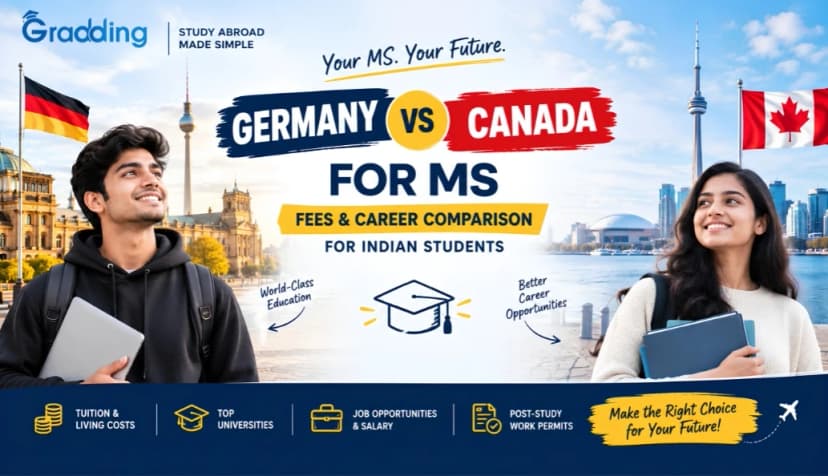
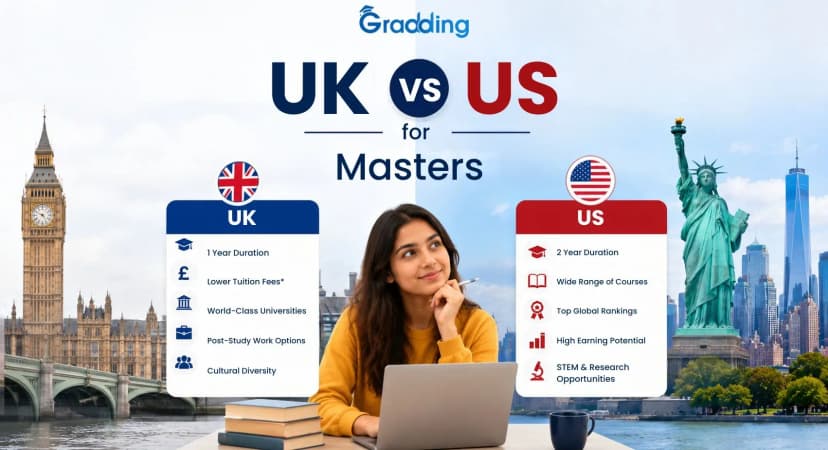
The USA wins on salary potential and career acceleration. Germany wins on cost. Canada wins on PR pathway. UK wins on program duration (1 year saves fees). The right choice depends on your specific priorities — career growth in tech vs immigration vs minimising cost.
FAQs
1. Is the USA good for MS in Computer Science?
Yes — and it's not even close. The USA has the highest density of tech companies hiring CS graduates, the strongest university research programs in the world, and a 3-year post-study work authorisation. If you're planning a career in AI, software engineering, data science, or any technology field, a US MS degree remains the gold standard.
2. What is the minimum GPA for MS in USA?
Most universities require a minimum GPA equivalent of 3.0 on a 4.0 scale (roughly 65–70% in Indian systems). For competitive programs like those at CMU, Stanford, or UIUC, you'll need 3.5+ (85%+). Some universities have no formal GPA cutoff but evaluate holistically.
3. Can I get a scholarship for MS in USA?
Yes. The most accessible form of funding is a Graduate Teaching or Research Assistantship (GTA/GRA) from your department, which covers tuition and pays a stipend. External scholarships like the Fulbright-Nehru Fellowship cover full expenses. Planning 12–18 months in advance significantly improves your chances.
4. How much does an MS in USA cost for Indian students?
Total costs (tuition + living for 2 years) range from approximately $40,000 (affordable public universities like ASU or UTD) to $160,000+ (elite private universities like MIT or USC in expensive cities). Most students end up in the $70,000–$120,000 range.
5. What is STEM OPT and how does it help?
STEM OPT is a 24-month work authorisation extension available to graduates of STEM-classified programs in the USA. Combined with the initial 12-month OPT, it gives you 3 years to work in the USA after graduation — on an F-1 student visa. This is one of the most significant advantages of studying in the USA versus other countries.
0 comments


Hand Picked Courses
Get Scholarship Assistance
Get Offer in 15 Days*
Finance/Loan Assistance
I want FREE assistance with






Planning to Study MS in the USA?