
Study in Netherlands 2027: Discover Top Universities, Fees, Visa & More
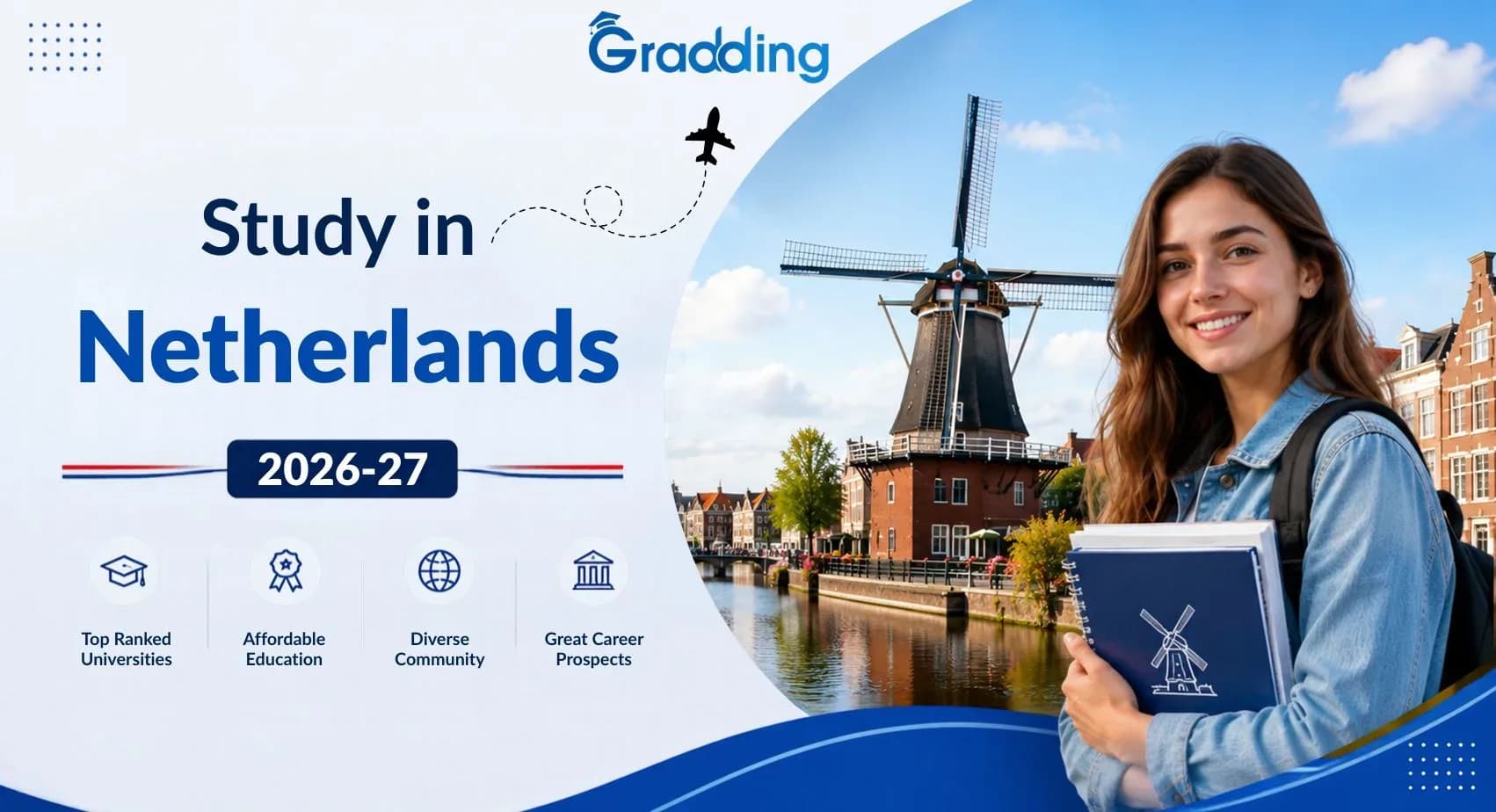
Imagine studying at a world-ranked institution, earning a globally recognised degree, studying in English and experiencing life in one of Europe’s strong education destinations. Sounds exciting, right? This is why the opportunity to study in the Netherlands stands as an appealing choice for international students. Whether it is selecting the right university, understanding tuition fees, obtaining a student residence permit or planning for your post-study career, you will find all the essentials about the opportunity to study in Netherlands for international students in the 2026-27 academic year.

Summarise with AI
Choose your AI Assist



Table of Contents

1. How much does it cost to study in Netherlands for Indian students?
2. Is IELTS mandatory for the Netherlands?
3. Can I study in Netherlands without a study gap issue?
4. Is the blocked account mandatory for Indian students?
5. How long does the Netherlands student visa take to process?
6. Can I get PR in Netherlands after studies?
Why Study in the Netherlands?
The combination of internationally renowned universities and high-quality English-language programmes is what makes the opportunity to study abroad in Netherlands stand out among top European education countries.
- Internationally Renowned Universities: The Netherlands hosts several leading universities that appear in the QS World University Rankings 2026, such as Delft University of Technology, University of Amsterdam, Utrecht University, and Wageningen University & Research.
- English-Taught Programmes: Universities like the University of Amsterdam and Utrecht University provide a range of English-taught programmes for international students.
- Research and Innovation: There is a strong focus on research at the Netherlands’ universities in areas of technology, engineering, business, sciences, social sciences, and sustainability.
- International Learning Environment: Utrecht University, for instance, has students from over 120 different countries, whereas the University of Amsterdam has students from over 100 different countries.
- Opportunity To Work After Graduation: Qualified candidates can apply for an orientation-year residence permit of the Netherlands, which is for one year, to seek employment or start their own business.
- Pragmatic Teaching Style: A lot of courses in the Netherlands focus on learning independently, discussion, research, and using academic knowledge in real-world situations.
- Ideal Location in Europe: Apart from this, studying in the Netherlands provides students proximity to European centres of education and business.
Top Universities to Study in Netherlands 2026-27
The Netherlands is home to an unexpectedly good number of world-renowned universities despite its small size, with 9 of them ranking in the top 200 globally. Here are the top universities in Netherlands based on the QS World University Rankings 2027.
| University Name | QS World University Rankings 2027 |
|---|---|
| Delft University of Technology (TU Delft) | 48 |
| University of Amsterdam (UvA) | 60 |
| Utrecht University | =113 |
| Leiden University | =119 |
| Erasmus University Rotterdam | 148 |
| Eindhoven University of Technology | 152 |
| Wageningen University & Research | 154 |
| University of Groningen | 157 |
| Vrije Universiteit Amsterdam | =185 |
| University of Twente | =223 |
Note: Use our University Predictor tool to calculate your admission chances and find universities that match your academic profile.
Key Highlights
- U Delft and the University of Amsterdam (UvA) are the only two Dutch universities featured in the top 100 world rankings, with TU Delft holding on to the number one rank in the nation for many consecutive years.
- The Netherlands has 10 universities ranked in Europe’s top 100 rankings, making it equal to the UK and Germany in this regard.
- TU Delft tops the charts for its Engineering, Architecture and Applied Sciences because of its strong connections with industries such as ASML.
- Erasmus Rotterdam and UvA are famous for their courses in business, economics and finance.
- Wageningen is renowned worldwide for agriculture, environmental science and sustainability.
Popular Programmes to study in the Netherlands
Programme selection is much more important than what students understand because the Netherlands is famous for its expertise in a few disciplines only.
Best Bachelor's Programmes
- BSc in Computer Science (University of Amsterdam, TU Delft, Maastricht University) — the Netherlands is known for its advanced technology and startup scene, in particular in the areas of Amsterdam and Eindhoven, which makes this degree very practical to pursue.
- BSc in International Business (Erasmus Rotterdam, Tilburg University) — based on real-life business case studies, rather than theoretical knowledge, plus Rotterdam's port-based economy provides students with direct connections to international companies.
- BSc in Mechanical Engineering (Delft University of Technology, University of Twente) – The reputation of Delft University and its connections to companies such as ASML and the European Space Agency make this an excellent engineering programme at a European level.
- BSc in Psychology (Utrecht, Leiden) — Both universities are noted for their mixture of research-based education and applied education, which is especially prevalent in Dutch psychology degree programmes.
Best Master's Programmes
- MSc in Data Science (UvA, Tilburg University) - The Netherlands has developed into one of the strongest centres for data and artificial intelligence in Europe; these programmes focus on practical challenges faced in the industry rather than theoretical ones.
- MSc in Business Administration (UvA, Erasmus Rotterdam) – Specifically, Erasmus is the location of the CEMS Global Alliance, offering students membership in an exclusive network of elite business schools across the world.
- MSc in Mechanical Engineering (TU Delft, Twente) – this program has a high connection to the reputation that the Netherlands has in terms of being a place of engineering and applied sciences.
- MSc in Environmental Sciences (Wageningen, Leiden) – this is one of the top sustainability-oriented master’s programs because Wageningen University is ranked among the top institutions in agriculture and environmental sciences.
Note: Not sure which programme suits your profile? Connect with our Study Abroad Consultants to explore popular courses, university options and the right study path for your career goals.
Intakes in Netherlands: September vs February
The majority of programmes in the Netherlands have intakes in September, with February being an alternate intake. The choice of intake should be based on your programme, country and deadline for the visa process.
September Intake
- The September intake is the major intake that usually provides a large variety of Bachelor’s and Master’s programs.
- The number of programs is larger than February since there is a wider variety of courses and activities offered by universities at this time.
- The majority of the scholarships are connected with the September term.
- Students must apply for residence permit much earlier than the deadline set by universities.
- For instance, Leiden University suggests 1 April as the general deadline for Master’s applicants from non-EU/EEA countries who require a visa or residence permit for their September intake, although programme-specific deadlines may vary.
February Intake
- Feb intake is a limited intake and is available only for certain programmes.
- There are a lot fewer Bachelor's and Master's programmes available.
- This can be helpful if you miss the September intake or the specific programme that you wish to join has an intake in February.
- You should verify if the programme that you are interested in takes in students during February.
- The general application deadline for a Master's programme at universities for international applicants is October 15 for the February intake.
Admission Process for International Students
Applying to a Dutch university is largely a programme-specific process. Start by checking the course study in Netherlands requirements, then work through registration, document submission, admission and — where required — immigration formalities.
Step 1: Select your programme
Consider curriculum, level of degree, cost of tuition, location, language of teaching, and relevancy to future career prospects before applying.
Step 2: Determine if you qualify
The universities examine your education in relation to the academic demands of the programme. For Master’s programmes, applicants must have a Bachelor’s degree in the relevant field, whereas Bachelor’s applicants should have an education recognised by the institution.
Step 3: Verify English language requirements
English language programs usually require proof of your English proficiency level unless you have an exemption from the university. Each program will have its own requirement for the English test and cut-off mark.
Step 4: Document preparation
Based on your chosen program, you might require:
- Academic transcripts
- Degree certificates/school leaving certificates
- Passport
- CV
- Motivation letter
- Reference letters
- Test results (for English proficiency)
- Portfolio (for selected programs)
- Course descriptions/syllabus (Master’s applicants)
Step 5: Register through Studielink
Studielink is the national registry service where students apply for admission to Dutch higher education institutions. The university can also ask students to fill in an additional form on its website. For instance, the University of Amsterdam writes that students start the enrolment procedure in the Master’s Programme via Studielink.
Step 6: Apply for university admission
Complete the application form and provide the required documentation in time for the programme.
Step 7: Wait for admission
Your application will be assessed based on academic qualifications and other requirements, including interviews and tests for some selective programmes.
Step 8: Accept your offer and prepare financially
After you have been admitted, follow the instructions provided by the university for accepting the offer and paying tuition fees and demonstrating sufficient funds for staying in the Netherlands.
Step 9: Obtain your visa/residence permit
For students requiring immigration authorisation, the recognised educational institution will apply for the student residence permit, and if needed, also for the Provisional residence permit (MVV).
Eligibility Criteria
The criteria may vary based on the program, but for international applicants, you can generally expect to fulfil these criteria:
- Secondary school completion certificate for admission to Bachelor programmes.
- Bachelor’s degree in a field related to the programme for admission to Master's programmes.
- Specified knowledge of a certain subject or prerequisites.
- Proficiency in the English language through IELTS 6.0 to 7.0 or TOEFL iBT 80 to 100 for most English-taught programmes.
- Specifications regarding GPA or academic requirements based on the program.
- Portfolio, entrance examination, and other entry requirements.
Cost of Studying in Netherlands in 2026-27
For international students, the major cost factors are tuition and accommodation. A sensible budget should also take into account food, transportation, learning materials, insurance, leisure, and miscellaneous costs apart from just considering tuition expenses.
Here are the real figures helping you understand the overall cost of studying in Netherlands.
Tuition Fees
- Non-EU/EEA Bachelor’s degree: Average tuition ranges from €9,000 to €20,000 annually.
- Non-EU/EEA Master’s degree: Average tuition ranges from €12,000 to €30,000 annually.
- Some universities might collect an application/handling fee of approximately €75-100 for some non-EEA candidates.
- The fee you pay will be higher or lower based on your chosen institution and study program; therefore, you should use the official tuition-fee page of the university to make calculations.
Living Expenses and Groceries
According to research done in Netherlands, a student's total monthly expenditure for living is roughly between €1,000 to €1,500.
Typical monthly expenses include:
| Expense | Indicative monthly cost |
|---|---|
| Rent/accommodation | Around €450–€1,000 |
| Groceries | Around €244 |
| Study books/materials | Around €41 |
| Transportation | Around €67 |
| Leisure and sports | Around €239 |
| Basic Dutch health insurance when working in NL | Around €133 |
Miscellaneous Expenses
Do not forget to budget for:
- Residence permit application - €254 for the student residence permit application for the year 2026.
- Application/handling fee - Some universities/colleges charge roughly €75 to €100.
- Books/courses - Approximately €41/month for books and courses.
- Transportation - €40 to €100 per month.
- Mobile phone/internet charges - €15 to €30 per month, with some plans offering student plans as low as €6 to €15.
- Clothing/personal spending - €100 to €200 per month.
- Travel expenses back home - €50 to €150 per round trip.
Scholarships in Netherlands for International Students
Scholarships can reduce the financial burden, but most are competitive and many cover only part of the total cost. Check the scholarship rules alongside your programme application because deadlines are often earlier.
| Scholarship | Eligibility | Benefit |
|---|---|---|
| NL Scholarship |
|
|
| Radboud Scholarship Programme |
|
|
| Radboud NL Scholarship |
|
|
| VU Fellowship Programme (VUFP) |
|
|
Netherlands Student Visa, Work Rights and Post-Study Career
This is where most guides either oversimplify things or skip the parts that actually cause delays. Here's the full picture, from your visa application through to your career after graduation.
Student Visa Process
- In order to meet Netherlands student visa requirements, Indian students need two documents: the MVV, which is your entry visa, and the VVR, your residence permit for the duration of your course.
- Your university handles the MVV and VVR application on your behalf once you accept your offer, so this isn't something you apply for independently.
- You'll need to prove financial means of roughly €1,050 to €1,300 per month, and most Indian families arrange this through a blocked account or a bank statement covering the full programme duration.
- Start the financial documentation process as soon as you receive your admission letter, since gathering these documents late is one of the most common causes of visa delays.
- After arriving, you must register with your local municipality within five days to get your BSN (Citizen Service Number), which you'll need for a bank account, health insurance, and any job or internship.
- A TB test is also required within three months of receiving your residence permit, since India isn't on the current exemption list.
Part-Time Work Rules and Earnings During Studies
- Students from non-EU countries may work a maximum of 16 hours a week when classes are going on, providing enough income to cover daily expenses but not jeopardising your study visa.
- Full-time work is also allowed during the summer months of June, July, and August, when most students increase their savings.
- As of 2025, the minimum wage in the Netherlands amounts to about €14 per hour, making part-time employment a decent source of income to cover a portion of your monthly expenses.
Post-Study Work Visa and Career Prospects
- As a graduate, you become entitled to the Orientation Year visa called the "zoekjaar," under which you can remain for 12 months looking for Post-study work opportunities in Netherlands.
- For this year, you can work on a full-time basis without the need for any additional work permit, making the process of finding jobs less stressful compared to other countries.
- After obtaining a job offer, one will be able to apply for a Highly Skilled Migrant Visa, thereby becoming eligible for permanent residency in the country.
- The engineering sector, information technology, data analysis, logistics, and finance represent the strongest sectors for overseas students to obtain jobs after completing their studies.
- The average entry-level salary is usually within a range of €2,200 - €3,200 per month, enabling most overseas graduates to recoup their study expenses within a few years of employment.
FAQs:-
1. How much does it cost to study in Netherlands for Indian students?
Bachelor's tuition ranges from €9,000 to €24,000 a year, while master's programmes cost €10,000 to €30,000 annually. Add €800 to €1,400 monthly for living expenses, depending on your city and lifestyle.
2. Is IELTS mandatory for the Netherlands?
Yes, most English-taught programmes require IELTS 6.0 to 7.0 or an equivalent TOEFL score. Some universities waive this if you've studied in an English-medium school, so it's worth checking individually.
3. Can I study in Netherlands without a study gap issue?
A study gap isn't automatically disqualifying. You'll typically need to explain it clearly in your motivation letter or SOP, especially for competitive or Numerus Fixus programmes with limited seats.
4. Is the blocked account mandatory for Indian students?
Not always a blocked account specifically, but you must prove financial means of around €1,050 to €1,300 per month. Most Indian families use a blocked account or a detailed bank statement to meet this.
5. How long does the Netherlands student visa take to process?
The MVV and residence permit combined usually take around 60 to 90 days to process. Applying early, right after receiving your admission letter, helps avoid last-minute delays before your intake.
6. Can I get PR in Netherlands after studies?
Not directly. Graduates first get a 12-month Orientation Year visa to find work, then transition to a Highly Skilled Migrant Visa. Long-term residency becomes possible after several years of continuous employment.
0 comments


Hand Picked Courses
Get Scholarship Assistance
Get Offer in 15 Days*
Finance/Loan Assistance
I want FREE assistance with





Ready to Start Your Study Abroad Journey?
Connect With Us!