My visa got rejected, can you help me with finding the reason behind it?

In March 2026, Indian students applying for the UK student visa have a 96.16% chance of receiving approval. However, visa refusals are not uncommon, and the consequences of such UK visa rejections can be devastating. Sometimes, even a single error in your document can lead to visa refusal. Considering all documents properly is important to avoid these mistakes. This guide will provide detailed information on the grounds on which UK student visa refusals are issued to Indians. Moreover, it explains the Genuine Student Test, informs you about your options in the event of a refusal, and gives you a checklist before you submit your application.
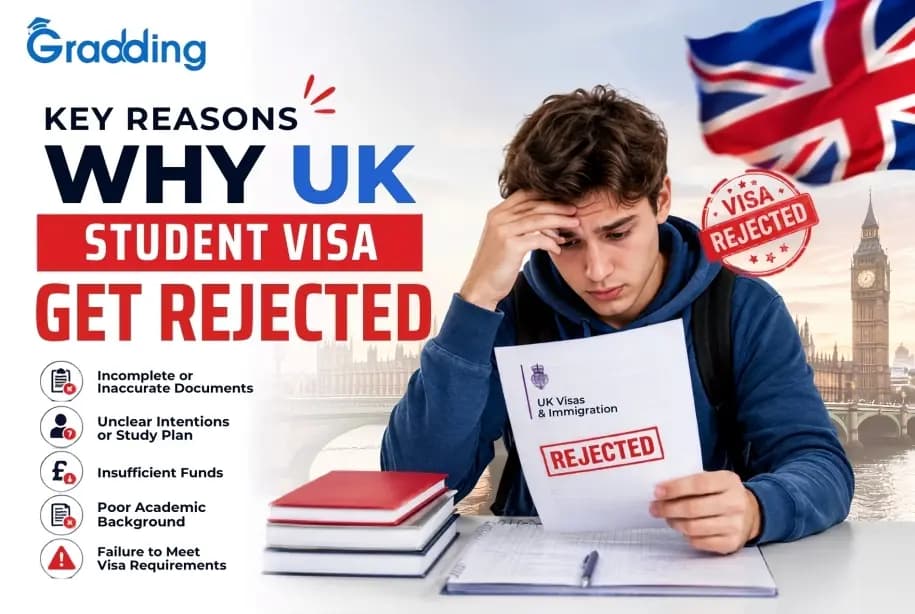





Table of Contents
1. What is the rejection rate of UK student visas for Indian students in 2026?
2. What is the most crucial reason for UK student visa refusal for Indians?
3. Can I reapply for a UK student visa after rejection?
4. Does a UK student visa rejection affect future visa applications?
5. What is the Genuine Student Requirement (GSR) and its effects on Indian applicants?
6. Can a UK student visa be rejected due to a weak SOP?
7. What happens if my bank balance drops during the 28-day window?
8. Do I need to mention a previous UK visa rejection when reapplying?
9. Can I appeal a UK student visa rejection?
10. How long should I wait before reapplying after a UK visa rejection?
11. Is a TB test required for a UK student visa from India, and can rejection happen if I use the wrong clinic?
12. Can using my parents' bank account cause a UK student visa rejection?
The UK has refused around 4% of Indian student visas in 2025. In the first few months of 2026, around 13% study visa applications of international students have been refused. However, Indian students enjoys 96% visa grant rate, which is quite high and favourable. The refusal rate for student visas in the UK stood at around 4.75% in 2025 after being very low at 1.86% in 2022. The visa rejection rate is approximately 4% among Indian nationals. Therefore, for every 25 visas applied, only one is refused. Although the odds are very high, they are rather significant when considering that there are thousands of Indians going abroad every year to study.
Understanding the most crucial causes of rejection will be the best way forward before submission. The UKVI decision makers have a systematic approach to eligibility criteria, and if an applicant fails any criterion, it becomes a key reason to reject the entire application.
This is the foremost cause behind the denial of the student's visa application. As of December 2025, UKVI introduced financial requirements, which require students to show proof of having £1,334 each month for up to 9 months during their studies in London (£12,006 in total) or £1,023 each month in case they study in a place that is not London, along with the tuition fee as mentioned in their CAS. In this context, it is required that the said money be kept in their bank account for 28 days.
The slightest inconsistency between information on the UK student visa application form and evidence – misspelling a name, different dates of a course start on the CAS and application, wrong passport number, for example – can result in a refusal. UKVI officers are trained to detect all inconsistencies, and such inconsistencies serve as a red flag.
Genuine Student Requirement (GSR) acts as the principal tool for UKVI in assessing the intent. In case the caseworker has a problem with your real intentions of studying and leaving the UK after the course, you will have your application rejected. We discuss this aspect in detail in the following paragraph.
A CAS issued by a UK educational institution is valid only for six months. Lapsed CAS, incorrect CAS or CAS from an institution where the Tier 4 licence was suspended or revoked, would result in rejection automatically.
Most Indians opt for either IELTS Academic or PTE Academic UKVI for their English proficiency test. The cut-off IELTS score required for UK to get a student visa is 5.5 bands overall (and none below that), but many universities require B2 proficiency level, that is, a score above 6.5 bands. Expired tests (as IELTS test scores are valid for two years only) or unaccredited test centres can lead to rejection.
The list issued by the UK Home Office requires people applying for a UK visa to undergo screening for tuberculosis before applying, particularly those coming from India and whose UK visa will last more than six months. The examination must be conducted in a clinic accredited by the UK government.
The existence of any overstay during the period of any visa in the past, or the existence of criminal records, or even any previous refusal due to fraud, could result in a high possibility of having an application rejected. This is because UKVI checks the entire history of applications.
For the university offering the sponsorship, they must have a valid license for sponsorship for Tier 4 students. It happens sometimes that students receive offers from universities and even CAS numbers, but the licenses of the universities either expire or are reduced before they decide to issue visas.
If there is an evident discrepancy between your previous education and the proposed program, or the chosen course is not coherent with your prior education, you can expect UKVI to scrutinise your application in greater depth. It is imperative to include a well-written personal statement regarding your educational and professional ambitions.
Genuine Student Requirement (GSR) is possibly the most significant yet least understood factor in the UK student visa regime. This is not something that you can simply tick off your list, but is instead a comprehensive evaluation carried out by the UKVI caseworker based on your entire application.
According to the Appendix Student of the UK Immigration Rules, your visa application can be rejected by the UKVI if they think that you are not a genuine student. This shows that you need to convince the officer of the following factors.
Many students feel stuck when they see their UK graduate visa has been rejected. However, it is not the end of the journey because they can either appeal for an administrative review or reapply. Here is what these terms actually mean and on what grounds student can make their decision on the next step:
If you feel that the caseworker has wrongly interpreted the Immigration Rules, and your concern relates to a factual or procedural misinterpretation instead of a discretion exercised, you have the right to lodge an Administrative Review. This will cost you £80, payable within 14 days of the refusal decision if you are within the United Kingdom, and 28 days if you are out of the country. An Administrative Review is not an appeal process. Another caseworker evaluates whether the decision was properly made following the rules.
You may apply for the UK student visa as many times as you like. Reapplying is the right thing to do if the reason for your denial was something that can be fixed – lack of proof, better finances, or having completed your English test. Before applying again, carefully analyse the letter of refusal. Justifications for refusals should always be given by the UKVI, although varying degrees of detail apply. In cases where the refusal has been issued on grounds of GSR, the explanation may simply be generic enough to point out that you need to look at your entire application for credibility.
Students often face visa rejection due to several minor mistakes. However, by keeping crucial considerations, such as ensuring the correct CAS, maintaining a minimum balance and right documentation, they can avoid refusal.
The rates of UK visa rejection have seen a rapid increase since 2022, which directly shows there is a prominent reason behind it. The key causes include:
From 2025 onwards, the UK will conclude the transition from a physical to a fully digital immigration system. BRP cards have ceased to be issued, and instead, eVisas are used - digital records linked with the UKVI account online. The applicant's identity is confirmed via the use of the 'UK Immigration: ID Check' app. This approach has increased the intricacies of the procedure, and errors made during digital verification caused by this resulted in processing delays and sometimes outright refusal.
Owing to the perseverance by the UKVI, there have been many universities in the UK which have had to introduce their own systems for assessing the status of a student as “Genuine.” The universities that issue CAS to students who are later issued rejection notices owing to the findings of the GSR may face penalties, including having their Tier 4 license suspended. Therefore, the process for issuing CAS in 2026 will be much stricter than in previous years.
The UKVI revised its financial maintenance requirements in December 2025, which involved raising the benchmark for monthly living expenses required from the applicants. The new benchmarks require students to have a monthly budget of £1,334 when studying in London and a monthly budget of £1,023 while studying out of London over a period of 28 days. From these figures, it is clear that the new benchmark requirements have increased considerably from the previous benchmarks.
Indian students have always been among the most successful groups when it comes to obtaining UK visas for their education. The success of Indian students in getting visas is a result of two factors, namely, the quality of applications and the strength of the market in India. However, 4% students have seen refusal due to several reasons. To avoid these refusals, students should seek guidance from Gradding’s study abroad consultants. We offer assistance at every step, from preparing an SOP for UK University to help you understand GSR requirements. So, connect today!
Ans. The visa refusal rate for Indian students is around 4% for compelling applications. It suggests that only genuine applicants can get a visa to study in the UK universities.
Ans. Incorrect or insufficient financial documents are the most crucial reason for UK student visa refusal. Common problems include wrong bank statements and inadequate funds.
Ans. Yes, students can immediately reapply for a visa after receiving rejection. For this, you need to address the key reason for rejection and submit valid evidence with the new application.
Ans. No, prior visa rejection does not harm future applications directly. However, the visa officers will review the immigration history of applicants.
Ans. The Genuine Student Requirement evaluates whether a student has a genuine intention of studying in the UK. It is important to mention clear details regarding course selection and career goals to avoid visa refusal.
Ans. Yes. A vague SOP can directly lead to visa rejection, especially if it fails to clarify your career plans, academic progression and reasons behind course choice.
Ans. This can result in UK visa refusal, as the UKVI demands continuous maintenance funds in your bank account throughout the qualifying period, which is 28 days.
Ans. Yes. You must declare your previous UK visa rejection when reapplying. If you fail to disclose information regarding past refusal, it is seen as misleading information, resulting in rejection.
Ans. Mostly, student visa refusals in the UK do not possess the right of appeal completely. However, it depends on the specific situation, such as if you think that UKVI has made a case-working mistake.
Ans. There is no fixed waiting period after a UK visa rejection. But you must reapply after addressing the refusal causes completely and collecting stronger evidence.
Ans. Yes, Indian applicants need a tuberculosis test certificate, which should be provided by a UKVI-approved clinic. Using a report granted by a non-approved UKVI clinic results in refusal.
Ans. No, using your parents’ bank account does not lead to UK student visa rejection. You can use their account if they are funding your studies.
My visa got rejected, can you help me with finding the reason behind it?


I want FREE assistance with
Secure your study visa with expert guidance!
disclaimer:logos and other registered trademarks of universities used on this platform are held by their respective owners. Gradding does not claim ownership or association on them, and their use is purely for informational and illustrative purposes.