
PTE Reading Rules: How to Tackle Questions with Simple Grammar
PTE reading is one of the most crucial elements of the language proficiency exams. It assesses your ability to comprehend the language. Thus, understanding the PTE reading rules is crucial. Hence, contributing a major part to the total scores. Each question type has specific instruction that you must read before attempting the questions.

Summarise with AI
Choose your AI Assist



Table of Contents

Rule 1: Have/has/had + past participle tense (V3)
Rule 2: Am/is/are/was/were + past participle tense (V3)
Rule 3: Be/being/been + past participle tense (V3)
Rule 4: Preposition 'to' + first form of the verb (V1)
Rule 5: Preposition with, of, for, about + verb+ing
Rule 6: Articles a/an/the + noun
Rule 7: Article a/an/the + adjective + noun
Rule 8: Modal verb + first form of the verb
Rule 9: Many + Plural nouns
Rule 10: It/which/that + Singular form of the verb -s/-es
Rule 11: Conjunction Rule
Introduction to PTE Reading
The second part of the PTE exam is the reading section. It lasts for 29-30 minutes. Moreover, it contains five different questions types. These are
- Multiple-choice, choose multiple answers
- Reorder paragraphs
- R
eading fill in the blanks - Multiple-choice, single answers
- Reading and writing fill in the blanks.
You will know about them in the upcoming section. Moreover, in this blog, you will learn about reading rules for PTE along with the significance of knowing them.
Question Types in PTE Reading
The PTE reading section is among the crucial segments contributing to overall scores. You should know the PTE grammar rules and types of questions to ace the exam. Also, you can refer the pictorial representation below to know the types of questions and their description.
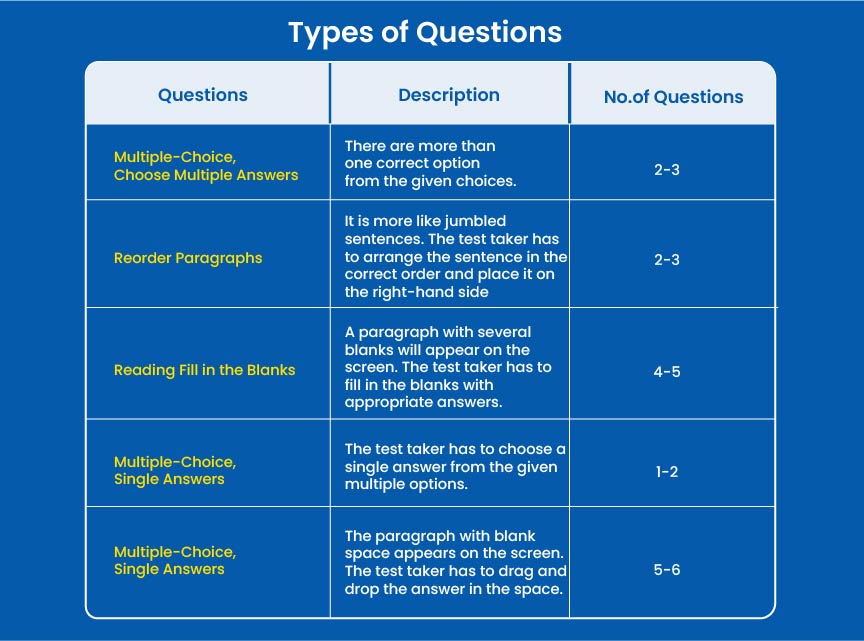
This table mentioned about the various types of questions that a test taker comes across in the reading section. In the upcoming section, you will learn how important PTE reading rules are.
Also Read: PTE Read Aloud
Importance of Knowing PTE Reading Rules
The grammar rules for PTE reading section are crucial to understand. In this section, you will know the benefits of knowing the PTE reading rules. A few of them are mentioned below.
- The test taker understands the rules for each question type resulting in proper time allocation.
- The familiarity with the PTE grammar rules allows the test taker to answer the questions correctly.
- It helps the test taker to strengthen their ability to skim and scan the text.
- These grammar rules of PTE reading allows the test taker to pay attention towards vocabulary.
- The score potential with these increases by mastering the PTE grammar rules It also increases confidence and reduces errors.
- Being well-prepared with PTE reading rules reduces anxiety and helps them to attempt the reading section with clarity and focus. Also, your overall PTE result get improved.


Grammatical Rules for PTE Reading
Rule 1: Have/has/had + past participle tense (V3)
After have/has/had, choose the past participle of a verb with the form -ed or the third form.
For example:
- He had washed his old car.
- She has watched the movie.
- I have eaten some cookies.
Rule 2: Am/is/are/was/were + past participle tense (V3)
After am/is/are/was/were, choose the past participle of a verb with the form -ed or the third form.
For example:
- I am called by the principal.
- Water is boiled.
- He was taught English by his teacher.
Rule 3: Be/being/been + past participle tense (V3)
After be/been/being, choose the past participle of a verb with the form -ed or the third form.
For example:
- This workshop has been held in the art gallery since last week.
- I am being worried about my future.
- They have been interviewed.
Rule 4: Preposition 'to' + first form of the verb (V1)
After the preposition “to”, choose a verb in the present or first form of the verb. Remember to not use ‘-ing’ form of verb with the preposition ‘to’.
For example:
- I decided to go to New York to visit my sister.
- I have to write an essay.
- He wants to fly in Emirates.


Rule 5: Preposition with, of, for, about + verb+ing
After the prepositions ‘with’, ‘of’, ‘for’, and ‘about’, use verbs ending in ‘-ing’.
For example:
- Thanks for giving me a ride.
- How about going to the zoo this weekend?
- He scolded me for thinking about chicken.
Rule 6: Articles a/an/the + noun
There are two types of articles:
- The definite article “the”
- The indefinite article “a”, “an”
‘A’ or ‘an’ usually comes before ‘the’ before the same noun in a paragraph.
Remember that nouns always come after articles. So, if the blank comes after a/an/the, you will quickly identify the noun from the filling options.
Here are 3 Article Rules:
- “An” comes before words that begin with a vowel sound—five vowels” a, e, i, o, u. For example: an elephant, an orange, an apricot, an hour.
- “A” comes before words that begin with consonants. For example: A mango, a student, a building, a one
- ‘The’ comes before the noun forms of a word to indicate that the noun’s identity is known to the reader. Also, ‘the’ is used when the noun is one of a kind.For example: the Universe, the United States of America
Rule 7: Article a/an/the + adjective + noun
While rule 6 states that a/an/the goes with nouns, they may go with noun phrases (adjective + noun).
If there is a blank between an article and a noun, we will specify an adjective to fill in.
For example:
- a tall building
- a unique outfit
- an amazing opportunity
- the mesmerizing view
Rule 8: Modal verb + first form of the verb
can/ could/shall/should/may/might/will/ would/must/have to + first verb form. A modal verb (or modal auxiliary verb) expresses the certainty and uncertainty of action.
For example:
- You must leave the danger zone.
- I can complete the report within three hours.
- He should see a dentist before his teeth get worse.
Rule 9: Many + Plural nouns
After ‘many’, look for a plural noun to fill in the blank. The plural form of a noun will always have “-s, -ies or -es”.
For example:
- Many students are waiting for the school bell.
- He can speak many languages.
- Many countries were sent an invite for the conference.
Rule 10: It/which/that + Singular form of the verb -s/-es
After it/ which/ that, you must fill in the blank with the singular form of the verb with -s or -es.
For example:
- It takes a few months to finish the project.
- He cooks a dish that has a distinctive French taste.
- A computer that works faster than mind.
Rule 11: Conjunction Rule
The verb form must be consistent before and after a conjunction.
For example:
- My family will go to Melbourne and settle there.
- He called me but did not discuss about the prospect.
- I can neither work nor complain about my role.
These were a few PTE reading rules that you follow in order to ace the exam in the first attempt. If you are unsure about these, then you can contact the experts. However, the next section contains the PTE reading tips and tricks in order to ace the language proficiency test in the first attempt.
Also Read: Retell lecture in PTE
Tips and Tricks for PTE Reading
The experts always gives PTE reading tips so that the students can ace the reading section of the PTE exam in the first attempt. However, each question type requires special strategy to ace. Refer to the image below to reading rules for PTE questions and know the way to excel it.
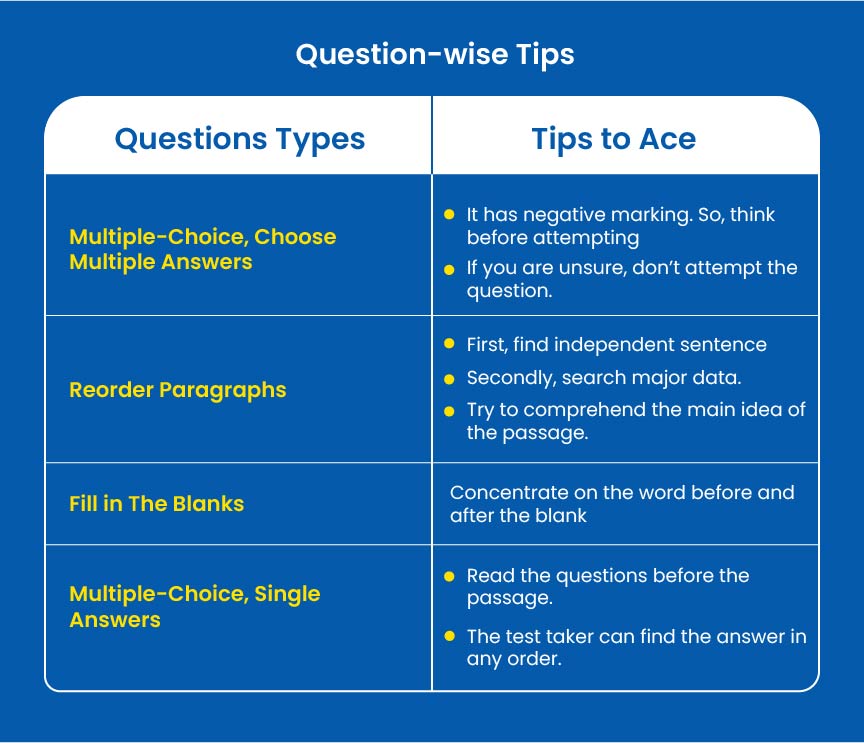
In the above image, you got to know the way to ace each question type. Now, let’s know the PTE reading tips and tricks to clear the reading section.
- The test takers must learn to identify the word types once they have skimmed through the passage.
- The test taker must develop a regular reading habit for enhances grammar skills and vocabulary.
- Besides, focused and active reading, the test taker must practice speed reading. Also, they must ensure that they read without missing the words.
- Next, the test taker can watch English movies. It will help them to understand the communication way of the local people.
- The last but not the least is enrolling in PTE online coaching. The experts will help you to succeed.
Following these tips will help you to ace the reading section in the first attempt.
Enroll for the best PTE Coaching classes online and get desire score in your first Attempt
Book Free PTE Masterclass
Conclusion
In conclusion, you got to know about the reading rules for PTE exam. Also, you are now aware of the grammar rules to ace the reading section of this language proficiency exam. If you want to improve your skills, then you can sign up for PTE reading practice test. Platforms like Gradding allow you to take mock test even without classes. So, enroll today and clear the language exam tomorrow.
Also Read:
FAQ's
What is the Pattern of Reading Section in the PTE Exam?
The reading section lasts for around 30 minutes. Also, it contains five various tasks. These includes
- Multiple-Choice
- Choose Multiple Answers
- Reorder Paragraphs
- Reading Fill In The Blanks
- Multiple-Choice, Single Answers
- Reading And Writing Fill In The Blanks
Can I Get Full Marks in the PTE Reading Section?
Yes, you can get full marks in the PTE reading section with the right preparation. Also, knowing the PTE reading rules is important to get full marks in this section.
Is PTE Reading Hard to Ace?
PTE reading section is considered the toughest of all in the PTE exam. But consistent practice will help the test taker to ace it with desires scores.
How Can I Practice Reading in PTE?
There are many ways to practice the PTE reading section. You can enrol in PTE classes or just sign up for reading mock test. These two things will help you a lot in practicing for this section.
What is the Marking Criteria of the PTE Reading Section?
There are two types of scoring in the PTE reading section. One is correct/incorrect and other is partial credit. Also, the marks in the reading section of the PTE exam gets deducted. So, the test taker must be careful while attempting this part of the language exam.
0 comments

Practice Makes a Man Perfect!Take FREE pte Mock Tests
Start FREE Mock Test


Get Unlimited Access with
PTE Prep Boost

Mock Tests

Practice Questions

Study Material

Recorded Classes
What is your Target PTE Score?





Get Familiar with the Updated PTE Exam
Start Free Mock Test