
Financial Documents for Study Visa 2026 — Complete Checklist
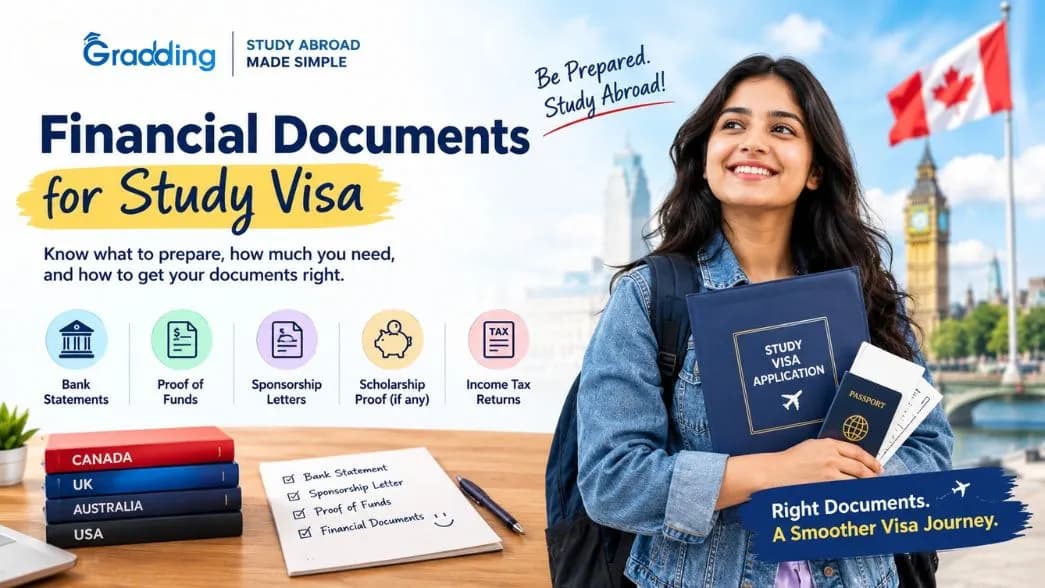
Getting your finances right can be just as important as getting your university documents in order when applying for a study visa in 2026. Visa officers are not simply checking whether your bank account has enough money. They also want to understand where your funds came from, whether they have been held for the required period, and whether you can actually access them when needed. From bank statements and fixed deposits to education loans, sponsor income and scholarship letters, the Financial Documents for Study Visa you submit need to tell a consistent financial story. This guide covers the key financial documents you may need and the requirements to watch for across major study destinations.

Summarise with AI
Choose your AI Assist



Table of Contents

1. What Financial Documents Are Required for a Student Visa?
2. How Many Months of Bank Statements Are Needed for a Student Visa?
3. Can I Use an Education Loan as Financial Proof for a Student Visa?
4. Why was My Student Visa Rejected for Financial Reasons Even Though I Have Enough Money?
5. Can Property or Gold Be Used as Financial Proof for a Student Visa?
What Do Visa Officers Actually Check in Financial Documents?
Do you know that there are a lot of study abroad applicants who assume that the officers just look at the closing balance on their bank statement? But the reality is that they are trying to find answers to three main questions. Can you afford the full cost of study? Where is the money coming from? And is it genuinely available to you? And every single one of the financial documents for study visa in your file needs to answer at least one of them:
1. Whether Your Funds Cover the Required Amount
The visa officers are going to compare your documented funds against the total shown on your offer letter or admission document (tuition plus estimated living costs) and against the country’s minimum financial requirement. There are some countries which ask for one year of costs whereas there are others who look for the full course.
Also make sure to not just aim for the exact minimum. You can show a comfortable buffer, as it can help in signalling that a small change in exchange rates or fees will not leave you stranded.
2. The Source of Your Money
This is actually the place where a lot of the applications suffer. The visa officer wants to see a clear and believable trail which can show how your funds were earned or accumulated. And depending on who will be funding your education abroad, this can include things like:
- Salary slips and income tax returns
- Business registration and audited financial statements
- Property or land sale documents
- An education loan sanction letter
3. Whether the Funds Are Accessible and Have Been Held Long Enough
There are a lot of countries that expect you to hold the funds for a minimum period before you apply. So the visa officer is going to look at your transaction history and not just one date. They also take a look at how easily you can access the money.
In this, your savings, fixed deposits, and sanctioned Education Loan for Study Abroad are generally easier to verify than assets which are a little hard to liquidate. And as for loans, having an unconditional sanction letter is going to carry more weight than one that has a pending condition.
6 Core Financial Documents for Student Visa
One thing you should note is that it does not matter which country you are applying to; your financial file is almost always going to be built from the same six documents. And which ones you need are going to completely depend on how your studies are going to be funded.
Meaning that a student who is self-funded and a student who is holding a scholarship will have to submit very different sets of documents. But here are some core documents that you might need:
1. Bank Statements — The Foundation
Your bank statement is the first thing that the visa officer is going to look at and is actually the one document that almost every applicant needs to submit. They are not only going to show how much you have. But also how your money has moved over time.
What to include:
- Statements which cover the period that your destination country requires. This is usually 3 to 6 months but it mainly varies.
- You will also need to submit statements from every account that you will be relying on. It can be either yours or your sponsor’s.
- Bank-issued or bank-stamped copies. Also do not provide self-printed or edited versions.
Watch out for: You should stay clear of any large and unexpected deposits shortly before you apply. If that particular big credit is from a gift, a property sale, or even a matured investment, then you should attach a document to prove it. Having a steady balance with regular and easy-to-explain transitions will be much easier for you to convince the visa officers than a sudden spike.
2. Fixed Deposit Certificates
Fixed deposits are surprisingly popular in student visa files. One of the main reasons is that they show money which you have set aside and kept on hold. This helps in showing your genuine savings rather than funds which are parked for a temporary time.
What to include:
- The FD certificate and/or your statements, which will show your deposited amount, start date, maturity date, and interest date.
- A letter from the bank which will confirm that your FD is active and that the funds in it can be liquidated for your education.
- Lastly, statements from the linked savings account so that the visa officers can trace where the deposited money came from.
Watch out for: FDs which are going to mature before your intended travel date or the ones which you hold jointly with someone who is not a close family member of yours. Both can raise questions about accessibility.
3. Education Loan Sanction Letter
If a bank or financial institution is funding part or all of your studies, then you will need to have a sanction letter as your proof. The visa officers usually treat a sanctioned loan as strong evidence because a lender has already assessed the risk and approved the funds.
What to include:
- The official sanction letter on the lender’s letterhead.
- Loan amount, interest rate, repayment terms, and disbursement schedule.
- Any conditions which are attached to the loan, along with proof that you have met them.
Watch out for: Conditional sanctions. A letter with pending conditions carries less weight than an unconditional one. Also make sure the loan amount, combined with your other funds, covers the full cost shown on your offer letter.
4. Sponsor’s Income Proof
If a parent or close relative is funding your studies, then you will need to show that they can genuinely afford it. This is where the officers are going to look closely at whether the income of your sponsor and the funds that are claimed actually match.
What to include:
- Income tax returns for the last 2 to 3 years.
- Salary slips and Form 16 (for salaried sponsors), or business registration and audited financial statements for sponsors who are self-employed.
- The bank statements of your sponsor
- A sponsor letter or affidavit of support and proof of relationship, such as a birth certificate.
Watch out for: Mismatches between the income that you have declared and the balance being shown. A modest income paired with a very large balance needs documentation explaining how the money was accumulated.
5. Scholarships and Assistantship letters
Scholarships, fee waivers, and assistantships can significantly reduce the amount you need to show from your own pocket. But only if the paperwork is clear.
What to include:
- The official award letter from the university or funding body
- The exact amount awarded, the duration, and what it covers (tuition, living expenses, or both)
- For assistantships, details of the stipend and any tuition waiver that comes with the role.
Watch out for: Conditions like maintaining a minimum GPA or working a fixed number of hours. Officers will read these, so make sure the letter states clearly what is guaranteed. If the award covers only part of your costs, show separate proof for the remaining amount.
6. CA-Certified Net Worth Certificate
Last but not least, you will need to submit a net worth certificate which is issued by a practicing Chartered Accountant. This will help in giving the visa officers a consolidated view of the sponsor’s total assets and liabilities. This can be really useful when the wealth of your sponsor is spread across property, investments, business holdings, and savings instead of it being in one bank account.
What to include:
- A certificate on the CA’s letterhead along with their membership number and a UDIN (Unique Document Identification Number)
- A clear breakdown of assets and liabilities. They need to have supporting documents like property papers, investment statements, and loan details.
- A date which is recent because the older certificate might not be accepted.
Watch out for: Using it as a standalone document. Your net worth certificate is going to help in supporting your other evidence but will not replace your bank statements or income proof.
Country-wise Financial Requirements for Student Visa
Most of the top study abroad destinations like the UK, Canada, Australia, USA, and Canada have their own different ways to measure if you will be able to support your education. Here are brief country-wise requirements for it:
USA (F-1 Visa)
The government of the USA has not set a fixed minimum bank balance for an F-1 visa. But for this, you will need to show funds that are equal to your first-year Cost of Attendance (CoA) on your I-20. This figure is going to help you cover your tuition, living expenses, and other mandatory costs. And it can differ from one university to the next. Here is a US F-1 Student Visa Guide for documents.
What to show:
- Liquid funds that will help you cover at least the first-year CoA on your I-20. Your university is going to check your proof of funds before they issue the I-20 and the consulate will review the same documents at your visa interview.
- Accepted proof includes your bank statements, education loan sanction letters, scholarship or assistantship letters, and sponsor income documents.
- There are some US universities which require financial documents that have been issued within the past six months. So it is important that you check your university’s rule.
UK (Student Visa): 28-Day Rule
There are two parts of the UK Student Visa requirements. One, you need the unpaid balance of your first-year tuition fees as shown on your CAS and second, a fixed monthly amount for living costs. The amount of cost of living is going to majorly depend on where you are studying and usually counts for a maximum of nine months.
Also note that the amount is going to rise on 30 November 2026 and the rate that is going to apply depend on your application date. Not your course start date. Applications that are made before 30 November are going to follow the old amounts, even if your course is going to start later.
| Study location | Applications before 30 Nov 2026 | Applications from 30 Nov 2026 |
| London | £1,529/month (up to £13,761) | £1,570/month (up to £14,130) |
| Outside London | £1,171/month (up to £10,539) | £1,203/month (up to £10,827) |
The 28-day rule: Your funds need to stay at or above the required minimum for 28 consecutive days. And this period should not end no more than 31 days before you apply. In case your balance ends up dipping below the threshold even for a bit, then the count is going to start again. So make sure that you plan your timing well before you intend to apply.
What to show:
- Bank statements that has a daily balance which can cover the full 28 days.
- For parental fund, you are going to need a declaration letter, your birth certificate, and your parents’ statements.
- Shares, bands, pensions, and crypto are not accepted as proof of funds.
Canada (Study Permit)
For Canada Study Permit, you will need to show three main things. These are your first-year tuition, living expenses, and return travel. Note that for applications which are submitted at least on or after 1 September 2026, a single applicant who is from outside of Quebec need to show at least CAD $23,448 for living expenses, up from $22,895.
This amount will only cover living costs only and the tuition and transportations cost needs to be shown on top. For example, if you are a student that has CAD $18,000 in first-year tuition, then you should expect to show well over $40,000 in total.
What to show:
- Bank statements, a GIC, an education loan, a scholarship, or documented sponsor support.
- Proof of first-year tuition which is either paid or covered by your funds.
Australia (Subclass 500)
To get a Subclass 500 visa, you need to show financial capacity for at least the first 12 months of student. This is around AUD 29,710 in living costs for a single applicant plus tuition and return airfare.
If your family members are coming with you then you need to add:
- AUD 10,394 for a spouse or de facto partner
- AUD 4,449 for each dependent child
- AUD 13,502 per year for each school-age child, for school costs
What to show:
- Bank statements, education loan approval letters, or sponsor documents that together cover tuition, living costs, and airfare.
- Proof of where the funds came from and with the income evidence of sponsor.
Germany (Student Visa)
Germany’s standard proof is a blocked account, aka Sperrkonto. For a 12-month Germany Student Visa for Indian Students you need to deposit €11,904, equal to €992 per month, and after arrival you can withdraw a maximum of €992 each month. This amount is actually in link with the German BAföG rate and is usually updated every one to two years.
What to show:
- A blocking confirmation (Sperrbestätigung) from an approved provider, showing the full required amount.
- Valid health insurance, which is a separate requirement
- If you have a scholarship, its award letter. Recognised scholarships such as DAAD or Erasmus+ can replace the blocked account, but the embassy makes the final call. Some applicants also use a formal obligation letter (Verpflichtungserklärung) from a resident in Germany.
How Much Money Do You Need to Show?
There is not a single number that is similar globally because every country has its own threshold and checks it regularly. But here is a quick snapshot for 2026:
- USA: No fixed amount, and you are required to cover your first-year Cost of Attendance as stated on your I-20.
- UK: You need unpaid tuition (per your CAS) plus £1,171–£1,529/month for living costs (up to 9 months). This is rising to £1,203–£1,570 from 30 November 2026.
- Canada: CAD $23,448/year for living costs (outside Quebec), plus full tuition and return travel.
- Australia: AUD $29,710/year for living costs, plus tuition and airfare.
- Germany: €11,904/year (€992/month) in a blocked account, or equivalent scholarship proof.
Common Reasons for Student Visa Rejection Due to Financial Documents
Do you know that most of the visa rejections are not because of lack of money? In reality there are about how they are being documented. Here are a few recurring issues.
- Insufficient funds: Your overall funds do not cover tuition, living costs, and travel as per the latest official figures.
- Sudden and unexplained deposits: Large sums appearing shortly before applying and with no proof of source.
- Funds not held long enough: For example, like the UK’s 28-day rule, where any dip below the threshold will result in a reset of the clock.
- Unclear source of income: Cash deposits, inconsistent business records, or non-liquid assets (property, gold) used as “proof.”
- Inconsistent documents: mismatched names, dates, or amounts across the bank statement, sponsor letter, and application.
- Ineligible sponsor: When your funder is not a close family member or their income does not support the amount that was claimed.
- Conditional loan sanctions: A loan letter with pending conditions carries less weight than an unconditional one.
- Forged or non-bank-issued documents: Altered figures or unofficial formats can trigger refusal and future bans.
- Outdated or improperly formatted documents: Missing stamps, signatures, or translations.
Conclusion
A strong financial documents for study visa file is not about showing the biggest possible bank balance. It is about making your finances easy for a visa officer to verify. Your statements, loan documents, sponsor income, deposits and other evidence should clearly explain how much money you have, where it came from and whether it is available for your studies. Since financial rules and required amounts can change, especially across countries such as the UK, Canada and Australia, you can connect with study abroad experts from Gradding, they will help you complete end to end documentation, visa process, and even How to Write a Financial SOP for Student Visa. Connect today!
FAQs
1. What Financial Documents Are Required for a Student Visa?
You will usually need bank statements, fixed deposit certificates, an education loan sanction letter (if applicable), sponsor’s income proof, and scholarship letter (if awarded). Exact requirements vary by country.
2. How Many Months of Bank Statements Are Needed for a Student Visa?
Usually 3 to 6 months, but it varies from country to country and can change. It is important that you always confirm your current requirement with the official immigration source for your destination.
3. Can I Use an Education Loan as Financial Proof for a Student Visa?
Yes, most countries accept an unconditional loan sanction letter from a recognised bank or lender. A conditional sanction, with pending requirements, carries less weight.
4. Why was My Student Visa Rejected for Financial Reasons Even Though I Have Enough Money?
Rejections are a lot of the time about presentation and not amount: unexplained deposits, funds not held long enough, inconsistent documents, or an unclear source of income can all trigger refusal even when the total is sufficient.
5. Can Property or Gold Be Used as Financial Proof for a Student Visa?
Generally no. Most countries require liquid, easily accessible funds, like bank balances, fixed deposits, or sanctioned loans. Non-liquid assets are usually not accepted on their own.
0 comments


Hand Picked Courses
Get Scholarship Assistance
Get Offer in 15 Days*
Finance/Loan Assistance
I want FREE assistance with





Secure your study visa with expert guidance!