
Post Study Work Visa 2027: Country-Wise Guide for Indian Students
Do you know that choosing a study-abroad destination used to come down to rankings and tuition fees? But now, it comes down to Post Study Work Visa 2027. That is how long you are allowed to stay and work afterwards. The UK has actually cut its Graduate visa to 18 months. Australia has raised the age cap and English benchmark. Canada expanded PGWP access for master’s and PhD holders. These are not just footnotes. These things are going to directly affect your ROI on a foreign degree. This guide is going to break down exactly what each country calls its post-study work route, how long it lasts, who qualifies, and what comes next. So you are choosing a country based on facts and not assumptions.

Summarise with AI
Choose your AI Assist



Table of Contents

1. What is a Post Study Work Visa?
2. Which Countries Offer Post Study Work Visas in 2027?
3. Which Country Offers the Longest Post Study Work Visa?
4. Can Indian Students Get a Post Study Work Visa After Graduation?
5. Can I Get a Post Study Work Visa After a Master's Degree?
6. Do I Need a Job Offer for a Post Study Work Visa?
What Is a Post Study Work Visa?
To put it simply, a Post Study Work Visa 2027 is an immigration pathway which helps international graduates stay in the country where they studied. Preferably for working and in some cases finding a job once they have completed their degree. A post study work visa helps these global students transition from “student” status to “working professional” status without having to leave the country first.
But one thing that you need to understand is that there is no single “post study work visa” universally. Each country has its own version of it and with its own name, eligibility rules, and duration. As for Indian students who are planning their study-abroad journey, knowing these differences upfront can help in making a real difference in choosing where to apply.
Take a look at how it differs across some of the popular study abroad destinations:
- United Kingdom: Graduate visa which is valid for 2 years after completing a degree (3 years for PhD graduates).
- Canada: Post-Graduation Work Permit (PGWP) which has its duration linked to the length of your study program (up to 3 years).
- Australia: Temporary Graduate visa aka subclass 485 visa, with duration varying by qualification level.
- New Zealand: Post study work visa, generally valid for up to 3 years depending on the course and location of study.
- United States: Optional Practical Training (OPT), usually 12 months, but STEM graduates can apply for a 24-month extension, giving up to 3 years of work authorisation in total.
Which Countries Offer Post Study Work Visas in 2027?
Most of the major study-abroad destinations still offer a Post Study Work Visa 2027. However, their names, durations, and eligibility rules are going to vary widely by country.
| Country | Route | How Long |
| Canada | Post-Graduation Work Permit (PGWP) | Up to the length of your programme, max 3 years — including the full 3 years for Master's and PhD graduates |
| New Zealand | Post Study Work Visa | Up to 3 years; Master's and doctoral graduates eligible for the full 3 years |
| Australia | Temporary Graduate visa (subclass 485) | 2 years (Bachelor's/Master's Coursework), 3 years (Master's by Research/PhD), plus 1–2 extra years for regional study. Age cap: 35 (up to 50 for Master's Research/PhD, or HK/BNO passport holders) |
| Ireland | Third Level Graduate Programme (Stamp 1G) | 12 months, extendable by a further 12 months for Master's graduates |
| United Kingdom | Graduate visa | 2 years if you apply on or before 31 December 2026; 18 months from 1 January 2027 onward. PhD graduates get 3 years |
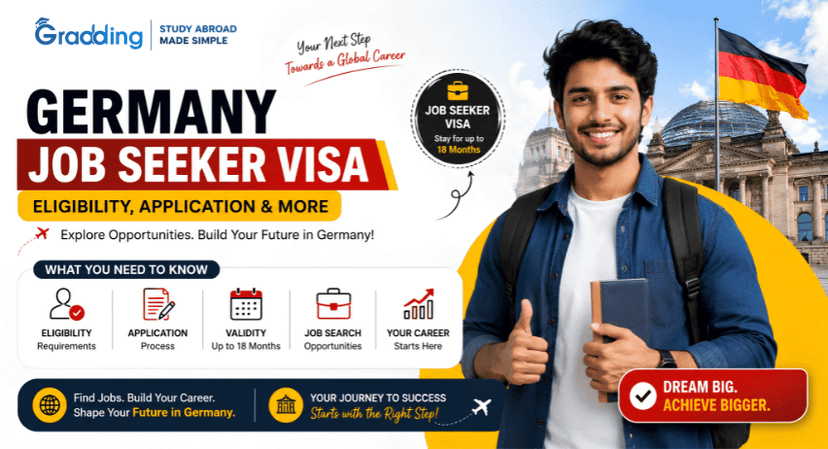
| Germany | Residence permit to seek employment (Job Seeker Visa) | Up to 18 months, not renewable |
| United States | Optional Practical Training (OPT) + STEM extension | 12 months, plus 24 further months for eligible STEM degrees |
| Netherlands | Orientation year (zoekjaar) | 1 year (12 months), not renewable on the same degree |
Post Study Work Visa in Canada 2027
The Post Study Work Visa 2027 of Canada which is the Post-Graduation Work Permit (PGWP) has become one of the most popular options among Indian students. One main reason behind this is that it is an open work permit. This means that as a graduate, you can work for almost any employer, in almost any role, without needing a job offer first. In addition to this, it also helps as a direct bridge to Canadian permanent residency.
How Long Can You Stay After Graduation?
One thing you need to note when you plan to study in Canada is that the length of your PGWP is going to tie directly to how long your study program was. Why? Because Canada does not hand out a flat and a one size fits all duration.
- For programs from 8 months to under years, your PGWP will be valid for the same length as your program.
- The PGWP for Programs that are 2 years or longer is valid for 3 years.
- Bachelor’s, Master’s, and doctoral graduates can get a 3-year full permit regardless of their exact program length. It just needs to meet the minimum criteria.
- Also note that you need to apply for your PGWP within 180 days of receiving your final marks or official confirmation of program completion. If you miss this window then you might lose your eligibility altogether.
Who Is Eligible for PGWP?
Another thing you should know is that not every course or institution qualifies for PGWP. So it is extremely important that you check the specifics before you enrol and not after you graduate. To be eligible, you will need to have:
- Studied at a Designated Learning Institution (DLI) that has PGWP eligible status as not all colleges and universities qualify.
- You have completed a program which was at least 8 months long, full-time, and mainly in-person.
- You have maintained full-time student status throughout your academic session. You only get limited exceptions, such as your final semester.
- You also meet the language requirement which is CLB 7 (IELTS 6.0 in each band) for bachelor’s, master’s, and doctoral graduates. CLB 5 for college-level and certificate graduates.
What Happens After PGWP?
The PGWP itself is not renewable- once it expires, it is gone for good. So most graduates use their PGWP years in a strategic way. They aim to build enough skilled Canadian work experience so that they can qualify for permanent residency before the permit runs out. Take a look at some of the most common pathways:
- Canadian Experience Class (CEC) via Express Entry: This is the fastest and the most popular PR route for PGWP holders. This requires you to have at least 1 year (1,560 hours) of skilled work experience (TEER 0, 1, 2, or 3) which is gained within the last 3 years.
- Provincial Nominee Programs (PNPs): There are many provinces which run their own streams that target international graduates and skilled workers.
- Federal Skilled Worker Program (FSWP): This is an option if you have qualifying foreign or Canadian work experience.
Post Study Work Visa in Australia 2027
Australia’s version of the Post Study Work Visa 2027 is the Temporary Graduate visa (subclass 485). This is one of the most flexible options around the world. Mainly because it can give you full work rights without you needing to have a job offer or employer sponsor.
Duration and Eligibility
The 485 visa runs across three streams. And the one that is going to apply to you and for how long is going to depend completely on your qualification level.
| Stream | Who It's For | Duration |
| Post-Vocational Education Work Stream | Trade/diploma graduates in an occupation on Australia's skilled occupation list | 18 months |
| Post-Higher Education Work Stream | Bachelor's, Master's, and Doctorate graduates | 2 years (Bachelor's or Master's Coursework), 3 years (Master's by Research or PhD) |
| Second Post-Higher Education Work Stream | Graduates who studied at a regional campus | An extra 1–2 years on top of the above |
You will need to have the following things in order to qualify for the Post-Higher Education stream:
- You have completed a CRICOS-registered course of at least 2 academic years (92 weeks) that are completely taught in English.
- Apply within 6 months of receiving your final results.
- You are under the age of 35 at the time of application. However this rises to 50 if you are a Master’s by Research or PhD graduate, or hold a Hong Kong/BNO passport.
- Meet the English requirement: IELTS 6.5 overall and no band below 5.5 (or equivalent) and it needs to be tested within the last 12 months.
- You have held a student visa within the last 6 months and have not held a 495 or skilled graduate visa.
What Happens After Subclass 485?
Like most Post Study Work Visa 2027, the 485 is not renewable once it expires. So the years on it are best spent building the work experience and credentials which are needed to move onto something longer-term. Here are the main pathways that graduates pursue afterwards:
- General Skilled Migration: The subclass 2189 (points-tested, no sponsor needed), 190 (state/territory nominated), and 491 (skilled regional visa) all draw heavily from the 485 graduate pool.
- Employer-sponsored visas: The subclass 482 (skills in Demand visa) or 186 (Employer Nomination Scheme) if you secure a job offer from a sponsoring employer during your 485 period.
- State or territory nomination: There are a lot of states which run their own streams that target specifically local graduates.
Post Study Work Visa in UK 2027
The post study work visa UK aka Graduate visa is one of the most straightforward options which are available to international students. It is not sponsored, does not require a job offer, UK scholarships for Indian students, and will let you work at any skill level.
How Long Is the Graduate Visa in 2027?
The duration that you are going to get is going to depend entirely on when you apply. And not when you graduate. This is a distinction which matters a lot for planning.
- Apply on or before 31 December 2026: Bachelor’s and Master’s graduates get the full 2 years.
- Apply on or after 1 January 2027: Bachelor’s and Master’s graduates get 18 months. This is a reduction which is confirmed by the Home Office in a Statement of Changes published in October 2025.
- PhD and other doctoral graduates: Unaffected by the change, they continue to receive 3 years regardless of when they apply.
Who Is Eligible?
To qualify for the Graduate visa, you will generally need to:
- You need to hold a valid Student visa (or Tier 4 visa) at the time of applying.
- Have successfully completed an eligible Bachelor’s degree, Master’s degree, PGDE, or PhD at a UK institution that has reported your course completion to UKVI.
- Not have previously help permission under the Tier 4 Doctorate Extension Scheme.
- You apply from inside the UK as this visa cannot be applied for from outside of the country. You can not travel while your application is pending.
- Use the same Confirmation of Acceptance for Studies (CAS) number tied to your current Student visa.
What Happens After the Graduate Visa?
One thing you should note is that your Graduate visa cannot be extended or renewed. Once your 18 months run out, you will need to have already moved onto a longer-term route. Most graduates work toward:
- Skilled Worker visa: This is the most common next step and it will require you to have a job offer from a licensed UK sponsor, a role at the appropriate skill level, and a minimum salary threshold.
- Global Talent visa: This is for those who can demonstrate exceptional talent or promise in fields like academia, research, arts, or digital technology.
- Start-up or Innovator Founder visas: This is for graduates who are looking forward to launching their own business in the UK. However, these come with their own separate eligibility bars.
Post Study Work Visa in Germany 2027
To clear this beforehand, Germany does not call its post-study route a “visa” in the way the UK or Australia does. It is a residence permit which is used to seek employment. But functionally, it does the same job: it lets international graduates stay on after finishing their degree, work to support themselves, and search for a role that matches their qualification. It is also one of the more student-friendly options globally. There is no lottery, no cap, and no employer sponsorship needed to get started.
Duration and Eligibility
The Germany job seeker visa gives graduates one of the longer windows on this list, though with a firm ceiling:
- Duration: Up to 18 months and it's non-renewable. Once it expires, you must have already transitioned to a job-based permit.
- Eligibility: You must have completed a degree at a recognised German higher education institution.
- Applying: Since you are already in Germany on a student residence permit, you apply directly through your local Ausländerbehörde (Foreigners' Office) to convert it. There is no separate embassy step or visa application from abroad.
- Proof of funds: You will need to show you can financially support yourself during the job search. At a threshold similar to the student visa requirement which is roughly around €11,904/year.
- No job offers needed upfront: This permit is specifically designed to let you search after graduating and not before.
What Happens After the Job-Search Period?
This 18-month clock is supposed to end in one outcome: a qualifying job offer, which lets you convert into a longer-term work permit. The two main routes from here are:
- EU Blue Card (§18g AufenthG): This is the most common and most attractive option for graduates. It offers one of the fastest paths to permanent residency in Europe (as little as 21 months with B1-level German, or 27 months without). You will need a job offer which meets the annual salary threshold which is €50,700 for standard occupations, or €45,934 for shortage occupations.
- Regular skilled worker permit (§18a/§18b AufenthG): For all the roles that do not meet the Blue Card salary threshold but still match your qualification. This route typically has a longer runway to permanent residency (often 4-5 years) compared to the Blue Card.
Post Study Work Visa in USA 2027
USA does not exactly have a Post Study Work Visa 2027 and this is one of the most common points of confusion for Indian students researching US options. Unlike the UK’s Graduate visa or Canada’s PGWP, the USA does not issue a separate “post study work visa.” Instead, international graduates on an F-1 student visa use Optional Practical Training (OPT), which is technically an extension of student status rather than a standalone work visa.
OPT lets you work full-time for any US employer in a role related to your field of study, without the employer needing to sponsor you upfront. That is the good news. The catch is that OPT is temporary and non-renewable in itself; it is really a bridge, not a destination, and how you use that bridge matters far more than in most other countries on this list.
OPT and STEM OPT Duration
- Standard OPT: 12 months, available once per degree level (bachelor’s, master’s, or doctoral)
- STEM OPT Extension: This is an additional 24 months for graduates of STEM-designated degree programs. This helps in bringing the total to 36 months which makes it the longest post-study runway among all the countries covered in this guide.
- Filing Fee (2026): $1,780 per application and this is up from $1,685 which it was the previous year.
- Application Window: Up to 90 days before graduation, and no later than 60 days after.
- 90-day Unemployment Rule: You cannot accumulate more than 90 days of unemployment during standard OPT, so job security matters throughout, not just at the start.
What Happens After OPT?
OPT cannot be extended once you have used your 12 (or 36, for STEM) months. The only way to keep working in the US afterwards is to convert to a different visa category. The most common are:
- H-1B speciality occupation visa: This is the standard next step but it is capped and is based on lottery. The USCIS introduced a wage-weighted selection system which favours higher-paid positions.
- Cap-gap protection: If your employer is filing a timely H-1B petition before your OPT expires, your work authorisation automatically extends through September 30. So you are not going to be forced to stop working while the petition is pending.
- O-1 visa: This is a narrower option for graduates who can demonstrate extraordinary ability in their field.
- Employer-sponsored green card process: This is a longer-term route which some graduates pursue once on H-1B. However, it is considerably slower and more competitive than most other countries’ PR pathways.
Post Study Work Visa Eligibility for Indian Students
While each county has its own rules, most of the post study work visas share a few common eligibility threads that Indian students should check before enrolling.
Recognised institution: Your course must be at an approved or designated institution (e.g., a DLI in Canada, a CRICOS-registered provider in Australia, a UKVI-licensed sponsor in the UK)
Minimum course length and mode: Most countries require a full-time, in-person program of a set minimum duration (typically 8 months to 2 years)
- Valid student status: You must apply from within the country, while your student visa is still valid and usually within a fixed window after your results are declared (ranging from 60 days to 6 months)
- Language requirements: Some routes (like Canada’s PGWP or Australia’s 485) require a minimum English test score; others, like the UK’s Graduate visa, don’t.
- Field of study: A few countries (e.g., Canada for sub-bachelor’s programs) tie eligibility to specific in-demand fields, while others place no such restriction.
- Age limits: Mainly relevant for Australia’s subclass 485, which caps eligibility at 35 (with exceptions for research/PhD graduates)
- Financial proof: A small number of routes like Germany’s job-seeker permit, require evidence you can support yourself during the work-search period.
What Happens After a Post Study Work Visa Expires?
A post-study work visa is temporary by design- once it runs out, you can not renew it, and you need to have already moved onto a longer-term pathway to keep working legally. Depending on the country, this usually means one of the following:
- Skilled or employer-sponsored work visa: Like the UK’s Skilled Worker visa, the US H-1B, Australia’s subclass 482, or Germany’s EU Blue Card. These usually require a qualifying job offer.
- Permanent residency pathway: Canada’s Express Entry (via the Canadian Experience Class), Australia’s General Skilled Migration, or New Zealand’s skilled migrant category all let eligible graduates apply for PR using work experience gained during their post-study visa.
- Further study: There are some graduates who choose to enrol in another qualification, restarting the student visa and post-study work cycle.
- Return home: If no further visa route is secure in time, graduates must leave the country once their permit expires.
Conclusion
The Post Study Work Visa 2027 are not a formality. They are often the single biggest variable that separates a degree that pays for itself from one that does not. With rules shifting this fast across the UK, Australia, Canada, and beyond, picking a destination on outdated information is a real risk. This is exactly where Gradding earns its place in your planning. As a study-abroad platform. Gradding tracks these policy changes as they happen and matches you with universities and courses in countries where your post-study and PR pathway actually lines up with your goals. Not just where the campus looks good on paper.
FAQs
1. What is a Post Study Work Visa?
It is an immigration route that is going to let international gradates stay in the country where they studied to work (or search for work) after finishing their degree, without needing a fresh visa application from outside the country.
2. Which Countries Offer Post Study Work Visas in 2027?
The main destinations are the UK (Graduate visa), Canada (PGWP), Australia (subclass 485), New Zealand (Post Study Work Visa), the USA (OPT), Germany (job-seeker permit), Ireland (Stamp 1G), and the Netherlands (Zoekjaar).
3. Which Country Offers the Longest Post Study Work Visa?
The USA offers the longest runway which is up to 36 months for STEM graduates via OPT plus the STEM extension. Canada, New Zealand, and Australia’s PhD stream also offer up to 3 years.
4. Can Indian Students Get a Post Study Work Visa After Graduation?
Yes, Indian students are eligible for the same post-study routes as other international students, as long as they meet each country’s course, institution, and language requirements.
5. Can I Get a Post Study Work Visa After a Master's Degree?
Yes, and master’s graduates often get better terms than bachelor’s graduates. For example, the full 3-year PGWP in Canada, or a longer subclass 485 in Australia for research-based master’s programs.
6. Do I Need a Job Offer for a Post Study Work Visa?
No. Post study work visas like the UK’s Graduate visa, Canada’s PGWP, and Australia’s subclass 485 do not require a job offer to apply. That is what sets them apart from work visas like the H-1B or skilled worker visa.
0 comments


Hand Picked Courses
Get Scholarship Assistance
Get Offer in 15 Days*
Finance/Loan Assistance
I want FREE assistance with



Secure your study visa with expert guidance!