
The Lost Luggage Claim Form Listening Practice Test with Answers
You must be familiar with the fact that “practice makes a man perfect”, and to maintain this legacy in the IELTS listening exam, we have provided you with an exclusive sample named “lost luggage claim form listening answers”.
It is all about an interaction between a student called Jenny Lee and an agent at the lost luggage counter in an international airport.Before solving this practice test, you must be aware of what the IELTS listening section takes into account. So, to begin with that, the listening test includes 4 audios with 10 questions each, which lasts for 30 minutes and you are allotted an extra 10 minutes for transferring the answers.
IELTS Prep Boost
Elevate your preparation with exclusive tools
Unlimited Access Includes
BEST PLANDuration Days
Transcript for The Lost Luggage Claim Form
Agent: Okay, who's next please?
Jenny: I think I am.
Agent: How can I help you?
Jenny: I just came in on flight 372 from Singapore at 11.30 and my luggage hasn't arrived. I've been waiting at the baggage claim for about half an hour now and everything seems to have come off the plane. The conveyor belt has stopped and all the passengers have gone. So I came here to find out what has happened to my bag.
Agent: Can I see your ticket please? Here it is. So you came from Hong Kong today and changed planes in Singapore, right?
Jenny: Yes, the connection in Singapore was a tight one. The plane got in late and I had to rush to get to the next flight.
Agent: That's the problem right there. There wasn't enough time to get your bags onto the connecting flight. Normally Singapore airport is very efficient. Now I need you to fill in these forms. Your name?
Jenny: Jenny Lee.
Agent: Address?
Jenny: I guess you want my address here. I'm staying with relatives. Just a minute I'll have to look it up. It looks like 5H3. No, it's 533 East 67th Street in Riverside.
Agent: Do you have the phone number there?
Jenny: Yes I do. It's 93014269.
Agent: So you came in on Qantas flight 392. Do you know the number of the flight out of Hong Kong?
Jenny: Let me see. I think it was Café Pacific 9000 or something. Oh yes, it says here CX912.
Agent: Right. Now I need a description of the luggage. How many pieces did you check in?
Jenny: Just one.
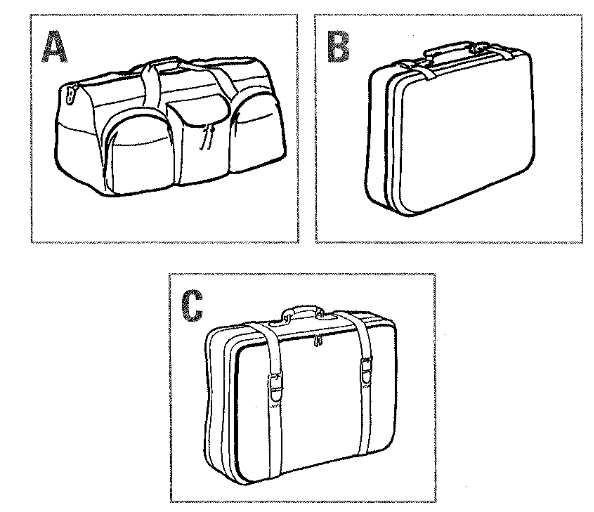
Agent: Can you describe it for me? Here is a picture to help you.
Jenny: Okay. It's a big bag like this one. Rectangular. Not hard-shell but soft covered and it has a zipper around the front.
Agent: Is it black?
Jenny: No, sort of a grey colour.
Agent: Any identification?
Jenny: Just a tag with my name on it.
Agent: Any other features?
Jenny: Well, it has wheels and a retractable handle on the end so you can pull it as well as the handle in the middle.
Agent: Okay, that's fine. Now if your bag missed the connection, I'm sure it'll be put on the next flight. I'll email Singapore as soon as I finish here. The next flight comes in at 17:50. That's 10 to 6 this evening. You can pick it up then.
Jenny: 10 to 6? That's too long to wait. Can I get my uncle to pick up the bag on his way home from work?
Agent: Sorry. You have to be here yourself to clear customs.
Jenny: Of course. I almost forgot. Will the bag come here to this desk?
Agent: Yes. You pick it up here, then take it over to the customs area. By the way, don't forget to bring your passport. You will also need to have the key plus your ticket with baggage claim number on it.
Jenny: Oh, okay. Guess I'll have to come back tomorrow then. It's lucky I packed everything I need for now in my carry-on bag.
Agent: Yes, that's always a good idea. Be prepared.
Questions for The Lost Luggage Claim Form Listening Test
Question 1
Circle the correct letter A-C
1. Jenny’s journey began in …
A. London
B. Singapore
C. Hong Kong
Questions 2-4
Complete the form
Write no more than 3 words for each answer.
LOST LUGGAGE CLAIM FORM
| Name | Jenny Lee |
| Address | 2 __________ St, Riverside |
| Telephone Number | 3 _____________ |
| Arrived On | Flight QA 392 |
| Connecting Form | Flight 4 ___________ |
Questions 5-8
Circle the correct letter A-C
5. Which of the drawings resembles Jenny’s bag?
6. Which extra feature does Jenny identify?
A. black colour
B. wheels
C. a metal handle
7. What time should Jenny’s bag arrive?
A. 5:50 pm
B. 6:10 pm
C. 7:50 pm
Question 8
Write NO MORE THAN TWO WORDS for the answer.
When Jenny picks up the bag, she has to 8___________ in person.
Questions 9-10
Name TWO things that the agent advises Jenny to bring
9 _____________
10 ____________
Premium IELTS Coaching
at an Affordable Price
Answers to the Lost Luggage Claim Form Listening Test
This section is going to unlock the “answers of lost luggage claim form listening test”, which will help you match your given answers. Moreover, the intention behind providing you with the answer key stands to be offering you an opportunity to look into your weak areas and allow a chance for improvement. So, let’s delve into it!
Question 1
Question 2
Question 3

Unlock All Answers for Free
Question 4
Question 5
Question 6
Question 7
Question 8
Question 9
Question 10

IELTS Prep Boost
Unlimited Access Includes
Other Passages
Important Links for IELTS Exam
Explore Free IELTS Mock Tests
Find IELTS Coaching Centres
Practice Every IELTS Module
Essential IELTS Tools & Resources
Study Abroad Consultants in India
Top Study Abroad Destinations
Exams Required to Study Abroad
Popular Universities to Study Abroad
Important Links for IELTS Exam
Explore Free IELTS Mock Tests
Find IELTS Coaching Centres
Practice Every IELTS Module
Essential IELTS Tools & Resources
Study Abroad Consultants in India
Top Study Abroad Destinations
Popular Universities to Study Abroad
Quick Links
Until now, you have solved two various types of questions in “lost luggage claim form IELTS listening answers” and looked into its answer key for verification. Moreover, the audio in this sample reveals a conversation between Jenny Lee (a student) and an agent at the lost luggage counter in an international airport. So, now delve into this guide, which is all about the key details of the IELTS listening test. Let’s explore: -
Key Highlights of the IELTS Listening Section
Being aware of the IELTS Listening Section’s key highlights is quite essential. So, let’s look into them in detail as given below: -
- Test Format: The format of the IELTS listening test stands to be very simple. Moreover, it includes 4 sections that have 10 questions each; thus, making it to a total of 40 questions.
- Allocation of Time: The exam duration stands to be 30 minutes. Along with this, candidates are given 10 extra minutes for transferring answers.
- Question and Audio Types: Students have to listen to various types of monologues or conversations. Besides, it ranges from day-to-day contexts to academic scripts. Also, there are a few types of questions in this listening section from form completion to multiple choice questions.
- Skills Assessed & Increased Difficulty: With every audio, the level of difficulty inevitably increases and normally, the skills of retaining a certain information with understanding abilities are assessed.
- Academic Test Type / General Test Type: The test format of the IELTS listening section is similar in both exam types.
Hopefully, you are now fully familiar with the key highlights of the listening test with its sample named lost luggage claim form Listening answers withaudio; moving forward, it is now time to learn various types of questions you come across in this sample listening test. So, let’s look into it!
Task Type in the Lost Luggage Claim Form Listening Answers
In this section, you will be acquainted with the types of a few tasks / questions you come across while attempting the IELTS Listening sample test named “lost luggage claim form Listening Answers”. Besides, for thorough knowledge about different task types you can have your hands on the IELTS self-help kit aiming for better preparation. In addition, this sample covers two question types: multiple choice questions & complete the flowchart. So, let’s have a look at each one by one!
- Multiple Choice Questions (MCQs) (1 – 5): The multiple choice type of questions (1 – 5) in the IELTS listening test offers you a few options from which you are required to choose the most appropriate one, such as A, B, C, or D. Moreover, to score better marks through this question type, you must have the ability of active listening along with recognizing and understanding the context. Besides, use the elimination method that will help you secure the right answer.
- Flowchart Completion Type of Questions (6 – 10): This type of question you come across in the IELTS listening test (flowchart completion questions) needs you to complete a diagram. Moreover, the diagram shows a sequence of steps or a process in which you have to fill in the missing words or phrases from the audio you had listened to. Thus, pay attention to the audio and try to grasp the right data for forming the chart by ensuring the correct spelling of the answers.
Besides these, it is recommended that you attempt various IELTS listening mock test for hands-on knowledge about the other question types.
Common Mistakes of the IELTS Listening Section
Many students tend to lose a lot of marks due to involuntary mistakes being carried out. As a result, they secure undesired band scores that are not accepted by top universities, instead they have to reappear for exams. Thus, to avoid such a situation, one must be aware of common mistakes that are mandatory to avoid. Let’s start!
- Ignoring the Instructions: First and foremost, candidates often do not put much effort into reading the instructions before starting with the exams. Resultantly, they end up giving wrong answers and losing marks. For example, the instruction tells you to answer some questions in three words strictly, yet you cross the word count & due to that neglect, your scores are deducted.
- Spelling & Grammatical Errors: Always due to much pressure or hurry, candidates tend to write incorrect spellings besides knowing the right answer. In addition, many a time, they also commit grammatical errors, such as failing to add “s” in plural words. As a result, they have to bear a loss of marks and lower band scores.
- Falling for Distractors: The next common mistake often made by them stands as “falling for distractors” that you face in the audio. Moreover, these are given to assess your attention while listening to the recording; thus, avoid falling for such words or data without losing your focus on the actual details.
- Not Paying Complete Attention to Details: Prospects get too indulged in hearing the audio that miss out on everything, even grasping the key details. Losing your focus stands to be one of the typical mistakes that might happen while looking for a particular answer. So, if you feel that you are missing out on paying complete attention, just stay calm and try to not lose your focus for the remaining audio.
- Not Cross Checking the Answers: Last but not least, after paper completion, many students do not recheck their answers. Besides, it is possible when students feel all caught up and carry out common mistakes, such as incorrect spelling, and wrong implementation of grammatical rules. Thus, you must go through the answers once again after completion.
So, this is all about the common mistakes that you must avoid making; moreover, if you want to practice well and avoid making such errors, you should enroll in the online IELTS coaching, which trains your mind well.
IELTS Band Calculation for Listening Section
Did you know that the IELTS listening section boasts 40 questions and scores of this particular section are calculated as per the right answers? Each correct answer allows you one mark and after that, they are converted into a band score from 1 to 9 using official tables. So, let’s refer to the table mentioned below for in-depth learning of the IELTS band calculation:
| Band Score | Score / 40 |
|---|---|
| 9 | 39-40 |
| 8.5 | 37-38 |
| 8 | 35-36 |
| 7.5 | 33-34 |
| 7 | 30-32 |
| 6.5 | 27-29 |
| 6 | 23-26 |
| 5.5 | 19-22 |
| 5 | 15-18 |
| 4.5 | 13-14 |
| 4 | 10-12 |
| 3.5 | 8-9 |
| 3 | 6-7 |
| 2.5 | 4-5 |
Conclusion
Summing up this IELTS listening sample named “lost luggage claim form listening answers”, you must be now fully aware of what you come across while appearing in this test. Moreover, it helped you get familiar with the key features, different question types, and common mistakes you must avoid carrying out. Wish you luck and hope you score well!
