
Describe A Time When You Saw A Lot of Plastic Waste - IELTS Cue Card
In the IELTS Speaking Part 2, aka the cue card round, you could be asked to talk about almost anything. Be it personal experiences, your preferences, or opinions about people, places, things, or events. One such topic you might encounter is “Describe A Time When You Saw A Lot of Plastic Waste” Sounds simple, right? Well, it is not.
In topics like this, you have to go beyond the basics to score well and get your desired score! Not sure how you can do that? Do not worry! In this blog, you will find three high-quality sample answers along with follow-up questions to help you aim for a Band 8+ score.

Summarise with AI
Choose your AI Assist



Table of Contents

Introduction to IELTS Cue Cards
The IELTS cue cards, which are also often called the “Long Turn”, are the second part of the Speaking section. This tests how well you can speak on your own about a topic and check whether you can:
- Speak confidently for a longer time in English
- Organise your ideas in a clear and logical way
- Use a good range of vocabulary
- Express your thoughts clearly and smoothly
- Maintain a natural and steady speaking pace
The examiner will give you a card that will have a topic written on it in the Speaking Part 2 of IELTS. For this, you will get a total of 3 to 4 minutes. Here, 1 minute is for you to prepare, and around 1 to 2 minutes is for you to speak on the topic.
How to Answer the Cue Card?
It is important that you fully use your 1-minute preparation time wisely to do well in the IELTS Speaking Part 2. This 1 minute will give you a chance to think about different things you can talk about and how you can organise your response.
One thing you need to remember if you are aiming for Band 8+ is that your task here is not just to answer the question. You also have to speak fluently, use idioms, connect your ideas and include enough detail to keep the examiner interested.
For the topic “Describe A Time When You Saw A Lot of Plastic Waste”, you can try to include the following details:
- The situation: Where did you see the plastic waste? Was it a beach, a street, a river, or somewhere else?
- When it happened: Was it recently or a long time ago?
- What you saw: What kind of plastic waste was there? Bottles, bags, wrappers, or something else? How much was it?
- Why was it there?: Do you think it was due to littering, poor waste management, or an event?
- Your reaction: How did you feel when you saw it? Were you shocked, upset, or concerned?
- What you did (if anything): Did you take any action, like cleaning it up or spreading awareness?
The cue card that you will get will also include a few pointers that you can use to guide your answer. These will help you understand what the examiner is actually expecting from your response. And you can get the following pointers for this topic:
- Where and when did you see the plastic waste?
- Why was there a lot of plastic waste?
- What did you do after you saw it?
- And explain what your thoughts were about this.
Here is how your IELTS Cue Card might look:
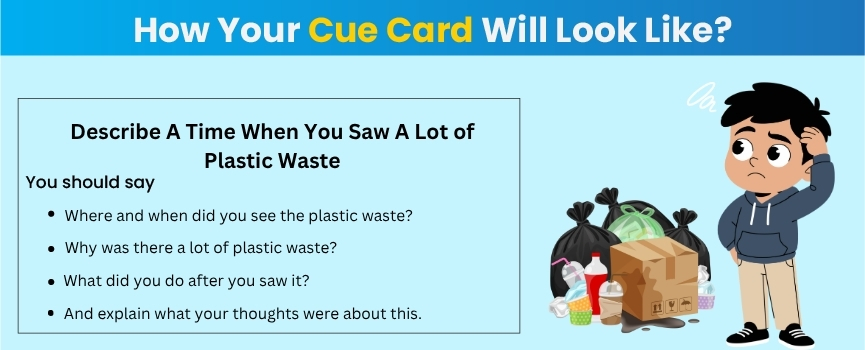
Now, let us take a look at some sample answers for the topic “Describe a time when you saw a lot of plastic waste”, which covers all these important points. And it can also be helpful if you’re preparing through online IELTS classes.
Describe A Time When You Saw A Lot of Plastic Waste - Sample 1
This first sample will show you how to give a well-structured answer. One with a clear introduction, detailed explanation and a strong ending. Let’s take a look:
Introduction
A moment that I clearly remember is when I saw more than a normal amount of plastic waste in my surroundings. I was genuinely shocked when I first saw it. And it then ended up leaving a strong impression on me. This was mainly because I had never seen that much pollution before.
Where and when did you see the plastic waste?
This actually happened to me a few months ago when I was planning to go see a lake in my home town with a couple of my friends. That day, my friends and I planned a relaxing evening. But when we went to the lake and saw the amount of plastic waste and pollution, it destroyed our whole evening. The lake and the area around it were fully covered with plastic waste.
Why was there a lot of plastic waste?
The reason behind the area around the lake being extremely dirty and full of waste was due to two main reasons. One was that the visitors were extremely careless and littered their waste without giving it a thought. Second was the lack of proper waste management. The place simply didn’t have enough dustbins, and most of the visitors were throwing their garbage wherever they could.
What did you do after you saw it?
When I saw it, my immediate reaction was one of concern, and I got a bit disturbed. But then my friends and I decided to pick up some of the waste and dispose of it properly. Even though completely cleaning the area on our own was impossible, we tried to make an effort. And to make another step towards plastic waste, I even shared some pictures of the lake on social media in order to encourage others to be a little more responsible.
And explain what your thoughts were about this.
In all honesty, it made me realise how serious the plastic pollution problem really is. It is not just about one place. It is happening everywhere. I felt that people also need to be more aware and responsible. And authorities should also take stricter action to manage waste properly.
Conclusion
In the end, it was an eye-opening experience for me, and it made me a little more aware of my habits. It also encouraged me to lower my plastic use in my daily life. I truly think that small steps can make a huge difference when it comes to saving our environment.
 Access speaking Mock Test
 Describe A Time When You Saw A Lot of Plastic Waste - Sample 2
You also get scored based on your range of vocabulary in the IELTS Speaking Part 2. Hence, this next sample uses extensive vocabulary for IELTS words so that it gets easy for you to know how you can score better marks.
Introduction
Throughout my life, there have been many instances when I saw or came across plastic waste. But one incident that I remember that left a long-lasting impression on me was when I saw it in a place that I used to visit as a child. Much more than this, it also made me realise how severe the issue of environmental pollution is.
Where and when did you see the plastic waste?
This happened last winter when I was visiting my parents in my hometown and planned a small outing with my school friends. We decided to go to a popular tourist beach in my city. The beach was mainly known for having scenic views, and since it was a place that I used to visit a lot as a kid, I was genuinely very excited.
Why was there a lot of plastic waste?
But when I reached there, I was completely shocked. All I could see was a shoreline filled with plastic waste like bottles, disposable cups, food packaging and small broken pieces of plastic. I could not help but think about the reason behind the overwhelming amount of plastic on the beach. Later, I found out that it was a result of the irresponsible behaviour of tourists and an inadequate waste disposal system by the authorities. Another one of the reasons was the unnecessary and more-than-required use of single-use plastics.
What did you do after you saw it?
There was nothing much that I could do but feel concerned. So my friends and I then decided to collect as much waste as we could and dispose of it in the nearby bins. Later, more people joined and helped clean the beach. It obviously was not enough, but our efforts that day felt extremely meaningful. It felt like we were actually making an effort towards the right direction. Following that day, I also spoke to a few locals who told me that it is a persistent problem in the area.
And explain what your thoughts were about this.
This particular experience actually made me more concerned about the future of our environment. It also showed me the kind of damage our negligence can cause in our natural spaces. It also made me realise that there is an urgent need for much stricter regulations and public awareness when it comes to dealing with this issue.
Conclusion
To put it simply, witnessing a lot of plastic in a place where I grew up was disheartening. But despite that, it also motivated me to have more eco-friendly habits. And ever since then, I have also been trying to minimise my plastic use. I am also encouraging others to do the same.
Master the IELTS exam with our Prep Boost
What’s included:
- Pre-recorded video lectures
- Advance Study Materials
- Detailed Feedback Report
Describe A Time When You Saw A Lot of Plastic Waste - Sample 3
Let’s take a look at what a high-quality IELTS Speaking Part 2 answer looks like. One that can help you aim for a band 8+ score. Take a look:
Introduction
One experience in particular which has stayed with me is when I saw an alarming amount of plastic in my neighbourhood. And more than finding it disgusting and icky, I found that particular instance to be thought-provoking. It made me think about the side effects and issues that this excessive plastic pollution is creating on us, our children and more importantly, our environment.
Where and when did you see the plastic waste?
This happened around a couple of months, maybe around 6 months ago, when I was visiting a riverside that is located fairly close to my neighbourhood. It’s a nice place to go for an evening walk. It is peaceful, and a lot of people go there for picnics and their evening walks.
Why was there a lot of plastic waste?
The entire area was heavily polluted. It had plastic debris everywhere. Everything from water bottles and snack wrappers to single-use bags was there, and they were scattered all over the ground. Some of them were even floating in the water. I believe this situation was because of public negligence. And also because of too much dependence on disposable plastics.
What did you do after you saw it?
When I first saw it, I could not help but feel a little disheartened because it truly is a beautiful place, and seeing it dirty was highly concerning. And hence I decided to take some actions along with my friends instead of simply ignoring the issue. We tried to collect as much rubbish as we could and even installed a few dustbins. It was a small effort if we compare it to the scale of the problem. But for us, it felt like a step in the right direction. Later that day, I also shared my experience online in order to create more awareness among people about this issue.
And explain what your thoughts were about this.
When I think about this incident, in retrospect, I think it made me realise how deeply the problem of plastic pollution has become. It is not just an environmental concern anymore. It actually acts as a reflection of our collective habits and how we run away from any kind of responsibility. To be honest, I actually and strongly feel that unless we as individuals become more mindful and the authorities do not implement stronger regulation this situation is only going to get worse.
Conclusion
This whole experience that I went through with excessive plastic waste was not just eye-opening. But I also made myself a little motivated to actually make a change for our environment. It made me adopt more practices that are sustainable. This includes reducing plastic usage and promoting eco-friendly alternatives. I think small habits and consistent efforts can contribute to meaningful change when it comes to protecting our environment.


Lexical Resources
As mentioned earlier, your vocabulary (also called lexical resource) plays an important role in your IELTS score. To help you understand better, here’s a list of some useful words and phrases used in the sample answers above, along with their meanings:
| Word | Meaning |
|---|---|
| Littering | throwing trash carelessly in public places |
| Lack | not having enough of something |
| Consequences | results or effects of an action |
| Dispose | to throw away or get rid of something |
| Conscious | aware or careful about something |
| Instances | examples or situations |
| Impression | a feeling or opinion about something |
| Substantial | large in amount or size |
| Severity | seriousness of a problem |
| Scenic | having beautiful natural views |
| Shoreline | the land along the edge of a sea, river, or lake |
| Inadequate | not enough or not good enough |
| Immediate | happening right away |
| Initiative | Taking the first step to do something |
| Persistent | continuing for a long time |
| Negligence | lack of proper care |
| Regulations | official rules or laws |
| Awareness | knowledge or understanding of something |
| Disheartening | making you feel sad or discouraged |
| Adopt | to start using or following something |
| Alarming | worrying or shocking |
| Unpleasant | not nice or not enjoyable |
| Provoking | causing thoughts or reactions |
| Degradation | the process of becoming worse |
| Outskirts | areas on the edge of a city |
| Scattered | spread around in different places |
| Rooted | strongly fixed or established |
| Mindful | careful and aware |
| Implement | to put a plan into action |
| Deteriorate | to become worse over time |
| Sustainable | Able to continue without harming the environment |
Follow-up Questions
In the IELTS Speaking test, after you finish your cue card, the examiner will ask you a few follow-up questions. These questions are going to be related to the same topic: “Describe a time when you saw a lot of plastic waste.” These speaking cue card practice questions that you will get will give you a chance to speak more. And more importantly, it will help you show how well you can discuss ideas more deeply.
1. Why is plastic so widely used despite the pollution?
I believe plastic is used so much because it is affordable. It is also weightless and very easily available. It is also stable, which makes it easy to shape into different forms. This makes it a great choice for packaging and everyday products. Even though people know about its harmful effects. Many companies still depend on it because the other options can be more pricey or less useful.
2. What are the long-term effects of seeing such waste?
In my opinion, seeing a large amount of plastic waste can have both emotional and behavioural effects espeically in the long run. It can create awareness and motivate us to adopt an eco-friendly lifestyle. But some people can get used to it, which can, in turn, make them less concerned.
3. Who is most affected by this pollution?
In my opinion, aquatic life and animals are the ones that are most affected by plastic pollution. Because they a lot of time misunderstand plastic for food. This can be toxic or even deadly. Apart from that, people who are living in polluted areas, especially near rivers or seaside regions, are also getting affected. It can create a huge impact on their health and quality of life.
4. How can individuals help reduce this waste?
People can play an important role by making little but meaningful changes in their daily lives. For example, they can avoid the use of single-use plastics. They can also carry reusable bags and bottles. And correctly dispose of waste. They can also spread awareness and encourage others to follow good practices.
5. What can be done to clean up the existing plastic waste?
To clean up plastic waste, both governments and people need to work together. Having Large-scale and clean-up drives can be helpful in places like beaches and rivers. The government can also invest in better waste management techniques and recycling facilities.
Tips to excel in IELTS Cue Card
And lastly, if you want to excel in the IELTS speaking part 2, there are some strategies that you can follow to articulate your response for the 8+ band.
- Make sure that while talking about the topic, you try to maintain a smooth flow and coherence. You can easily do this with the help of connecting words like “moreover”, “additionally,” or “however”.
- In your response, also try to give real-life examples when possible. This will make your response more authentic and give you a chance to speak naturally about things and events you already know. This will eliminate the chance of getting stuck.
- Another great strategy is to deconstruct your card during your preparation time. This can easily be done by identifying the theme, giving an IELTS speaking mock test, knowing the required tense, and the specific details that are requested.
- Avoid rushing and manage your pace. Try to speak at a steady and natural speed using clear pronunciation.
- Lastly, use an IELTS band score calculator so that you can better guide your IELTS preparation and understand where you need improvement.
Conclusion
Scoring Band 8+ in the IELTS Speaking section for the topic “Describe a time when you saw a lot of plastic waste” requires you to do more than just answer the question. You need to speak fluently, organise your ideas clearly, and give detailed responses.
If you often find cue cards challenging, taking online IELTS classes or practice tests can really help improve your confidence. With the right preparation and regular practice, you can deliver a strong and impressive answer.
0 comments

Practice Makes a Man Perfect!Take FREE ielts Mock Tests
Start FREE Mock Test


Get Unlimited Access with
IELTS Prep Boost

Mock Tests

Practice Questions

Study Material

Recorded Classes
What is your Target IELTS Band?








Not Confident in Speaking? Practice Cue Card Now.
Start Practice