
Describe a Thing You Did To Learn Another Language- IELTS Cue Card
The IELTS speaking section is more than just simply answering questions in English instead it is an opportunity to express how naturally and confidently you can express your opinion, memories and experiences. The cue card in the IELTS speaking test is often regarded as the biggest challenge and lasts around 11 to 14 minutes. However with the help of the right approach it can also be one of the best options to reflect your vocabulary, fluency and ability to organise ideas quickly.
In this blog you will get the sample answers for Describe a person who impressed you in primary school along with useful vocabulary, follow up questions and key tips. These resources will help you build ideas and improve fluency and answer with greater confidence.

Summarise with AI
Choose your AI Assist



Table of Contents

What Challenges Did You Face While Learning German?
Do You Have a Favourite Korean Drama That Helped You The Most?
Do You Think Language Exchange Apps Are Effective For Learning?
How Do You Think Watching Dramas Helps With Cultural Understanding?
What Specific Challenges Did You Face While Learning French?
Introduction to IELTS Cue Cards
During the IELTS Speaking test, you may receive a cue card that asks you to speak about a specific topic on the basis of your personal experience. The card mainly includes a main question with a few prompts to guide your response. You get only one minute to prepare your ideas and jot down some notes before speaking continuously for up to two minutes. The IELTS cue card topics can cover a wide range of subjects like people, places, experiences, and personal achievements.
For this particular cue card, “Describe a thing you did to learn another language”, you need to explain a method or activity which helped you develop your language skills. A well-organised response, appropriate vocabulary, and relevant examples can make your answer more fluent, natural, and impressive, which helps you perform better in the IELTS speaking test.
How to Answer the Cue Card?
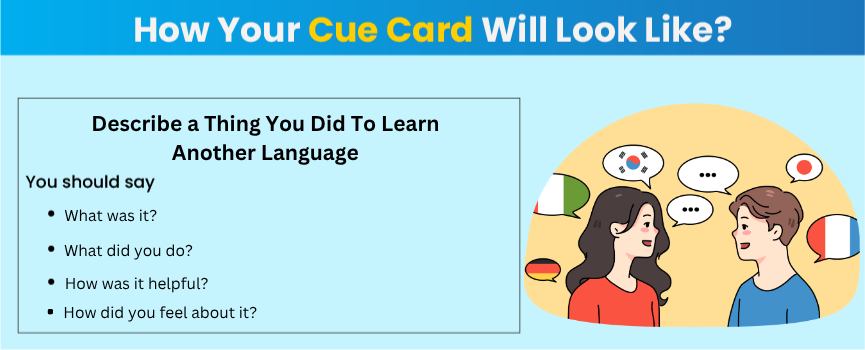
To answer the describe a thing you did to learn another language cue card properly, one should organise your response around the key points given in the question. It will help you develop your ideas clearly and logically while speaking confidently and naturally.
You can structure your answer by covering these four types of IELTS cue card practice questions in brief:
1. What was it?
2. What did you do?
3. How was it helpful?
4. How did you feel about it?
Thus, by following this structure, you can give a well-developed response without losing track of your ideas.
Describe a Thing You Did To Learn Another Language - Sample 1
This is the first type of sample answer for the IELTS speaking cue card on describe a thing you did to learn another language. The sample highlights the challenges of learning French, the importance of overcoming failure, and how using technology helped make the learning process easier. It also reflects determination, personal growth, and the value of finding an effective learning method.
Introduction
Learning another language has always been quite challenging for me. I had struggled with new languages such as Spanish, German, and particularly French. So I never considered myself especially good at learning foreign languages. However, when I went to college, I decided to give it another try.
What Was It?
The thing I did to learn another language was using Duolingo, which is a language learning app. I used it to learn French, that i has chosen as my third language in college. Since French has complicated grammar and sentence structures, I initially found it extremely difficult.
What Did You Do?
I started with the help of Duolingo and constantly practised French. The app turned language into a kind of game by giving me points and rewards for finishing exercises. I practised vocabulary, grammar, sentence formation, and other basic concepts via these interactive lessons.
How Was It Helpful?
It was extremely useful as it made learning French more enjoyable and less stressful. The short exercises helped me practice regularly, whereas the points and rewards motivated me to further pursue. So gradually I began understanding grammatical concepts and forming sentences with greater confidence.
How Did You Feel About It?
Initially, I felt quite frustrated and lacked confidence as I was struggling with the language. I even failed the course once that was quite disappointing. However, using Duolingo provided me with a new approach to learning, and I slowly became more motivated. So I felt proud when I noticed that I was finally making progress.
Conclusion
Overall, with the help of Duolingo, it was a turning point in my language learning journey. It taught me that struggling with something does not mean I cannot learn it. With constant practice, the right method, and determination, I was able to overcome my problems and become more confident in learning French.
 Access speaking Mock Test
 Describe a Thing You Did To Learn Another Language - Sample 2
This is another sample in the IELTS speaking section on the given topic “describe a thing you did to learn another language”. It highlights the experience of learning Korean through regular practice, watching Korean content, and learning new words.
The sample also stresses the challenges, efforts, and enjoyment involved in learning a new language.
Introduction
I would like to talk about learning the Korean language, and I learned Korean by watching Korean dramas. I started watching them simply out of curiosity, but over time I realised that they were a great way to learn the language and enhance my understanding of Korean.
What Was It?
I would watch Korean dramas with subtitles and pay very close attention to the way the actors spoke. I particularly focused on their pronunciation, common expressions, and the way they communicated with each other in everyday situations.
What Did You Do?
While watching the dramas, I tried to remember frequently used Korean phrases and expressions. I also paid attention to informal slang and the differences in the way people spoke as per their relationship or situation. Sometimes I would pause a scene and repeat the dialogue myself to practice my pronunciation.
How Was It Helpful?
This method was actually helpful as it allowed me to learn Korean naturally and enjoyably. I picked up everyday expressions, improved my listening skills, and became more familiar with Korean culture and social nuances. By repeating the dialogues, I became more comfortable with the pronunciation and rhythm of the language.
How Did You Feel About It?
I found this method very enjoyable as it did not feel like traditional studying. I could entertain myself while learning something useful at the same time. It also motivated me to continue learning Korean as I could certainly notice my progress whenever I understood a phrase without relying completely on the subtitles.
Conclusion
Overall, watching Korean dramas was an enjoyable and effective way for me to learn Korean. It included entertainment with language practice, and that improved my listening and pronunciation and motivated me to further learn more about the culture and language.


Describe a Thing You Did To Learn Another Language - Sample 3
This is another sample in the IELTS speaking section on the particular topic “Describe a Thing You Did to Learn Another Language”. It focuses on the experience of learning German via a language exchange application, language learning applications including Duolingo, and German movies and series.
Introduction
Now I would like to talk about something I did to learn another language, which was learning German. I became interested in German as I wanted to learn a new language and also because I thought it could be useful for my future.
What Was It?
It was my experience of learning German. I have always been interested in the German language as it is widely spoken in Europe and is also useful in fields like engineering and technology.
What Did You Do?
To improve my German, I regularly used language learning applications like Duolingo. I also watched German movies and TV series with subtitles. With the help of these activities, I practised conversation, learned new words, and became much more familiar with German sentence structure and pronunciation.
How Was It Helpful?
This method was very helpful as it combined structured learning with real-time practice. The application helped me build my vocabulary and practice communication, whereas watching movies and series helped me understand how German is used in everyday situations. It also improved my confidence, especially in speaking and listening.
How Did You Feel About It?
Though I faced some difficulties along with learning German, I felt really motivated. Every time I understood a new word or sentence, it felt like an achievement. Through this, I became more aware of German culture, which I found fascinating.
Conclusion
In total, learning German via apps and German TV shows was a very effective and enjoyable experience. It not only improved my skills in the language but also increased my confidence and interest in German culture.
Master the IELTS exam with our Prep Boost
What’s included:
- Pre-recorded video lectures
- Advance Study Materials
- Detailed Feedback Report
Lexical Resources
Vocabulary plays a vital role in IELTS speaking part 2 as it allows you to share your thoughts with greater accuracy, variety, and confidence. The examiner looks at how accurately you select and use words to explain your ideas instead of simply counting the number of difficult terms you know.
To achieve a stronger band score, you should not rely on the same simple words throughout your response. Instead of this, try to include appropriate synonyms, descriptive expressions, topic-specific vocabulary, and natural idiomatic phrases where suitable. So, a verified vocabulary can help you describe experiences in greater detail, explain details, express feelings, and develop your ideas more conveniently.
The following table presents useful vocabulary for IELTS and expressions for diverse types of IELTS cue card topics. Consistent learning and practising these words will help you communicate more naturally, improve fluency, and make your speaking Part 2 answers more impressive.
| No. | Word | Meaning |
|---|---|---|
| 1 | Structures | The way something is arranged |
| 2 | Interactive | Involving communication or participation between people or things |
| 3 | Gradually | Slowly or over a period of time |
| 4 | Disappointing | Causing someone to feel let down or unhappy |
| 5 | Determination | The strong desire and effort to achieve something |
| 6 | Highlights | Shows or emphasises the most important parts |
| 7 | Subtitles | Written words shown on a screen which represent spoken dialogue |
| 8 | Phrases | Groups of words that express an idea or meaning |
| 9 | Social nuances | Small or subtle differences in how people behave and communicate in society |
| 10 | Traditional | Related to customs or ways of doing things that have existed for a long time |
| 11 | Engineering | The field of designing and building machines, structures, systems, etc. |
| 12 | Achievement | Something completed or accomplished |
| 13 | Effective | Producing the desired or intended result |
Follow-Up Questions
After the IELTS speaking section, the examiner will ask some follow-up questions that are based on critical analysis and evaluate your capacity in a competitive setup. These are the following questions, so here they are:
What Challenges Did You Face While Learning German?
Initially, I struggled with a few aspects of the language specially its grammar and pronunciation. Some of the grammar rules are very confusing, and I found certain sounds tough to produce as they were entirely unfamiliar to me. So instead of giving up, I kept practising and used language exchange platforms to get guidance from local speakers.
Do You Have a Favourite Korean Drama That Helped You The Most?
Yes, there is one drama that I really enjoyed watching: Crash Landing on You. So, apart from having a really interesting storyline, it consists of plenty of natural conversation helped me learn how people communicate in everyday situations, so I was able to improve my practical language skills while enjoying the show.
Do You Think Language Exchange Apps Are Effective For Learning?
Definitely yes, I think language exchange apps can be a great source to learn a language, as they let you communicate with native speakers instead of only studying from textbooks. Apps also make learning more convenient, and I can practice whenever I have spare time and focus on the skills I find most difficult.
How Do You Think Watching Dramas Helps With Cultural Understanding?
I actually believe that watching dramas is a great way to learn about the culture of any place or country as well as its language. Drama reflects how people behave, interact with each other, and follow everyday norms. It also helps to learn jokes, emotions, and cultural references, which might be tough to learn from a textbook. As a result, I can communicate more naturally in real-life situations.
What Specific Challenges Did You Face While Learning French?
Learning the French language was not easy for me, especially when it came to grammar and sentence formation. At first, I struggled to put words together rightly, as there were so many rules to remember. So at that time I felt quite frustrated and confused, and my past experiences with unsuccessful language learning made me doubt my abilities.
Tips to Excel in IELTS Cue Card
A strong performance in IELTS Speaking Part 2 needs more than just knowing English well. You also need to think quickly, organise your ideas effectively, and communicate them organically within a limited time. The strategies below can help you make your cue card responses clearer, richer and more confident.
1. Learn to Develop Your Ideas
Avoid giving only basic statements and try to support your opinions with supportive arguments, personal details and examples. It makes your response more detailed and demonstrates your ability to extend your answers organically.
2. Use a Clear Response Structure
Try to make your answer in a simple structure, as it becomes easier to deliver. So begin by introducing the topic, develop it with relevant details and personal experiences, and finish with a brief concluding thought. This framework can also help when you get an unfamiliar topic.
3. Train Yourself to Think Quickly
The one-minute preparation period can pass very quickly. So practice generating ideas under real-time pressure, or do IELTS speaking practice online and write just keywords or short phrases instead of completing sentences. This will help you remember your points without sounding memorised.
4. Record and Review Your Responses
Recording your practice sessions is an effective way to identify repeated vocabulary, grammatical errors, pronunciation problems, and moments of hesitation. And reviewing these recordings constantly can help you recognise weaknesses and improve them over time.
5. Prioritise Clear Communication
A high band score does not depend on using complicated words in every sentence. So instead of this, focus on expressing your ideas accurately, organically and clearly. This is because the appropriate vocabulary combined with good grammar and fluent delivery is far more effective than forced or unnatural expressions.
6. Practice Under Real Test Conditions
Knowing what to say is not enough; instead, you also need to manage your time properly. You must practice speaking for the full two minutes while maintaining a steady pace and developing each point sufficiently. So regular timed practice or mock IELTS sessions can help you become more comfortable with the pressure of the actual test. However, you can take online IELTS classes offering real-time test simulation for further practice of basic concepts.
Conclusion
Wrapping up! The IELTS cue card about describing something you did to learn another language provides you with a great option to talk about your personal learning experience and explain how you improved your language skills. And for a good performance in IELTS speaking part 2, regular practice is quite important. So taking speaking practice tests, learning suitable vocabulary, and practising how to express ideas naturally can gradually enhance your IELTS exam preparation. It is also useful to use real-life examples and personal experience, as it makes your answer more natural and engaging.
If you still need additional preparation support, expert guidance, personalised feedback, and regular IELTS speaking mock test at, Gradding. com can help you figure out weaknesses and work towards your desired IELTS band score.
0 comments

Practice Makes a Man Perfect!Take FREE ielts Mock Tests
Start FREE Mock Test


Get Unlimited Access with
IELTS Prep Boost

Mock Tests

Practice Questions

Study Material

Recorded Classes
What is your Target IELTS Band?



Not Confident in Speaking? Practice Cue Card Now.
Start Practice