
Describe an Item on Which You Spent More Than Expected - IELTS Cue Card
There will be those who have gone shopping with intentions of buying something relatively cheap but have ended up spending more on the item than anticipated, and it is this experience which the cue card "Describe an Item on Which You Spent More Than Expected " aims to get you to describe. This might seem easy, but many candidates struggle to incorporate price and rationale in just two minutes.
In this blog, the required information regarding the cue card is revealed, three sample answers to the cue card are provided based on different products, together with some vocabulary, follow-up questions, and tips.

Summarise with AI
Choose your AI Assist



Table of Contents

Introduction to IELTS Cue Cards
If this is your first time appearing for the exam, it helps to first understand what IELTS Cue Cards actually are. They are small prompt cards handed to you during IELTS speaking part 2, each carrying a topic along with a few bullet points you are expected to cover while speaking for one to two minutes, after a minute of preparation time.
This segment of the IELTS Speaking section will not be evaluating how extravagant your purchase has been but will be assessing how well you can organize yourself and communicate effectively with appropriate language use and without using any memorized material. The issue of spending beyond your means is common with virtually every examinee at one time or another; that is why the subject becomes very easy to customize, as it just involves describing an ordinary occurrence in your life.
How to Answer the Cue Card?
Now that the question about sample topics has been posed, it is important to look at what the structure of IELTS Speaking Part 2 looks like. Once you have been given the cue card, take advantage of the minute of preparation time and write some keywords down for each of the points, as opposed to composing complete sentences, which would make your speech sound artificial and memorised.
There is no point trying to compose full sentences in your mind during the preparation minute - just a few notes will be more than enough. An easy structure to follow would be naming the item, saying how much money was actually spent on it, talking about reasons for its purchase, and explaining why extra money was spent compared to initially planned. Practice with several IELTS cue card practice questions to get used to this pattern long before taking an exam.
It is not necessary to elaborate on all the points equally; IELTS examiners assessing this IELTS speaking section are interested in your fluency and coherence rather than in mechanical ticks of all the boxes.
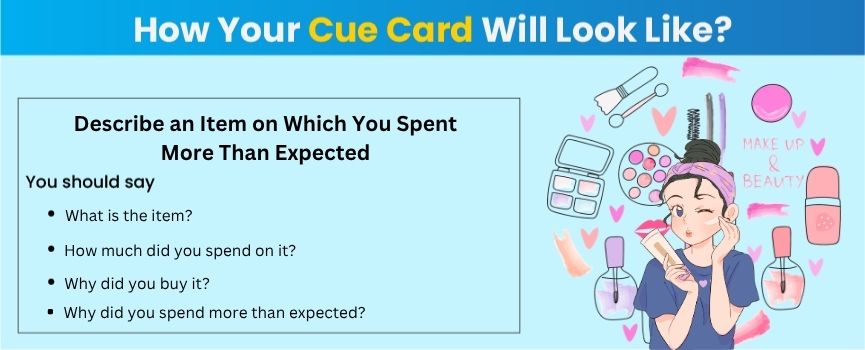
Describe an Item on Which You Spent More Than Expected - Sample 1
Here is the first sample response, built around a smartphone purchase.
What Is the Item?
The item I wish to discuss is the smartphone that I purchased around a year ago. And it must be said that buying it was probably the most impulsive purchase I made recently.
How Much Did You Spend on It?
Originally, I intended to buy the phone for about twenty thousand rupees, which should cover a mid-range phone at that time. In the end, however, I paid a little less than thirty-eight thousand rupees for a significantly better device.
Why Did You Buy It?
My previous phone became slow and started lagging while making video calls or using several apps simultaneously, and I needed to replace it with a better one.
Why Did You Spend More Than Expected?
When I got into the store, the salesperson offered me a model that had an improved camera, extra memory, and a more powerful processor. So I found out that it would be wiser to spend more money now than to have to upgrade again soon.
Conclusion
Reflecting on all this, while it is true that I ended up spending twice as much as initially planned, I have no regrets about the purchase, because the mobile phone has worked really well for me and helped make things easier in my work as well as in my personal life during this whole year. It lasted long enough for me to avoid thinking about changing it.
 Access speaking Mock Test
 Describe an Item on Which You Spent More Than Expected - Sample 2
This next sample shifts the setting to a wedding outfit rather than an electronic gadget.
What Is the Item?
The item that I will be describing in this essay is a traditional outfit that I bought recently for a relative’s wedding, something which I didn’t plan on spending a lot of money on at all.
How Much Did You Spend on It?
Originally, I had decided to spend about ten thousand rupees on an affordable outfit, but in the end, I spent somewhere close to twenty-five thousand rupees.
Why Did You Buy It?
Given that it was a family wedding, and these kinds of events do happen rarely, it was necessary for me to get something appropriate to wear and not to use my old outfit, especially because there were many relatives that I had not seen for a very long time who were supposed to attend the wedding.
Why Did You Spend More Than Expected?
Once I started looking, I saw many designs that seemed to be way more elegant than anything I had imagined, and after trying out some outfits, I just couldn’t resist getting one that looked good on me.
Conclusion
Despite the high price tag on the suit, I felt very comfortable in it during the wedding, thus making me believe that it was somehow worth the cost. Now looking back, it appears that the suit turned out to be quite versatile, considering that I used it on two other occasions after the wedding as well.
Describe an Item on Which You Spent More Than Expected - Sample 3
The final sample looks at a laptop purchase made for professional reasons rather than a personal or social occasion.
What Is the Item?
The item that I want to describe is a laptop that I bought last year especially for my freelance design work, which I have taken up lately.
How Much Did You Spend on It?
Initially, I intended to spend around forty-five thousand rupees for an efficient laptop but eventually ended up spending seventy thousand rupees.
Why Did You Buy It?
My previous laptop could not run the necessary design software and kept freezing during the render process, and also sometimes crashed midway while working, so I had no option but to upgrade.
Why Did You Spend More than Expected?
While making comparisons at the store, I came to the conclusion that any laptop in my budget would face the same problem within one or two years' time, so I opted for the one with a faster processor and larger memory despite the excess expenditure.
Conclusion
Though the initial cost seemed to be high, this laptop has proved efficient in completing all the projects without any problems, and now I feel that spending extra money was necessary rather than a luxury since I have recovered all my costs within a month through various other projects.

Lexical Resources
Building your vocabulary for IELTS, along with a few natural idioms, can meaningfully strengthen your Lexical Resource score. Here are some worth using in your own answer:
| VOCABULARY | MEANING |
|---|---|
| An impulsive purchase | An item purchased without proper planning |
| Mid-range | Not very cheap and also not very costly |
| Significantly better | Clearly of better quality or efficiency |
| Upgrade | Replacing something with a newer or better version of it |
| Start lagging | Become slow or non-responsive |
| Simultaneously | At the same time |
| Extra memory | Extra storage or RAM in a device |
| Powerful processor | Processor that can handle tough jobs efficiently |
| An affordable option | An item that is reasonably priced |
| Elegant design | Styling or attractiveness of something |
| Couldn’t resist | Could not resist the urge to possess or purchase something |
| Price tag | The price tag on an item |
| Versatile | Appropriate for various uses or occasions |
| Worth the cost | Worth the price you paid for it |
| Have no regrets | Be totally happy or contented with your choice |
| Spend more than expected | Spending more money than initially planned |
| Excess expenditure | Extra cost beyond the budget |
| A luxury rather than a necessity | Desired but not necessary |
| Recover my costs | Getting back the money you spent on it |
| Prove to be useful | Proving itself handy |
| Make things easier | Making things easier for oneself |
| Well worth the money | Worth its price |
| A high price tag | Expensive in terms of price |
| Looking back | Reflecting upon something after the occurrence |
| The extra expense was justified | The extra cost was justified |
Follow-Up Questions
After your two-minute answer, the examiner typically moves into part 3, asking broader questions connected to what you discussed during IELTS speaking part 2. Here are seven examples you might encounter -
1. Are you a person who usually spends more money than planned?
Ans. Not really, considering that I consider myself a fairly sensible consumer, although there are instances where something or a real necessity pushes me into overspending.
2. On what does the young generation usually spend a lot of money?
Ans. There are quite a few young people who end up spending a lot on gadgets like cell phones and computers, fashionable clothes, or increasingly even video games or car accessories.
3. Is it necessary to accumulate some money for future uncertainties?
Ans. Definitely, as future events are not certain and the savings come as a cushion for any uncertainties that may occur.
4. Do you think that advertisements influence how people spend money?
Ans. Yes, to a large extent. The advertisements and the marketing of such goods make people feel that the product has become more necessary and valuable than it really is.
5. Do people repent of overspending later?
Ans. People have different views on this issue. Some repent later, while others do not consider that the extra cost has been worth it due to the usefulness of the product.
6. Do elderly people pay attention to finance more than the youth?
Ans. Yes, as elders are more experienced and mature in terms of financial matters, and thus they tend to be very careful while spending money.
7. What methods can people use to refrain from overspending?
Ans. Setting a budget in advance, not acting on impulse while shopping in the stores, and comparing prices before purchasing the items could all help in controlling spending.
8. Do you consider quality more significant than cost in the purchasing of goods?
Ans. Mostly yes, because an item with a slightly higher cost but better quality will always prove more beneficial for the buyer in the long run as compared to a cheap one that needs to be replaced soon.
9. How has online shopping altered the pattern of people’s spending?
Ans. Online shopping has made people more impulsive in spending and hence made the whole process of spending relatively easier for them.
Tips to Excel in IELTS Cue Card
Here are a few practical tips to help you perform well on this cue card and across the wider IELTS speaking section, whether this is your first attempt or you are retaking the test to improve your score:
- Think of a real purchase - It will always be easy to narrate something real because you will not need to invent anything on the spot.
- Make use of your one minute - You should write down keywords rather than sentences since you have to speak freely without seeming to read.
- Speak normally - When you try to speak as fast as possible, it is going to be very difficult to describe what you think; therefore, do not try to finish your narration quickly.
- Come up with a vocabulary base - If you study vocabulary concerning shopping and spending money regularly, it will become easy to use it when answering other cue card questions.
- Indicate the numbers - The indication of the approximate budget you had and the sum you spent seems much more believable than anything else invented.
- Express your feelings towards the decision - It will be good to tell whether you liked or disliked your decision.
- Practise out loud - Reading a sample silently is not the same as speaking it aloud. Regular IELTS speaking practice online helps you internalise rhythm and pronunciation from wherever you are.
- Take a mock speaking test - An IELTS speaking mock test helps simulate the spontaneity and pressure of the real exam far better than reading alone ever could.
- Consider structured guidance - If you are unsure where you are losing marks, online IELTS classes can offer more targeted feedback than self-study alone.
- Stay consistent - As with every part of IELTS exam preparation, steady daily practice over a few weeks tends to outperform last-minute cramming by a wide margin.
Final Thoughts
At its core, "Describe an Item on Which You Spent More Than Expected" is not asking you to describe something extravagant; it is asking you to speak naturally about a purchase you have genuinely made and reflect honestly on why the final cost went beyond your original plan. Whether it be a phone, a party dress, or a laptop which was bought due to need, the important thing to remember here is that you speak clearly, follow the format, and allow yourself to include a bit of your own logic.
Look at the sample questions above, use those sentences that suit your own way of speaking, practice, and try to make it sound as if you speak your own words instead of remembering them. A bit of preparation will help you use this cue card and make it one of the most relatable cards to speak about, as everybody has a story to tell when it comes to spending a little extra.
0 comments
Practice Makes a Man Perfect!Take FREE ielts Mock Tests
Start FREE Mock Test


Get Unlimited Access with
IELTS Prep Boost

Mock Tests

Practice Questions

Study Material

Recorded Classes
What is your Target IELTS Band?


Not Confident in Speaking? Practice Cue Card Now.
Start Practice