
IELTS Listening Flowchart Completion: Tips and Samples
The Flow-Chart Completion IELTS Listening task is designed in a way that demands candidates to consider one step at a time and follow the process as it unfolds. It is quite different from other listening tasks as you just don’t have to catch the facts, but it is more of keeping track of each stage in order and recognising key information that is paraphrased. Above all, the strict word limit and one chance to listen to the recording make this task even more challenging for students.
No worries, this complete guide will help you uncover how to approach the IELTS listening flow chart completion task with expert tips and sample questions.


Summarise with AI
Choose your AI Assist



Table of Contents

What is IELTS Listening Flowchart Completion?
A flowchart is simply a pictorial representation of a specific process or data flow in a sequence. The Flow-Chart Completion IELTS Listening is a task type designed to assess the candidate’s ability to comprehend the correct sequence of events, logical flow, and particular details of the process defined in the audio.
For this task, you will be provided with a flow chart with a few gaps that you have to complete after listening to the audio recording.
How to Answer IELTS Listening Flowchart CompletionQuestions
With the correct approach to mastering the IELTS listening flow chart completion task, you can structure your practice and avoid common mistakes, which will lead to higher scores.
Step 1: Read The Instructions Carefully
- Begin by reading and understanding the instructions related to the word limit or any other task-specific information.
- You will be provided with details about how to fill the missing gaps and how many words and/or numbers are allowed to be written in each gap.
Step 2: Look at The Visual Cues
- The flow chart presented in the task clearly depicts a few steps or stages, which you must thoroughly understand and note.
- Focus on the starting point (the beginning of the process), move ahead with the direction of the arrows (to understand the flow of the process) or any other graphic hints.
Step 3: Predict Type of Missing Information
- For completion tasks, asking yourself and predicting the answer is a core step. Here, just anticipate what type of words fit in the gap, whether it is a noun, adjective, number, date, etc.
- Predicting does not mean just relying completely on your knowledge when choosing an answer. For this task, strongly focus on what the speaker says in the audio.
Step 4: Pay Attention to Signposting Language as You Listen
- During your IELTS flow chart completion, pay close attention to signposting language, often used by speakers in recording.
- These are generally the words or phrases signalling that the speaker is moving to a new point. The signposting language can be referred to as road signs, guiding you to move in the right direction.
- A few of the common examples include, first, next, in the next stage, moving further, after and many more.
Step 5: Review Your Answers
- After you have completed filling in all the gaps in the IELTS flow chart, take some time to review and evaluate your answers.
- Look for word forms (whether the word fits in the rest of the sentence), spelling errors and word limit.
Key Challenges in IELTS Listening Flowchart Completion
Given the multi-tasking and highly concentrated nature of Flow-Chart Completion IELTS Listening, a significant portion of candidates face various challenges.
- Rephrased and Synonymous Information: The recording played in the Flow-Chart Completion IELTS Listening task rarely matches the word given in the flow-chart exactly. Here, the major challenge students face is failing to focus on synonyms and paraphrased expressions that deliver the same meaning to correctly fill the gaps.
- Following Sequence While Multitasking: The task requires candidates to multitask, to listen to the recording, read the flow chart and write the answers simultaneously. The major challenge students face is a gap, and struggling to catch up.
- Recognizing Next Step: With the audio moving quickly, identifying the next step of the flowchart is a major challenge. Candidates often have to stay strongly alert about transitional phrases to get ideas about the sequence of events.
- Meeting Task Requirements: Adhering to the word limit and spelling accurately is one of the challenges that students often face. For every IELTS listening task, exceeding the word limit is clearly marked as incorrect, even if the answer is logically correct.
- Dealing with Distractors: While the recording plays, students have to strongly focus on details that may sound correct in the first instance, but are corrected or modified later. This requires active listening to make sure you are not choosing the wrong word.
IELTS Listening Flowchart Completion Sample Exercises
Given below are the sample IELTS listening flow chart completion exercises to help you practice with exam-simulated audios.
IELTS Listening Flow Chart Completion Practice Sample 1
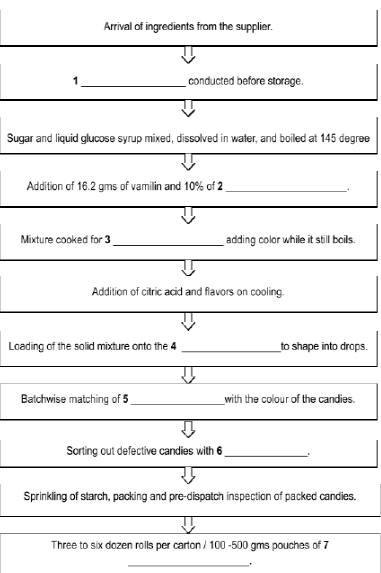
You will hear a speech by a supervisor at Jenny Davis, manager at the Rowentree Candy factory, who is talking about candy making. First look at Questions 1-7. Now listen to the audio carefully and answer 1-7.
Complete the flowchart below.
Write NO MORE THAN THREE WORDS AND/OR A NUMBER for each answer.
Answers for the Sample 1
1. quality check
2. reworks or the reworks
3. Thirty minutes or 30 minutes
4. roller machine
5. The flavours
6. metal detector
7. single wraps
IELTS Listening Flow Chart Completion Practice Sample 2
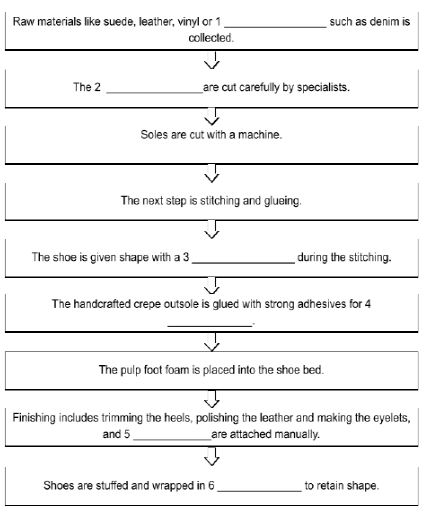
You will hear a speech by a supervisor at the Regal Shoe Manufacturing Company, who is talking about shoe production. Listen to the audio carefully and answer 1-7.
Complete the flowchart below.
Write NO MORE THAN TWO WORDS for each answer.
Answers
1. fabrics
2. uppers
3. lasting board
4. durability
5. shoelaces
6. wax paper
Tips & Strategies to Solve the Flowchart Completion IELTS Listening
Here are some proven IELTS listening flow chart completion tips to help you practice effectively and enhance your preparation.
- For effective preparation, practice using a reliable IELTS listening practice test, which will help you spot your mistakes and improve over time.
- Pay strong attention to transitional words used in recording to stay aligned with the flowchart’s order.
- Preview the instructions and overall flowchart structure in the beginning.
- Provide your response within the specified word limits and correct spelling.
- Understand the order of steps in the chart to predict what can come next in the audio.
- Watch for rephrased details and synonyms used in recording.
- Take section specific IELTS mock test to practice under timed conditions and exam scoring pattern.
Final Thoughts
Summing up, for effective IELTS preparation, the flow chart completion task demands multitasking and attention to detail skills. However, it becomes far more manageable once candidates understand how information is organised & sequenced in the recording, and practice regularly with a reliable IELTS listening test with audio and answers. With a thorough examination of the flowchart, anticipation of details, and catching up of paraphrased information, you can score high in this task. If you are facing any challenges while preparing for the test, connect with our experts through IELTS online coaching to receive dedicated guidance and training.
FAQs
1. Should I use American or British spelling in the IELTS Listening Flow chart completion Chart?
You are allowed to choose American and British English Spelling in the IELTS Listening test, as both are accepted. However, your spelling must be correct, and you should be consistent in the form you choose.
2. Can I write my answers in lowercase in the listening module?
You can write your answers in either lowercase or uppercase. Examiners, do not penalize answers written completely in lowercase, but all answers must be right and correctly spelled.
3. What is the difference between table completion and flowchart completion?
In a table completion task, answers are organized into rows and columns summarising facts or characteristics. For flowchart completion, you must fill in the missing steps of a process or a sequence. Both tasks are designed to assess the candidate tach the structured information, with the flow chart focusing on process order and the table focusing on categorised fact.
4. How do I improve my listening for different accents?
IELTS Listening features a range of native English accents, including British, Australian, New Zealand, and North American accents. To master each accent, you must practice with diverse English resources that will help you get familiar with how words and sounds vary.
5. How many times can I listen to the recording?
For IELTS Listening, you will hear each recording only once, requiring strong concentration and recognition skills.
0 comments

Practice Makes a Man Perfect!Take FREE ielts Mock Tests
Start FREE Mock Test


Get Unlimited Access with
IELTS Prep Boost

Mock Tests

Practice Questions

Study Material

Recorded Classes
What is your Target IELTS Band?








Get familiar with the Real IELTS Exam for Free!
Start Free Mock Test