
In IELTS Reading, there are 14 question types divided into 3 sections for a total of 40 questions. Each section has 3 or 4 different types of questions to answer. To complete all the answers in the reading section of IELTS, you only have one hour. In order to prepare well for your test, make sure that you practice each type of question through an ielts reading practice test. Thus, this blog covers the IELTS reading question types for both Academic and General along with tips and strategies to help you. Now let’s discuss how many types of questions are there in the reading section of IELTS.

Summarise with AI
Choose your AI Assist



Table of Contents

1. Matching Headings
2. Matching Paragraph Information
3. Matching Features
4. Matching Sentence Endings
5. True/ False OR Not Given
6. Multiple Choice
7. List Completion
8. Choosing a Title
9. Short Answer
10. Sentence Completion
11. Summary Completion
12. Table Completion
13. Flow Chart Completion
14. Diagram Completion
How Many Types of Questions Are There in IELTS Reading?
The IELTS Academic and General reading tests require you to answer 40 questions in a time period of 60 minutes. Therefore, there is no such difference in that regard. Both tests have a similar structure, the main difference is the level of difficulty. To excel in this section, it is important to understand the various reading types of questions. These questions are particularly designed to evaluate your skills such as reading for gist, finding information, and understanding logical arguments. By familiarizing yourself with the types of questions in IELTS reading, you can enhance your overall performance in this section.
The IELTS Reading test consists of three large texts that have a range of styles, from descriptive and factual to analytical. It is collected from materials such as books, journals, magazines, and newspapers. The questions are particularly suitable for individuals aiming to enroll in a university or pursue professional registration. Moreover, in the image below, there are various question types of IELTS reading test that can be asked in your exam.
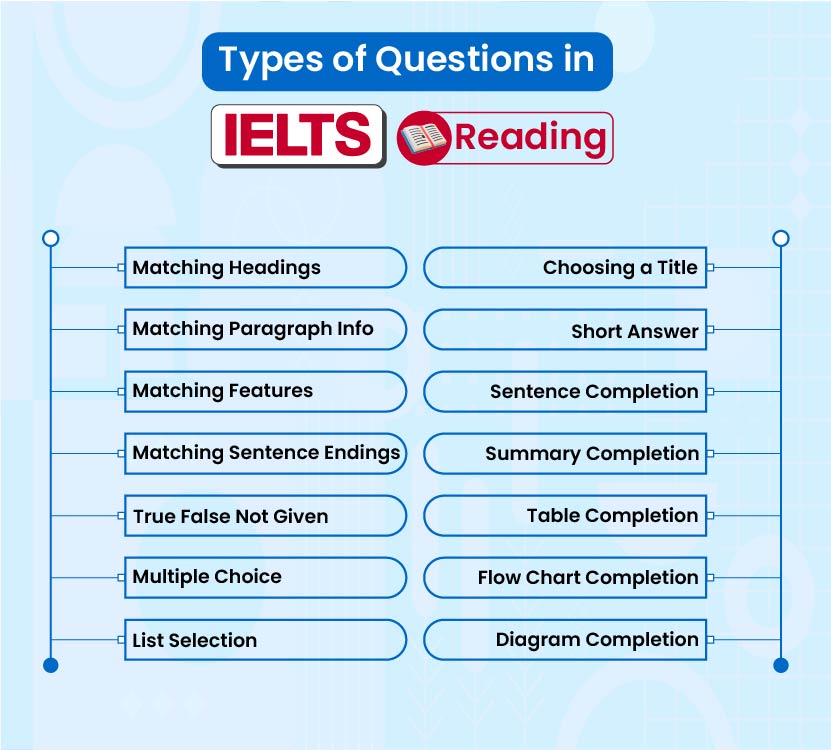
Let’s understand the questions of the IELTS reading section in detail.
14 IELTS Reading Question Types: A Comprehensive Overview
The IELTS Academic and General Reading test comprises 40 questions. Each question is of 1 mark. There are various reading types of questions used in the test to assess your skills. Now, let’s go through each question and the skills you will need for each one, as well as helpful tips.
1. Matching Headings
A list of headings marked with (i, ii, iii,..) and a passage with lettered paragraphs (A, B, C,...) are given. You must match the heading to the correct paragraph and write the appropriate number on the answer sheet. To make the task harder, there will be more headings than the number of paragraphs.
Skills:
- Understand the main idea of the text instead of the details.
- Identify the difference between a main idea and supporting points
- Read for the overall “gist” of the passage.
Tips:
- Read the headings before you read the passage
- Be aware of synonyms and look for them
- Answers don’t come in order, so you cannot use the text’s order as a guide
Read more: Explore our detailed guide on IELTS Reading Matching Headings with examples and expert strategies to score better.
2. Matching Paragraph Information
In this question type, there are several paragraphs labelled with different letters (A, B, C,...). You are supposed to match the information given in the question with the information found in one of the paragraphs. The task demands to write the letter of the correct paragraph on the answer sheet.
Skills:
- Ability to scan a text to detect specific information
- Understand specific supporting details in the text.
- Read the questions first and underline the keywords.
Tips:
- Think of some ways to paraphrase keywords
- Start with the easiest question first
- Think about the synonyms as you answer the questions.
Read more: Explore our detailed guide on IELTS Reading Matching Paragraph Information with examples and expert strategies to score better.
3. Matching Features
In this question of IELTS Reading, you need to match a set of statements or a piece of information from the given options. These options are a group of features from the passage. There’s a possibility that some options will not be used, while some may be used more than once.
Skills:
- Ability to determine relationships and connections between facts
- Make sure you are aware of the scanning technique
- High level of concentration
Tips:
- Read the first two and last two sentences of the paragraph and skim the other text
- Eliminate used headings to avoid confusion
- Briefly sum up the main idea of the paragraph in your own words
Want to master this? Read our detailed blog on IELTS Reading Matching Features

Practice for IELTS Reading Section with our Free IELTS Reading Mock Test ! ![Reading Section]() Take Reading Mock Test Now!
Take Reading Mock Test Now!
 Take Reading Mock Test Now!
 4. Matching Sentence Endings
The first half of the sentence will be provided, and you will need to match it with the second half. To complete the sentence, use the information from the passage.
Skills:
- Understand the main idea within the sentence
- Read the passage in detail
- Look for important information
Tips:
- Scan to find the location of the answer
- Read the instructions carefully to avoid basic mistakes
- All the sentences must be grammatically correct
Check out: IELTS Reading Matching Sentence Endings Practice & Tips for in-depth practice.
5. True/ False OR Not Given
Among all the types of questions in IELTS reading, this is the most tricky one. You will see statements that you need to identify as True/False or Not Given. You need to understand which information is in the passage, which is not, and which is not included.
Skills:
- You should recognize the information conveyed in the passage
- Spot the information in the text
- Understanding the opinions of the writer
Tips:
- Answers come in order
- Make sure that you do not confuse “No” with “Not Given.”
- Do not apply your knowledge about the passage
Read more: Explore our detailed guide on IELTS Reading True/ False OR Not Given Questions with tips, examples, and strategies.
6. Multiple Choice
In this, you will see a question with a selection of options (in letter format from A-D). The format can be a question or completing the sentence with the correct option. You are required to choose the right option from the list.
Skills:
- Get an overall idea of the passage
- You must have a good reading speed
- Scan the specific information
Tips:
- First, read the questions and then the paragraph
- Look for the distractions present in the question to confuse you
- Read in detail
Read more: Explore our detailed guide on IELTS Reading Multiple Choice Questions with examples and expert strategies to score better.
7. List Completion
Among the IELTS reading types of questions, this one is a little confusing as it resembles other variety of tasks in the reading section. In this, you will see a question and a list of possible answers, similar to the MCQs. Moreover, this question will tell you how many answers you will need to select, so you will need to select more than one answer.
Skills:
- Grasp the details in the text, so that you can correctly answer the question
- Focus on supporting details rather than the main idea
- Scan the text for specific keywords
Tips:
- You must select the exact number of options- (not more nor less)
- Read the instructions carefully and follow them
- While reading the answers, remember the keywords in each option.
Explore further: See how to solve IELTS Reading List Completion Questions efficiently with real test examples.
8. Choosing a Title
In this question of IELTS Reading, you have to choose the best title for a passage, based on the information given in the passage.
Skills:
- Identify the aim of a passage
- Know the purpose of a piece of writing
- Being able to skim-read
Tips:
- Study the difference between a general idea and a specific detail.
- Pay attention to the opening and closing paragraphs
- Read the titles closely for detail
Find out more: Understand this question type better in our detailed post on IELTS Reading Choosing a Title Question Type
9. Short Answer
In IELTS reading question types, students find this question the easiest to answer. You must answer the question using information from the text with a short phrase. Write your answers in specific words/numbers as per the given instructions.
Skills:
- Look for the specific details in the text
- Understand basic information
- Paraphrase the text to grasp the question statements
Tips:
- Understand the question words (Who, What, Where, When, Why)
- Think about the grammar once you get an overview of the question
- Check how many words you can use for the answer
Read more: Learn everything about IELTS Reading Short Answer Questions with examples and step-by-step strategies.
10. Sentence Completion
In this question, you are asked to complete the sentence with a specific number of words. It may be ‘one word, two/three words, no more than three words/a number, and so on.
Skills:
- Understand paraphrasing and synonyms
- Choose the right word from the text
- Scan the specific information
Tips:
- Think about the grammar
- Remember to double-check your spelling
- Use the time cautiously.
Learn more: Visit our complete guide on IELTS Reading Sentence Completion Question Type
11. Summary Completion
You will see a summary of a passage. To answer, you must use the real text to complete it. The answers don’t need to appear in the same order as given in the passage.
Skills:
- Have the potential to choose the correct words from a list of answers.
- Scan for specific information
- Ability to recognize a wide range of synonyms
Tips:
- Words must be grammatically correct
- Remember the parts of speech (nouns, adjectives, verbs).
- Read through your completed summary to ensure that it makes sense.
Know the details: Check out our blog on IELTS Reading Summary Completion Question Type
12. Table Completion
You will notice a table with missing information. Your task is to complete the summary using one word from the list for each gap.
Skills:
- Skim the text for a better understanding
- Paraphrase the original text
- Understand synonyms
Tips:
- Answers might not come in order
- Read the column headings in the table
- Check back to the text to make sure you have the correct information
Practice smarter: Follow this complete guide on IELTS Reading Table Completion to improve your accuracy.
13. Flow Chart Completion
You will see a flow chart with misplaced information. You need to correctly fill the flow chart, and may or may not have a word bank. Flow Charts are typically considered “Most Difficult” in the IELTS Reading section.
Skills:
- Locate the specific information in the text
- Learn how to paraphrase details from the passage
- Understand synonyms
Tips:
- Don’t let the layout or image related to the flow chart confuse you
- Always double-check your grammar
- Use the direction of the arrows and boxes to follow the order of information
For a deeper understanding: Explore IELTS Reading Flow Chart Completion – Skills & Tips
Get FreeIELTS Classes
We will get you admission in Top Abroad Universities with Completely FREE IELTS Coaching! 

14. Diagram Completion
You will spot one or more diagrams with incomplete labels. Using information from the passage, you need to fill those gaps.
Skills:
- Choose appropriate words
- Locate information in the passage
- Relate the details to the diagram
Tips:
- Find the information in the passage
- Identify the type of word you need for your answer (noun/verb, etc)
- Answers do not always come in order
Read more: Explore our detailed guide on IELTS Reading Diagram Completion Questions with examples and expert strategies to score better.
Overall, these are the 14 types of questions in IELTS reading that you will be facing. Now let’s discuss in the next section the common challenges in the reading types of questions and how to overcome them.
Common Challenges and How to Overcome Them
- Academic Style: Many students find it hard to deal with the tricks of Academic English if they have never faced it before. Also, the reading section of IELTS includes such topics, so they have to be prepared to avoid confusion.
- Misleading and Confusing: Well, IELTS reading question types are specifically designed to challenge the students. Thus, the more tests a student takes, the easier it gets to see certain patterns and tendencies.
- Being Aware of the Structure: Having good language skills is not enough to succeed. Quick performance is only possible if the student is familiar with the body of the test and the syllabus of IELTS reading section.
- Focus on the Details: It is not enough to have a basic understanding of what the text is about. The key to success in this part is demonstrating a supreme level of text comprehension.
Overall, these are the most common challenges that any student faces in the IELTS reading part. To overcome these issues, you can start your IELTS journey with us. Now our next section covers some strategies that you can use to ace the types of questions in IELTS reading.
Strategies to Success in IELTS Reading
1. Skimming and Scanning: These two are the most effective techniques for managing the complex sentences in the reading section. When you skim a paragraph, you get an overview or main idea of the passage. On the other hand, scanning involves searching for specific data and keywords.
2. Effective Time Management: Time management is one of the crucial skills that can make or break your performance. The reading section is not liberal with time, so it’s important to pace yourself. Another time-saving strategy is to read the questions before diving into the passage.
3. Building Vocabulary and Comprehension: The IELTS exam pattern for the reading section is based on strong vocabulary. As it is a key to unlocking the meaning of complex sentences. Regularly read academic texts, journals, and articles to familiarize yourself with the formal language. The more students read, the less challenge they find in the passage.
Overall, the reading section is difficult, and these strategies will help you achieve the desired score.
Gradding Premium
Master the IELTS exam with our Prep Boost
What’s included:
- Pre-recorded video lectures
- Advance Study Materials
- Detailed Feedback Report
Conclusion
Finally, this blog has helped you to get familiarized with IELTS reading question types, and implement the tips provided for each task. Through the tips and skills, you can enhance your performance and overall score. With consistent efforts, you can confidently navigate the reading section and achieve success in your IELTS exam. Develop a study plan that focuses on each question type individually. Moreover, if you want to prepare for the IELTS reading section then join our offline or online IELTS classes at Gradding.com
0 comments
Practice Makes a Man Perfect!Take FREE ielts Mock Tests
Start FREE Mock Test


Get Unlimited Access with
IELTS Prep Boost

Mock Tests

Practice Questions

Study Material

Recorded Classes
Buy Now
What is your Target IELTS Band?
Band 6.0 to 7.0
Band 7.0 to 8.0
8+ Band
Get familiar with the Real IELTS Exam for Free!
Start Free Mock Test