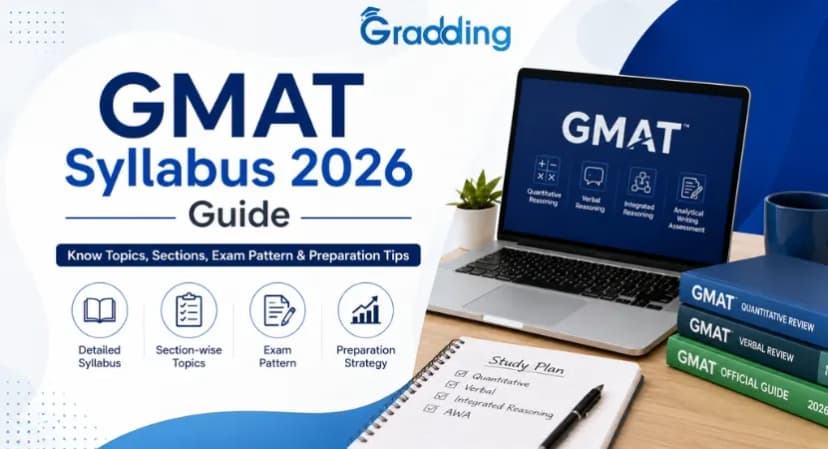
GMAT Exam Overview 2026: Fees, Structure and Registration Process
Thinking of pursuing an MBA degree or other master’s program in Business Administration? You are likely to come across the GMAT exam, a standardised test that is recognised globally as one that helps business schools evaluate your readiness for graduate education. No matter if you are just finishing up your college studies or changing professions and entering the world of business, you can find detailed information about what the GMAT is all about, how it works, and how to prepare for it.

Summarise with AI
Choose your AI Assist



Table of Contents

1. What is the full form of GMAT?
2. How many times can I take the GMAT?
3. What is a good GMAT score for MBA admission?
4. Is GMAT harder than GRE for Indian students?
5. How long is a GMAT score valid?
6. How long does it take to prepare for the GMAT?
7. Is GMAT compulsory for MBA programs abroad?
8. What are the three sections of the GMAT Focus Edition?
9. Can a fresher take the GMAT exam?
10. What is the GMAT Focus Edition and how is it different from the old GMAT?
What is the GMAT Exam?
GMAT is one of the many standardised exams that you can decide to undertake while applying for an MBA graduate program. It stands for Graduate Management Admission Test and helps business universities or schools to compare the academic skills of different applicants. More than 2,000 institutions recognise the GMAT across 110 countries, including about 200 institutions in India. The Graduate Management Admission Council (GMAC) assesses key abilities such as reasoning, analytical skills, and information skills and offers the GMAT.
Key Highlights on GMAT 2026 Edition
The exam features a Focus Edition format that is different from the old GMAT exam format. The key differences between the two exam types are as follows:
| Feature | Old GMAT (Classic) | GMAT Focus Edition (Current) |
|---|---|---|
| Total duration | 3 hours 7 minutes to 3 hours 30 minutes | 2 hours 15 minutes |
| Total questions | 80 | 64 |
| Number of sections | 4 (AWA, IR, Quant, Verbal) | 3 (Quant, Verbal, Data Insights) |
| Analytical Writing Assessment (AWA) | Present (separately scored, 0–6) | Removed entirely |
| Integrated Reasoning | Separate section, scored 1–8, didn't count toward total | Expanded into Data Insights, counts equally toward total score |
| Sentence Correction | Part of Verbal | Removed from Verbal |
| Geometry | Part of Quant | Largely removed from Quant |
| Data Sufficiency | Part of Quant | Moved to Data Insights |
| Total score range | 200–800 | 205–805 |
| Section order | Fixed | Candidate chooses the order |
| Answer review/edit | Not allowed | Up to 3 answers can be changed per section |
Who Should take the GMAT?
The GMAT caters to a certain type of candidate population, but the criteria are broader than what people would assume. Common candidates who should take this exam include:
- Fresh university graduates of any discipline who aspire to pursue an MBA program abroad
- People with experience of 2-5 years who want to get into an MBA program (full-time or executive).
- Professionals who want to switch their careers and need some strong quantitative measure of performance for the same.
What is the GMAT exam structure 2026?
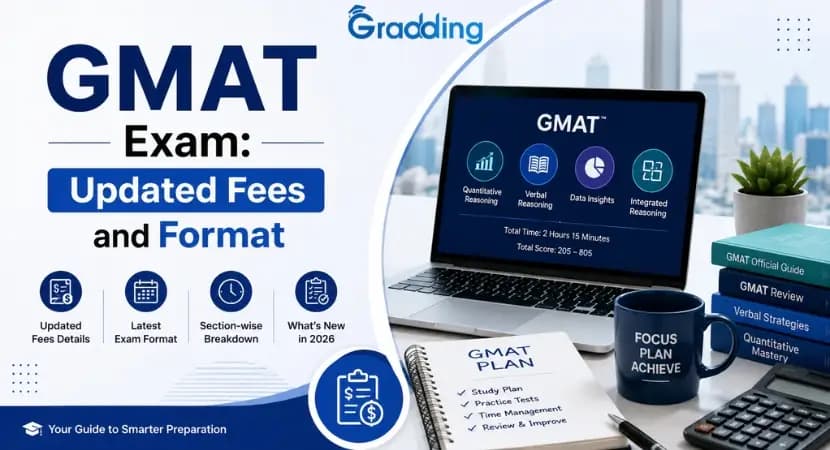
The GMAT exam 2026 is composed of three equally weighted sections that take 45 minutes each: Quantitative Reasoning, Verbal Reasoning, and Data Insights. The entire exam takes exactly 2 hours and 15 minutes to complete with 64 questions and one optional break for 10 minutes. Here is what students can expect in each section of the exam:
- Quantitative Reasoning section – It consists of 21 questions dealing with problem solving. This part of the GMAT exam syllabus evaluates basic algebraic and arithmetic skills; it does not include Data Sufficiency and traditional geometry.
- Verbal Reasoning section – Students will see 23 questions in this part. It examines Reading Comprehension and Analytical Skills. Sentence Correction has been removed from the syllabus.
- Data Insights section – This task contains 20 questions. It tests data interpretation skills and includes Data Sufficiency, Graphic Interpretation, Two-Part Analysis, Table Analysis, and Multi-Source Reasoning.
What is Computer Adaptive Testing in GMAT?
CAT in GMAT shows that there is an adjustment of the difficulty level of subsequent questions based on the answers you give. If you answer a question correctly, the difficulty level of the next question increases, whereas if you fail a question, the difficulty level decreases. The score you obtain depends not only on the number of correct answers but also on your proficiency level. It is important to consider this factor before starting the GMAT exam preparation. Instead of providing the same long test to all students, the computer uses Item Response Theory (IRT). Using this theory, the computer can determine your exact level of expertise by varying the difficulty of the questions.
How is the GMAT scored?
Your total score in GMAT is measured between 205 and 805 with increments of 10 points, while your score in each of the three sections is scored individually on a scale from 60 to 90. Given that Quant, Verbal, and Data Insights have equal weightage, it is not possible to offset a poor score in one section using another.
The table below shows the conversion of GMAT exam scores in percentile format for a better understanding:
| Score | Approximate Percentile |
|---|---|
| 745+ | 99th percentile |
| 695 | 98th percentile |
| 655–665 | 90th percentile |
| 645 | 88th percentile |
| 600 | 75th percentile |
| 550 | 55th–60th percentile |
What is a good GMAT score?
The definition of a "good" GMAT score depends on your application purpose. Most prestigious MBA schools require GMAT scores above 685, and top-notch MBA institutions require even higher scores, which are 700 or more. Here are the approx. average for GMAT accepted universities across the globe:
| University Name | Country | Approx. GMAT Score Requirements |
|---|---|---|
| Harvard Business School | USA | 695 - 730 |
| London Business School (LBS) | UK | 650 – 710 |
| Melbourne Business School | Australia | 600-650 |
| York University | Canada | 550 – 660 |
| University of Oxford | UK | 650 – 690 |
| MIT Sloan School of Management | USA | 645 – 725 |
| Wharton School, University of Pennsylvania | USA | 675 – 705 |
| University of Toronto | Canada | 620 – 730 |
| Western University | Canada | 670 – 710 |
| IESE Business School | Spain | 640 – 715 |
GMAT Exam fees 2026
The basic GMAT exam fees for taking the test at the centre are $275, while the online test costs $300. Fees are affected by taxes that vary from place to place (for example, for those in the UK and EU, the normal rate of VAT is charged). Moreover, the rescheduling fees vary between $55 and $180.
| Fee type | Base fee (USD) | Approximate cost in India |
|---|---|---|
| Test centre exam | $275 | INR 27,000 |
| Online (at-home) exam | $300 | INR 28,881 |
| Rescheduling (60+ days before) | $55 | INR 5,294 |
| Rescheduling (15–60 days before) | $110 | INR 10,589 |
| Rescheduling (under 14 days before) |
| INR 15,884 |
How to Register for the GMAT Exam?
The process of GMAT exam registration is quite easy; students need to follow the steps cited below to book their test:
- Create an mba.com account– Start the process by creating your mba.com account with the full name that is stated on your government identification card.
- Verify Identity- Confirm your identity and complete your profile, which includes nationality, date of birth, and contact details.
- Choose Exam Format- Make your choice regarding the format you prefer, either GMAT Online or the Testing Centre format.
- Select location and Date- Decide on the date and location, since availability in Indian testing centres is limited a few weeks before peak periods.
- Pay Registration Fee– Students need to pay a registration fee through their credit or debit card if international transactions are enabled; remember that GST is added, as well as a small foreign transaction fee by your bank.
- Receive Confirmation- Get your confirmation and access to GMAC official study material.
Eligibility Criteria for GMAT Exam
Candidates preparing for the exam must understand the GMAT exam eligibility requirements to apply for it without any problems. Here are the details of specific requirements that students must meet to take this exam:
- Age requirement- 18, or 13-17 if consent from parents/guardians has been obtained before applying.
- No educational prerequisites– GMAC does not require any qualifications for the candidate or a specific degree field for the examination.
- Number of attempts limits- maximum 5 attempts in any 12 months, and each attempt must be at least 16 days apart. The recent change made by GMAC is removing the previous lifetime limit on attempts (8 attempts), meaning that now there is no fixed lifetime limit on attempts anymore, but only the yearly one stays in place.
- Passport requirement for India test centres- an up-to-date passport is a crucial requirement.
GMAT vs GRE: Which is better for Indian students?
Students who are willing to advance their career in the management field should opt for the GMAT because it will help them study abroad with GMAT at top business schools. However, students looking for flexibility between MBA and technical Master’s degrees should choose the GRE exam.
| Comparison Factor | GMAT | GRE |
|---|---|---|
| Purpose & Acceptance | Explicitly designed for entrance into MBA programs and business schools. Endorsed by leading business schools all over the world. | Approved for MBA programs as well as masters and doctoral programs in different disciplines. |
| Exam Pattern & Difficulty | Focuses on numerical problems, data analysis, and analytical skills. Less emphasis on vocabulary. | It includes verbal, analytical, and quantitative reasoning tests, giving greater importance to vocabulary. |
| Career Goals | Appropriate for those individuals who wish to pursue careers in management consultancy, finance, marketing, and corporate management as MBA candidates. | Suitable for those individuals seeking diverse graduate studies, such as engineering, sciences, humanities, and business. |
| Admissions & Scholarships | Acknowledged by business schools; there are some business schools that value GMAT scores in their admissions process. | Recognized by many of the most renowned business schools. High GRE scores may improve scholarship opportunities. |
| Best Choice for Indian Students | Recommended for those students who have set goals for their MBA degree and good quant skills. | Recommended for those students who are unsure, will apply to several graduate schools, or have better verbal skills. |
GMAT Score Validity and Sending Scores to Universities
GMAT scores stay valid for a period of exactly 5 years from the actual date of your test completion. Despite the fact that the test-administering organisation, GMAC, maintains your score information within their database for up to 10 years, most business colleges will outright reject your score if it is older than 5 years.
Students can send their GMAT exam scores to top business schools and universities using the following three easy steps. They can use the university predictor tool to find the most suitable institution for themselves:
- Log In: The first step requires the candidate to go to the MBA.com Official Score Sender website.
- Search Institutions: Find your choice of universities based on their names or programs offered. The program codes are no longer required in your search.
- Confirm and Send: Review your institutions carefully before you send. The system will deliver your official test scores within 24 hours.
GMAT Score Required for MBA Programs in US, UK, Canada & Australia
The top MBA programs demand high GMAT scores, which usually range between 650 and 730, and differ from one university to another. However, the minimum score requirement for the GMAT exam for study abroad is as follows:
| University | Country | Approx. GMAT Score |
|---|---|---|
| Wharton (UPenn) | USA | 733–735 |
| Melbourne Business School | Australia | 670 |
| Harvard Business School | USA | 735–740 |
| ISB | India | 710 |
| IIM Executive/PGPX programs | India | 650+ |
| London Business School | UK | 700–710 |
| Schulich | Canada | 640 |
| UNSW | Australia | 640 |
| MIT Sloan | USA | 730 |
| Oxford Saïd | UK | 690 |
How to Prepare for GMAT Exam?
Students should dedicate a period of 2 to 4 months to prepare for their GMAT scores. The best way to prepare involves creating a benchmark through a reliable diagnostic test, learning basic concepts, and doing complete tests within a time limit. Moreover, they can employ the following expert tips in their study plan to enhance their overall practice:
- Know the Exam Format – Before you embark on the preparation process, it is advisable that you get familiar with the GMAT test format, types of questions, and marking. This way, you will be able to create a good preparation strategy as compared to focusing on less significant areas.
- Learn Basic Concepts – Many test takers jump straight into taking practice tests, but the real trick to getting a good grade lies in having proper foundations in place. Build on your skills related to numbers, analysing data, and thinking analytically before you start solving under time pressure. It will make dealing with complex problems much easier.
- Practice with Mock tests – Remember that you should give practice tests for their entire length in undisturbed conditions. You will be able to develop a sense of time, improve your stamina, and get used to the speed of the test. After any test, it is important to analyse your mistakes and know what went wrong.
- Emphasize on Quality – Practicing many questions is not as productive as learning from every mistake made. One needs to make a list of mistakes, identify the areas where one keeps on making mistakes and then revise those areas.
- Practice with Persistence – Make a viable timetable for your studies and follow it. The idea of planning a few hours of studying per day is far more productive than last-minute cramming. Apart from the correct planning, do not forget about enough sleep, physical exercise, and rest.
Students can easily secure scores above 700 on the GMAT exam with the right preparation strategies and consistent practice. However, the real struggle is finding the right study abroad university. In this case, you can seek assistance from our study abroad consultants to make a rational decision for your future. So, connect today!
FAQs:-
1. What is the full form of GMAT?
GMAT stands for Graduate Management Admission Test, a standardised exam used for admission to MBA and other graduate management programs.
2. How many times can I take the GMAT?
Students can take the GMAT exam up to 5 times in any rolling 12-month period, with a mandatory 16-day gap between attempts.
3. What is a good GMAT score for MBA admission?
It depends entirely on your target schools, but a score in the mid-600s is competitive for many good programs, while M7 schools typically expect 700+.
4. Is GMAT harder than GRE for Indian students?
GMAT's Data Insights and Data Sufficiency questions test business-context reasoning that some students find tougher, while GRE Verbal's vocabulary demands trip up others. Indian students often do very well on GRE Quant specifically.
5. How long is a GMAT score valid?
The GMAT scores are usually valid for 5 years from your test date.
6. How long does it take to prepare for the GMAT?
Most candidates prepare for 3–6 months, depending on their starting baseline and target score.
7. Is GMAT compulsory for MBA programs abroad?
No, some programs offer GMAT waivers or are test-optional, but it remains strongly preferred at most top-ranked business schools, including Harvard and Oxford.
8. What are the three sections of the GMAT Focus Edition?
The three sections are Quantitative Reasoning, Verbal Reasoning, and Data Insights, each 45 minutes long and equally weighted.
9. Can a fresher take the GMAT exam?
Yes, there's no work-experience requirement to sit for the exam itself, though most competitive MBA programs expect candidates to have some professional experience by the time they enrol.
10. What is the GMAT Focus Edition and how is it different from the old GMAT?
It is the current version of the exam, launched in 2023 and made mandatory from February 2024. It is shorter, has 3 sections instead of 4, drops the essay section, and replaces Integrated Reasoning with the more heavily weighted Data Insights section.
0 comments


Hand Picked Courses
Get Scholarship Assistance
Get Offer in 15 Days*
Finance/Loan Assistance
I want FREE assistance with