
GMAT Syllabus 2026 | Latest Exam Pattern, Sections & Preparation Guide
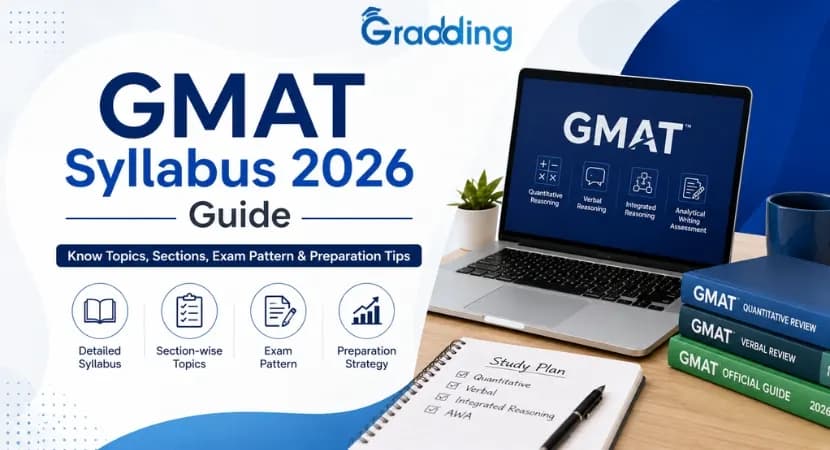
When you are looking to secure admission into an MBA program, you have probably come to realize how much the GMAT syllabus 2026 differs from that which your seniors took. The exam has been reformed by GMAC through the GMAT Focus Edition and now emphasizes the skills needed by B-schools such as quant skills, verbal skills, and data literacy skills. In this guide, we will discuss the complete/updated GMAT syllabus, its format, topics per section, and a realistic study plan. Read On!

Summarise with AI
Choose your AI Assist



Table of Contents

1. How many times can I appear for the GMAT exam?
2. Can I skip any section of the GMAT exam pattern?
3. Is there any break available in GMAT exam 2026?
4. How long does it take to prepare for the GMAT exam?
5. Can I use a calculator in the GMAT exam?
6. How to get a perfect GMAT Score?
7. How should candidates prepare for GMAT according to its syllabus?
8. What are the significant changes in the latest GMAT syllabus?
9. Is the GMAT Syllabus same as CAT Exam?
10. Is GMAT hard to take?
How to Ace the GMAT Exam?
GMAT success requires consistency and not just a shining performance in one area. It is because every section carries equal weight in the GMAT Focus Edition. The successful candidates link their preparations with the updated GMAT syllabus and give equal importance to Data Insights along with Quantitative and Verbal. They review mock tests question-type by question-type to fix recurring mistakes, not just the total score.
The time limit for all the sections is the key to consider because the candidates get less than two minutes for each question when there are 20-23 questions in 45 minutes per section.
GMAT Syllabus 2026: Latest Updates
One of the very significant changes has been made in the GMAT syllabus examination in decades. According to GMAC, the conventional GMAT has been now re-named as GMAT Focus Edition in February 2024, and from 2026 onward only the form of GMAT known as Focus Edition will be accepted by all the universities. It has to be noted that the name of GMAT does not include 'Focus Edition' in its official title, and GMAT is known as such because of its similar structure.
The syllabus of GMAT exam now consists of three sections having equal weightage in the marks system. These sections include Quantitative Reasoning, Verbal Reasoning and Data Insights. The syllabus of new GMAT examination has lowered the time period of the entire examination from more than 3 hours to 2 hours 15 minutes, along with a break of 10 minutes.
What's New in the GMAT Focus Edition?
There are a few key changes that become apparent once you look at the new syllabus for GMAT:
- The Analytical Writing Assessment (the essay portion of the test) has been eliminated.
- No geometry problems in Quantitative Reasoning.
- Sentence Correction problems are gone in Verbal Reasoning.
- Data Sufficiency, which was a part of various sections before, is now included only in Data Insights.
- The introduction of a completely new Data Insights section that combines Integrated Reasoning style problems and Data Sufficiency.
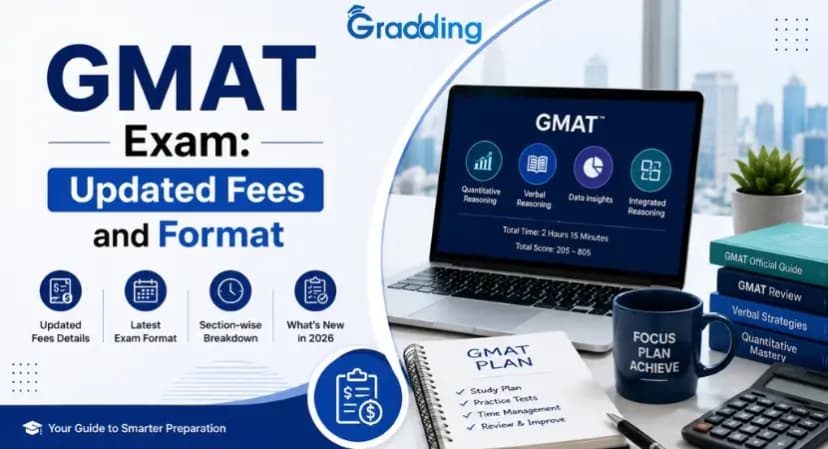
- The scoring has been changed to a scale of 205-805 from the former 200-800, so scores should not be compared across formats directly.
- Students will be able to decide on section sequence and even edit up to three answers in each section, unlike in the old format.
- Score validity period remains five years.
Differences Between the Classic GMAT and GMAT Focus Edition
Basically, nothing beats understanding the GMAT test syllabus 2026 by seeing it in comparison to its previous test format.
| Basis | Classic GMAT | GMAT Focus Edition |
|---|---|---|
| Duration | Around 3 hours 7 minutes | 2 hours 15 minutes |
| Sections | 4 (including AWA) | 3 (no AWA) |
| Geometry | Included in Quant | Removed |
| Sentence Correction | Included in Verbal | Removed |
| Data Sufficiency | Spread across sections | Concentrated in Data Insights |
| Score range | 200 - 800 | 205 - 805 |
| Answer review | Not allowed | Up to 3 edits per section |
| Section order | Fixed | Candidate's choice |
This reduced format implies fewer items to memorize, but each question counts more and therefore needs to be answered more accurately. It is also important to know that most Indian and international business schools such as IIM, ISB, and XLRI have stated that they will accept only the new format.
GMAT Exam Sections 2026
The GMAT new exam format comprises 64 questions distributed into 3 sections, where each section is allocated 45 minutes’ time duration. The following is an outline of the GMAT syllabus in terms of individual sections.
Quantitative Reasoning Syllabus
In the Quantitative Reasoning section, there are 21 Problem Solving questions to solve in 45 minutes, and calculators are strictly forbidden in this section. This section evaluates your understanding of arithmetic and basic algebra, but more than that, it measures the logic behind your problem-solving under time constraints. The GMAT topics in this section include the following:
1. Arithmetic:
- Number Properties: Integers, odd/even numbers, prime numbers, divisibility, factors, and multiples.
- Fractions & Decimals: Operations and conversions.
- Percentages & Ratios: Proportions, ratios, and profit/loss calculations.
- Exponents & Roots: Order of operations, powers, and roots.
- Statistics: Descriptive statistics like mean, median, mode, and range.
2. Algebra:
- Linear & Quadratic Equations: Solving equations and interpreting solutions.
- Inequalities & Absolute Values: Solving and graphing inequalities.
- Functions: Understanding and manipulating algebraic functions.
- Sequences: Arithmetic and geometric progressions.
3. Applied Math:
- Word Problems: Translating real-world scenarios into mathematical expressions.
- Rates: Speed-time-distance and work-time problems.
- Counting Methods: Permutations and combinations.
- Probability: Discrete probability and set theory.
Now that you do not have to focus on geometry anymore, the emphasis should be on number properties, algebraic expressions, and practical applications in the form of word problems.
Verbal Reasoning Syllabus
There are 23 Verbal Reasoning questions that are also done within 45 minutes and these questions test only your comprehension and reasoning abilities without any grammar rules. The two types of questions in this section are:
1. Reading Comprehension:
- Main Idea / Primary Purpose: Identifying the passage's overall theme or the author's intent.
- Supporting Ideas: Locating specific facts or details explicitly stated in the text.
- Inference: Drawing logical conclusions based on information implied rather than directly stated.
- Application: Applying concepts from the text to a new, hypothetical situation.
- Logical Structure: Understanding how the passage is organized (e.g., chronological, cause/effect, compare/contrast).
- Style and Tone: Analyzing the author's attitude, word choice, and the overall tone of the text.
2. Critical Reasoning:
- Find the Assumption: Identifying unstated premises that are required for the argument to hold together.
- Strengthen/Weaken the Argument: Determining which new evidence or information would make the argument's conclusion more or less valid.
- Evaluate the Conclusion: Identifying what additional information would be most helpful in determining the logical strength of the argument.
- Resolve a Paradox: Finding the logical explanation or solution for two seemingly contradictory statements.
- Inference: Identifying a statement that must be true based purely on the premises provided.
- Boldface Questions: Analyzing the structure of an argument by identifying the specific role played by specific portions of text (which appear in bold print).
Sentence Correction has been eliminated from the Verbal Reasoning section, meaning you would not have to learn any grammar rules as previous GMAT test takers had to do.
Data Insights Syllabus
Here lies the reason why the current GMAT Syllabus PDF looks so drastically different from any previous version up until 2024. Data Insights consists of 20 questions to be completed within 45 minutes, and this is the only section where an on-screen calculator is permitted. It evaluates the ability to derive meaning from data provided in various forms, which, according to GMAC, is a crucial skill for today’s business jobs. There are five types of questions here:
- Data Sufficiency: Determines whether the information given is enough to solve a quantitative problem, without necessarily requiring you to solve it completely.
- Multi-Source Reasoning: Requires analysing data spread across multiple tabs, texts, tables, or graphics to answer questions.
- Table Analysis: Tests your ability to sort and interpret data laid out in a spreadsheet-style table.
- Graphics Interpretation: Involves reading graphs, charts, and visual data to draw accurate conclusions.
- Two-Part Analysis: Presents a problem with two related components that must both be answered correctly, testing quantitative and verbal reasoning together.
In essence, this part involves math, logic, and data literacy, thus surprising many candidates who take it for granted that it is all about math. Take it seriously as a separate subject.
GMAT Syllabus Vs Exam Pattern
It becomes quite convenient to separate two items which generally tend to get mixed up with one another - syllabus and exam pattern. The GMAT exam syllabus refers to the matter to be tested, while the GMAT exam pattern refers to the way in which the test is going to be conducted.
This is how the exam pattern looks like in general:
| Section | Number of Questions | Time Allotted | Calculator Allowed |
|---|---|---|---|
| Quantitative Reasoning | 21 | 45 minutes | No |
| Verbal Reasoning | 23 | 45 minutes | No |
| Data Insights | 20 | 45 minutes | Yes |
| Total | 64 | 2 hours 15 minutes | - |
You have an option to pick and choose the order of these sections as well as to take a break for 10 minutes only once throughout the test. Every section will receive individual scoring from 60 to 90 and then added up to form your total score ranging from 205 to 805. Knowing this GMAT test syllabus and pattern together helps you in making a choice concerning the sequence of the sections in your own test.
GMAT Preparation Tips
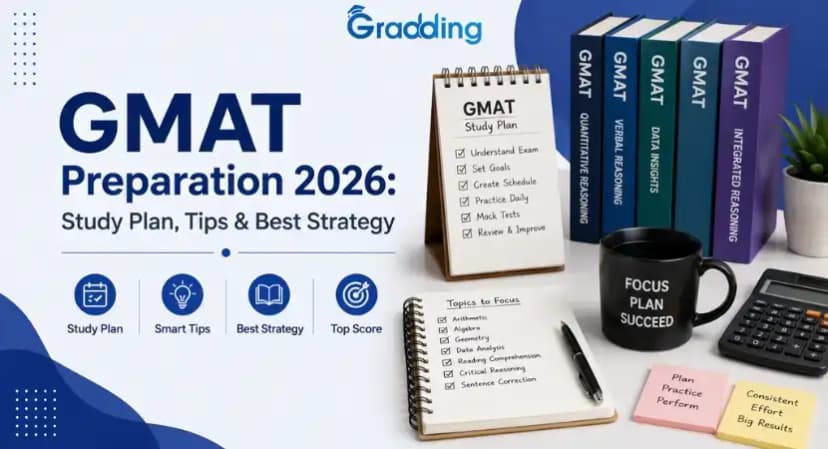
1. Building a Study Plan
- Most candidates prepare 4–6 months before their test date, depending on starting comfort level with the GMAT curriculum.
- Take a diagnostic mock in week one to identify your baseline across all three sections.
- Spend the first month building foundational Quant and Verbal concepts.
- Introduce Data Insights early, since it blends skills from both other sections.
- Spending 4-6 weeks doing full length practice exams and analyzing errors is ideal.
- Taking a short break before taking the exam prevents overworking yourself.
- Consistency is more effective than intensity when it comes to preparation.
2. Choosing Study Material
- Concentrate on only those areas that pertain to the syllabus of the GMAT Focus Edition test.
- GMAT Official Guide is still the best source to start off from.
- Add to this coaching classes, discussions on GMAT Club, and practice tests from mba.com, which come closest to replicating the actual exam environment.
3. Mock Tests & Performance Analysis
- Mock tests build stamina and pacing, not just accuracy.
- After each mock, analyze performance question type by question type.
- If self-study feels directionless, a study abroad consultants team can help align your GMAT timeline with application deadlines.
4. Setting a Target Score
- Research median GMAT scores at shortlisted schools early in your prep.
- Calculate the weekly study hours required to reach your target.
What to Do After the GMAT Exam?
After finishing the GMAT exam, your score is shown right away on your screen, and it is up to you to choose either to report your score or not at the time when you leave the test center. The Official Score Report becomes available just after a few days from your test date, and you have the choice to send your score reports to five schools for free for the next 48 hours after that.
From here, compare your score against your shortlisted universities' median GMAT ranges. When you are close to the target, concentrate on other parts of your application like the CV and the letter of intent. In case of a significant difference, you can retake the GMAT test following the waiting period of 16 days for a maximum of five times in 12 months and eight times altogether. As from November 2023, the university will automatically see your latest score, which means that the retake offers you a fresh chance without being influenced by your previous score.
Frequently Asked Questions:
1. How many times can I appear for the GMAT exam?
You can attempt GMAT maximum of five times in a rolling 12-month period and a total of eight times in life, but you must maintain a gap of at least 16 days between two consecutive attempts.
2. Can I skip any section of the GMAT exam pattern?
No, you cannot skip any section. The section will be considered completed when all the questions of that section have been answered or the time limit has been exhausted.
3. Is there any break available in GMAT exam 2026?
Yes, one optional 10 minutes break is provided, and you can take that break after the completion of the first or the second section according to your preference.
4. How long does it take to prepare for the GMAT exam?
Most test-takers need a preparation time of four to six months, which varies as per the proficiency level of the person, targeted GMAT score and the amount of time he/she can invest in GMAT preparation.
5. Can I use a calculator in the GMAT exam?
Only in Data Insights section an on-screen calculator is provided while in Quantitative Reasoning and Verbal Reasoning sections it is not allowed.
6. How to get a perfect GMAT Score?
In order to secure a near-perfect GMAT score, it is essential for the candidates to demonstrate an accurate performance in each of the three equally important GMAT sections. It requires discipline and time management during preparation as well as a comprehensive analysis of each GMAT practice test.
7. How should candidates prepare for GMAT according to its syllabus?
Prepare yourself according to the three sections, i.e., Quantitative Reasoning, Verbal Reasoning, and Data Insights in equal time and without prioritizing any specific topic in your syllabus.
8. What are the significant changes in the latest GMAT syllabus?
Significant changes in the new GMAT syllabus include the elimination of the Analytical Writing Assessment, Geometry and Sentence Correction questions, addition of the Data Insights section and modified score range between 205 to 805.
9. Is the GMAT Syllabus same as CAT Exam?
No, GMAT syllabus differs from CAT Exam. While GMAT includes Quantitative Reasoning, Verbal Reasoning, and Data Insights sections, CAT has Verbal Ability and Reading Comprehension, Data Interpretation and Logical Reasoning, and Quantitative Aptitude, including Geometry section.
10. Is GMAT hard to take?
GMAT is a very hard adaptive test requiring accuracy and critical thinking rather than memorization. However, it can be mastered if one studies systematically. Moreover, GMAT requires steady work, as it is almost impossible to guess all answers correctly.
0 comments


Hand Picked Courses
Get Scholarship Assistance
Get Offer in 15 Days*
Finance/Loan Assistance
I want FREE assistance with






Ready to Start Your Study Abroad Journey?
Connect With Us!