
GMAT Preparation 2026: Complete Study Plan, Tips and Best Strategy
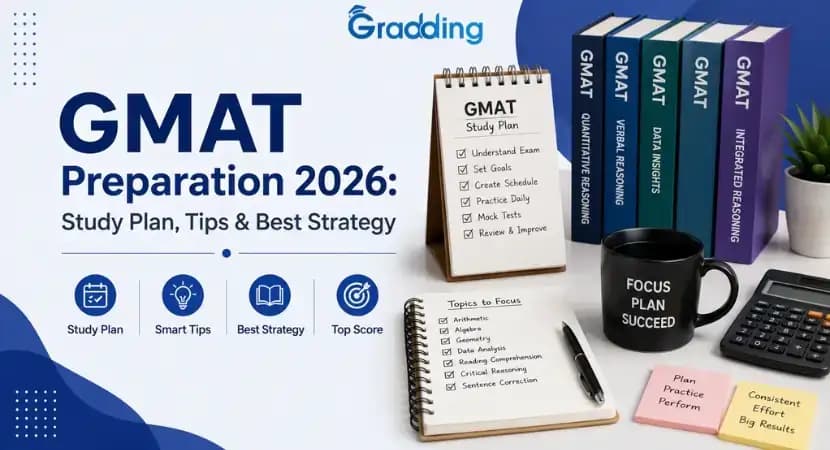
When you are looking forward to studying in an elite MBA school, then GMAT preparation is definitely what stands between you and the admission notice. Additionally, GMAT is not the kind of examination where cramming in the eleventh hour pays off. It requires a plan. A genuine one, with a timetable, sectional objectives, and lots of practice tests to gauge your position before the exam day arrives. But many students struggle to create a smart study plan and follow it consistently. Therefore, this guide deals with everything about efficient GMAT preparation in 2026.

Summarise with AI
Choose your AI Assist



Table of Contents

1. Can You Prepare for the GMAT Without Coaching?
2. How Long Does It Take to Prepare for the GMAT?
3. How should beginners start GMAT preparation?
4. Is 3 months enough for GMAT preparation?
5. How many hours should I study daily for the GMAT?
6. Which books are best for GMAT preparation?
7. Can I prepare for the GMAT without coaching?
8. How many mock tests should I take before the GMAT?
9. What is the best GMAT preparation strategy for a 700+ score?
10. How can I improve my GMAT score quickly?
Why Is GMAT Preparation Important?
Candidates can easily be inclined to treat the GMAT simply as another box to check off in terms of their MBA application process. That is far from the truth. The admissions committee at many top business schools uses the test to provide a standard gauge for measuring individuals with widely varied academic backgrounds, industries, and nationalities. Scoring well on this test not only increases your chances for acceptance but also leads to potential scholarship opportunities to reduce the cost of your education.
- Admissions & Funding- A good grade is a reflection of your academic abilities and is very much correlated with securing merit-based scholarships in prestigious universities.
- Skill Development- The acquisition of knowledge leads to skills in analyzing information and developing comprehension of what one reads. Moreover, you develop an ability to complete tasks under time constraints.
- Standardized Comparison- Since everyone comes with a diverse background in academics and professional experience, GMAT provides an excellent benchmark for business schools to predict your forthcoming performance.
How to Start Your GMAT Preparation?
The biggest mistake that most people make is opening a textbook right from the very first day without knowing where they stand. However, they forget to consider the basics of the exam, such as getting familiar with the GMAT exam pattern or creating a weekly study plan. Here is how you can start your GMAT preparation in 2026:
- Evaluate Your Preparation Level – Do a thorough diagnostic test at first. Before you decide which study plan you will go for, sit down for an official or reputable practice test within a time limit. Your score in the beginning determines how far away from where you are now and where you wish to be.
- Understand Exam Format – Get acquainted with the format of the test. At present, the GMAT includes three equally weighted sections: Quantitative Reasoning, Verbal Reasoning, and Data Insights. All of which last for 45 minutes, which means that you don’t have to worry about an essay writing section.
- Set a Targeted Score – Determine a realistic target score. Investigate the usual GMAT scores among the schools you have listed and work backwards from there. The student who is concentrating on a local university will not need to prepare in the same way as someone applying to an elite business school.
- Select Study Format – Choose your mode of operation: independent study, GMAT coaching, or both. This decision will be based on an honest analysis of your own discipline, weaknesses, and strengths.
- Build a Study Calendar – Develop a timetable based on weeks. Break down your preparations into phases, such as concept building, topic-based practice, section-wise practice, and complete mock tests rather than simply having an aim to ‘study daily’.
30-Day, 60-Day, and 90-Day GMAT Study Plans
A proper GMAT study plan consists of basics, practice, and a mock test. The ideal duration for studying is between 100 and 240 hours. Choose among 30 days, 60 days, and 90 days depending on your starting score, target score, and availability of time per day.
30-Day Study Plan
A one-month preparation period will work well for students who already possess solid mathematical or verbal abilities but do not have any practice taking the GMAT. In other words, the student should get acquainted with the format of the test, questions, and answering process within a limited time frame. Here is a study plan for thirty days:
| Week | Study Plan |
|---|---|
| Week 1 | Perform the diagnostic test, do a thorough analysis of the exam format, and identify two to three question types where you are weak. |
| Week 2 | Take targeted and timed exercises every day in your areas of weakness, alternating between Quant and Verbal questions. |
| Week 3 | Concentrate on Data Sufficiency Analysis, doing data sufficiency, analyzing tables, and multi-source reasoning along with some light revision of the other two categories. |
| Week 4 | Take two to three full-length practice tests under realistic exam conditions, do a thorough analysis of the errors, and minimize studying during the last two days before your test. |
60-Day Study Plan
Two months would be an ideal time frame for many working professionals and students since there is no need to go through the entire process of laying the groundwork when only a few basics need to be understood.
| Week | Study Plan |
|---|---|
| Week 1- 2 | Enhance basics in Quant (arithmetic, algebra, word problems) and get acquainted with Critical Reasoning and Reading Comprehension patterns in Verbal. |
| Week 3 - 4 | Initiate section-wise practice tests with the inclusion of questions from Data Insights, along with your preparation of Quant and Verbal. |
| Week 5 - 6 | Finish your first practice tests and identify any weaknesses that you have. |
| Week 7 - 8 | Increase your mock test schedule to one per week, change your section order and timing strategy, and reserve the last few days for just review. |
90-Day Study Plan
The period of three months would be ideal for new candidates, people who have decided to change their careers even after being out of academics for several years, or candidates who wish to make a significant improvement in their scores. Here is a GMAT study plan for these students:
| Month | Study Plan |
|---|---|
| Month 1 | Focus entirely on fundamentals within the framework of all three sections without any time constraints, as the objective is to get accuracy and understanding, not speed. |
| Month 2 | Begin timing restrictions, start taking sectional practice tests, and start tracking accuracy trends so that you can spot patterns in errors. |
| Month 3 | Move on to full-length mock tests and detailed error analysis, along with reviewing all that stands between you and a good score, ending with an easygoing last week. |
Section-Wise GMAT Preparation Strategy
There is a common misconception of approaching all three parts of the exam in the same way. Each one tests a different kind of thinking; now you must be thinking about how to prepare for GMAT. Hence, here is a section-wise preparation approach to enhance your overall practice:
Quantitative Reasoning Preparation
At present, the GMAT Quant section contains Problem Solving questions only, whereas the Data Sufficiency questions are part of the Data Insights section. Hence, it is more manageable for GMAT preparation 2026. You will have 21 questions to solve in 45 minutes, drawn from arithmetic, algebra, and word problems, with an extra focus on geometry.
- Build your basics in terms of percentages, ratios, number properties, equations, inequalities, and probabilities before working on your speed.
- Improve your estimation and mental math skills because you do not get any calculator on the screen in this section, and hence approximations might save a lot of time.
- Pay special attention to word problems, since transforming the language to an equation is often the hardest part, not the math.
Verbal Reasoning Preparation
Verbal Reasoning now tests only Critical Reasoning and Reading Comprehension, consisting of 23 questions in 45 minutes. Sentence Correction is no longer in existence, and this makes the section more focused on testing reasoning ability and understanding than grammar skills.
- For Critical Reasoning, practice making out the assumptions, finding the logical flaws and analysing the impact of the information on the argument.
- For improving the Reading Comprehension section, the GMAT preparation strategy would be to summarise each paragraph mentally in your own words as you go through the passage, rather than revisiting the passage under the pressure of time.
- Read the editorials, business writings and opinion pieces regularly, as that helps build up the stamina and experience required in the section. Avoid cramming too much of "question type tricks."
Data Insights Preparation
Data Insights is the most recent section and, for many students, the least familiar one, containing 20 questions that have to be answered within 45 minutes, in addition to an on-screen calculator. This section includes quantitative reasoning and data interpretation through such formats as Data Sufficiency, Table Analysis, Graphics Interpretation, Multi-Source Reasoning, and Two-Part Analysis.
- Since the section carries as much weight as the Quant and Verbal sections, do not treat it as less important. Many students lose scoring possibilities simply due to lack of practice in this section.
- Learn how to read data from tables, graphs, and short texts swiftly while making sure there is consistency in them under time pressure.
- Train yourself on Data Sufficiency individually, since this requires a unique approach. The task is to determine whether there is enough data provided to solve the problem, not to solve the problem itself.
Importance of GMAT Mock Tests and Practice Questions
Practice GMAT syllabus questions and mock tests are the basis of your preparation. They build exam stamina, teach you how to complete the Data Insights and Verbal sections in 45 minutes, and provide an error analysis of your conceptual gaps. Below are a few factors that show the prominence of mock tests and practice questions:
- Reduces the Gap between Learning and Performance- Knowledge about GMAT can only be the first step towards success. Exercises and practice tests will help you apply your knowledge in actual testing conditions when the time limits and level of difficulty play a very important role. They transform theory into practical skills.
- Develop Test-Day Endurance- The GMAT requires sustained concentration and endurance for its 2 hours and 15 minutes duration. Practice tests will make sure that you have the endurance to stay focused, accurate, and judgemental for the whole duration of the test.
- Enhance Speed and Time Management- Using practice tests, you can gauge whether or not you are making efficient use of time in answering various questions. Practice tests help you identify patterns such as spending too much time on difficult questions that will leave little time for easier questions.
- Build Confidence with Adaptive Format - The adaptability of the GMAT means that the level of difficulty changes depending on how well you answer. Complete practice tests will help you get used to this format and keep you confident even when facing difficult questions, knowing that temporary problems will not affect your accuracy on subsequent questions.
- Boost Skill Through Targeted Training– Questions organised according to topics and sections will improve speed, accuracy, and familiarity with different types of questions before moving on to full mock tests.
Common GMAT Preparation Mistakes to Avoid
Cramming at the last minute instead of reading books for 2 to 4 months, ignoring the error log that records your mistakes and not practising with the official whiteboard interface are a few of the common errors that affect your scores negatively. Considering these errors are crucial, especially for students pursuing the GMAT self-study format of preparation.
- Skipping the diagnostic test - Plunging straight into books without figuring out where you stand does not allow you to gauge your progress and identify what topics to study.
- Studying Without Timer- Answering practice questions without timing yourself, which creates a false impression of readiness. The key to passing the GMAT is time management and not knowledge itself.
- Forgetting about the error log- Looking at wrong answers only once and moving forward may cause making the same mistakes again in the next practice test.
- Inadequate preparation for Data Insights- Many students, by tradition, devote too much attention to Quant and Verbal sections, whereas the newly introduced Data Insights gets only secondary attention. Thus indirectly affecting the result negatively.
- Too much usage of outdated materials- Working from old GMAT study material sources that still have Sentence Correction or Integrated Reasoning problems wastes valuable preparation time.
Last-Minute GMAT Preparation Tips
As you draw closer to the day of your test, the emphasis should shift from gaining new information to consolidating your current understanding and preserving your mental energy. Hence, here are some useful last-minute GMAT preparation tips that will help you avoid common errors:
- Stop learning anything new during the final 48–72 hours and devote yourself exclusively to reviewing your mistake log and reinforcing your current knowledge base.
- Provided there is sufficient time left, take your last light practice test 2- 3 days before the exam and then relax afterwards.
- Make sure you check all the logistics beforehand: the location where you will be taking the test, how virtual proctoring will be conducted, the ID you are allowed to use, and the scheduled time.
- Make sure you have enough rest the night before the exam; a lack of sleep can cancel out more prep efforts than most people think.
- Have a small review session in the morning of your exam – choose several easy questions you know you can answer correctly rather than struggle with something new. Make sure you know your test section order ahead of time and practice it.
In a nutshell, GMAT preparation does not depend upon the amount of time spent; it depends on how efficiently one makes use of his/her time. A good study plan that matches your time schedule, an effective test-taking strategy divided according to the sections in the Focus Edition, the proper material and mock tests would take you much further than last-minute preparation could ever do. Moreover, as Gradding’s study abroad consultants suggest, a strong GMAT score can help students secure admissions in the best business schools across the world.
FAQs:-
1. Can You Prepare for the GMAT Without Coaching?
Yes, many students learn how to prepare for tests by themselves, especially when they have an academic background and discipline to follow a schedule with a well-prepared strategy and study materials.
2. How Long Does It Take to Prepare for the GMAT?
The ideal time required to prepare for the GMAT exam is between one & 3 months. However, students with a strong foundation can easily prepare within 1 month.
3. How should beginners start GMAT preparation?
Start by taking a comprehensive diagnostic test to analyze your skills, and then get familiar with the GMAT Focus Edition format, create a realistic study plan and work on basic concepts.
4. Is 3 months enough for GMAT preparation?
Yes, three months can be considered an appropriate and sufficient amount of time for most candidates, even those who are beginners, but only if the time is used effectively for consistent practice.
5. How many hours should I study daily for the GMAT?
Candidates should dedicate 1.5-3 hours per day on weekdays and during weekends, and spend about 3-4 hours on full-length practice tests and analysis.
6. Which books are best for GMAT preparation?
The Official Guide for GMAT Review published by GMAC, Manhattan Prep's strategy guides and Kaplan's GMAT are widely considered essential, as they contain authentic exam questions.
7. Can I prepare for the GMAT without coaching?
Yes, many students secure good results through organized self-study using official study material and online sources of questions and mock exams.
8. How many mock tests should I take before the GMAT?
A realistic target would be to do 6 to 10 practice tests in the entire course of your preparation period, which becomes more frequent as your exam approaches.
9. What is the best GMAT preparation strategy for a 700+ score?
A proper balance of concept mastery, section timing, full-length test practice, and error analysis usually sets apart 700+ scorers from other test takers. Hence, it is important to prepare equally for each section.
10. How can I improve my GMAT score quickly?
The fastest way to improve your GMAT score is by reviewing the errors you made in your practice tests and then concentrating on your weak areas rather than going through everything.
0 comments


Hand Picked Courses
Get Scholarship Assistance
Get Offer in 15 Days*
Finance/Loan Assistance
I want FREE assistance with






Ready to Start Your Study Abroad Journey?
Connect With Us!