
Study Abroad for Diploma Holders: Countries, Courses & Eligibility
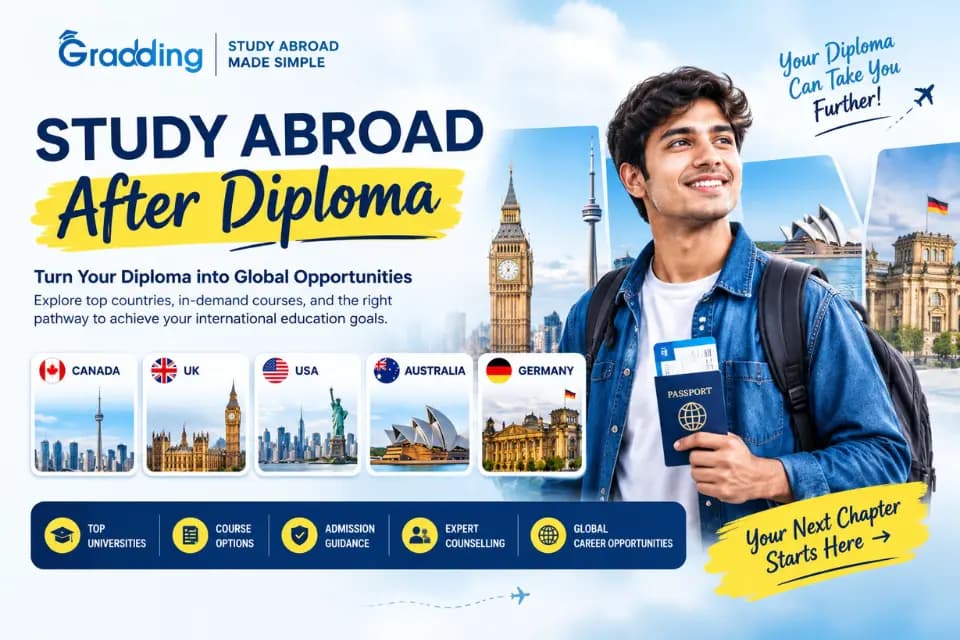
Finishing a diploma is an achievement, but for many students, it also raises a big question: What next? There are many that assume that a diploma limits their options, especially when friends from other streams are heading overseas for a bachelor’s degree. But the reality is quite different. Around the world, universities value the hands-on skills diploma holders bring, and several have built dedicated routes just for them. Whether you dream of an engineering degree in Canada, a business program in the UK, or a hospitality career in Australia, the path exists. This guide breaks down the countries, courses, and eligibility rules you need to know to plan your next step with confidence.

Summarise with AI
Choose your AI Assist



Table of Contents

1. Can I Study Abroad After Completing a Diploma in India?
2. Can Diploma Holders do a Bachelor's Abroad?
3. Which Countries Accept Indian Diploma Holders?
4. Can I Get Direct Admission After a Diploma?
5. Can I Enter the Second Year of a Bachelor's After a Diploma?
6. Can I Transfer my Diploma Credits to a Foreign University?
Can Diploma Holders Study Abroad?
Yes, Diploma holders can continue their education abroad. But the route for it is a lot of the times different from that of students who actually have completed their Class 12 or a bachelor’s degree. And where you are going to start is going to depend on the duration of your diploma, your subject, marks, and the rules of the university or country you choose.
Also note that the universities mainly prefer students who actually plan to continue in the same or a closely related field. For example, a student with a three-year diploma in mechanical engineering can often move into a bachelor’s in mechanical engineering, automobile engineering, or manufacturing.
Study Abroad After Diploma: Your Main Options
You are not limited to one route after a diploma. Below are the main pathways you can consider:
1. Direct Bachelor’s Admission (First Year)
There are some universities which accept a diploma as an entry qualification and admit you into year one of a related bachelor’s program. This is actually one of the simplest route. Though it means that you have to study for the full course duration.
2. Advanced Entry (Second or Third Year)
If you hold a 3-year diploma in a related field, then there are some universities that might give credit for your earlier studies and place you in the second or even third year. This can help you in saving both time and tuition fees.
3. Top-Up Degree
A top-up degree is going to convert your diploma into a full bachelor’s and typically in one year. This is common in the UK, Ireland, and Australia and works greatly for students who are in business, IT, engineering, and hospitality.
4. Foundation or Pathway Programs
If your marks or subject background do not meet direct entry requirements, a foundation or pathway program can bridge the gap. You progress into the bachelor’s program at the same or a partner university once you complete it.
5. Higher National Diploma (HND) Progression
HND programs which are mainly offered in the UK will let you continue at an advanced level and later move into the final year of a bachelor’s degree.
6. Postgraduate Programs
In a few countries, a 3-year diploma with strong work experience may qualify you for selected postgraduate or graduate certificate programs. This is less common and varies by university.
7. Vocational and Career-Focused Programs
Countries like Canada, Germany, and Australia offer practical, skill-based courses with strong industry links. Many of them include internships and lead to good job prospects.
Best Countries to Study Abroad After Diploma
There are multiple countries which offer clear pathways for diploma holders. But each one of them have their own rules on credit recognition, entry level, and work options. Here is how the top five compare:
Study in UK After Diploma
The UK is one of the most diploma-friendly destinations. There are many universities which give top-up degrees which convert a diploma into a full bachelor’s in about one year. Students can also join higher National Diploma (HND) routes, foundation programs, or advanced entry into the second year of a related bachelor’s course.
Indian students with a 3-year diploma in engineering, business, IT, or hospitality often find suitable options. An IELTS score of around 6.0 to 6.5 is commonly required. After graduation, the post study work visa generally allows students to stay and work in the UK for Two years.
Study in Canada After Diploma
Canada provides a practical and career focused education where you can choose from advanced diplomas, graduate certificates, and degree programs with co-op or internship options. There are some universities that also accept diploma holders into their bachelor’s programs with partial credit.
The tuition in Canada is also lower than in the UK or Australia and students can also work part-time during their studies. Once you graduate, you can get eligible for a Post-Graduation Work Permit (PGWP). This can then lead to long-term residency options. But one thing you should note is that the immigration and study permit rules change a lot and that is why it is important that you check your current requirement before you apply.
Study in Australia After Diploma
Australia has a well-structured pathway system. Diploma holders can a lot of time enter the second year of a related bachelor r’s degree which can save both time and money. There are a lot of universities which also run pathways diplomas with guaranteed progression into degree programs.
Popular fields include engineering, IT, business, nursing, and hospitality. English requirements usually fall between IELTS 6.0 and 6.5. Students on a student visa can work a limited number of hours during study, and eligible graduates may apply for a post-study work visa.
Study in Germany After Diploma
Germany is a popular study abroad destination, mainly because it offers low or no tuition fees at public universities. But getting a direct entry if you have an Indian diploma can get a little difficult. Mainly because German universities usually look for a recognised higher education entrance qualification. There are also a lot of diploma holders who first complete a Studienkolleg (foundation course) or a preparatory program.
Germany also has strong universities of applied sciences, which focus on practical learning and industry links. There are many programs which are taught in English. Though knowing German can help with daily life and job possibilities. Graduates can apply for an 18-month job-seeker visa after completing their degree.
Study in USA After Diploma
The USA offers flexible route through community colleges. There are a lot of diploma holders which start with an associate degree or transfer program, then move to a four-year university to complete a bachelor’s. Credit transfer depends on the institution and how closely your coursework matches theirs.
Most of the universities in the USA usually require TOEFL or IELTS scores and at times can even as you for your SAT or ACT results. Even though the costs can be a bit high, there are some community colleges which can offer you a more affordable starting point. Furthermore, eligible students can also work on campus and use Optional Practical Training (OPT) after graduation to gain work experience.
Can Diploma Holders Get Direct Admission to a Bachelor's Abroad?
Diploma holders can sometimes get direct admission. But this is not always guaranteed. Whether the university is going to accept the diploma is going to depend on the country, the institution, and how well is your diploma matching the bachelor’s program that you want.
What the Universities Usually Check:
- Whether your diploma is in a field that is related to the degree you are applying for
- The duration of your diploma (3-year diplomas are generally viewed more favorably than 1 to 2 year ones)
- Your overall marks or grades
- English language scores like IELTS, TOEFL, or PTE
- Whether your institution is recognized and your transcripts are verifiable
Eligibility to Study Abroad After Diploma
Your eligibility is going to depend on the country, university, and course you choose. But most of the institutions assess a similar set of criteria. Meeting these basics can put you in a strong position to apply.
Academic Requirements
- Diploma qualification: You should have completed a recognized diploma, ideally of three years. There are some universities that also accept 1 or 2 year diplomas, usually for pathways or foundation programs.
- Minimum marks: Most of the universities expert you to have around 50% to 60 or higher. Though there are competitive programs which can ask you for more.
- Subject Relevance: A diploma in a field related to your chosen bachelor’s course improves your chances of direct or advanced entry.
- Class 10 and 12 records: There are some universities, especially in Germany and the USA that may also ask for your school marks.
English Language Requirements
Most of the universities in English-speaking countries ask for proof of English proficiency. The typical minimum scores are:
- IELTS: 6.0 to 6.5
- TOEFL iBT: 80 to 90
- PTE: 50 to 60
There are some universities that may waive the requirement if you studied in English, but this varies.
Documents Required to Study Abroad After Diploma
The exact list of documents that you are going to require to study abroad after your diploma is going to depend majorly on your country, university, and the course. But most of the colleges ask for a similar set of documents, which include:
Academic Documents
- Diploma certificate and mark sheets: Proof of your completed diploma which also include semester-wise or year-wise transcripts.
- Class 10 and 12 mark sheets: There two are needed by almost every university. Especially if you did your diploma after class 10.
- Syllabus or course details: This is helpful for credit transfer or advanced entry as most of the universities use it to compare your subjects with their program.
- Medium of instruction certificate: There are some universities which accept this as a proof of English-language study.
Identity and Language Documents
- Valid passport: It should have enough validity for the full course duration
- English test score report: IELTS, TOEFL, PTE, or Duolingo. Depending on what the university accepts.
- Passport-size photographs: This is needed for applications and visa forms.
What Courses Can Diploma Holders Study Abroad?
As a diploma holder, you can choose from a wide range of courses abroad. From full bachelor’s degrees to short and skill-based programs. The best fit is going to depend on your diploma subject, marks, career goals, and the country you are targeting.
- Information Technology and Computer Science: Software development, cybersecurity, data analytics, artificial intelligence, and network security.
- Engineering and Technology: Civil, mechanical, electrical, mechatronics, and construction engineering.
- Business and Management: International business, accounting, digital marketing, human resource management, and supply chain management.
- Hospitality and Tourism Management: Hotel operations, culinary arts, bakery and pastry, and event management.
- Health and Allied Sciences: Nursing studies, pharmacy technician programs, medical laboratory technology, and health science.
- Design and Creative Arts: Graphic design, interior design, fashion design, animation, and digital media production.
How to Apply to Study Abroad After Diploma
After you are done with your diploma, the process for applying to an abroad university is pretty close. And starting early and most importantly staying organised is going to help you avoid delays.
Step 1: Define Your Goal and Shortlist Countries
You should first start with deciding what you want to study abroad after your diploma. You can then try to understand at what level and what your overall budget is. Once you are sure about all of these, you can then start comparing all your different option on things like their tuition fees, living costs, work options, and post-study opportunities.
Step 2: Research Universities and Programs
Once done, you can start looking for universities that accept students with a diploma. You should then check for their entry requirements as well as student visa requirements, policies around credit transfer, intakes, and application deadlines. Also make sure to shortlist around 5 to 8 options across different budget ranges and admission difficulty levels.
Step 3: Check Eligibility
Take a look at the minimum marks needed, the diploma duration, subject relevance, and English score which is required for each programs. In case you are not meeting the direct entry criteria then you can consider getting a foundation or path way program.
Step 4: Take Required Language Tests
You can prepare for and take IELTS, TOEFL, PTE, or Duolingo. But this depend on what your chosen universities accept. Make sure that you book your tests early as you are going to need the scores for both your admission and the visa.
Step 5: Prepare Your Documents
Gather all your documents like the diploma certificate, mark sheets, Class 10 and 12 records, passport, SOP, recommendation letters, resume, and portfolio if needed. You can also request a credit assessment from the university if you are applying for advanced entry.
Step 6: Submit Your Applications
Apply through the university’s official portal or an authorised education counsellor. Pay the application fee, upload your documents, and track your application status regularly.
Step 7: Receive and Accept Your Offer
You may receive a conditional or unconditional offer letter. Read the conditions carefully, then accept the offer and pay the tuition deposit to confirm your seat.
Step 8: Arrange Finances and Apply for a Visa
Prepare proof of funds, such as bank statements or an education loan sanction letter. Then you can apply for your student visa with your offer letter, passport, and financial documents. Some countries also require medical tests, police clearance, or a biometric appointment.
Step 9: Plan Your Move
Once your visa is approved, book your flight, arrange accommodation, and get health insurance. Look into study abroad scholarships and student orientation programs as well.
Conclusion
In the end, having a diploma is not an end of your complete academic journey. But, it is a head start that can actually set you apart from others. In fact, do you know that students who have practical training find it a little easier for them to adapt to the university’s coursework and can stand out to employers abroad. But the only thing you need to wary about is choosing the right country, course, and entry route.
To further help you with this, you can get support from experts at Gradding. They can help you with shortlisting universities, checking your overall eligibility, comparing different programs, and then helping you through your application process.
FAQs
1. Can I Study Abroad After Completing a Diploma in India?
There are a lot of universities abroad who accept Indian diploma holders for bachelor’s programs. There are also some that might ask you to take a bridging or foundation course first.
2. Can Diploma Holders do a Bachelor's Abroad?
Having a diploma can be your entry point to a bachelor’s degree abroad. The universities mostly check the duration of your diploma, subjects, and grades.
3. Which Countries Accept Indian Diploma Holders?
Some of the most popular countries include Canada, Australia, the UK, Germany, Ireland, New Zealand, and the USA.
4. Can I Get Direct Admission After a Diploma?
There are some universities which offer direct entry if your diploma is in a related field and your marks and English test scores (like IELTS or TOEFL) meet their requirements. There might be others that may ask you to complete a pathway or foundation program first.
5. Can I Enter the Second Year of a Bachelor's After a Diploma?
In some cases, you can enter the second year of a bachelor’s after a diploma. Having a 3-year diploma in a related subject can sometimes qualify you for second year or lateral entry. Whether this applies depends on the university and how closely your diploma matches the degree.
6. Can I Transfer my Diploma Credits to a Foreign University?
You can partially transfer your m credits. The universities usually review your subjects and may give credit for courses that match their program. This is known as credit transfer or advanced standing. The Approval is mainly decided by each university and you will need to share your transcripts and syllabus.
0 comments


Hand Picked Courses
Get Scholarship Assistance
Get Offer in 15 Days*
Finance/Loan Assistance
I want FREE assistance with

Ready to Start Your Study Abroad Journey?
Connect With Us!