
UK vs Ireland for Indian Students 2027: Fees, Jobs & Visa
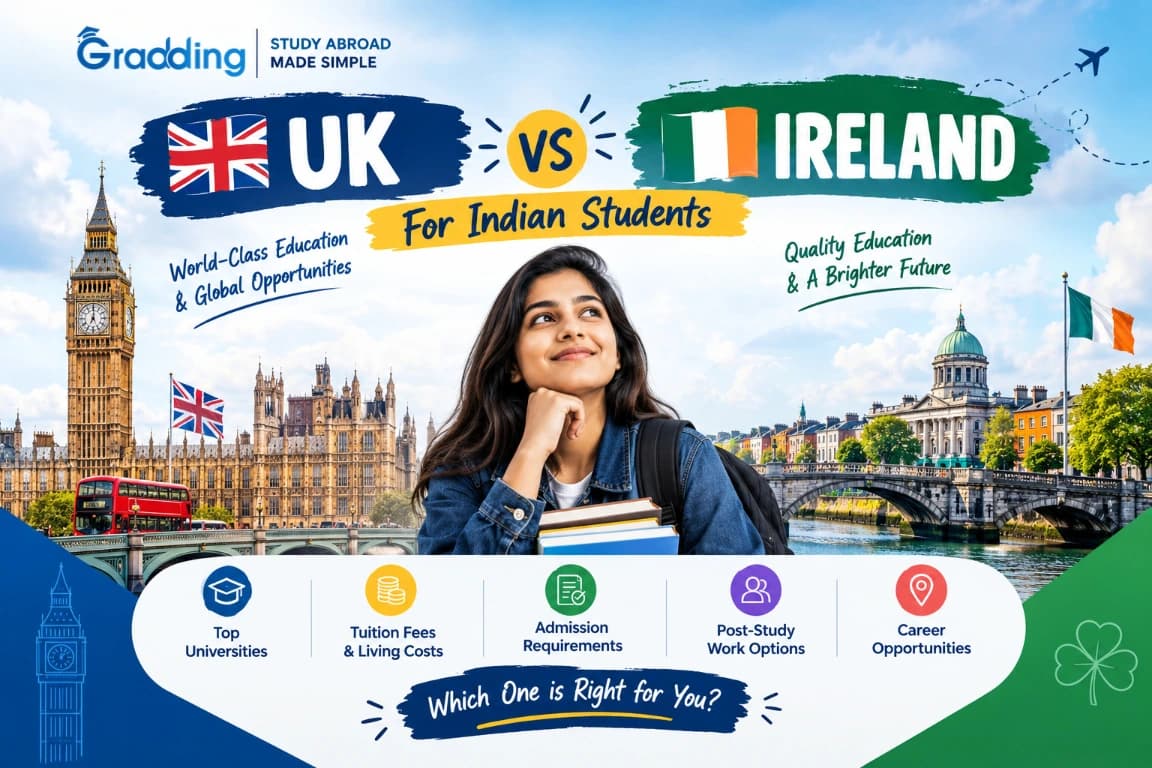
If you are an Indian student who is planning to study abroad in 2027 then the UK and Ireland is probably one of the two appealing options that sit on your shortlist. Both of these study abroad destinations share a language, a one-year master’s option, and some of the top universities in the world. But there is one big thing that is changing. From 1 January 2027, the UK Graduate visa is dropping to 18 months. Whereas Ireland’s Stamp 1G is still offering up to 24 months after a master’s. This gap can shape your career plans as much as tuition fees can. In this blog, we are going to compare costs, universities, visa rules and post-study work options so you can pick the country that fits your goals and budget.

Summarise with AI
Choose your AI Assist



Table of Contents

1. Is the UK or Ireland Better for Indian Students in 2027?
2. Is Studying in Ireland Cheaper Than Studying in the UK?
3. Which Country Offers Better Post-Study Work Opportunities?
4. Is the UK Graduate Visa Longer than Ireland's Stamp 1G?
5. Which Country is Better for a Master’s Degree?
6. Can Indian Students Work Part-Time in the UK and Ireland?
UK vs Ireland for Indian Students: Quick Comparison
To begin with, here is a simple side-by-side look at the main things than Indian students check before they choose a country:
| Factor | UK | Ireland |
| Tuition fees | Usually higher, and varies a lot by university and course | Usually a bit lower, but top courses can still be costly |
| Living costs | High, especially in London | High in Dublin, lower in cities like Cork, Galway and Limerick |
| Master’s length | Mostly 1 year | Mostly 1 year |
| Number of universities | Very large choice | Smaller choice |
| Post-study visa name | Graduate visa | Stamp 1G (Third Level Graduate Programme) |
| Post-study stay after bachelor’s | 18 months (for applications from 1 Jan 2027) | 12 months |
| Post-study stay after master’s | 18 months (for applications from 1 Jan 2027) | Up to 24 months |
| Post-study stay after PhD | 3 years | Longer than master’s |
| Part-time work during studies | Usually up to 20 hours a week in term time | Usually up to 20 hours a week in term time |
| Full-time work in holidays | Allowed in official holidays | Up to 40 hours a week in holiday periods |
| Best for | Students who want more course and university options | Students who want a longer stay after a master’s and a smaller, friendlier country |
Cost of Studying in the UK vs Ireland
The cost of studying abroad is actually one of the biggest factors for Indian students, especially when it comes to choosing between UK and Ireland. You will have to plan for things like rent, food, travel, health cover and visa costs. Below is an approximate of how much it can cost you to study in the UK and Ireland.
Tuition Fees for Indian Students
Both the UK and Ireland charge Indian student’s higher fees than the local students and the exact amount is going to depend on your university and course. The tuition fees in the UK and Ireland can be quite similar and is a little cheaper than in other study abroad destinations like the US or Australia.
| UK | Ireland | |
| Typical fees | Roughly £12,000 to £30,000+ a year | Around €10,000 to €25,000 a year for undergraduate courses |
| Higher-cost courses | Medicine can go up to about £58,600 a year | Medicine and some business or engineering courses also cost more |
| Master’s length | Usually 1 year | Usually 1 year |
A few things to keep in mind:
- Top-ranked universities usually charge more.
- MBA, Medicine and engineering courses cost more than arts or humanities courses.
- Scholarships can cut your fees. Ireland offers the government of Ireland International Education Scholarships, which includes a €10,000 stipend and a full tuition waiver. There are also many UK universities that also have their own scholarships for Indian students.
- Visa fees differ. One source lists the UK student visa at about £524 and the Ireland study visa at €60 for single entry or €100 for multiple entries.
Cost of Living and Accommodation
Rent is the biggest living cost in both countries, and it is much higher in capital cities. Both tuition and living costs are bigger in capital cities.
UK:
- London is the most expensive city, while cities like Manchester, Birmingham, Leeds and Belfast cost less.
- Student halls and shared flats are the most common options.
- You must show the UK Home Office that you have enough money for living costs. This is called maintenance funds, and the amount is higher for London than for the rest of the UK. Check the latest figure before applying.
Ireland:
- Dublin is the most expensive city, and rent there can be very high. Cork, Galway and Limerick are cheaper.
- Most international students who are planning to study in Ireland should expect to spend about €900 to €1,800 per month on living costs, excluding tuition.
- If you are a student that comes from visa-required countries, then you need to show immediate access to at least around €10,000 per year for living costs and on top of course fees.
- Non-EU students also need to have private health insurance. This can cost you about €160 to €600 per year.
Simple takeaway: So the living cost of both countries is almost close to one another. However, the city you choose matters more than the country. Studying outside London or Dublin can save you a lot. Ireland may cost a little less overall, but the UK has more university and scholarship options at different price levels.
UK vs Ireland: Which Has Better Universities and Courses?
Both countries have strong universities. But they differ in size and choice. The UK is much larger, with many more universities and subjects. Ireland is comparatively smaller, but many of its top universities are performing exceptionally well in world rankings.
Top Universities in the UK vs Ireland
UK: The UK is homes to some of the top universities in the world. In fact, there are four universities from UK that are in global top 10 in the recent QS World University Rankings 2027. These are; Imperial College London (2nd), Oxford (4th), Cambridge (6th) and UCL (8th). And there are a total of 17 UK universities that come in the top 100. Which is strongest showing of any destination outside of the US.
Ireland: The top Irish universities are doing well even if it has fewer universities. There are two Irish universities in the global top 100 for the first time. The Trinity College Dublin at 75th and University College Dublin at 100th. The University College Cork also rose 26 places to 220th. Some of the popular choices in Ireland include the University of Galway, University of Limerick, and Dublin City University.
| UK | Ireland | |
| Number of universities | Around 130 | Around 8 universities, plus technological universities |
| Top-10 world universities | 4 | None |
| Top-100 world universities | 17 | 2 |
| Best for | Maximum choice and top-ranked brands | Good quality in a smaller, easier-to-navigate system |
Which Country Is Better for Your Course?
UK is usually better if you want:
- A very wide range of courses, including niche subjects.
- Top-ranked options in law, finance, economics, medicine, arts and humanities.
- Strong university brands that employers around the world recognise.
- A bigger choice of universities at different price levels.
Ireland is usually better if you want
- Technology, computer science, data and AI courses, since many global tech and pharma companies are based in Ireland.
- Business, pharma, biotech, medical devices and finance courses.
- A 1-year master’s with a longer stay to look for work afterwards.
- A smaller campus feel with strong industry links
UK vs Ireland Student Visa: Eligibility and Requirements
As an Indian student, you will need a visa to study in both the UK and Ireland. However, the visa system for both the countries work differently. The UK uses a points-based Student visa. Whereas Ireland uses a long-stay D Study visa and then a residence permit after you reach.
UK Student Visa Requirements for Indians
You will have to meet these requirements in order to apply for the UK student visa:
- Offer and CAS: You need 70 points. This will come from a valid CAS from a licensed sponsor, proof of funds, and English at B1 or B2 level.
- Money in your account: You must show your first-year tuition (If unpaid) plus living costs. The maintenance amount is £1,529 a month in London and £1,171 a month outside London. The funds must stay in your account for 28 consecutive days before you apply.
- English language: You usually need an approved Secure English Language Test such as IELTS for UKVI or PTE Academic for UKVI, although in some cases your university can assess your English instead.
- TB test: A tuberculosis certificate from a Home Office-approved clinic in India is mandatory for Indian applicants.
- Passport and documents: You will need a valid passport and your academic documents.
- Apply on time: You must apply for your visa within six months of receiving your CAS.
UK costs to plan for: The visa application fee is roughly £524 to £558, depending on the source and date, so check the exact amount when you apply. The Immigration Health Surcharge is currently £776 per year for students, and it is paid when you apply. The TB test is a separate cost in India.
Ireland Study Visa Requirements for Indians
Most degree students from India apply for the long-stay D Study visa:
- Letter of Acceptance: You need an unconditional letter of acceptance for a full-time course with at least 15 hours of daytime study per week, from an approved institution on the ILEP list.
- Money for living costs: All international students must show immediate access to €10,000 for living costs for the first academic year, and the same amount is needed for each later year. If you plan to use fixed deposits, you need a bank letter confirming you can withdraw the money.
- Tuition payment: You must pay the full fee if it is under €6,000, or at least €6,000 if the fee is higher.
- Health insurance: Private medical insurance of at least €25,000 is part of the documents checklist.
- English language: The minimum score depends on the university. The visa-stage minimum is around IELTS 5.0, but universities usually ask for more, such as 6.0 or 6.5 for many degree courses.
- After you arrive: You must register with immigration to receive an Irish Residence Permit, which costs €300.
Ireland costs to plan for: The D visa application fee is small compared with the UK, and the IRP registration fee is paid after arrival. Ireland has also introduced biometrics at a VFS centre, so plan time for that appointment.
| UK Student visa | Ireland D Study visa | |
| Offer document | CAS from a licensed sponsor | Unconditional letter of acceptance (ILEP-listed course) |
| Living cost proof | £1,529/month in London, £1,171/month outside (for up to 9 months) | €10,000 per year |
| How long funds must be held | 28 days | Recent bank statements, usually around 6 months |
| Tuition proof | Unpaid first-year fees added to funds | Usually pay at least €6,000 (or the full fee if lower) |
| English | Approved test (SELT), or university assessment in some cases | University requirement, with a lower visa-stage minimum |
| TB test | Required for Indian applicants | Not listed as a requirement |
| Health cover | Immigration Health Surcharge (£776/year) | Private medical insurance (€25,000 minimum) |
| After arrival | Collect your BRP/eVisa details | Register for an IRP (€300) |
UK vs Ireland Post-Study Work Visa and PR
After your degree, both countries let you stay and look for work. The UK’s route is getting shorter from 2027, and Ireland’s is longer for master’s graduates. Neither visa gives you permanent residence (PR) directly. You have to move to a work visa or permit first. Rules change, so confirm details on the official UK government and Irish immigration websites.
UK Graduate Visa Duration and Eligibility
How long you can stay:
- If you apply on or before 31 December 2026, you get 2 years (3 years for PhD graduates).
- From 1 January 2027, bachelor’s and master’s graduates get 18 months instead of two years, while PhD graduates still get three years.
If you are planning to start a course in 2026 or 2027, you will most likely apply after the change. Students starting courses from late 2026 will typically apply after the cutoff, so should plan around 18 months of post-study work.
Who is eligible:
- You must hold a valid Student visa when you submit your application, and you cannot switch to the Graduate route from any other visa.
- You must have successfully completed an eligible UK degree at a sponsoring university.
- You can only apply for the Graduate visa once.
- This is an unsponsored route, so you do not need a job offer. You can work full-time or part-time, or look for work.
UK PR (Settlement):
- Time spent on the Graduate visa does not count toward the qualifying period for settlement.
- To get PR (called Indefinite Leave to Remain), you generally need to move to a post-study work visa in the UK such as the Skilled Worker visa, and time on that visa counts toward ILR.
- The UK government has proposed an “earned settlement” model. It would raise the standard qualifying period from five to ten years for most migrants, with some people able to shorten it if they meet certain criteria. You can check the latest status of this change before you plan, because it may affect how long it takes you to get PR.
Ireland Stamp 1G Duration and Eligibility
How long you can stay:
| Your Irish degree | Stamp 1G duration |
| Bachelor’s (Level 8) | 12 months |
| Master’s or PhD (Level 9 or 10) | 24 months |
Stamp 1G is granted for 12 months, and master’s graduates can receive a further 12 months, subject to conditions. In 2026, a graduate on Stamp 1G can work full-time, up to 40 hours a week, without an employment permit.
Who is eligible:
- You must have completed your degree in Ireland and hold a valid student permission (Stamp 2) when you apply.
- You should apply for Stamp 1G before your stamp 2 expires.
- You apply through immigration registration and get a new Irish Residence Permit card.
- Self-employment is generally not permitted on Stamp 1G.
Ireland PR (long-term residence):
- Stamp 1G does not directly grant permanent residence.
- To stay longer, most graduates move to an employment permit. A Critical Skills Employment Permit reaches Stamp 4 in 2 years, while a General Employment Permit takes 5 years. Stamp 4 gives long-term residency with unrestricted work rights.
- Time on Stamp 1G counts as reckonable residence for citizenship applications. Do not assume it counts for every long-term residence application, though, so check the official guidance for your situation.
- From 1 March 2026, the standard Critical Skills Employment Permit salary threshold increased to €40,904. So you need a job paying at least that to use the faster route.
| UK Graduate visa | Ireland Stamp 1G | |
| Bachelor’s | 18 months (from 2027) | 12 months |
| Master’s | 18 months (from 2027) | 24 months |
| PhD | 3 years | 24 months |
| Job offer needed? | No | No |
| Counts toward PR? | No | Counts toward citizenship residence, but not directly toward Stamp 4 |
| Next step to stay longer | Skilled Worker visa | Critical Skills (2 years to Stamp 4) or General Employment Permit (5 years to Stamp 4) |
Conclusion
Both the UK and Ireland offer a strong route to Indian students for international career. But they suit differently to different students. The UK wins on choice with more universities, more courses and big name brands. Ireland stands out for master’s students who want a longer window to find work, and for those aiming at tech, pharma or finance roles. Your course, budget and long-term plans should decide it.
And if you are still not sure then Gradding’s study abroad experts can help you compare universities, shortlist courses and prepare your financial and visa documents. They can also guide you on post-study work options. So that you can apply with a clear plan rather than guesswork.
FAQs
1. Is the UK or Ireland Better for Indian Students in 2027?
Neither the UK or Ireland is better than the other for Indian students in 2027. On one hand UK offers more universities and courses. Ireland on the other hand is smaller, usually cheaper, and can give you a longer stay after your master’s. So what’s better for Indian students ultimately boils down to what they are looking for.
2. Is Studying in Ireland Cheaper Than Studying in the UK?
Studying in Ireland is usually cheaper than that in the UK, but it depends on the course and city. The tuition fees in both of the countries vary a lot. And big cities like London and Dublin can cost you much more than smaller ones.
3. Which Country Offers Better Post-Study Work Opportunities?
Ireland currently offers more time and better opportunities for a master’s graduate in 2027. But both of the countries have a large job market and you are going to need a good job offer in order to stay long term there.
4. Is the UK Graduate Visa Longer than Ireland's Stamp 1G?
The UK’s Graduate Visa is not anymore longer than Ireland’s Stamp 1G. If you apply for the UK Graduate visa, either on or after 1 January 2027 then you will get 18 months instead of 2 years.
5. Which Country is Better for a Master’s Degree?
The UK is a better option, if you are looking for well-known universities and huge choice of subjects. Whereas Ireland is a better option for you, if you are looking for up to 2 years of stay.
6. Can Indian Students Work Part-Time in the UK and Ireland?
Indian students can work part time in both the countries. But there is a limit to it. In UK, students can work up to 20 hours a week and in Ireland, students can work up to 40 hours a week.
0 comments


Hand Picked Courses
Get Scholarship Assistance
Get Offer in 15 Days*
Finance/Loan Assistance
I want FREE assistance with







Ready to Start Your Study Abroad Journey?
Connect With Us!