
Describe Your Favourite Food - IELTS Cue Card
Preparation for IELTS will not seem daunting until you take part in the IELTS speaking Part 2, which is known as the long turn. The one-minute preparation time will seem to be the most stressful part of the test for most people, not because the ideas are absent, but because of the ticking clock and the inability of some to say things the way they ought to be said. For the IELTS speaking section, scoring your desired band will become easy through constant practice of real questions for the exam. This guide covers high-scoring sample answers for the IELTS cue card "Describe Your Favourite Food", along with practical tips to strengthen your overall preparation.

Summarise with AI
Choose your AI Assist



Table of Contents

Introduction to IELTS Cue Cards
The cue card is a critical part of the IELTS speaking Part 2. This is a topic card that contains three to four prompts, each assessing a candidate’s ability to speak in natural English.
Key Points
- Before answering the cue card, candidates have one minute of preparation time. They should use it to analyse the main theme of the topic and jot down the keywords instead of preparing full sentences.
- After preparing the answer, candidates have to deliver the answer within two to three minutes by giving appropriate and detailed answers to each prompt to grab the examiner’s attention throughout.
- Each response is marked against four equally important parameters: grammatical range and accuracy, fluency & coherence, lexical resource &and pronunciation.
- Topics on IELTS Cue cards are taken from life experiences, including places, persons, things, events and activities. Candidates can make use of their own experiences or imaginary situations to give an elaborate answer.
How to Answer the Cue Card?
For students who wish to get good grades in the IELTS speaking section, what it takes is a proper method and technique. Here are a few important tips that can be considered while responding to the cue cards.
- Make sure to read all the bullet points prior to starting preparation, as each bullet point requires a proper answer, which cannot be answered by a mere reference and shifting to the next one.
- Relate everything to real-life examples and experiences, as it will help you to speak confidently without forgetting what you want to say.
- During the preparation time, do not try to write full sentences. Write a few keywords corresponding to each point.
- Do not begin your response with a generic phrase, as they sound clichéd and waste time. You should get directly into the topic from the start.
- You must respond to each bullet point to let the examiner know that your thoughts are well-organised and coherent, unlike a collection of disjointed thoughts.
- Make sure to provide details wherever necessary in your answer, such as the name, place, or any detail that makes it specific.
Let us first take a glance at the format in which the actual cue card for this topic will be presented in the exam before we move on to the sample answer.
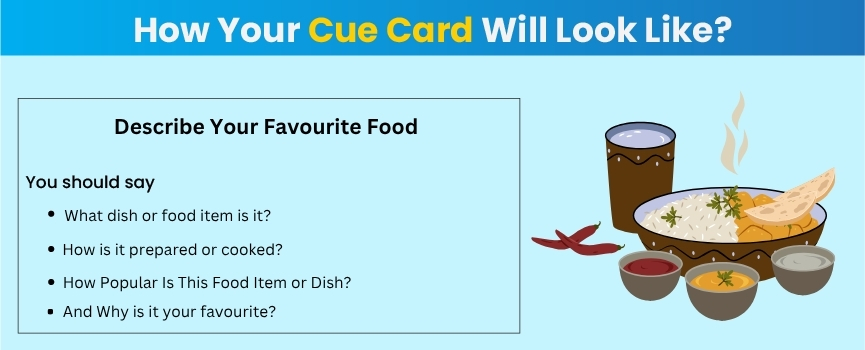
Describe Your Favourite Food - Sample 1
This is sample 1 for the IELTS cue card "Describe Your Favourite Food." This will give you an idea about the way in which you can answer the prompts using your own details.
Introduction
My favourite type of food that I can think of is sushi. I had tried this food on one of my trips, and it changed my perception towards food forever. No food ever prepared before prepared me to experience the taste of this food properly.
What dish or food item is it?
This is a food item that comes from Japan and is made up of rice flavoured with vinegar and includes fish, egg, or vegetables. The most common types of sushi include Nigiri sushi, where fish is cut into slices and placed on a ball of rice, and Maki sushi, where rice and other items are rolled in Nori.
How is it prepared or cooked?
The primary constituent of Sushi is the sushi rice, which is prepared by mixing rice vinegar, sugar, and salt into short-grain rice that is still warm. When it comes to preparing the nigiri sushi, it is generally done by shaping the rice using hands and then perfectly mixing it with fish cut into the correct thickness.
How Popular Is This Food Item or Dish?
Sushi is very common in Japan and can be seen everywhere at all price levels, whether it is the economical belt sushi or the more pricey omakase. Internationally, sushi has grown to become one of the most recognisable dishes of Japanese cuisine.
Why is it your favourite?
For the simple reason that it is the most exacting dish I have eaten before. Each detail - from the temperature of the rice, to the thickness of the fish, to the proportion of wasabi - is intentional. A good sushi is one of the few dishes in which both the craftsmanship and the taste stand out as prominently as each other.
Conclusion
The quality of sushi set the standard for all other dishes in that group. Now that I had tasted one of the real deals, all those before it became just rough drafts. This is likely the true test of a favourite.
 Access speaking Mock Test
 Describe Your Favourite Food - Sample 2
Given below is sample 2 of “Describe Your Favourite Food” to give you an idea of how a universally known food item can be described with actual details and a conversational tone for IELTS speaking part 2.
Introduction
The first food that immediately pops into my head is the burger. Everyone at some point in their lives must have had a burger; however, an exceptionally good burger is totally out of the league compared to the fast-food burgers you can get anywhere.
What Dish or Food Item Is It?
Burgers can be defined as a type of sandwiches, which have a patty of either chicken or meat made from plants inside a soft bread sandwich, accompanied by different ingredients such as lettuce, tomatoes, onions, cheese, and different sauces. The concept itself may be quite basic, but what makes a difference is the quality of ingredients used and how they are prepared.
How Is It Prepared or Cooked?
The perfect burger is all about the patty, properly garnished with salt and pepper, and cooked on a very hot cast-iron skillet so as to get a crisp exterior but juicy interior. The bun is toasted lightly, and the cheese is melted straight onto the patty, with the toppings being layered properly.
How Popular Is This Food Item or Dish?
Burgers are readily available across various types of eating, including cafes, fast-food chains, restaurants and more. In India, the burger has established itself in its culinary tradition and can be found in both chain and local restaurants. There are many variations of the burger, which include the beef burger, paneer burger, and potato patty burger.
Why Is It Your Favourite?
The thing that is my favourite is generally because no other dish contains as many textures inside one bite as the perfect hamburger. Whether it is the crunchiness of the lettuce leaves or the softness of the bun and even the juiciness of the patty & tartness of the sauce, everything blends perfectly and complements each other. It is in the simplicity of the burger where its beauty lies.
Conclusion
I have had burgers everywhere from street vendors to fast food joints and even fancy eateries. The difference between the good and the bad is huge. Discovering an amazing burger is always exciting, and that’s one of the reasons why it remains my favourite.
Master the IELTS exam with our Prep Boost
What’s included:
- Pre-recorded video lectures
- Advance Study Materials
- Detailed Feedback Report
Describe Your Favourite Food - Sample 3
The following is a sample 3 for the IELTS cue card "Describe Your Favourite Food" to assist you in learning the right way to handle each prompt given in the cue card.
Introduction
Pav Bhaji is the first thing that comes to my mind. Although I have eaten many different types of street foods, this is the only food which I keep returning to and will never hesitate to order it anywhere, irrespective of where I am.
What dish or food item is it?
Pav Bhaji is one of the well-loved street foods of Mumbai, where you have a mixture of mashed vegetables cooked in spicy sauce and served with soft bread rolls known as pav. It may seem like a simple dish, but the taste is not at all to be called as simple. While you can easily find its recipe and idea behind creation, the flavour makes it hard to replicate.
How is it prepared or cooked?
This is done by frying vegetables like potatoes, peas, cauliflower, and capsicum that have been boiled on a flat iron plate known as a tawa. Butter, tomato, and pav bhaji masala are used. All of this is blended while being cooked. The pav is fried on the same iron griddle using lots of butter.
How Popular Is This Food Item or Dish?
This dish was born in Mumbai, although it can now be found all over India, from street vendors to food chains and eateries. The dish has totally transcended any geographical frontiers. This is possibly why this dish feels so universal in India, since most Indians grew up eating it.
Why It Is Your Favourite?
The fact that it stands to be my favourite is that it satisfies your taste buds with just one bite, something even the most complex dishes cannot achieve. The yummy blend of spicy bhaji and soft toasted bread satisfies your taste buds entirely. Moreover, it tastes even more unique if you eat it while standing at a street stall.
Conclusion
I have had pav bhaji in several cities, but those prepared on a good tawa in small roadside shops are the tastiest for me to date. Till today, I haven't enjoyed a restaurant preparation which has given me such pleasure.


Lexical Resources
Showcasing a strong range of vocabulary for IELTS is undoubtedly one of the proven techniques to boost your overall scores. Given below is a table including all the lexical resources, including idioms and expressions, used in the samples above.
| Lexical Resource | Meaning |
|---|---|
| Perception | Understanding of something according to personal experience and perspective |
| Vinegar | A sharp-tasting liquid used for cooking and food seasoning through the fermentation process of alcohol. |
| Constituent | A basic ingredient required to make a larger compound |
| Omakase | A Japanese way of eating meals in which the chef chooses all the dishes served to the guests |
| Exacting | High degree of accuracy, care and diligence in each aspect |
| Craftsmanship | Superb quality or craftsmanship is reflected in something made very carefully and with precision. |
| Patty | A round-shaped slice of finely chopped vegetables placed in a burger |
| Cast-iron skillet | A round-shaped slice of finely chopped meat or vegetable placed in a burger |
| Culinary tradition | A round-shaped slice of finely chopped meat or vegetable placed in a burger |
| Transcended | A round-shaped slice of finely chopped meat or vegetable placed in a burger |
| Geographical frontiers | Territorial boundaries in which something usually occurs and exists |
| Out of the league | Much better than any other of the same type or kind |
| Rough drafts | Earlier stages and forms of something that have been improved and surpassed by the ultimate form |
| Pops into my head | To come to mind instantly without much thought and planning |
| Beauty lies in simplicity | The concept that simplicity is the best or most attractive attribute of something |
| Set the standard | Set an average of excellence for all other things in the same category to be compared to |
| Blends perfectly | Where various things come together in perfect harmony and balance |
Follow-up Questions
After finishing the IELTS speaking part 2, there remains one more vital area, which is the discussion in Part 3, consisting of some follow-up questions on the topic mentioned in the cue card. Below are some samples of follow-up questions that will prove useful for your IELTS preparation.
Q1: Does the taste in food of individuals vary as they age?
Absolutely yes. Generally, individuals start by liking basic tastes during their childhood years, but as they grow up, they begin to develop more advanced tastes. This may be because of the new experiences of trying other types of foods or cuisines.
Q2. In what ways has globalisation impacted the eating practices of people in your country?
In a huge way. Foreign foods like Italian, Japanese, and Mexican cuisines have become very popular in Indian cities. They have become a regular feature in eating practices in India. Alongside these new foods, people continue to consume their traditionally cooked foods too.
Q3. Is eating fast food bad for one’s health?
Many health problems arise due to regular intake of fast food, such as obesity and heart disease. Having fast food once in a while is not really a problem, but having it regularly poses a problem because then it becomes the primary food source for an individual.
Q4. How come people seem to be getting increasingly interested in food that is foreign to their own cultures?
Mainly due to exposure. With social media, travel, and international restaurant options, it is easy for people to get exposed to food from other regions around the world. Once one experiences the real thing, everything else follows through curiosity.
Q5: Is Cooking a Necessary Life Skill?
Definitely. Being able to cook means having the ability to control what one consumes and less reliance on prepared foods, and a useful life skill that comes in handy every day. It also allows for a whole new approach to food and its consumption.
Tips to Excel in IELTS Cue Card
Some of the most helpful tips for students who wish to boost their scores in the speaking part of the IELTS test are given below.
- The best approach to prepare for the speaking section is to continue practising through updated speaking cue card practice questions on different topics before appearing for the examination.
- Before starting to prepare your response, make sure to analyse the questions provided in the cue card to know what is expected of you and use the right tense accordingly.
- For a dedicated practice session, take a section-specific IELTS speaking mock test free that will allow you to get acquainted with task types with more confidence.
- Your answer must be coherent. Begin with an introduction, address all the bulleted points, one after the other, and then conclude.
- Make sure you make use of the real IELTS band calculator online to track your progress and find out where you need to improve in terms of various aspects.
- Fluency is more critical than perfection, so aim for a fluent response and correct yourself immediately without stopping; a captivating reply will get you higher scores than a technically correct one.
- Get in touch with expert tutors by taking IELTS classes online to get personalised feedback and training at your own level and for your target band.
Conclusion
In conclusion, getting ready for the IELTS speaking section is much easier when the right approach and the right materials are used. The samples mentioned above deal with various kinds of food and personal situations and present a good example of how one can answer the question on the topic in a more detailed and natural way.
Confused about where to start from? Don’t be afraid – our experienced teachers will assist you via online IELTS classes and provide you with professional materials.
0 comments

Practice Makes a Man Perfect!Take FREE ielts Mock Tests
Start FREE Mock Test


Get Unlimited Access with
IELTS Prep Boost

Mock Tests

Practice Questions

Study Material

Recorded Classes
What is your Target IELTS Band?






Not Confident in Speaking? Practice Cue Card Now.
Start Practice