
List of Free Education Countries for Indian Students
On average, an Indian student spends almost INR 30 to 50 Lakhs for a single degree abroad. However, in free education countries like Germany, Norway and more, that same degree can cost zero or little in tuition. Yes, you read it right, studying abroad in 2026 is no longer about spending huge amounts of money, but making a smart choice. If you have been putting your dream of studying abroad on hold because of the high costs involved, this guide will help you explore the top countries where you can study for free or at minimal cost while earning globally recognised certifications.

Summarise with AI
Choose your AI Assist



Table of Contents

What Does Free Education Abroad Really Mean?
As the name suggests, the meaning of free education abroad is not studying without paying any fee, but it refers to paying zero or near-zero tuition fees at public universities. In numerous European countries, governments fund universities to allow students access to high-quality education without paying tuition fees.
However, students are obliged to incur:
- Semester or administrative fees (generally €150 to €350 per semester)
- Health insurance (compulsory in European countries)
- Accommodation and Living expenses (€600 to €1800/month based on the country chosen)
- Travel visa and other mandatory charges.
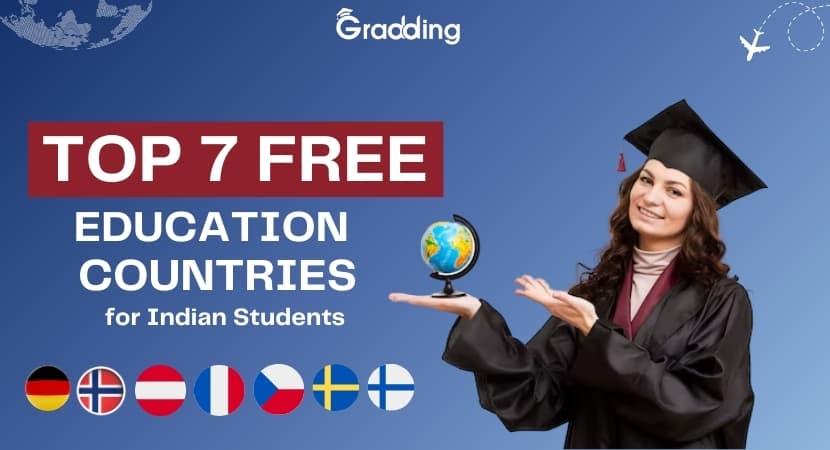
Top 7 Countries offering free education to Indian students
Almost 41 countries around the world offer free higher education to international students, with popular options being the European nations. Here are the key facts about the leading free education countries in 2026, helping you to make an informed decision.
1. Germany
Germany has been offering free education since 2014 and is undoubtedly the top choice for students looking for quality education at low or zero tuition. It boasts a strong job market, world-class research facilities and globally recognised universities that directly appeal to international students to study in Germany.
Over the years, Germany has also witnessed an increase in international enrolment, reaching around 4,50,000 and India is among the top source countries (nearly 60,000 Indian students).
|
Tuition Fee |
€0 at public universities (€150 to €350 per semester fee applied) |
|
Top Universities | |
|
Average Living Costs |
€992 to €1100 per month |
Also Read: How to Study in Germany for Free
2. Norway
Norway is among a few countries with free education for international students, including non-EU nationals at public institutions.
Over the years, the country has offered tuition-free education to students from every nationality. However, the key highlight for students is the high living costs compared to other European countries.
|
Tuition Fee |
€0 at public universities |
|
Top Universities |
|
|
Average Living Costs |
€1300 to €2000 per month |
3. Austria
Austria is one of the most underrated countries where education is free, given that the public universities offer high-quality education at zero tuition, charging a small administrative fee.
Austria is the top affordable option for international students in central Europe, with Vienna, the capital of Austria, ranking among Europe’s top student cities for the standard of living.
|
Tuition Fee |
Tuition free with €726 per year as admin fee |
|
Top Universities |
|
|
Average Living Costs |
€900 to €1300 per month |
4. France
France is often a less talked-about destination among free higher education countries. With government-subsidised tuition at public universities, studying in France is just a small portion of the fees compared to top destinations.
The opportunity to study in France is highly valuable, given that students enjoy the exposure to European culture, widely accepted certifications, and low tuition.
|
Tuition Fee |
€2,770/year (bachelor's) and €3,770/year (master's) at public universities |
|
Top Universities |
|
|
Average Living Costs |
€800–€1,200/month |
5. Czech Republic
The Czech Republic is one of the most appealing countries in the list of free education countries. Studying programs in Czech language programs are completely free, and even the cost of studying in English is significantly lower, generally below INR 2 lakh per year, which is significantly affordable compared to Western European countries.
|
Tuition Fee |
Czech-taught programs are completely free, and English programs are offered under ₹2 lakh/year |
|
Top Universities |
|
|
Average Living Costs |
€600 to €900/month |
6. Sweden
Sweden is known all over the world for its innovative and research-oriented education system. However, whereas undergraduate and master's courses are chargeable for non-EU citizens, PhD courses are totally free for all. Further, with the Swedish Institute Scholarship, free higher studies are available to deserving Indian students at the master's level too.
|
Tuition Fee |
€7,500–€15,000/year (non-EU bachelor's/master's); PhD free for all |
|
Top Universities |
|
|
Average Living Costs |
€924–€1,217/month |
7. Finland
Finland is also among the countries offering free education to all students enrolling in Finnish or Swedish-taught courses. For international students planning their master’s or PhD in Finland, tuition is generally free with the help of scholarship options.
|
Tuition Fee |
Free for PhD and master’s courses |
|
Top Universities |
|
|
Average Living Costs |
€700 to €1300 per month |
Also Read: Top Countries To Study Abroad
Eligibility & Requirements to Study for Free
Meeting the eligibility criteria is the first practical step for students planning to attend free education in other countries. The particular criteria and admission requirements vary by country and university; here are the basic requirements that countries expect.
Educational Requirements
- Finish high school (12th Grade) for UG programs
- Have a bachelor’s degree for PG programs
- Maintain a good GPA (around 3.0/4.0).
- Programs may require a specific subject or a related degree.
Language Skills
- Show proficiency in the English language (TOEFL or IELTS)
- For a program in a local language, proficiency in a particular language (like Swedish, German, or Czech) is required.
Other Requirements
- Valid Passport and student visa
- Proof of funds to cover living costs
- Letter of recommendation, motivation letters, or entrance exams (if program demands).
How to Apply to Free Education Universities Abroad?
The application process to universities in free education countries requires students to follow multiple steps that ensure a smooth admission process. From researching about the right country and shortlisting the universities to accepting the offer letter and applying for a student visa, every step is essential.
STEP 1: Find the Right Country
The process starts with choosing a country that fits your career goals, academic interests and budget. While tuition in most countries is free or the amount charged is nominal, living costs may vary, and students have to plan accordingly.
STEP 2: Shortlist the Universities
Once you have finalised the country, look for the universities that have strong global rankings while offering strong career prospects. Here, you must shortlist 4-5 universities that are well-recognised for quality education, as it will help you make an informed decision.
STEP 3: Select the Right Course
Selecting the right course is yet another crucial decision to take while studying abroad. The majority of free education countries for Indian students offer English-taught programs in a wide range of disciplines, allowing students to gain expertise in their desired field. Make sure the chosen course aligns well with your career and PR plans.
STEP 4: Meet Eligibility Criteria & Requirements
Meeting the eligibility conditions and requirements is the next important step in the application process. Top universities in countries with free education expect a strong academic profile and language test results. Further, admission requirements often vary from university to university.
STEP 5: Prepare the Necessary Documents
After meeting all the requirements, you are asked to gather a list of mandatory documents that support your online application and help the admission officials verify your profile. These documents generally include standardised test scores, English proficiency scores, LORs, SOP, CV and more.
STEP 6: Apply Through Official University Portals
Submit your application online through the official university portal or universal platforms like Uni-assist in Germany. The deadline for applications generally closes three to six months before the beginning of the semester, so make sure to apply early.
STEP 7: Arrange Health Insurance
Getting yourself a verified and valid health insurance for international students is a crucial part of the application process. Check the university and country requirements before buying health insurance.
STEP 8: Apply for a Student Visa
Once everything is done and you have received the admission letter from the chosen university, it is time to apply for a student visa. Considering the processing for visa generally takes 1 to 3 months, apply well in advance to avoid delays.
Also Read: Cheapest Country To Study For Indians
How to Choose the Right Country for You?
With so many great choices in countries offering free education, the choice ultimately depends on your personal preferences. Here are a few factors to shortlist the final option smartly:
Instruction Language: If your preferred language of instruction is English, Germany, Norway, and Finland offer a range of English-taught programs. However, if you are open to a new language, the Czech Republic, Sweden and Austria offer free tuition for the majority of their programs.
Study Field: Choose a country that excels in your desired study area, such as Germany, which is recognised for engineering and STEM. Similarly, France excels in social sciences and business, and Finland is ideal for education, design, and technology.
Living Costs: Among various free education countries for international students, the Czech Republic and Austria are the most affordable options. Countries like Norway and Sweden offer tuition-free or scholarship-backed education, but the monthly cost of living is higher.
Career & Post-Study Goals: Consider what your career goals are and the country you want to build a career in. Generally, Germany's 18-month job seeker visa and Finland's 2-year residence permit are the strongest in Europe for post-graduation employment.
Scholarship Availability: For countries where tuition applies, explore and apply for scholarships before shortlisting universities.
Work Opportunities in Free Education Countries
Choosing to study in countries with free education is not only about zero or low tuition fees, but also about rewarding work opportunities that help students to gain valuable work experience and build an international career.
Here is a quick snapshot of work permits offered by countries offering free education.
|
Country |
Post-Study Work Permit |
Part-Time Work (During Studies) |
|
Germany
|
18-month job seeker visa |
120 full days or 240 half-days/year |
|
Norway
|
12-month residence permit |
Up to 20 hours per week |
|
Austria
|
1-year job search visa |
Up to 20 hours/week (no permit) |
|
Finland
|
2-year residence permit |
Up to 30 hours/week |
|
Sweden
|
12-month residence permit |
Up to 40 hours /week |
|
Czech Republic
|
9-month job search permit |
Up to 30 days/year |
|
France
|
1-year APS work permit |
Up to 964 hours/year |
Final Thoughts
All things considered, studying abroad requires smart planning and execution that helps you receive a world-class education without spending massively on tuition fees. Every year, hundreds of thousands of international students choose to study in free education countries. Top destinations like Germany, Norway, Finland and more offer widely recognised degrees at affordable rates. With proper guidance and assistance, you can also study in one of these European nations and enjoy rewarding career opportunities. Connect with our study abroad consultants today, get your profile reviewed and select the country that best suits your academic interests and career goals.
FAQs:
1. Are there English-taught programs in free education countries?
Yes, many free education countries like Germany, Finland, Sweden, and Norway offer English-taught bachelor’s and master’s programs. These programs allow international students, including Indians, to study abroad without learning the local language.
2. Can I get a 100% scholarship in Germany?
Yes, international students can get 100% scholarships in Germany through programs like DAAD and university-funded scholarships, which may cover tuition fees, living expenses, health insurance, and travel costs.
3. Can Indian students study abroad for free?
Yes, Indian students can study abroad for free in countries like Germany, Norway, Austria, and Finland through tuition-free public universities or fully funded scholarships offered by governments and universities.
4. Do free education countries charge any administrative or semester fees?
Yes, most free education countries charge small administrative or semester fees, usually ranging from €100 to €500 per semester, which cover student services, transport passes, and campus facilities.
5. Which free education country has the lowest living cost?
Among free education countries, the Czech Republic, Germany, and Poland offer relatively lower living costs for international students, with average monthly expenses ranging between €500 and €900 depending on the city.
0 comments


Hand Picked Courses
Get Scholarship Assistance
Get Offer in 15 Days*
Finance/Loan Assistance
I want FREE assistance with




Ready to Start Your Study Abroad Journey?
Connect With Us!