
Describe A Book You Read That You Found Useful - IELTS Cue Card
The cue card in the IELTS speaking part 2 examines students’ proficiency to interact effectively at length in English. It analyses fluency, vocabulary and grammar knowledge of the candidate through a face-to-face interview. Students can encounter topics on different subjects, and one of the most significant topics is “Describe A Book You Read That You Found Useful”. It is a unique topic that provides an opportunity to define your cognitive skills. Therefore, this blog includes 3 samples that help students understand how to respond appropriately.

Summarise with AI
Choose your AI Assist



Table of Contents

Introduction to IELTS Cue Cards
The IELTS speaking section includes a cue card, considered one of the most prominent and complex parts of the exam. In this section, applicants need to speak on a certain topic for 1-2 minutes. The cue card includes a few prompts that the student should cover in the entire conversation. Once the student finishes the section, it is followed by a further discussion with the examiner that includes follow-up questions.
Test-takers can expect a wide range of topics that are usually based on study, work, achievements, family, place or friends. One such topic is “Describe A Book You Read That You Found Useful”.
How to Answer the Cue Card?
To approach the cue card section effectively in IELTS speaking part 2, focus on increasing your familiarity with the question type and topic details. Organise the details in a clear structure to maintain a logical flow. Moreover, when answering the question, you should ensure to speak with confidence without faking an accent. You can take IELTS classes online or offline to learn how to answer the cue card. Below are three samples on the topic “Describe A Book You Read That You Found Useful” that will help you understand how to answer effectively.
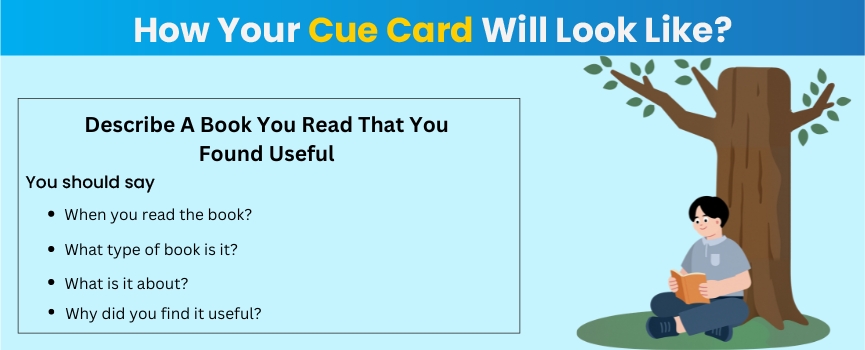
The questions are listed below:
1. When you read the book?
2. What type of book is it?
3. What is it about?
4. Why did you find it useful?
Below is an image of how the cue card for the topic Describe a Book You Read That You Found Usefulwill appear when you take the exam.
Describe A Book You Read That You Found Useful - Sample 1
You can see the first sample for the IELTS cue cards and understand how to respond to these questions by covering the prompt.
Introduction
Books are considered our best friends, and I try to read different books during my free time. One of the exciting books that I read was The Alchemist. It is very well-written by Paulo Coelho. It has a long-lasting impression on my perspectives because of its ideal blend of personal growth, philosophy and adventure. The book is both inspiring and engaging for readers.
When you read the book?
I bought the book one year ago when I went to my grandmother’s house during summer break. I was searching for something that is thought-provoking and uplifting to utilise my free time effectively. That was the ideal time to read that book because I was discovering personal goals and career prospects. Hence, it resonated with me deeply because its theme focuses on pursuing dreams and destiny.
What type of book is it?
It is a fiction novel that blends exciting elements of self-help, spirituality and adventure. The Alchemist create an engaging narrative that is entertaining and stimulating. While the book tells the life story of a young shepherd’s journey, it also offers deep life lessons regarding persistence, purpose and comprehending the world.
What is it about?
The book portrays the journey of Santiago, who is a young shepherd. He starts dreaming about finding hidden treasure somewhere in Egypt. Along his way to find the treasure, he learns vital lessons regarding listening to our heart, identifying opportunities and following personal legend. This story is all about self-discovery, courage and the hunt for an individual’s true calling in his life.
Why did you find it useful?
I found this book very useful because it helped me understand the importance of my goals and inspired me to approach challenges optimistically. It helped me understand why resilience, patience, and staying honest to my goals are important. The book offers universal teachings, and each chapter inspired me to think practically towards my ambitions, rather than waiting for something to happen passively.
Conclusion
Overall, this book is so much more than only finding the hidden treasure. It’s an escort that allows self-discovery and personal growth. By mixing adventure and impactful lessons, it inspires readers to choose their dreams, trust the process and stay persistent. After reading this book, I was left with crucial insights that influenced my perspectives and choices.
 Access speaking Mock Test
 Describe A Book You Read That You Found Useful - Sample 2
Now, see the second sample for the IELTS speaking section, where you need to describe a book you read that you found useful.
Introduction
I have read many books, but one book that changed my personality and way of thinking is “The Forest of Enchantments”. It is written by Chitra Banerjee Divakaruni. I am someone who likes to study mythology and historical tales, and this book is a perfect blend of both. It presents the entire Ramayana story from the perspective of Sita.
When you read the book?
Last year, I was travelling to another city and found the perfect time to read this mythological book. I was curious to read this book because of its ideal blend of strong female perceptions, emotions and mythology. I started the book, and within a few chapters, I was completely absorbed in this emotional and resilient journey of Sita. Her courage, struggles and sorrows made it tough to stop reading.
What type of book is it?
It is a work of fiction that highlights mythologies. It reimagines old scenarios of Ramayana, emphasising Sita’s perspective. Also, it blends poetic storytelling with ancient narrative. The book is really heart-warming because it combines emotional depth, romance and adventure, which makes it a perfect mix of reflective and literary experience.
What is it about?
The book portrays Sita’s life throughout the fourteen years when they left their home, her trials and her resilience. From the birth of Sita to her upbringing and marriage to Rama to exile, the author has portrayed her perspectives. The book reflects on Sita’s emotions, intelligence and strength, making it a perfect story of self-discovery, courage and dignity.
Why did you find it useful?
I found this book quite valuable because it provides a deep understanding of empathy, female experience and resilience. It motivated me to reflect on personal strength and social expectations, inspiring some thoughtful insights into personal emotions and connections. The book reinforced values of integrity and bravery in overcoming issues.
Conclusion
The Forest of Enchantments offers an appealing mythological reinterpretation of the mythological event, focusing on the emotional journey of Sita. The book combines epic traditions with modern insights, offering empowerment, empathy and inspiration. Reading this book was both engaging and enlightening, leaving me with an appreciation for storytelling and resilience.
Describe A Book You Read That You Found Useful - Sample 3
Below is one more sample on describing a book you read that you found useful, which will help you understand the IELTS speaking part 2 to answer them precisely and secure strong scores.
Introduction
I would love to share my experience of reading Kafka on the Shore, which is a masterpiece by Haruki Murakami. This book enchanted me through its philosophical undertones, imaginative scenarios and surreal storytelling. It aligns diverse elements of writing, such as mystery and psychological detailing. These elements make it a memorable reading experience, which inspires readers to reflect on their unconscious mind.
When you read the book?
I started reading Kafka on the Shore eight months ago when I fell asleep. I like to read books that are imaginative, and I found this book. I was attracted to its unique narrative from the first chapter. Hence, I finished the whole book within a week because I kept reading it throughout.
What type of book is it?
This book is an artwork of psychological fiction merged with magical realism. It combines mysterious occurrences, fiction and philosophical thoughts. The narrative complexity of Kafka on the Shore fills in between two main characters that blend their realities, experiences and dreams. Thus, it makes it intellectually stimulating and complex for readers. It is the best book for people who like to think deeply about consciousness and life.
What is it about?
It follows a fifteen-year-old boy named Kafka Tamura who leaves his home and runs away. Another character is Nakata, who has mysterious skills and is an older man. Their journeys interweave through weird events, which create a story of identity, fate, the unconscious mind and memory. This book is rich in myth, unexpected twists and symbolism which leave readers with diverse perspectives.
Why did you find it useful?
I found this book strongly impactful because it evoked my critical thinking and creative skills. Moreover, it induced me to think about the uncertainties of life. It stimulated reflection on personal choices, identity and finding balance between free will and destiny. The imaginative narration of this book inspired me to learn literary skills.
Conclusion
In a nutshell, Kafka on the Shore offers an ideal mix of philosophy, psychological depth and magical realism. It engrosses readers emotionally and intellectually when discovering deep themes, such as destiny, consciousness and identity.
Master the IELTS exam with our Prep Boost
What’s included:
- Pre-recorded video lectures
- Advance Study Materials
- Detailed Feedback Report
Lexical Resources
Lexical resources account for 25% of the overall scores in the speaking section of the exam. It evaluates your skills to use a vast range of advanced vocabulary clearly while conveying your points in the cue card section. Hence, students should advance their vocabulary for IELTS exam. A few advanced words based on the above samples are as follows:
| Vocabulary Words | Meaning |
|---|---|
| Philosophical undertones | Delicate ideas regarding existence and life |
| Engaging narrative | An interesting story that attracts readers |
| Thought-provoking | Something that causes deep thinking |
| Inspiration | Motivating or encouraging |
| Self-discovery | The method of comprehending oneself |
| Mythological reinterpretation | Retelling old myths with a new perspective |
| Universal teachings | Lessons that are important and applicable to all readers |
| Literary skills | The skill of understanding or creating literature successfully |
| Narrative complexity | Intricate story structure |
| Interweave | To blend, weave two or three things together |
| Evoked | To summon memories, responses or feelings |
| Empowerment | A feeling of strength and confidence |
Follow-Up Questions
If you have ever taken an IELTS speaking practice online test, you must have been aware of these follow-up questions. They allow examiners to evaluate a test-taker’s skills to extend speech and maintain fluency. However, based on the above topic, students may encounter the following follow-up questions.
1. What kind of books do you prefer to read, non-fiction or fiction? Why?
Ans. I am someone who prefers reading books that include fiction writing. It is because these types of books enable me to discover creative worlds and explore human experiences through storytelling. However, sometimes I enjoy reading non-fiction books too because they enhance practical knowledge.
2. In your opinion, is reading a book crucial for students? Why?
Ans. Yes, books are important for students. Reading novels from diverse genres expands vocabulary knowledge, develops critical thinking and enhances comprehension abilities. Moreover, books offer valuable knowledge of different philosophies and cultures. It allows students to thrive personally and academically.
3. What do you prefer: watching movies or reading books?
Ans. I personally prefer reading books because they offer more in-depth knowledge than movies. Books enable me to explore my imaginative side and envision different scenarios and characters, drawing on my thinking skills. Also, reading books allows me to explore the characters' internal emotions and thoughts that movies omit.
4. How does a book influence the thinking behaviour of individuals?
Ans. Books influence the behaviour of people by exposing them to fresh perspectives, experiences and ideas. They often encourage personal growth, inspire critical thinking, enhance empathy and shape values. It helps individuals make better decisions with an optimistic mindset.
5. How do you select a book for reading?
Ans. I choose books according to online reviews, personal interests or recommendations from my peers. Moreover, I seek books which are inspiring, thought-provoking or include topics that I want to explore. These usually include mythology, psychological fiction or personal growth.
Tips to Excel in IELTS Cue Card
Students should solve a wide range of IELTS cue card practice questions and enhance their familiarity with the question types. Moreover, they should try to enhance their vocabulary and communication skills. Here are a few expert tips that allow students to excel in the cue card section:
- Organise Your Response – To perform well in the IELTS speaking section, you should create a precise and clear structure for the answer. It should include an introduction that defines the topic, main ideas, and a conclusion that summarises your key points. You can start the answer by using idioms or quotes.
- Use Appropriate Vocabulary – This section assesses the English proficiency of candidates, making it essential to exhibit your vocabulary knowledge. Thus, you should include a mix of complex and simple sentences when discussing the topic.
- Speaking Fluently and Naturally – Another proven tip that may help you excel in this section is speaking naturally and fluently. You can develop this skill by engaging in regular conversation with native speakers. Moreover, you can record yourself and listen to the audio to identify weak areas.
- Don’t Memorise Response – You should avoid memorising answers because the examiner can easily understand that the candidate has memorised the response. Instead, speak naturally by adding your personal experiences to make the answer more authentic and relevant.
- Avoid Use of Unfamiliar Words – You may feel like impressing the examiner with complex and unique words, but it can turn into a drawback. It usually happens when you forget the actual meaning of that complex word. Hence, during IELTS preparation, focus on keeping the language simple but impactful.
Conclusion
To sum up, excelling in the IELTS speaking part 2 is not a tough nut to crack. All you need is consistent practice, dedication and expert guidance. Practice is the key to success, and with the right strategies, you can easily secure an 8+ band score. However, many student struggle to understand how to frame correct sentences and relate their personal experience with the topic, leading to poor scores. If you are struggling with the same, connect with our experts at Gradding. Our professionals help you improve your speaking skills and offer an IELTS speaking mock test free. It enables candidates to understand their preparation level and tailor their study plan accordingly.
0 comments

Practice Makes a Man Perfect!Take FREE ielts Mock Tests
Start FREE Mock Test


Get Unlimited Access with
IELTS Prep Boost

Mock Tests

Practice Questions

Study Material

Recorded Classes
What is your Target IELTS Band?

Not Confident in Speaking? Practice Cue Card Now.
Start Practice