
Describe A Disagreement You Had with Someone - IELTS Cue Card
Do you know that 80% of candidates fail to score 6+ band in IELTS, especially because they struggle in the cue card section? Yes. Preparing for this section can be daunting, as it tests your fluency, confidence, and skills to speak at length. However, students who practice with samples and clear strategies can ace the IELTS speaking section. Thus, this guide includes 3 samples on the topic “Describe A Disagreement You Had with Someone”. It will help you increase your familiarity with the speaking part.

Summarise with AI
Choose your AI Assist



Table of Contents

Introduction to IELTS Cue Cards
The IELTS speaking part consists of cue card topics, where test-takers are given a topic with 3 to 4 prompts. Candidates need to speak for 1-2 minutes on this topic. These cards include a key topic, such as “describe a disagreement”.
Along with the main topic, it includes cues that are mentioned in bullet points to guide the response. This section of the IELTS exam assesses the vocabulary, coherence, and fluency of a candidate.
How to Answer the Cue Card?
Preparing for the IELTS speaking part 2, students need consistent practice and the right strategies, which include:
- Use the Right Structure – Frame a precise structure to answer your cue card, which should include a clear introduction, prompts, details, and lastly a conclusion. You can add examples and personal details to cover the prompts.
- Storytelling Method – This may sound tricky, but it works well. Use a story to address all the points mentioned in the cue card to cover 2 minutes easily. It will help you present your points fluently and confidently. Also, it will look natural.
- Use of Tense – It is crucial to make the right use of tenses. Hence, start the discussion with the past tense to set the scene, move to the current situation, and add future instances. You can explore different cue card practice questions online to learn the correct use of tenses.
Based on the above tips, students should focus on answering their cue card, “Describe A Disagreement You Had with Someone”, with an engaging introduction. After providing brief details of the topic, start answering the following questions.
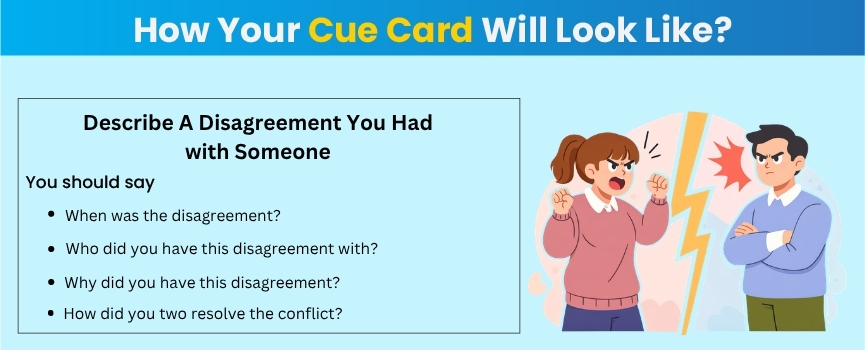
- When was the disagreement?
- Who did you have this disagreement with?
- Why did you have this disagreement?
- How did you two resolve the conflict?
You can have a look below to find how your IELTS cue card for the topic “Describe A Disagreement You Had with Someone” will appear.
Describe A Disagreement You Had with Someone - Sample 1
Here is the first sample for the IELTS cue card on "describe a disagreement you had with someone", which answers the above-cited questions. Students can also find IELTS speaking mock test free samples to understand how to respond to the cue cards.
Introduction
Disagreements may occur because of various perspectives or ideologies on a specific thing. When an individual criticises another's idea, it usually results in a disagreement. Similarly, I had a conflict with my best friend, which I will share.
When was the disagreement?
Two years ago, I had a minor conflict with my friend when we went on a trip. It happened due to our myriad expectations regarding the itinerary. My best friend preferred a packed timetable to explore everything, while I was looking for a relaxing and calming trip where we could explore slowly. This different perspective led to a disagreement between the two of us.
Who did you have this disagreement with?
The issue was with my closest friend, whom I have known for 7 years. We usually share an understanding bond, but during this particular holiday trip, we started arguing. He likes to keep everything very organised. However, I am a go-with-the-flow kind of person, which made it challenging to find a consensus.
Why did you have this disagreement?
The disagreement took place because we had different planning styles and priorities. He created a busy and rushed schedule. It made me stressed. Whilst my friend was feeling frustrated because he was thinking we would end up wasting time. It created a short but noticeable disagreement between us.
How did you two resolve the conflict?
I noticed the tension and decided to interact with my friend. We had an honest and direct conversation by setting our expectations. We decided to balance all activities and created a plan that had a perfect blend of sightseeing with relaxation. That is how we enjoyed the trip without getting anxious and frustrated. Open interaction helped us to understand diverse perspectives and find a solution to them.
Conclusion
Eventually, this conflict strengthened our relationship by teaching us the importance of respecting one another’s perspectives. Moreover, we learned the significance of communication and compromise. After this trip, our planning has become smoother when it comes to spending holidays together.
Describe A Disagreement You Had with Someone - Sample 2
Below is an example that answers “Describe a Disagreement You had with Someone”, which enables students to comprehend how to frame their responses clearly in the IELTS speaking part 2. Take a glance:
Introduction
Having disagreements with our friends and families is very common, which we all have experienced at one point. Here, I will discuss my classmate with whom I had a small issue during a group project.
When was the disagreement?
One year ago, I had an issue with my friend during an assignment. It arose because of our diverse ideas regarding the project completion work. I wanted to keep the project detail-oriented. So, I said we will start the research first and then design the presentation. However, my other friend said we should focus on the presentation design, which created issues initially.
Who did you have this disagreement with?
The conflict was with my classmate, who is not so close to me. We had already worked together on a few projects before, but we had never had any disagreements. However, this time we had different plans, which clearly clashed. I am someone who plans everything, whereas he enjoys dealing with impromptu tasks. This difference in our working styles made it difficult to agree on one point.
Why did you have this disagreement?
The conflict occurred due to my nature of planning everything rather than rushing into tasks. I thought working on a presentation without proper research would affect our project and our grades, too. However, my classmate thought that starting early would give us plenty of time to create an innovative and unique presentation. Although we both wanted the best, we disagreed due to different strategies.
How did you two resolve the conflict?
We solved this conflict by discussing our ideas calmly and clearly with each other. After having a clear discussion, we decided to distribute the work. I took responsibility for handling research and content work, whilst my other teammate worked on designing the presentation.
Conclusion
At last, this conflict taught me the power of clear communication and compromise. I realised how teamwork can lead to better work. Our presentation turned out to be the best one in the class. Moreover, our friendship stayed the same.
 Access speaking Mock Test
 Describe A Disagreement You Had with Someone - Sample 3
This sample for the IELTS speaking section topic “Describe A Disagreement You Had with Someone” perfectly portrays how to answer the cue card questions.
Introduction
Disagreements are an ordinary thing that occur so often in any human relationship. It can be with your family, friends, or peers. I remember one such incident where I argued with my sister. Although we share a very good connection, sometimes it becomes difficult to agree on one point.
When was the disagreement?
A month ago, I had a disagreement with my sister when we were both sitting at home. We were planning to redesign the study area of our shared bedroom. However, we both had different plans to decorate the whole space, which led to a minor dispute.
Who did you have this disagreement with?
I argued with my sibling. She is my younger sister. We share a genuine connection with each other and enjoy ourselves a lot when we are together. However, that day her innovative ideas clashed with my creative plans to change the study area, resulting in a heated argument.
Why did you have this disagreement?
The disagreement started because she wanted to shift all my materials to the other side of the bed to keep the shelf empty for plants. However, I did not agree with this idea because every time I require a book, I would need to leave my place to get it. Whereas, she kept telling it would make the area look more organised and attractive.
How did you two resolve the conflict?
We took some time and then decided to change the plan. I let her add plants on the shelf by removing a few books of mine, which were not very important. I also added a few paintings, which was my idea to make the space look appealing. We shared our ideas and listened to one another to get the best solution.
Conclusion
The disagreement was small, but it taught us how patience can help us avoid conflicts. Now, we interact with patience and respect one another’s preferences. It had made living together easier and happier.
Master the IELTS exam with our Prep Boost
What’s included:
- Pre-recorded video lectures
- Advance Study Materials
- Detailed Feedback Report
Lexical Resources
Students appearing for this exam understand how important it is to expand their vocabulary for IELTS cue card. Using diverse and complex words measures a candidate’s skills to use precise phrases, natural collocations, and unique idioms. Hence, here is a table that shows lexical resources used in the above samples to enrich your vocabulary skills.
| Word | Meaning |
|---|---|
| Conflict | a serious argument |
| Disagreement | A situation where people have different ideas or opinions |
| Ideologies | Sets of ideas or beliefs |
| Itinerary | A plan of a journey or trip, including the places you will explore |
| Consensus | Agreement between people |
| Different perspectives | When two individuals view the same situation in different ways |
| Clashed | When the opinions of people strongly disagree |
| Priorities | More important things |
| Rushed schedule | A plan that is too stressful and fast |
| Direct Conversation | Open discussion without hiding anything |
| Compromise | An agreement in which both involved parties give up something |
| Tension | A feeling of discomfort or stress in any situation |
| Strengthened Relationship | Made a relation better and stronger |
Follow-Up Questions
After answering the cue card questions in the IELTS speaking part 2, the candidate will be required to answer a few follow-up questions based on the prompt. Below are a few example questions that students can expect on the above topic.
1. Is it common to have disagreements between people?
Ans. Yes, I feel disagreements are very common because of different values, experiences, and opinions of people. It is normal for people to think differently and argue based on their ideologies. However, the important thing is how people manage these arguments effectively.
2. In your opinion, can disagreement help to improve relationships?
Ans. Yes, disagreements play a crucial role in improving relations. However, people need to resolve these conflicts properly. Disagreements allow people to understand the viewpoints, ideas, and perspectives of others. When both involved parties interact honestly, it strengthens their bond and builds trust. It makes their relationship stable and mature.
3. Do you feel disagreements are always harmful?
Ans. No, disagreements are not always harmful. In fact, these small conflicts can provide benefits if people handle them properly. These allow individuals to share their ideas and understand each other’s viewpoints. Moreover, sometimes these issues can lead to stronger relationships and better ideas.
4. How can people resolve disagreements effectively?
Ans. Individuals can solve conflicts effectively by interacting honestly and listening to one another’s perspectives. It is crucial to listen with patience to avoid arguments. Moreover, both individuals should focus on finding a solution with mutual understanding. Respecting diverse viewpoints is equally important in solving disagreements peacefully.
5. Which qualities can help you solve a conflict easily?
Ans. Empathy, effective communication, and patience are key skills that help handle any conflict smoothly. An individual should have active listening skills and patience to listen to what the other person is trying to explain. Moreover, being willing and open-minded to compromise is important to solve any argument effectively.
Expert Tips to Answer the IELTS Cue Card
Students can ace the cue card section if they understand how to structure their response and practice consistently. Moreover, they need to expand their knowledge of idioms, vocabulary, and natural collocations. Here is the right approach that you can follow to answer the cue card appropriately.
- Understand the Prompts – Before speaking, make sure to read the prompt and topic carefully. Most cue cards have different prompts, which act as a guide that shows what you are supposed to talk about. When you address each prompt, your chances of securing high scores increase because it shows a complete answer.
- Make Notes – You will have one minute before speaking. Use this time to jot down key information, short examples, or linking words that will help you connect the prompt with real ideas. For instance, if you are talking about a person, write his/her name with a phrase to make it relevant.
- Use Rich Phrases and Vocabulary – Students can incorporate appealing phrases to make their speech natural. However, to apply these tips, you will need consistent practice. For this, you can take an IELTS speaking practice online test regularly to enhance your speaking skills.
Conclusion
Mastering the IELTS speaking section may feel like an uphill battle, but when students practice with samples, it becomes easier. It helps in enhancing your familiarity with diverse topics, question types, and answer structures. Practising with detailed samples helps to enhance your confidence and fluency, which are crucial for scoring a high band. However, if you feel you need an expert’s guidance to understand your strong and weak areas for improvement. Connect with our professional tutors at Gradding. We offer both IELTS classes online and offline to provide flexibility to students. Remember, securing a high band in this exam can unlock diverse opportunities for your academic career.
0 comments

Practice Makes a Man Perfect!Take FREE ielts Mock Tests
Start FREE Mock Test


Get Unlimited Access with
IELTS Prep Boost

Mock Tests

Practice Questions

Study Material

Recorded Classes
What is your Target IELTS Band?



Get familiar with the Real IELTS Exam for Free!
Start Free Mock Test