
Describe A Practical Skill You Learned – IELTS Cue Card
Do you know that the IELTS speaking section is the most challenging section for students? Yes, you read it right, because this section assesses your ability to think quickly and express your ideas fluently and clearly. Part 2 of the speaking section is designed to assess students’ ability to prepare & make notes and then speak for 1-2 minutes on the topic. The cue card generally revolves around day-to-day topics with a few points to cover, allowing student to share their experiences and opinions.

Summarise with AI
Choose your AI Assist



Table of Contents

Introduction to IELTS Cue Cards
A cue card in the IELTS speaking part 2 is generally a small topic card, which plays a vital role in assessing your English language skills in everyday contexts. By presenting your views on a given topic, your fluency, coherence, vocabulary and grammar usage are assessed.
Now, the question may arise as to what makes the cue card part challenging? The answer is the limited time (3-4 minutes), students only get one minute to make notes and gather their thoughts, and then express their opinions for about 2-3 minutes.
The topics on the IELTS cue card generally range from personal experiences and everyday life to more abstract and global issues. Among various topics, one common topic that can be part of your IELTS speaking section is "Describe A Practical Skill You Learned", asking students to reflect on their personal experience.
How to answer the Cue Card?
Now that you are familiar with what the cue card is, let us learn about the correct approach to answering a cue card. For a perfect response, make sure to excel in your preparation and response time
1 Minute Prep Time
- Analyse your card, look for keywords and the tense required in response.
- Jot down detailed highlights for each point, while avoiding full sentences.
- Your response can be a reflection of personal experiences or a hypothetical situation, so plan accordingly.
2-3 Minute Response Time
- Start with a brief intro that clearly clarifies your topic.
- Make sure to address all the points given in the cue card by adding details & examples.
- Deliver detailed and engaging responses, while avoiding repetition of ideas to fill time.
- Properly utilise your response time and use the full two minutes; the goal must be to not rush or stop before time.
Take a look at how your candidate task, aka cue card, might look:
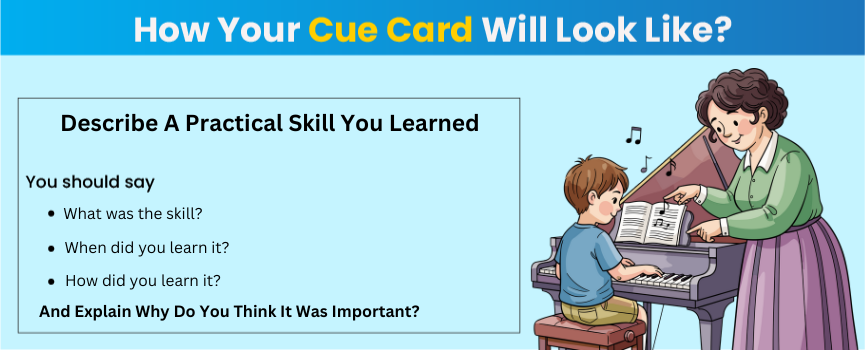
Describe A Practical Skill You Learned- Sample 1
Given below is the sample answer that will help you understand how to address the pointers and make the correct use of your time. Take help from this sample and formulate your response for practice purposes.
Introduction
Learning a new practical skill is definitely an exciting journey, as you start as a beginner and advance progressively, improving and enhancing it with each session. One such practical skill that I have learned recently is cooking, which has become quite useful in my routine.
What was the skill?
The skill I learned was how to cook nutritious gym meals for myself to support muscle growth and health. Earlier, I used to eat processed and fast food without paying much attention to my diet. Now, I can easily cook high-protein meals at home.
When did you learn it?
I started learning this skill around six months ago when I re-joined the gym after a long break. This time, I was serious about my physical strength & overall health, and my trainer explained to me how diet actually supports muscle building.
How did you learn it?
In the initial go, I took help from fitness influencers on YouTube who shared simple and quick recipes to cook delicious yet high-protein meals. Further, I also took assistance from my elder brother, who helped me prepare my weekly menu, learn to track my calories, and use various ingredients to prepare tasty meals.
And why do you think it was important?
The skill is important because it helps me stay energised throughout the day while supporting my muscle growth. The steady approach to gym meals helps me control my calories, avoid junk food and focus on being healthy.
Conclusion
Overall, learning to cook gym meals is undoubtedly one of the most useful skills that I have learned. It's a life skill that has become a sustainable routine for me, and will offer value for years to come.
 Access speaking Mock Test
 Describe A Practical Skill You Learned- Sample 2
Here is sample 2 of “Describe A Practical Skill You Learned” crafted to help students learn the correct approach.
Introduction
I believe learning practical skills is crucial for individual growth & development. One practical skill that I have recently learned is driving a car, which is highly valuable in everyday life.
What was the skill?
The skill I learned is driving and handling the four-wheeler vehicle with safety and complete precision. Earlier, it looked easy, but it actually required a perfect mix of focus, decision-making, and quick responses to ensure smooth driving.
When did you learn it?
I learned to drive a car six months ago, right after I turned 18 and became eligible to apply for a driving license. The journey was so smooth that within 3 months, I was able to drive on busy roads and narrow passages on my own.
How did you learn it?
It was my elder brother who helped me learn the basics of driving a car, including steering, braking, changing gears, and reversing on empty roads. Once I was comfortable with the basics, I enrolled in a professional driving school where the instructor taught me about various road signs, driving fundamentals, and car manoeuvres. In addition, the instructor helped me gain on-road confidence, allowing me to drive on busy roads without any fear.
And why do you think it was important?
Learning to drive a car was, no doubt, a crucial skill for me, given that it offered freedom of mobility. Now, I do not have to rely on buses or cabs for my commute. Moreover, this skill can be of great help in case of emergencies and quick travel.
Conclusion
Summing up, learning to drive a car is one of the life skills that everyone should learn, given that it offers comfort and convenience in daily life.


Describe A Practical Skill You Learned- Sample 3
Given below is sample 3 for the cue card on “Describe A Practical Skill You Learned”, which will help you learn how to use rich vocabulary in your responses.
Introduction
It is well said that an individual becomes a highly valuable asset with a set of practical skills. One such practical skill that I have recently acquired is money management, which has been a game-changer for me.
What was the skill?
The skill I learned was how to manage money, track expenses, spend wisely and save a portion regularly for the future.
When did you learn it?
I learned money management 7 months ago when I started earning and got my first job. From my first salary to now, managing my finances has been quite exciting.
How did you learn it?
In the initial go, I was looking for some videos on money management, but later I realised who else can be better than my father to learn about managing finances correctly. Since I was just starting to learn the skill, my father suggested I use the 50/30/20 rule, in which 50% of funds should be used for needs, 30% for wants, and 20% savings. This actually helped me learned the crucial aspects like setting out a contingency fund, establishing short-term goals and responsibly planning for the future.
And why do you think it was important?
Money management is an indisputable skill that every individual should learn at a young age. It helped me make the best use of my income, avoid overspending, and become confident about my finances.
Conclusion
Summing up, learning money management was one of my best decisions. It has fostered a sense of financial responsibility in me, boosted my financial literacy, and will definitely benefit me in the long run.
Master the IELTS exam with our Prep Boost
What’s included:
- Pre-recorded video lectures
- Advance Study Materials
- Detailed Feedback Report
Lexical Resources
After going through the above samples, you are now somewhat aware of what your responses to the IELTS speaking part must be like. However, one crucial thing that you must take into account is using a range of lexical resources, a crucial aspect to showcase your vocabulary for IELTS.
Here is the table of all the advanced words used in the samples above for your reference.
| Lexical Resources | Meaning |
|---|---|
| Practical skill | A useful ability that helps in real-life situations |
| Nutritious | Containing substances essential for growth and health |
| Muscle growth | Increase in muscle size and strength |
| Processed food | Food altered from its natural state, often less healthy |
| High-protein | Food containing a large amount of protein |
| Physical strength | The ability of the body to perform physically demanding tasks |
| Energized | Full of energy and enthusiasm |
| Steady approach | Consistent and regular effort |
| Life skill | A skill that is useful throughout life |
| Sustainable routine | Healthy habit or lifestyle maintained for the long term |
| Individual growth & development | Personal improvement mentally, socially, or physically |
| Precision | Accuracy and careful control |
| Handling vehicles | Operating a car or other transport safely |
| Decision-making | Choosing the best option among alternatives |
| Professional driving school | A certified institute for learning to drive |
| Road signs | Official symbols for traffic instructions |
| Car manoeuvres | Controlled driving actions in tricky situations |
| Mobility | Ability to move freely from one place to another |
| Convenience | Comfort and ease in performing tasks |
| Valuable asset | Something/someone beneficial and useful |
| Money management | Skill of budgeting, saving, and spending wisely |
| Track expenses | Monitor where money is being spent |
| Contingency fund | Emergency savings for unexpected situations |
| Financial responsibility | Managing money wisely and sensibly |
| Financial literacy | Knowledge and understanding of financial aspects |
| Benefit in long run | Advantages gained over a long period |
Follow-up Questions
Once you are done responding to your IELTS speaking part 2, the next thing in this section is a two-way discussion in which the examiner asks you a few follow-up questions related to your response. Here are some mock questions related to the samples above that will help you better understand the section.
1. What is the most important practical skill in modern society?
In my opinion, learning financial literacy is the most vital and important practical skill one must learn. Managing money every day without knowing the basics of financial literacy can be highly challenging. In today’s society, everyone must at least learn how to budget, save for the future and invest wisely. Financial literacy is not just a skill, but an ability to make informed decisions while avoiding falling into debt and spending unnecessarily.
2. Why is it important for young people to learn life skills?
Learning life skills is important for young people, given that it fosters a sense of responsibility and independence. Life skills like cooking, money management, computer literacy and more help in building confidence and preparing for real-world situations that cannot be learned from textbooks alone.
3. Are practical skills more important now compared to the past?
In today’s world, learning practical skills is of great importance, given that it also includes digital and soft skills. In various contexts, individuals are generally assessed based on the skills they possess and the value they add in any given situation. This critically demands that individuals should learn more and more practical skills, considering that it adds to their personal growth.
4. Do all skills require regular practice? Why?
Yes, every skill requires regular practice because consistency is the only key to success. Whether it is driving, cooking or even money management, every skill requires a steady approach for mastery and long-term retention. Without regular practice, skills generally fade away with time.
5. Do you think practical skills can improve career opportunities? How?
Definitely, learning practical skills can help individuals improve career opportunities. This is generally because employers today not just look for academic qualifications, but also for candidates that bring value to the company, have problem-solving skills, and can communicate effectively, making them an asset to the company.


Tips to Excel in IELTS Cue Card
Preparing for the IELTS cue cards may feel like a daunting task for many students, given the unpredictable nature of the task. No worries, here are some expert tips that will help you prepare better for the speaking section.
- Understand the Requirements – Get familiar with the requirements of the exam: understand its format, time limits, and scoring criteria that offer you a clear idea of what examiners expect and how you can actually prepare.
- Expand your vocabulary – Building a strong vocabulary can be seen as the fundamental tip to boost your scores in the IELTS cue card task. Try to learn new words, phrases and idioms related to a wide range of topics. For better results, consume English content in the form of books, new articles, and podcasts that will help you learn various styles.
- Practice Time Management – While the time given for the cue card task is limited, practising time management can be your key to success. Practice under timed conditions and try to organise well-structured responses and speak for the entire 2 minutes without rushing or repeating ideas.
- Practice Regularly – Consider this as a universal fact and not just as a tip, because a steady approach to practice will help you build fluency and better pronunciation.


Conclusion
Summing up, the IELTS speaking part 2 can seem tough for test-takers, but with an organised approach, proper technique and right guidance through online IELTS classes, students can excel and score their dream band in the speaking section.
Still not confident with your IELTS preparation? No worries, take our free ielts mock test and assess your scores using our AI-based IELTS band score calculator to learn where you stand. Based on the results, our experts will connect with you and will guide you to achieve your dream band score.
0 comments
Practice Makes a Man Perfect!Take FREE ielts Mock Tests
Start FREE Mock Test


Get Unlimited Access with
IELTS Prep Boost

Mock Tests

Practice Questions

Study Material

Recorded Classes
What is your Target IELTS Band?

Not Confident in Speaking? Practice Cue Card Now.
Start Practice