
Describe an Introvert Person Whom You Know – IELTS Cue Card
The IELTS speaking section is often seen as the most challenging one among all parts of the exam. The reason for this is not that the task types are difficult, but it assesses candidates’ capability to think fast and speak fluently in such a short period of time.
In speaking part 2 of the IELTS exam, the candidates will be provided with a topic and some prompts through a cue card. The candidates will be allowed to prepare for one minute by making some notes before speaking for two minutes.
In this guide, you will find out the right way to respond to the task, discover three well-written examples, enhance your vocabulary for IELTS and prepare yourself for the follow-up questions.

Summarise with AI
Choose your AI Assist



Table of Contents

The IELTS speaking section is often seen as the most challenging one among all parts of the exam. The reason for this is not that the task types are difficult, but that it assesses candidates’ capability to think fast and speak fluently in such a short period of time.
In speaking part 2 of the IELTS exam, the candidates will be provided with a topic and some prompts through a cue card. The candidates will be allowed to prepare for one minute by making some notes before speaking for two minutes.
In this guide, you will find out the right way to respond to the task, discover three well-written examples, enhance your vocabulary for IELTS, and prepare yourself for the follow-up questions.
Introduction to IELTS Cue Cards
The cue card for the IELTS speaking part 2 is a short topic card that evaluates your ability to communicate in English. It will help you express your personal experiences, opinions, and ideas while exhibiting your important linguistic skills. Simply said, there is no right or wrong answer; the crucial thing for the final score is how you present your arguments.
IELTS cue cards are generally considered challenging for many students owing to the very stringent time constraint involved. You have just one minute to prepare yourself to answer the questions and another two minutes to answer the questions. In this time frame, you need to discuss all the prompts provided in the cue card.
How to answer the Cue Card?
Now that you understand the purpose of a cue card, let us learn the best strategy to answer it effectively. Success in IELTS speaking part 2 depends on how well you utilise both your preparation time and speaking time.
1 Minute Preparation Time
- Read the cue card carefully and identify the keywords along with the tense required for your response.
- Make short notes for each prompt instead of writing complete sentences.
- Think of a real-life example or a relatable imaginary situation that allows you to answer every point naturally.
- Note down a few useful words or Idioms that can make your response more expressive.
2. Minute Speaking Time
- Begin with a short introduction that clearly introduces the person.
- Cover each prompt in the order given on the cue card.
- Add relevant examples and personal experiences to make your answer more engaging.
- Speak confidently and avoid repeating the same ideas just to fill time.
- Aim to utilise the complete two minutes without rushing through your response.
Given below is a sample of how your speaking cue card may appear during the exam.
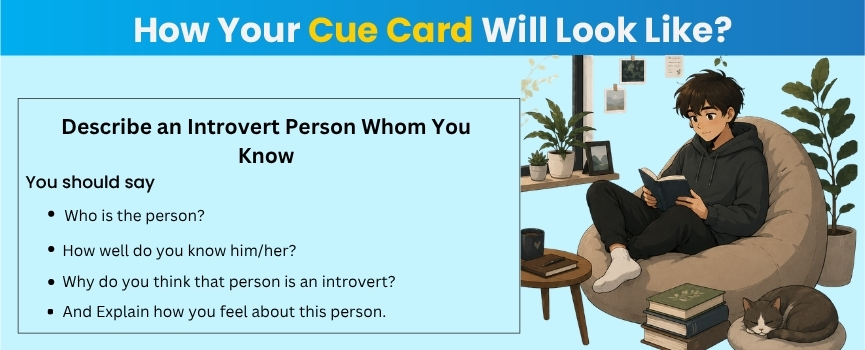
Describe an Introvert Person Whom You Know - Sample 1
A sample answer, which will guide you to prepare your answer in the most organised manner possible, is given below. You may use this as a guide in answering your cue card speaking practice questions.
Introduction
Every work environment has its fair share of personalities, but Pedro is an individual whose personality makes him stand out despite being quiet. He does not speak until he has something meaningful to say, and when he does speak, people tend to take notice.
Who Is the Person?
Pedro is my co-worker; he is a software developer. For about two years now, we have been working together. He is genuinely an excellent worker, and you can be sure that the work he does is always the best, and he does it ahead of schedule.
How Well Do You Know Him?
We engage in the same projects, and we meet almost daily during our meetings and teamwork activities. With time, I have had enough exposure to understand his thinking style. He might not open up very much about himself, but the respect that we share is real.
Why Do You Think That Person Is an Introvert?
Pedro does not like initiating conversations, and he always avoids big office parties. At lunchtime, he prefers either reading a book or going for a walk instead of sitting at a table full of people. However, if someone asks him a question, he always helps them without hesitation.
How Do You Feel About This Person?
Pedro is just one of those people whom I admire because of his silent way of proving that confidence is not necessarily about being the loudest person among everyone else. The way he practices self-control and listens rather than waiting for an opportunity to speak has taught me to value those qualities in other people as well.
Conclusion
Pedro happens to be the most reliable person that I have ever had the chance to work with. The fact that he is an introvert never holds him back; rather, it helps him concentrate more and become even more trustworthy compared to other people that I know.
 Access speaking Mock Test
 Describe an Introvert Person Whom You Know – Sample 2
This sample will be useful for you to know about yet another good way of answering this cue card. You can take help from the following example during your IELTS speaking practice session.
Introduction
I have many friends, but among them, Purvaai is one person whose personality is very unique in its own way. She is calm, a bit contemplative, and likes to spend her time in serene environments as compared to being in social gatherings. This is the reason I call her an introvert.
Who is the person?
Purvaai has been my best friend since our school days, and even though we study at separate universities, we are still in contact. She has always been an excellent student, a creative individual, and a very kind soul as well. Though she doesn’t say a lot, all of her actions portray that of a caring person.
How well do you know him/her?
She has been my friend for almost eight years, which means that I know her well. I have often seen her during holidays and communicate with her through calls and messages. After spending so much time with her, I have figured out that she shares herself with those who trust her and make her feel calm.
Why do you think that person is an introvert?
Instead of joining big social gatherings or parties, Purvaai likes spending time alone engaging in meaningful talks. Purvaai loves to read books, paint pictures, and listen to beautiful music when not busy. Instead of wanting to attract attention, Purvaai loves to spend time alone and enjoys building strong relationships.
Explain how you feel about this person?
Purvaai is somebody whom I admire a lot due to the fact that she is a good listener who is always willing to give me some sound advice when faced with any trouble. Her tranquil nature makes her company really relaxing. She has shown me how much can be said through silence.
Conclusion
Purvaai is an individual whom I respect because of her ability to be a great listener and offer sound advice anytime there is a problem. Her calm nature enables her to be quite company. She has taught me so much about the power of silence.
Describe an Introvert Person Whom You Know – Sample 3
The following is another example response that shows how you can write about the given cue card using descriptive words and your own experiences. The following practice can prove useful for you to succeed in the IELTS speaking Part 2.
Introduction
There is one individual in my family who can be considered a true introvert, and he happens to be my cousin Jimmy. Even though he may not speak much, his humble nature and thoughtful demeanour have made him earn respect from everyone around him.
Who is the person?
Jimmy is my younger cousin, and presently, he is employed in a private organisation as a graphic designer. Jimmy is highly imaginative, and most of the time when he is not busy, he either learns new techniques of designing or works on personal designing projects.
How well do you know him/her?
We spent our childhood together, growing, fighting, and learning from each other. We used to attend family gatherings and enjoy our holidays, and that helped develop our relationship. To date, we have always been talking about our jobs, hobbies, and other prospects.
Why do you think that person is an introvert?
Jimmy is not fond of being among crowds of people. He likes to work on his own and be around a few members of his family. He hardly ever gives his opinion unless asked, but when he does speak, his ideas are always practical and wise.
Explain how you feel about this person?
I really appreciate Jimmy because he makes me realise that confidence doesn’t necessarily depend on how much you speak. He has taught me through his disciplined life, modest nature, and calmness during tough situations. I always like hanging around him because all his talks are sincere.
Conclusion
Jimmy is one of the people I admire a lot. Despite being an introvert, Jimmy's success has not been affected in any way. In fact, his introversion has only enabled him to remain diligent, reflective, and focused on his objectives.
Master the IELTS exam with our Prep Boost
What’s included:
- Pre-recorded video lectures
- Advance Study Materials
- Detailed Feedback Report
Lexical Resources
Now that you have seen the above sample answers, you might have understood how to present your answer to this cue card topic. One more way to score high in the IELTS speaking part 2 is to use a variety of vocabulary.
The following table provides you with some useful words and phrases from the above samples.
| Lexical Resource | Meaning |
|---|---|
| Contemplative | Prefers to contemplate and reflect inwardly rather than outwardly express himself |
| Serene | Characterized by peace; is not disturbed in any way by external noise or activity |
| Demeanour | Refers to the behavior that a person demonstrates when interacting with other people |
| Imaginative | In possession of the skills necessary for creative and innovative thinking |
| Diligent | Showing careful and consistent application of energy to his tasks |
| Reflective | Thinks about things carefully and is considerate of all circumstances |
| Tranquil | Entirely calm and completely without stress or distraction |
| Meaningful | Characterised by depth, meaning, and significance as opposed to shallowness |
| Reliable | Dependable and consistently reliable in keeping one’s promises |
| Disciplined | Has self-discipline and structure in everything that he/she does |
| Modest | Not calling attention to oneself regarding one's accomplishments and capabilities |
| Humble | A lack of self-importance and treating other people with respect |
| Collaborative | Efforts made in collaboration with others to achieve a common purpose |
| Insightful | Having a profound knowledge of people and situations |
| Mutual respect | Mutual respect and appreciation felt by two or more individuals |
| Stand out despite being quiet | Being remembered by others without being obtrusive and attention-seeking |
| Power of silence | The concept of communicating through silence, which can say more than words |
| Opens up | Being ready to express one's thoughts and feelings to a trustworthy person |
| Take notice | To listen to someone or something that draws one's attention |
| Hanging around | Spending some leisure time with the person with whom one feels at ease |
Follow-up Questions
After completing your answer in the speaking task 2 of IELTS, the examiner proceeds to Part 3, where some follow-up questions about the same topic appear. The test-taker should be ready to discuss broader issues here. This is a two-way conversation designed to check your ability to give your opinion, support your answer, and discuss general ideas. Practicing these questions during your IELTS preparation is important to respond confidently on the test day.
Q1. What are the advantages of being an introvert?
An introvert is usually an excellent listener, a great decision-maker, and an effective observer because they think before acting. They make deeper connections because introverts prioritise quality relationships rather than superficial ones.
Q2. Can introverted people become good leaders?
Yes, leadership does not entail extroversion; it entails influencing and inspiring other people. Many introverted leaders are attentive listeners who take into account various viewpoints and build an environment in which people feel truly listened to.
Q3. Do you think social media has changed the personalities of introverts?
Yes, to an extent. The use of social media has eased the process of communication for introverts by taking away the burden of physical conversation. Overusing social media, however, can slowly erode one’s conversational skills in the real world.
Q4. Should schools encourage introverted students to participate in group activities?
Yes, but in a non-confrontational manner. Debates and discussions can help students boost their self-confidence slowly but surely. The most important thing here is that the teacher should foster an environment where all students feel safe and secure.
Q5. Is it important to respect different personality types?
Yes, each person is unique in his/her own way, and such diversity makes relationships and teamwork even better. The acceptance of differences leads to a more comfortable atmosphere where everyone feels appreciated, irrespective of how communicative he/she is.
Tips to excel in the IELTS cue card
1. Learn About the Exam Structure – Get an idea about the format of the IELTS speaking section and know the amount of time you have for preparation and speaking. It will help you get ready for the exam.
2. Build Up Your Vocabulary – Having a good vocabulary for IELTS is very important to speak naturally. Make sure you learn subject-related words, phrases, and idioms, and use them appropriately rather than memorizing hard vocabulary.
3. Manage Your Time Effectively – Make brief notes while preparing for one minute, rather than trying to write full sentences. During your response, make sure you address each point without rushing or repeating.
4. Practice Speaking Every Day – Practicing regularly will eventually help enhance fluency and improve pronunciation and confidence. Record yourself while answering and analyse your responses every day to see how you can improve. Further, practice consistently using different and trending speaking cue card practice questions.
5. Take mock tests– Practice using an IELTS speaking mock test, which helps you get familiar with the actual environment of the examination. You will be able to judge your own performance and manage time better.
6. Maintain Fluency Over Perfection – Do not interrupt yourself when you make a minor grammar mistake. Speak on the topic with confidence, as your fluency and coherence will be taken into account by the examiner.
7. Use Your Personal Experience – Always try to connect the cue card with something from your experience. Your personal story sounds more natural and is easier to memorise.
Conclusion
In conclusion, mastering the cue card task is one of the most efficient ways of succeeding at the IELTS speaking section. Start with learning the task format, prepare with a range of questions, and build a strong vocabulary, which will help you develop confident and high-scoring responses.
Still confused about where to start? Connect with our expert tutors through online IELTS coaching and start with a structured approach, seek guidance from experts, and receive detailed performance insights to boost your exam day confidence and achieve your target score with ease.
0 comments

Practice Makes a Man Perfect!Take FREE ielts Mock Tests
Start FREE Mock Test


Get Unlimited Access with
IELTS Prep Boost

Mock Tests

Practice Questions

Study Material

Recorded Classes
What is your Target IELTS Band?

Not Confident in Speaking? Practice Cue Card Now.
Start Practice