
IELTS Listening Matching Information: Samples, Tips, & How to Answer
The IELTS listening Matching Information is one of those questions that you can always count on being a part of the Listening test. It is an important question type that assesses your ability to follow a conversation, understand the relationship between facts, and recognise paraphrasing. Acing the Matching Information IELTS Listening question is extremely important because making even a few small mistakes can affect your overall Listening band score. This can, in turn, impact your IELTS result, especially if you are aiming for a high band. To learn how to answer it effectively, read the blog below!

Summarise with AI
Choose your AI Assist



Table of Contents

Understanding IELTS Listening Matching Information
The IELTS Listening Matching Information is a type of question in the IELTS Listening section that requires you to match or connect specific information from an audio recording to a set of options. In this, you will listen to an audio recording that usually revolves around either a conversation or a discussion. After this, you will see a list of options in the question paper which will be labelled as A, B, C, D, etc.
Your job here is to listen to the recording carefully and then connect each of the questions with the correct piece of options. These options can be pictures, words, phrases, or sentences.
Moreover, while solving Matching Information in listening, it is important to note that there will be more answer options than questions in order to distract you and test your ability to focus on the real meaning and not just keywords.
 Access Listening Mock Test
 IELTS Listening Matching Information Highlights
- Structure: In this question, you will usually see two different lists. One list will have the questions (things to match), and the other list will have the options (categories or descriptions).
- Order of Information: It is important to note that the Matching Information IELTS Listening question follows the same order as the audio. But the options, on the other hand, will be shown randomly. Moreover, the audio will use different words (paraphrasing) instead of repeating the options exactly.
- Use of Options: Depending on the given instructions in the IELTS Listening Matching Information question, you can use an option more than once. Moreover, there will be some options which may not be used at all.
- Answer Format: On the answer sheet, you only need to write the letter of the correct option. Writing the full phrase or sentence will be marked wrong.
Common Types of Matching Information Questions
The questions of Matching Information in listening generally come in parts 2 and 3, and they usually differ based on the kind of information you need to match and the number of answer options available. These include:
- Names to Actions/Ideas: Matching people, researchers, or organisations to what they did or said.
- Information to Places: Matching specific details or features to a location (e.g., matching a hotel to its description).
- Features to Categories: Matching items to specific groups or criteria, like matching courses to their requirements.
- Dates/Times to Events: Matching when something happened to what happened.
Practice Tests of IELTS Listening Matching Question
Take a look at the Matching Information IELTS Listening practice sample below to understand how the Matching Information question of IELTS listening will look:
1. IELTS Listening Matching Information Sample 1
Choose the correct letter A, B, C, or D.
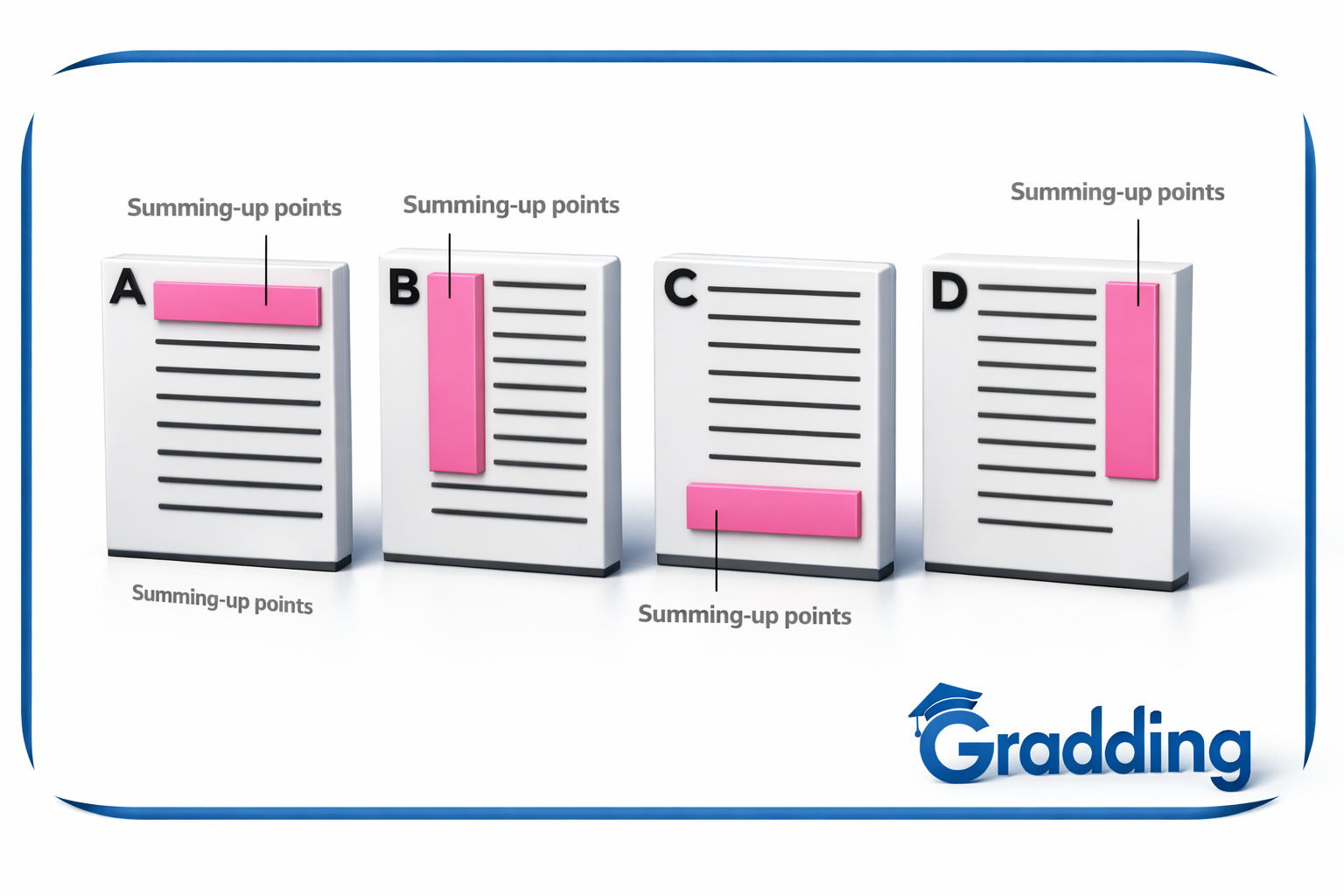
Where did Carlos write the points for summing up in his notes?
- A
- B
- C
- D
The Right Answer is B
2. IELTS Listening Matching Information Sample 2
From A-C, correct the matching letters
At the beginning of her talk, Rebecca mentions that new graduates may find it challenging to
A – Find suitable work
B – Take enough breaks
C – Stay motivated
The Right Answer is C
3. IELTS Listening Matching Information Sample 3
What choices do the students make for each section of their presentation?
Pick FIVE options from the box and write the correct letter (A–G) for Questions 26–30.
Options
A. Include visual aids
B. Keep the section brief
C. Engage other students
D. Verify the accuracy of the information
E. Give out a handout
F. Concentrate on a single example
G. Carry out online research
Sections of the presentation
26. Historical background
_________________________
27. Geographical factors
_________________________
28. Previous mistakes
__________________________
29. Future risks
__________________________
30. International impact
__________________________
The Right Answers are:
26. B
27. A
28. F
29. G
30. C
How to Answer Matching Information IELTS Listening?
To understand the best way to approach the IELTS Listening Matching Information, take a look below:
Step 1: Carefully Read the Instructions
To begin answering the Matching Information IELTS Listening question, you can:
- See the number of questions you are required to complete. For example, 1 to 4.
- Check what you require to match or how the matching works.
Note: Once you understand this, check for the “Golden Rule” where you can use one option more than once. If you can, then the instruction will mention it in the question.
Step 2: Check Out Both the Lists
Next, you can:
- Skim both of the listen quickly to understand the kind of info you might be listening to in the audio recording.
- Note that the first list, which is the Questions, will always be in order.
- The options in the other list might not be in order. So you need to listen to the audio carefully.
Step 3: Highlight The Main keywords
You can then underline all the main keywords like the dates, names, places, etc, in both the lists.
- You can also try to think of any possible paraphrases or synonyms which can be used for these keywords.
- Moreover, the answers you hear in the audio might not be the same as the ones given in the questions or options.
Step 4: Wait Until You Have All the Information
Now, wait until you get all the required information to answer the questions correctly. Also, while answering, there is a good chance that you will hear exact words as the ones given to you in the options.
But it is important to keep in mind that those might not always be the right answer and are there to trick you with close options. In such a case, it is important to listen carefully and avoid answering hastily.
Step 5: Check your Answers
And lastly, check your answers. To verify this, you can try to ask yourself whether:
- Do they make sense logically?
- Have you used any option more times than allowed (if the instructions say so)?
- Did you write the answer in the correct format?
- Did you miss any part of the question?
- Is your answer consistent with the audio?
Master the IELTS exam with our Prep Boost
What’s included:
- Pre-recorded video lectures
- Advance Study Materials
- Detailed Feedback Report
Tips & Strategy for Answering Matching Information IELTS Listening
To ace the IELTS Listening Matching Information question, you can follow the strategies mentioned below.
1. During Preparation
During your IELTS preparation, you can follow these tips:
- Practice Listening for Paraphrases
As we already mentioned above, the questions of Listening Matching Information rarely use the same words as the options. So during practice, write down an option and list 2–3 possible paraphrases. This will help you catch the correct answer even when the words are different.
- Work on Your Speed Reading Skills
In real tests, you will only have a few seconds to read questions. So when giving an IELTS mock test, read the options quickly, identifying keywords fast, and keep your eyes moving down the list. This helps you stay ahead during the audio.
- Practice with Real IELTS Tests
The best preparation is to practice with a real IELTS Listening mock test because their speed and accents match the real exam, you also learn how options are paraphrased, and you understand common traps and distractors.
- Review Mistakes Carefully
After each IELTS Listening practice test, don’t just check answers. Instead, try to understand why you got them wrong. This will help you avoid the same mistakes in the future.
Ask yourself:
- Was it because of a synonym?
- Did I miss a key detail?
- Did I confuse two options?
2. Before Listening
Before you listen to the audio, you can follow these IELTS Listening Matching Information tips. Check out:
- Identify What Kind of Information Is Being Matched
Instead of just “scanning” the IELTS Listening Matching Information questions and info, you can try to check what the task requires. This will help you understand what exactly you need to listen for. For example:
- Are you matching people to opinions?
- Places to facilities?
- Dates to events?
- Notice Unique Words In Each Option
You can also try to look for words which cannot easily be confused with others. For example, “railway station,” “bilingual staff,” “late-night opening,” or “free trial.” These unique terms usually come in the audio recording, and you can use them as a strong clue.
- Arrange Questions in Order
The Matching Information IELTS Listening question often follows the same order as the audio. You can number these questions mentally and expect the answers to appear in that same sequence.
- Predict the Answers
Try to guess what type of information might fit each question. This prepares your mind to recognise the right details when you hear them.
3. While Listening
After you listen to the audio, you can follow these tips:
- Listen for the First Clue That Confirms An Option
Don’t wait for the full sentence. Once you hear a key phrase that matches an option, mark it immediately. For example, if the option says “has a rooftop garden” and the speaker says “we have a garden on the roof”, mark it right away.
- Confirm the Match With A Second Detail
To avoid any mistakes, try to make sure that the speaker mentions one more detail that matches the option. Example:
- Option: “free parking for students”
- Audio: “We offer free parking… for students”
- Audio later: “...during evenings and weekends”
This second detail confirms the match.
- Ignore Distractors That Sound Similar
The IELTS Listening Matching Information audio often mentions several options quickly. If you hear something similar but not exact, do not mark it until you’re sure.
Example:
- Option A: “24-hour reception”
- Audio: “Reception is open late”
Note: This is NOT the same. Wait for the exact meaning.
- Use the “One Option Per Question” Rule
If you hear an option that fits a question, cross it out in your mind. This prevents choosing it again later. If you’re unsure, you can still mark it temporarily, but once you confirm the correct match, remove it from your list. This helps you stay organised and avoids repeating the same answer for Matching Information IELTS Listening questions.
Conclusion
Summing up, the IELTS listening Matching Information can be easy if you use the right strategy. The key to success is understanding what you are matching and using the options as clues before the audio starts. During the recording, you can also focus on unique details that clearly link to one option. And watch for words that signal a change of information, like “actually” or “however.”
By practising with a real IELTS listening test with audio and answers and using our above-mentioned method, you will learn to easily spot the correct answers faster and reduce mistakes. With consistent practice and help from IELTS online coaching at Gradding.com, this question type can become one of your strongest sections in the listening test.
FAQs
1. How to Solve Matching Information in IELTS?
- To solve matching information questions effectively:
- Read the question and options before the recording starts.
- Identify keywords and think of possible paraphrases.
- Listen for meaning, not exact wording.
- Follow the order of the audio, as answers usually appear sequentially.
- If you miss an answer, skip it and stay focused on the next one.
2. Can I Get a Second Chance to Hear the Matching Information Recording If I Don’t Hear It the First Time?
No, you do not get another chance at hearing the recording, and it is only played once. In case you miss an answer, it is best that you focus on the next question.
3. Can One Option Be Used More Than Once in Matching Information Questions?
You can use an option more than once if the instructions explicitly say so. The question generally mentions, “You may use any letter more than once.” If this instruction is not given, then each of the options will only be used once.
4. What Common Mistakes Do Students Make in IELTS Listening Matching Information?
- Some of the most common mistakes that test takers make in IELTS Listening Matching Information are:
- Listening for exact words instead of paraphrased ideas
- Choosing an answer too quickly without hearing the full information
- Getting distracted after missing one answer and not checking whether options can be used more than once.
5. How Many Matching Information Questions Usually Appear in The Listening Test?
There is no fixed number, but Matching Information questions usually appear in sets of 3 to 5 questions in one section of the Listening test. They do not appear in every IELTS test, but they are a common question type.
0 comments

Practice Makes a Man Perfect!Take FREE ielts Mock Tests
Start FREE Mock Test


Get Unlimited Access with
IELTS Prep Boost

Mock Tests

Practice Questions

Study Material

Recorded Classes
What is your Target IELTS Band?








Get familiar with the Real IELTS Exam for Free!
Start Free Mock Test