
Check Out Newest Writing Modules
Take IELTS Writing Practice Tests Onlinewith Real Exam Format
Practice with structured IELTS Writing Practice Tests designed to match real exam conditions. Get model answers, expert tips, and instant feedback to boost your writing band score.

Master the IELTS Writing Test: Your Path to Success
Improve IELTS writing with Professional practice materials
part 1
writing and answer questions
You should spend about 20 minutes on this task.
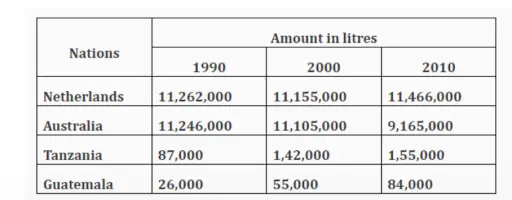
The table below shows the production of milk annually in four countries in 1990. 2000 and 2010. Summaries the information by selecting and reporting the main features, and make comparisons where relevant.
You should write at least 150 words.
Premium IELTS Coaching
at an Affordable Price
Develop Your Personalised Study Plan
Craft a custom study plan based on your target band score. Maximize your preparation with tailored resources to ensure you reach your targeted score.
My IELTS Practice Plan
8+
band After Practice
0
Months Left for Exam
45
Practice Questions


IELTS Prep Boost
Unlimited Access Includes
Why Choose Us? Your IELTS Excellence is Our Priority
Join millions of successful students who trusted us for their IELTS prep. With expert guidance, personalized plans, and top-notch resources, your dream score is within reach!

20k +Questions
Practice with hundreds of real test questions for better results.
90% Achieved Their Dream Band Score
More than 90% of our students achieve their dream band score with personalized plans, expert guidance, and continuous practice. Your success is our priority!"

 (4.8)
(4.8)Use by 2.3 M+ Members
Getting your Dream Band Score is Easy. Hear directly from our students
Achieve your target scores, transform dreams into reality!
Yash

8 
1st Attempt
" The comprehensive feedback is a game-changer. I finally understood how IELTS scoring works and improved my Task 2 essays significantly. "
Sneha

6
Before
8.5
After
" Listening practice tasks mirrored the real exam perfectly. I learned to catch key details and manage time effectively. "
Meera

8.5
1st Attempt
" With the section-specific practice, I was able to put in required efforts in each section that eventually boosted my confidence and help me achieved the dream band. "
Tanya

6.5
Before
8.5
After
" With Gradding’s IELTS prep boost, practicing for each section is easy and structured. My score jumped from 6.0 to 7.5 in just two months! "
Practice with India's Best Online IELTS Mock Test Platform
 Real IELTS Exam Experience
Live Evaluation and Feedback
Top IELTS Trainers and Mentors


Unlock Your Full Potential with Practice Tests

Kick-start Your Practice Test
Commence your IELTS writing practice to develop important skills and improve performance.
Pick Your IELTS Writing Part
Choose which writing part to focus on: Introduction, Long Turn, or Discussion Section.
Analyse Your Performance
Review your answers to identify strengths and areas for improvement in fluency and vocabulary.
We have joined hands with1800+ top universitiesto turn your study abroad dream a reality!"
Connect with our Experts


Frequently Asked Questions
Regular practice helps improve task response, coherence, vocabulary, grammar, and time management. Practise both Writing Task 1 and Task 2 under timed conditions and review your mistakes after every practice session.
Candidates have 60 minutes to complete both Writing tasks. A common approach is to spend around 20 minutes on Task 1 and 40 minutes on Task 2 because Task 2 carries more weight in the Writing score.
Writing regularly helps identify repeated grammar problems with sentence structure, verb tenses, articles, prepositions, and subject-verb agreement. Reviewing and correcting these errors after each practice task can gradually improve accuracy.
For IELTS Academic, Task 1 includes charts, graphs, tables, processes, maps, and diagrams, while Task 2 requires an essay. IELTS General Training Task 1 requires a letter, and Task 2 requires an essay.
Focus on answering every part of the question, developing ideas with relevant explanations and examples, improving paragraph organisation, using a wider range of accurate vocabulary, and reducing grammatical errors.
Practise different essay types such as opinion, discussion, advantages and disadvantages, problem and solution, and two-part questions. Plan your ideas before writing and analyse your completed essay for structure, relevance, vocabulary, and grammar.
Practise describing different charts, graphs, tables, maps, and processes for Academic Writing Task 1. Focus on identifying the key features, making relevant comparisons, and presenting information accurately rather than describing every detail.
Vocabulary is an important part of the Writing assessment. Use precise and relevant words, avoid unnecessary repetition, and learn topic-specific vocabulary and common academic expressions. Accuracy is more important than using complex words incorrectly.
Common mistakes include not fully answering the question, poor paragraph organisation, weak supporting ideas, repetitive vocabulary, grammatical errors, incorrect word forms, and spending too much time on one task.
Templates can help understand essay structure and organise ideas, especially during early preparation. However, responses should be adapted to the specific question rather than relying on memorised sentences that may sound unnatural or irrelevant.
Start with a clear main idea and support it with an explanation, reason, consequence, or relevant example. Asking questions such as "why?", "how?", and "what could happen?" can help develop an argument further.
Organise related ideas into clear paragraphs and use linking words naturally. Pronouns, referencing, repetition of key terms, and appropriate transitions can help connect ideas without making the writing sound repetitive.
No. 250 words is the minimum requirement for Task 2. Candidates can write more than 250 words, but the response should remain relevant and well organised rather than adding unnecessary content.
Writing below the required word count can negatively affect the Task Response or Task Achievement score. Candidates should ensure that Task 1 meets its minimum requirement and Task 2 contains at least 250 words.
Candidates can use official IELTS preparation resources, sample questions, online Writing practice platforms, and full-length mock tests. Resources that include sample answers and detailed explanations can make practice more effective.
Gradding Blogs

Prepare for IELTS at your fingertips!More than 1+ Million Downloads
Real IELTS Exam Experience
Live Evaluation and Feedback
Real-time Doubt-solving Sessions


Important Links for Ielts Exam
Explore Free IELTS Mock Tests
Find IELTS Coaching Centres
Practice Every IELTS Module
Essential IELTS Tools & Resources
Study Abroad Consultants in India
Top Study Abroad Destinations
Exams Required to Study Abroad
Popular Universities to Study Abroad
Important Links for Ielts Exam
Explore Free IELTS Mock Tests
Find IELTS Coaching Centres
Practice Every IELTS Module
Essential IELTS Tools & Resources
Study Abroad Consultants in India
Top Study Abroad Destinations
Popular Universities to Study Abroad
Quick Links
The IELTS writing section assesses your ability to express ideas, vocabulary, and task response. But for many, this section feels like climbing a mountain, daunting with the peak shrouded in mist. However, to achieve good scores, the IELTS writing practice test is the right map. Consistent practice, active preparation, time management, and understanding feedback can help achieve the desired band score. Using Gradding IELTS writing test practice for both Academic and General Training can transform your stress into confidence. Explore the latest writing practice test, which consists of new question types, a built-in timer, performance evaluation and progress tracking.
IELTS Writing Test Format Overview
The IELTS writing test is 60 minutes long and consists of two tasks, both in Academic and General Training. It assesses how a candidate clearly expresses their ideas and opinions, organises their responses, and uses academic vocabulary. The table below will give a clear overview of the IELTS writing section.
| Tasks | IELTS Academic Writing | IELTS General Training Writing |
|---|---|---|
| Task 1 | (20 minutes) Write a report of at least 150 words summarising or describing visual data like a chart, Graph, table or diagram. | (20 minutes) a letter-writing task (formal, semi-formal or personal) in response to a given prompt in at least 150 words. |
| Task 2 | (40 minutes) An Essay writing task requires you to respond to an Opinion, Discussion, argument or solve a problem on a given topic | (40 minutes) Write an essay in a report to provide a point of view, a problem, a direct question or any general topic in 250 words. It is more personal in comparison to academic style. |
IELTS Writing Task 1
The IELTS academic and general training writing task 1 differ from each other. Both assess similar core skills, but through distinct media: one is through describing an image or visual representation of something, and the other is writing a letter. Here is an overview of IELTS General and IELTS Academic Writing Task 1 in detail.
Academic Task 1
In IELTS Academic Writing Task 1, you will be given an image, and you must describe, summarise, or explain the key information it presents. Your task is to highlight the important trends, comparisons, and features in a clear and well-structured way. The image can be in various forms such as:
- Graphs – Used to compare data of different categories.
- Charts – Demonstrate the proportion or percentage of a whole
- Maps – Show a visual or a location that has changed over time
- Tables – Provide data in a structured format of columns and rows
- Processes Diagram – Provide details on the stages of any process, what works, etc.
General Training Task 1
The IELTS general writing task 1 involves writing a letter in response to the given situation or any prompt. You can get three types of letters.
- Formal Letter: Used to write to someone whom you don't know, such as an authority, any company figure or an official organisation regarding any issue. It must be polite and objective.
- Semi-Formal Letter: This letter is written in context to a situation where you know someone officially but not personally. The tone used in this writing is less rigid than a formal letter, but more polite than an informal letter.
- Informal Letter: This is for writing a letter to any family member, friend or close one. The tone is personal and casual, using greetings and closing lines such as 'dear' and 'best wishes'.
IELTS Writing Task 2
IELTS Academic Writing Task 2 is more difficult than IELTS General Writing Task 2. This is because it uses a more formal tone and complex topics; conversely, an academic essay requires understanding and compound analyses of a wide range of topics. But, by taking an IELTS writing practice test, you can become proficient in solving writing task 2, which assures a score of 8+ band. Here is the overview of both IELTS writing task 2.
The IELTS Academic and General writing task 2 consists of writing an essay on different topics, such as
- Opinion Essay – Justify or state the opinion on a given prompt or statement. It consists of phrases like "To what extent do you agree or disagree?" or "What do you think?"
- Discussion Essay – You have to discuss both sides of the argument mentioned in the prompt, and it often consists of opinion.
- Problem–Solution Essay - In the prompt, you must identify a problem and give one or more solutions to it.
- Advantages-Disadvantages Essay - Provide advantages or disadvantages of a specific topic, situation, or trend.
- Direct Question Essay – The prompt consists of a statement and asks two questions about it. Which you have to answer directly
Why Regular Writing Practice Is Important?
Solving IELTS writing practice tests regularly is important not only for identifying mistakes but also for improving them. It helps in many different ways, such as:
- It helps you improve your writing speed, get used to the time limit, and complete the task within the allotted time.
- Develop key skills such as robustly crafting persuasive agreements and expressing thoughts.
- By using IELTS writing test practice, you learn to write logically, using the correct vocabulary and forming an accurate introduction, body paragraphs, and conclusion.
- You become familiar with solving different question types such as describing charts, graphs, letters and essays.
- Solving the IELTS writing test develops confidence as you learn to structure your answer. Adjusting response length and overcoming problems.
How do IELTS Writing Practice Tests Help?
It is said that IELTS writing task 2 is worth twice as many marks as task 1. It is recommended to spend more time on Task 2 than on Task 1, as it carries more weight. In this case, practicing with IELTS writing practice tests would be a paradigm shift for you, but how? Below, we have dispelled your doubts.
1. Enhance Task Response, Coherence and Cohesion
Our IELTS writing practice test addresses all the parts of the question, providing relevant responses that help you to explore supporting points. Also, you manage to achieve a word count by maintaining flow and linking ideas.
2. Improve Vocabulary Range and Grammatical Accuracy
By solving practice tests, you develop topic-specific vocabulary that helps to express ideas clearly. Also, consistent writing permits you to use the right grammar structure.
3. Develop Time Management
In our practice test, the Built-in timer is included to simulate time pressure and help allocate time effectively between the two tasks.
4. Strengthen Critical Thinking and Idea Development
The IELTS Writing practice test strengthens your critical thinking skills by encouraging you to organise ideas in a clear, logical manner. It also helps you learn how to expand on each point effectively by developing it with a strong main idea.
5. Understand Band Descriptors and Scoring Methods
By understanding the scoring method and band descriptor, you learn what the exam will look like. Also, you evaluate your own work based on the descriptor.
6. Boost Confidence Through Consistent Practice
Overall, the more you practice, the more familiar you become with the test format, experience writing tasks under time pressure and explore new question types. Familiarity breeds confidence, reducing the anxiety of exam day.
Features of Our Writing Practice Platform
Using a fully purpose-built online IELTS writing practice test helps to identify the weaknesses and strengths. However, on the internet, you will find many writing practice tests, but do you know what makes Gradding’s online IELTS writing practice test stand out from the competition? It has student-friendly features. Let’s explore them in detail.
1. Real-Exam Simulation
Our IELTS writing practice paper provides a real exam environment that mirrors the official testing interface, exam pressure, clear instructions, completion of the word count, and more.
2. Extensive Database of Latest Task 1 & Task 2 Questions
The practice questions are frequently updated with a relevant writing prompt. The database offers the latest and past exam patterns to familiarise you with the question patterns for both task 1 and task 2.
3. Instant AI-Powered Performance Evaluation
Our practice test is fully AI-powered, delivering instant, unbiased feedback without waiting for a human evaluator. The advanced AI assesses your writing using the same scoring criteria as the actual test, helping you identify precise areas that need improvement.
4. Built-in Timer and Productivity Tools
Mastering time management is a crucial skill for the exam. Our practice test includes a built-in timer that simulates the exact time limits of the actual exam. Also, the productive tool, such as an integrated word count, helps to streamline the writing process.
5. Progress Tracking and Detailed Performance Analytics
IELTS writing practice test monitors your performance over time with comprehensive analytics. This feature tracks scores, finds mistakes, and provides visual data of your performance.
6. Available for Both Academic & General Training Modules
Whether you are preparing for university entry or immigration purposes, the IELTS writing practice test caters to your specific needs. This database is available for both academic and general training versions. This allows users to switch between modules and practice the writing task based on their goals.
IELTS Writing Band Descriptors & Scoring Criteria
In the IELTS exam, there are two score categories: the raw score shows the number of correctly answered questions. Later, that raw score is converted into a band score that ranges from 0 to 9.
| Band Score | Skill Level |
|---|---|
| Band 9 | Expert |
| Band 8 | Very good |
| Band 7 | Good |
| Band 6 | Competent |
| Band 5 | Modest |
| Band 4 | Limited |
| Band 3 | Extremely limited |
| Band 2 | Intermittent |
| Band 1 | Non-user |
| Band 0 | Did not attempt the test |
Additionally, the IELTS band descriptors are the official scoring criteria used by examiners to assess both IELTS writing tasks 1 and 2. Here is the scoring criteria used to give scores for IELTS writing tasks, both in academics and general training
- Task Achievement/Response
- Coherence and Cohesion
- Lexical Resource (Vocabulary)
- Grammatical Range and Accuracy
Understanding the scoring criteria and solving IELTS practice test writing daily can help to score an 8+ band. Walk through the table below to understand this in depth.
1. Task Achievement / Response
- Academic (Task 1): How well you describe, explain, or summarize visual information (such as a graph, chart, or map) and state the main features deprived of giving an opinion.
- General Training (Task 1): How well you craft a letter to a particular purpose (like explaining a situation or requesting information) and address all the points in the prompt.
- Task 2 (Both Modules): How well you address all parts of the question, present a clear position, and develop and support your ideas logically.
2. Coherence and Cohesion
How well your ideas are organized and connected. This includes having clear paragraphs with a topic sentence, using cohesive devices (like "however," "in addition," "for example"), and a logical overall structure.
3. Lexical Resource
The range and accuracy of your vocabulary. This includes using a variety of words and phrases appropriately and effectively.
4. Grammatical Range and Accuracy
The range of your grammar (e.g., using complex sentences) and how accurately you use it. Errors should not prevent communication.
Tips to Improve IELTS Writing Score
Using the IELTS writing practice test daily is key to success, but exploring new tips and tricks can help you score more effectively. Here are some valuable tips that can boost IELTS writing scores.
- Plan your schedule to take the IELTS practice test daily.
- Based on the IELTS writing practice test feedback, mark your weaknesses. It gives you an idea of how much you have to prepare for the exam to score well.
- Don’t rush to improve all the skills at a time, as it can create confusion. So, at a time, focus on only one skill.
- Practice brainstorming the topic and exploring planning approaches to write a winning essay.
- Use linking words and phrases to create a logical and smooth flow to connect ideas between sentences and paragraphs.
- Interlink simple, compound, and complex sentences to show grammatical range
- Proofreading and editing are vital in the last step to find mistakes and resolve them before time limit runs out.
- Read essays that scored highly to get an idea of how well-structured answers is created.
- Before the main exam, attempt a full-length IELTS mock test to experience difficulty and a real exam environment.
Conclusion
In short, solving IELTS writing practice tests is a bright pathway to acquire an 8+ band score. The practice test provides a clear view of the exam, designed to make students familiar with the exam pattern, manage time, solve new topics, and improve writing skills. Moreover, you develop new strategies to address issues that can help you answer writing tasks effectively, within the time limit. You can find the latest IELTS writing practice test online at Gradding.com that can help you explore new question types and topics. So boost your IELTS writing scores with our structured practice tests.
