
Describe A Person Who Likes to Grow Plants - IELTS Cue Card
Are you someone preparing for the IELTS speaking section? If so, then you might have already discovered that it features three parts, and part 2, the long turn, is often challenging for students. For this task, you receive a cue card, with 1 minute to prepare a response and at least 2 full minutes to speak. Preparing for this IELTS speaking part 2 becomes even more challenging because practice samples that sound natural and realistic are not readily available.
No worries, this guide covers the cue card topic “Describe a Person Who Likes to Grow Plants” with three sample answers, follow-up questions, and proven tips to help you master the speaking and boost exam-day confidence.

Summarise with AI
Choose your AI Assist



Table of Contents

Introduction to IELTS Cue Cards
A cue card is simply a topic card, featuring 3-4 prompt questions around the core theme. These prompts help the examiner assess the candidate's English speaking ability. Understanding what a cue card is will help you start your preparation for IELTS speaking part 2 with more confidence.
For this task, you have 1-minute preparation time during which you have to capture the core theme of the cue card and build a response around it. After preparation, students are required to deliver their response in simple English and multiple criteria, including coherence, use of vocabulary for IELTS and more, are considered to evaluate the score in this task.
IELTS cue cards topics generally revolve around personal experiences, places or events, which help student to craft a response around their past situation or hypothetical scenario.
How to answer the Cue Card?
While the cue card task is part of the IELTS speaking section, there is no defined way to approach it. However, to master this task, you must get the best out of preparation time and response time.
Here's a clear overview of how you can prepare for IELTS speaking part 2 with confidence.
For 1-minute prep time
- You must carefully examine the topic card and mark down keywords that will help frame a response.
- Focus on tense requirements and jot down the highlights while avoiding full sentences.
For a 2-3-minute response time
- Don't start with a robotic opener; rather, jump directly into the story.
- In a correct sequence, address each point mentioned in the cue card by adding details & examples.
- Aim for responding for at least 2 minutes without rushing or jumping to a conclusion.
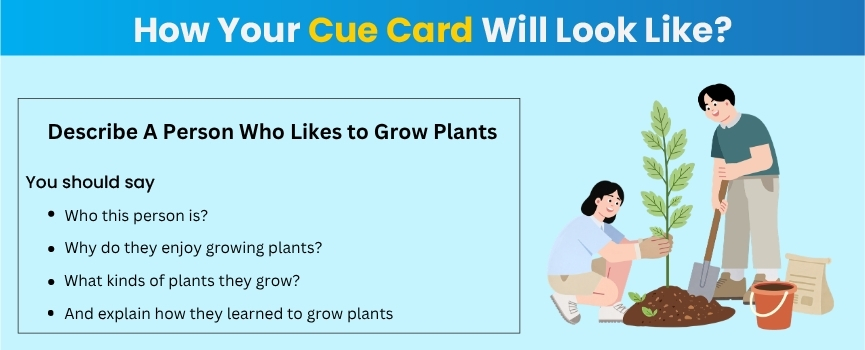
- Before jumping into the samples, here is a quick snapshot of what your cue card actually looks like in the IELTS exam.
Before you start your IELTS preparation for the speaking part 2, here is a quick photo of how your cue card might look in the test.
Describe A Person Who Likes to Grow Plants - Sample 1
Here is the sample 1 for IELTS cue card “Describe A Person Who Likes to Grow Plants” ot help you understand how to answer each prompt in a detailed and precise format.
Introduction
The first individual that pops into my head is a lady residing in the next few houses over from mine. While I may not be acquainted with her on a personal level, I walk past her garden every single day, and one can’t help but see what she has made there.
Who is this person?
She is Mrs Sharma, and must be about seventy years old. She worked at a nearby school and retired around ten years ago. She is just my neighbour, and we occasionally meet at the colony gate for general conversation, but this is sufficient for me to understand how much she loves her garden.
Why do they enjoy growing plants?
She actually mentioned once that each plant was a little project that started somewhere, went through a process, and ended with a result, something she obviously enjoys doing. I think she enjoys growing plants because nothing interrupts her; there are no distractions or demands on her time. She can work at her own speed, make her own choices, and observe the outcome of those choices.
What kinds of plants do they grow?
The flowers dominate her front garden, including roses of various colours, marigolds on the boundary and a jasmine creeper covering the whole front wall of her house. In her backyard, as observed through the fence, there seems to be more functionality with growing vegetables seasonally and some herbs in a small garden corner. All this was managed by her alone.
Explain how they learned to grow plants.
This was something she began doing after purchasing some pots for growing herbs on her balcony. This was when she was working. Nobody formally taught her, but over time, she learned to grow various plants through observation. Now that she is retired, she is really serious about her gardening and dedicates two hours of each morning to her garden.
Conclusion
Her garden has always been well kept, irrespective of whether it is winter or summer. This level of dedication speaks volumes for itself. This lady is just a perfect example of how a long-term commitment and dedication look in real life.
 Access speaking Mock Test
 Describe A Person Who Likes to Grow Plants - Sample 2
Given below is sample 2 for “Describe A Person Who Likes to Grow Plants”, helping you learn how to organise thoughts clearly.
Introduction
I would have to say that the first individual who comes to mind is my maternal grandmother. She has been gardening since before anyone else in our family can recall, and even at the age of eighty-one, she manages her own kitchen garden daily without any reminder.
Who Is This Person?
She is my mother’s mother, and I have spent most of my summer vacations with her. She lives in a semi-rural area in Rajasthan, residing in the same place for more than fifty years. Gardening is something she has always done since before most people in the family were born.
Why Do They Enjoy Growing Plants?
This has never been articulated in this way by her, and perhaps she might consider such a question rather peculiar. However, in observing her, one can see that it is in her garden that she feels most like herself. All that she plants is utilised - the vegetables in her food and the tulsi for tea.
What Kinds of Plants Do They Grow?
Her kitchen garden is not an amateur project but a genuine one. Her garden features ridge gourd, potatoes, spinach, lettuce & salad leaves and mustard. The tulsi plant can be found just before the entrance door, which is very common in her community. Further, she has cultivated a guava tree and some lemon plants herself.
Explain How They Learned to Grow Plants.
She was never taught anything formally but learned from her own mother, and from a lot of experience gained over many years of observation and experimentation on that same plot of land. She will know if a plant needs more or less water by merely looking at its leaves because of years of careful observation.
Conclusion
Sitting in the garden with her as a child was one of those things I have remembered more clearly than most other experiences. She never taught me how to garden, but just showed up, and that's what matters.
Master the IELTS exam with our Prep Boost
What’s included:
- Pre-recorded video lectures
- Advance Study Materials
- Detailed Feedback Report
Describe A Person Who Likes to Grow Plants - Sample 3
Here is the last sample for the IELTS cue card “Describe A Person Who Likes to Grow Plants”, helping you learn how to use different situations to answer prompts.
Introduction
The person who instantly comes to mind is my friend, Sameer, who comes from a little-known village in the state of Himachal Pradesh. He was my guide on a trekking trip three years back, and since then, we have been in contact. The bond he shares with plants is unique.
Who Is This Person?
Sameer is a young adult man of around twenty-something years old. He farms on a tiny plot of land that has been passed down through his family for several generations. He completed schooling in his village but decided to settle there instead of moving into a city, unlike many young people from the villages.
Why Do They Enjoy Growing Plants?
Sameer once told me that this isn’t really fun for him; rather, it’s a duty. It feeds his family, and if it’s a good year, there will be extra produce that he can sell to other people nearby. The pride he has in saying this about a good year was clear when he said it.
What Kinds of Plants Do They Grow?
The apple is the one he raises, typical of that region of Himachal Pradesh, alongside the potato and rajma beans, which thrive at heights. He also maintains the herbs used in his cooking in a separate segment within his garden area, such as coriander, fenugreek, and local greens, which I had never seen before meeting him.
Explain How They Learned to Grow Plants.
Sameer did not receive learning in the cconventionally receive learninghis father and grandfather, who had been with him from the beginning. It did not happen through formal classes but only from years of observation and experience. In Sameer’s case, taking care of plants is just part of life.
Conclusion
Meeting Sameer changed my perception a little bit. We mostly consider plants to be decorative or something we do during weekends. However, for him, it is just his everyday life and nothing else.


Lexical Resources
Demonstrating a strong use of vocabulary in your IELTS Part 2 is one of the easiest ways to boost your scores and show a strong command of English.
Here is the list of lexical resources, including idioms that are used in the samples above.
| Lexical Resource | Meaning |
|---|---|
| Residing | Living in a particular place on a permanent or long-term basis |
| Acquainted | Having long-term knowledge of a person without being close friends |
| Cultivated | Grown and cared for deliberately through consistent effort and attention |
| Semi-rural | An area partly countryside and partly developed, between the village and the city |
| Articulated | Express the sed clearly in words, especially something complex or personal |
| Surplus produce | Extra crops are grown beyond what is needed for personal use |
| Generational land | Land passed down through a family over many yearsLong-term |
| m commitment | A dedication to something maintained consistently over a long period |
| Kitchen garden | A small garden used for growing vegetables, herbs and fruits for cooking |
| Conventional manner | The usual or traditional way of doing or learning something |
| Perception | The way a person understands something is based on their own experience |
| Dedicated corner | A specific area set aside exclusively for one particular purpose |
| Functionality | The quality of being practical and useful rather than purely decorative |
| Amateur | Someone who does something without professional training |
| Observation | Watching something carefully over time to learn from it |
| Pops into my head | Something that comes to mind suddenly and without much effort |
| Speaks volumes | Clearly communicates something important without needing to say it directly. |
| Pass down through generations | To hand something from one generation to the next |
| At one's own pace | Working at a speed that suits the individual rather than following others |
| Just Showed Up | Being present consistently without making a fuss about the effort involved |
Follow-up Questions
Once you are well prepared for the IELTS speaking part 2, the next crucial thing to focus on is the two-way discussion, which is part 3 of the speaking section. This task is all about the examiner asking your 2-3 follow-up questions related to the response provided in part 2.
Here are a few questions that will help you better grasp the understanding of the follow-up task.
1. Do you think gardening is becoming more popular among young people?
Yes, certainly. Social media has certainly helped with this, too; seeing a person growing herbs on a small balcony makes it look achievable rather than daunting. Whether or not the majority of people will manage to keep it up is debatable, but the sense of interest in gardening is certainly there.
2. Is giving plants as gifts becoming more common?
Yes, over time, it is often looked upon as a thoughtful decision and more and more people appreciate it. A gifted plant is often associated with a specific meaning or personality trait, which makes people connect it with excitement.
3. What is the difference between traditional and modern farming methods?
Traditional farming was labour-intensive, seasonal, and organic. On the other hand, modern farming practices involve the use of machinery, chemicals, and hybrid seeds that increase crop yield at the expense of soil health. With time, people are increasingly shifting towards traditional farming, and it often looks premium.
4. Do you think it is important for children to learn how to grow plants?
Yes, really, growing something from a seed can teach a child about patience in a way that a classroom can't, and it can also help them develop a more positive relationship with food and with nature. These are things that city children particularly miss out on.
5. How do plants and green spaces affect people's mental health?
Several studies over the years have shown that being around plants helps reduce stress and stay more focused. On a personal note, having something living to care for gives a person a small sense of daily routine, and in a world where everything is moving at a very fast pace, this is a valuable thing.
Tips to excel in the IELTS cue card
Only preparing with realistic speaking cue card practice questions will not help you achieve your dream band score. You just need a correct approach and a few proven strategies that will help you ace this task with ease.
- Make the best use of your preparation time by carefully reading each prompt and making notes using keywords.
- Avoid skipping any bullet points and move in clear order to keep your answer coherent and ensure each prompt is covered.
- Avoid starting your response using rehearsed openings and go for a natural statement, as it will help you sound your response less robotic.
- Mention specific details like name, date, pace or any particular event to make your response sound more genuine.
- Do not try to rush through the answer; maintain a steady pace and aim to respond for at least 2 minutes.
Conclusion
Summing up, preparing for the IELTS speaking section may feel daunting at first, but with the right approach and guidance, you can easily master each part.
Still don’t know where to start? No worries, connect with our experts through online IELTS classes, and start your preparation with tailored guidance, performance insights, and practice resources, all designed to help you achieve your dream band.
0 comments

Practice Makes a Man Perfect!Take FREE ielts Mock Tests
Start FREE Mock Test


Get Unlimited Access with
IELTS Prep Boost

Mock Tests

Practice Questions

Study Material

Recorded Classes
What is your Target IELTS Band?








Not Confident in Speaking? Practice Cue Card Now.
Start Practice