
Describe Your Favourite Weather – IELTS Cue Card
Feeling comfortable with IELTS preparation may be relatively easy, but preparing yourself for IELTS speaking Part 2 will definitely make you face another problem. Having just one minute to prepare yourself and organise all your ideas is no doubt a real challenge, even if you know exactly what you need to say. This task requires much practice and proper strategy concerning the use of cue cards. In this writing piece, you will find some tips on how to deal with this task, as well as high-scoring samples of answering the cue card "Describe Your Favourite Weather."

Summarise with AI
Choose your AI Assist



Table of Contents

Introduction to IELTS Cue Cards
The cue card is the vital component of the IELTS speaking section designed to assess your ability to speak on a given topic at length. Here are the key details that candidates must get familiar with
- Your cue card is the actual topic card, having a brief description along with 3-4 prompts.
- You will have 1 minute to prepare a thorough response and understand the topic.
- Once you finish preparing, you have to speak about it for 1-2 minutes.
- The assessment of response is generally done based on how fluent and coherent your speech is, along with proper use of grammar, vocabulary, and pronunciation.
- Most of the IELTS cue cards revolve around personal events, places, and opinions.
- You can use actual instances or come up with something logically.
How to Answer the Cue Card?
Having a clear strategy and systematic thinking for the IELTS speaking section will allow you to provide a convincing and well-scored answer. Here’s how you can frame a confident response.
- Comprehend the topic well: Analyse the cue card thoroughly to find out what the topic is all about with all its prompts.
- Make proper use of your 1-minute planning time: Jot down important information, key points, examples, and vocabulary that will make sure you don't face any pauses during your discussion.
- Stick to a basic structure: Begin with a small introduction, discuss every prompt mentioned in the cue card, and finally conclude your response.
- Express yourself spontaneously and smoothly: It is more important to maintain a constant speech flow than to try to be perfect.
- Expand on your points: Provide a response that is backed with facts, details, or explanations.
- Stay focused on the topic: Try not to talk on any unrelated topic that is not mentioned in the question.
- Time management: Try to talk for around 2 minutes without repeating yourself or stopping suddenly.
You can have a look below to find how your IELTS cue card for the topic “Describe Your Favourite weather” will appear.
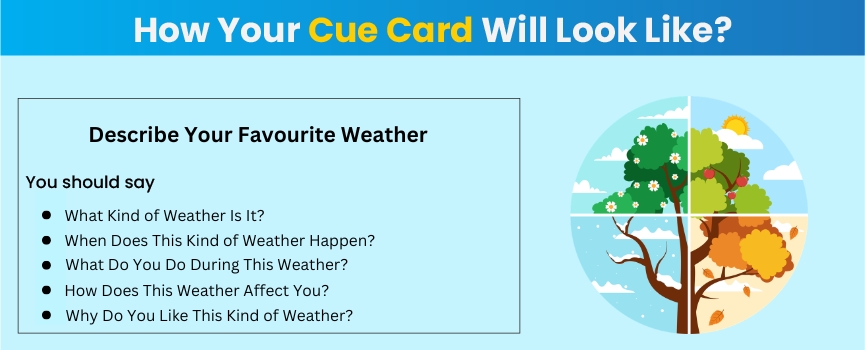
Describe Your Favourite Weather- Sample 1
India is blessed with many kinds of weather throughout various seasons, and each of them gives a totally new experience in its own way. Below is sample 1 of the cue card “Describe Your Favourite Weather”.
Introduction
If there were any single weather that I eagerly anticipate each year, then without any doubt, it would be winter. The atmosphere of winter, along with its coolness and tranquillity, is just not possible to be replicated by any other weather.
What Kind of Weather Is It?
The winters are extremely freezing and have fresh, clear blue skies, which cannot be found during any other time of year. The weather gets very cold, it feels chilly in the mornings, and there is also silence in the air, which can be found only during the winter.
When Does This Kind of Weather Happen?
Winter in India occurs at the end of November and extends till February. The period between December and January is the chilliest of the entire season. Winter is a relatively short season compared to the scorching heat that follows; perhaps because of this reason, it feels worth holding on to.
What Do You Do During This Weather?
Actually, it is the winter season that I look forward to planning my travel to places like areas in Himachal, walking on snow-covered paths, and enjoying sitting near the bonfire. When at home, I spend my time playing some games and being with my family members.
How Does This Weather Affect You?
Winter somehow resets some part within me because it makes everything come to a stop and makes stillness entirely justified. There is no better season for me to get a good sleep, and this weather allows me to be myself.
Why Do You Like This Kind of Weather?
This is the only time of year when I pause for a moment. In all other seasons, my days are packed with activity, thought and action. The winter season strips me of all this since it brings me the joy of crisp air, blue sky, and calm nights. Undoubtedly, there is no other season like it.
Conclusion
The only season that I miss the entire year is cold & winter. The chilly weather, along with the silence and calmness of the season, can be experienced during no other time. It is not a long season, but that adds to its charm.
 Access speaking Mock Test
 Describe Your Favourite Weather - Sample 2
Here is sample 2 for the cue card “Describe Your Favourite Weather” to help you understand how an unusual choice like rainy weather can help create an interesting IELTS speaking part 2 response.
Introduction
There is only one type of weather which I am eager to experience every now and then, and that is rainy weather. For the majority of people, this could seem to be irritating and muddy, but for me, it seems like the only moment when time takes a break.
What Kind of Weather Is It?
The weather is a combination of heat, moisture, and erratic climate conditions, where there would be heavy showers during the night, and skies would have a shade of grey, which I find more preferable than the blue sky in summer.
When Does This Kind of Weather Happen?
The monsoon season in India starts mainly from July to September. There is no consistency in the amount of rain; sometimes there is heavy rain, and other times there is light rain. These three months might seem very long, but in reality, they are shorter than any other season.
What Do You Do During This Weather?
I move slowly, reading books and cooking food at home instead of going to restaurants. On less demanding days, I go for long walks after the rain, during which time the atmosphere seems very fresh.
How Does This Weather Affect You?
The rain calms me because there is some effect about how it sounds that quiets the mental noise in one’s mind, which comes on most days. In fact, when the rains come, my concentration levels are high, and I feel myself most creative.
Why Do You Like This Kind of Weather?
It is because there is nothing fake about rain as it comes, transforms, and leaves behind a changed world. It’s something that can’t quite be described, but that can certainly be enjoyed.
Conclusion
The rainy season is that one season that I truly enjoy and do not look forward to passing. Other seasons find me wishing them away, hoping for another. However, during the monsoon, I am very content right where I am.
Describe Your Favourite Weather - Sample 3
Here is sample 3 of the cue card "Describe Your Favourite Weather" to show how a less talked weather can be used to produce a confident response for IELTS speaking part 2.
Introduction
The weather that I enjoy is the one in autumn. Although not much recognition is given to this kind of weather since there is more publicity about the monsoon and the winter, it is the one I find most satisfying.
What Kind of Weather Is It?
The weather is mild, and there’s a change in light due to dry air. There’s a lack of heat, yet the cold season is still afar off. This is when trees start changing colours, and everything around seems more tranquil compared to all other seasons.
When Does This Kind of Weather Happen
The season of autumn in India takes place from October to November. This is the time when the monsoon recedes, and winter begins. Autumn is the shortest season, which makes it worth noticing, and it can easily be overlooked if one doesn’t have their eyes on it.
What Do You Do During This Weather?
The season where I enjoy spending more time outside is autumn. Walking during the morning is enjoyable and not merely a routine task. I visit parks regularly, and I go on longer distances at a comfortable speed that the summer heat won’t permit.
How Does This Weather Affect You?
This makes me perceptive because the light during autumn has a softer and golden hue, making common sights appear more intriguing than before. I see more, walk faster, and enjoy an inner peace that is hard to obtain during any other season.
Why Do You Like This Kind of Weather?
The fact that autumn is my favourite season is that it does not demand anything of you. Summer compels you to confront heat; monsoon confines you to your house; winter needs preparations. Fall just comes, makes everything more beautiful and exits gracefully. This grace is what appeals most to me about it.
Conclusion
The autumn season can easily be overlooked, and that's most likely the reason I enjoy it so much. It’s not flashy or over-the-top, just enjoyable, given the kind of summer we have around here.
Master the IELTS exam with our Prep Boost
What’s included:
- Pre-recorded video lectures
- Advance Study Materials
- Detailed Feedback Report
Lexical Resources
Showcasing strong vocabulary for IELTS is a major area that every candidate must focus on. Here is the list of all important lexical resources used in the samples above to help you prepare confidently for IELTS speaking part 2.
| Lexical Resource | Meaning |
|---|---|
| Anticipate | To look forward to something with excitement before it actually happens |
| Tranquility | A state of complete calm and peacefulness in the surrounding environment |
| Replicated | Copied or reproduced in exactly the same way as the original |
| Scorching heat | Extremely intense and uncomfortable heat that is difficult to endure |
| Erratic | Unpredictable and inconsistent, changing without any clear pattern or reason |
| Consistency | The quality of behaving or occurring in a regular and expected manner |
| Perceptive | Having a sharp ability to notice and understand things that others might miss |
| Tranquil | Peaceful, quiet and free from any disturbance or disruption |
| Recedes | Gradually moves back or withdraws from a previously occupied position |
| Overlooked | Failed to notice or give proper attention to something present |
| Confront | To face or deal with something difficult or uncomfortable directly |
| Confines | Restricts movement or activity within a limited space or boundary |
| Intriguing | Arousing curiosity or interest in a way that is difficult to explain |
| Worth holding on to | Something valuable enough to cherish and not let pass without appreciation |
| Time takes a break | A moment when everything slows down and feels suspended from its usual pace |
| Mental noise | The constant stream of thoughts, worries and distractions that occupy the mind |
| Strips me of all this | Removes all unnecessary activity, pressure and distraction from daily life |
| Exits gracefully | Comes to an end in a smooth and understated way without any disruption |
| Packed with activity | Filled with a large number of tasks, commitments and things to do |
Follow-up Questions
Following the completion of the speaking test part 2, another important aspect that candidates have to focus on is the two-way discussion, which is part 3 of the speaking test. This discussion includes the examiner asking some follow-up questions in relevance to the response given by the student during part 2.
Here are some example questions that you can practice for your IELTS exam.
1. Does the weather affect one’s mood and productivity?
Yes, people feel more active and motivated when the weather is pleasant and nice compared to when it is extremely hot or rainy. The relationship between weather conditions and one’s mood can easily be observed by most people without much effort.
2. Does the weather influence how people select their places of residence?
Climate is a hidden factor when individuals decide to relocate, along with their careers and families. It is generally because someone who finds themselves unable to cope with very hot and cold climates takes this into consideration.
3. Does climate change influence weather patterns around the world?
Yes, the facts speak for themselves even without any scientific proof, as we can observe erratic rainfall patterns, unusual prolonged heat waves, and seasons that do not behave as predicted anymore. The question today is not if this phenomenon is taking place, but how fast the world will react to it.
4. Are people more aware of weather and climate issues nowadays than they used to be?
Yes, but awareness & knowledge do not always come with equal action. It is much easier to speak about climate change on social media today than a decade ago. The younger generation knows a lot more about it than earlier generations did at their age.
Tips to Excel in IELTS Cue Card
Just studying through speaking cue card practice questions will not be sufficient for scoring your desired marks; it should be accompanied by good strategies and proper sources that help ensure continuous improvement in the process.
- Experiment with various cue cards in order to ensure diversity in topics and themes, because you must develop self-confidence, as you may come across any surprise in your exam.
- Rather than striving for perfection, try to give emphasis on pronunciation and clarity, as this would enable you to communicate effectively in the test.
- Sign up for IELTS online coaching classes, and you will benefit from expert advice and a personal approach to learning to speak English fluently.
- While preparing for the exam, try thinking in English, as this will help you feel less hesitant during your test day.
- Develop your skills in idea generation by learning how to easily generate examples and supporting information for any given topic.
- Consistently assess your own abilities using an IELTS band score calculator to determine where you stand currently and improve from there.
- Try to identify the typical errors you usually make when dealing with the cue card task and avoid making these mistakes again.
Conclusion
In conclusion, getting ready for the IELTS speaking test is not as difficult as it may seem, especially when the right methods and materials are used. The examples given above will help you learn how to formulate high-scoring answers in a confident way.
If you are someone still struggling with IELTS Exam preparation, connect with our experienced tutors to get personalised guidance and access to unlimited practice resources.
0 comments

Practice Makes a Man Perfect!Take FREE ielts Mock Tests
Start FREE Mock Test


Get Unlimited Access with
IELTS Prep Boost

Mock Tests

Practice Questions

Study Material

Recorded Classes
What is your Target IELTS Band?








Not Confident in Speaking? Practice Cue Card Now.
Start Practice