
Describe Your Favourite Holiday Destination – IELTS Cue Card
The preparation for the IELTS speaking section might seem difficult for many students, especially while dealing with the cue card task. It is simply because the topics are unpredictable, the preparation time is less, and speaking fluently for 2-3 minutes is not easy for every candidate. However, with consistent IELTS preparation, students can eventually build confidence and enhance their fluency.


Summarise with AI
Choose your AI Assist



Table of Contents

Introduction to IELTS Cue Cards
The IELTS Cue Card is an essential part of the speaking exam that helps in assessing the speaking ability of students in English. The cue card features a topic and a few prompts, enabling them to structure their response effectively and answer in an organised way.
However, here’s the actual catch: the cue card task becomes challenging as candidates only get one minute to make notes and gather their thoughts, and then express their opinions for about 2-3 minutes.
Preparing with different speaking cue card practice questions enables students to become more fluent, confident, and knowledgeable about vocabulary and how ideas should be organised. The topic in the cue card may be about personal experiences, significant events, interests, or people, which makes it easier to frame a response for 2-3 minutes.
How to Answer the Cue Card?
As you are now fully aware of the basics of IELTS cue cards, it’s time for us to move to the expert trick on how to answer them.
In one minute of preparation time allowed by the examiner, understand the topic properly, identify the key words, and take down a few points, instead of sentences.
Start responding with a clear introduction and address each prompt mentioned in the cue card individually, accompanied by a few examples or details to make your response sound natural. Moreover, focus on not repeating the same ideas while speaking confidently for at least 1 minute and 45 seconds.
Here is the sample below to help you understand how your speaking cue card might look:
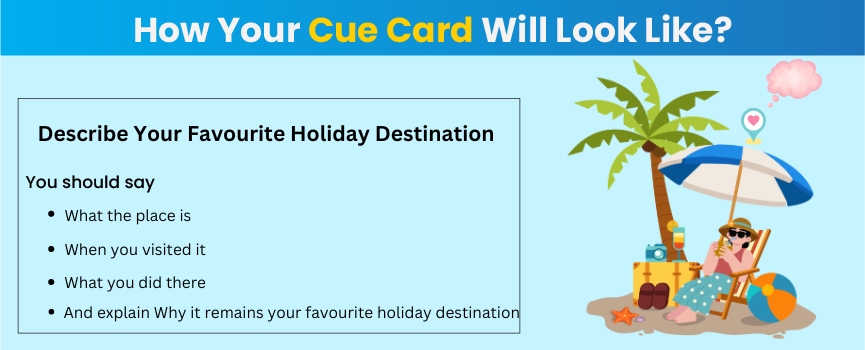
Describe Your Favourite Holiday Destination- Sample 1
This is an example of sample 1 for the cue card “Describe Your Favourite Holiday Destination” based on a personal experience to show you how adding specifics can make your response really engaging.
Introduction
The first city that comes to mind is Manali. Honestly, I have visited various cities, but it’s Manali that keeps popping up in my mind, and I would love to revisit it anytime again.
What the Place Is
Manali is a popular hill station located in the Kullu district of Himachal Pradesh. It lies at an elevation of around 2,050 meters above sea level. The city is enclosed on all sides by the river Beas, dense pine trees, and snowy mountains that can be seen from any part of the town.
When You Visited It
I made my trip in December 2022, which proved to be a perfect time to do so. The winter season in Manali is quite an experience compared to what it is like during summer due to the lack of visitors and heavy snowfall. The best part of my trip was that I spent six days there, which allowed me to explore each part of the town.
What You Did There
I visited famous places, including Rohtang Pass, Solang Valley, Hadimba temple, the old market of Manali and various other top spots. I even experienced my first-ever snow trekking expedition, and it was tough but satisfying at the same time. Additionally, in the evening, I spend my time exploring various cafes and chilling on the banks of the Beas River.
Why It Remains Your Favourite Holiday Destination
Manali makes an impact that not many places can. There's something about standing atop the Rohtang Pass in the midst of nothing but snow and wind that makes you feel truly alive. The peace that comes after coming back from such a place cannot be duplicated by any other place or experience.
Conclusion
I have attempted to go back there twice following my last visit, and somehow it did not work out both times. This is one of the best indications of what it means to me, as I want to go back rather than just continue somewhere else.
 Access speaking Mock Test
 Describe Your Favourite Holiday Destination - Sample 2
Below is sample 2 for IELTS speaking part 2, developed to highlight how fictitious journeys may be described with the same ease and authenticity.
Introduction
The place that I believe holds the position of my absolute favourite destination would be New Zealand. My fascination with locations in which nature seems to communicate in its own language finds fulfilment in New Zealand.
What the Place Is
It is an island nation located in the south-western Pacific Ocean, consisting of two major islands, the North Island and the South Island. Honestly, it is the scenic views of New Zealand that make it highly special. One can find volcanoes and geothermal valleys in the northern regions, fjords, glaciers, and alpine pastures in the southern regions.
When You Visited It
My trip was scheduled in March, when it was early autumn, and it was perfect timing. There weren’t many tourists due to the peak summer period ending, which made my trip even more exciting. The weather was warm but not hot, and there were beautiful foliage changes around the South Island region.
What You Did There
During my visit, I spent my time exploring Queenstown, went for a glacier walk, and did the amazing drive through Milford Sound. The rest of my trip was planned to enjoy the beaches in Rotorua and Auckland.
Why It Remains Your Favourite Holiday Destination
Nothing else comes even remotely close to matching the experience that New Zealand offered. The way in which the mountain ranges interact with water bodies, along with the movement of light on open spaces, has helped me experience that rare feeling of humility, which is why I still love it most.
Conclusion
Indeed, New Zealand has that effect of making any other place seem a little bit normal. It is not to belittle other tourist attractions, but it’s just that after visiting here, everything else becomes normal thereafter.


Describe Your Favourite Holiday Destination - Sample 3
Here is sample 3 for the IELTS speaking part 2 to highlight how a culturally and personally significant location would make a truly memorable IELTS answer.
Introduction
The place which is unique in my mind as one of my favourite places is Kashmir. This place has always been in my mind since my childhood, but nothing really describes how it looks until you see it yourself.
What the Place Is
Kashmir is located in the north of India and is surrounded by the Himalayan range. It is famous for its scenic beauty and breathtaking natural setting. A few of the attractions include the Dal Lake, Mughal gardens, the valleys of Gulmarg and Pahalgam, with the mountains as its background.
When You Visited It
I made my visit to Kashmir in April, which was the blooming period of the renowned tulip flowers. Indeed, it was the most favourable time as the harsh winter had already ended, and the valleys were adorned with vibrant greenery, creating an enjoyable climate to explore the town.
What You Did There
My trip began with spending some days on a houseboat at Dal Lake, and after that, I visited the Mughal gardens at Shalimar Bagh. In addition, I had an early morning ride in the shikara boat. Further, I travelled to Gulmarg, where I took the cable car ride to the snowline and strolled around the old markets of Srinagar.
Why It Remains Your Favourite Holiday Destination
The experience in Kashmir has left an indelible mark upon me. Staring at the sunrise while sailing on a houseboat through the waters of Dal Lake, with the mountains mirrored and the utter stillness surrounding you, is an experience which resets your priorities in life.
Conclusion
Kashmir is indeed a place whose reality is much better than its reputation. Although I have been to other destinations before, no other place compares to Kashmir. I would definitely revisit without any second thoughts.
Master the IELTS exam with our Prep Boost
What’s included:
- Pre-recorded video lectures
- Advance Study Materials
- Detailed Feedback Report
Lexical Resources
A strong range of vocabulary in your IELTS speaking section is a major score booster. Here is a table comprising all the important lexical resources, including phrases and idioms in the samples above.
| Lexical Resource | Meaning |
|---|---|
| Elevation | The height of a place above sea level, measured in meters or feet |
| Geothermal valleys | Areas where heat from the earth creates natural hot springs and steam vents |
| Alpine pastures | Open grassy areas are found at high altitudes in mountainous regions |
| Foliage changes | The seasonal shift in the colour and appearance of leaves on trees |
| Indelible mark | A lasting impression that cannot be erased or forgotten over time |
| Scenic beauty | Natural landscapes that are visually striking and pleasing to look at |
| Humility | A feeling of being small or insignificant when faced with something overwhelming |
| Glacier walk | A guided trek across a glacier, typically done with specialised equipment |
| Snowline | The altitude above which snow remains on the ground throughout the year |
| Fjords | Narrow inlets of the sea between cliffs, typically formed by glacial activity |
| Keeps popping up in my mind | Something that repeatedly comes to mind without being deliberately recalled |
| Makes you feel truly alive | An experience so powerful that it creates a heightened sense of presence and energy |
| Cannot be duplicated | Something so unique that no other place or experience can replicate it |
| Resets your priorities in life | An experience that causes you to rethink what truly matters to you |
| Everything else becomes normal | When an extraordinary experience makes all other things seem ordinary in comparison |
Follow-up Questions
After answering the IELTS speaking part 2 question, the next thing in this section is to have a discussion involving some follow-up questions that the examiner will ask you according to the response provided.
Here are some sample questions for the above topics to give you more insight into what the section entails.
1. Why do people like visiting new places?
I think that people really enjoy travelling because it allows them to relax, explore other cultures, and get away from the normal environment around them. Furthermore, it provides them with a chance to create memorable moments with their loved ones.
2. Which factors determine a successful holiday destination?
An ideal vacation place is one that has beautiful scenery, favourable weather, security, interesting places within, good food, etc. Other features like easy access and low-cost accommodation may make the location all the more desirable.
3. Is tourism a good thing for the development of a country?
Absolutely, because it helps to earn money, generate employment opportunities, and disseminate cultural values. It also helps in the development of hotels, transportation, and local industries.
4. Has anything changed in people’s travelling habits compared to the past?
Honestly, modern technologies have made travelling easy as travellers can easily make arrangements for their vacations, hotel accommodations, flights, and other matters online. Social networking sites have also stimulated people to travel.
Tips to Excel in IELTS Cue Card
IELTS Cue Card Preparation may appear challenging at first, as test-takers are required to give a confident speech about an unknown topic within a short time span. However, with the right preparation approach and regular practice, your dream band is not too far away.
Here are a few proven tips that you should follow when preparing for the speaking test:
- Get Familiar with Cue Card Structure – Before preparing for your IELTS speaking part 2 task, you need to be clear about what the cue card is all about, including the preparation time, speaking duration, and the overall evaluation criteria.
- Build Strong Vocabulary– Focus on enhancing your vocabulary for IELTS topics that come up often in the test, like travel, people, events, hobbies, and personal experience. Moreover, reading articles, listening to podcasts, and watching videos in English will be helpful.
- Organise your Thoughts Fast – During the minute of preparation time, jot down some brief notes rather than sentences. This will help you not get stuck while speaking and will help you not forget your thoughts.
- Fluency and Clarity – Rather than using difficult words and phrases, you need to learn to speak clearly. This means that an answer with clear structure and straightforward vocabulary will always sound better.
- Practice Under Real Exam Conditions – Take an IELTS speaking mock test to practice under simulated conditions on different cue card topics. This will eventually help boost your confidence, fluency, and time management skills.
- Record and Review Your Responses – Recording and analysing your recordings will enable you to spot common vocabulary words used, mispronunciations, and hesitation while speaking.
Conclusion
Summing up, the IELTS speaking section is simply one of the major score boosters if prepared smartly and using the right practice materials. Students should regularly take practice tests to tighten their grip on various cue card topics.
Still confused about where to start your preparation from? No worries, connect with our experts through online IELTS classes to receive tailored guidance and a preparation plan that helps you prepare confidently for the test.
0 comments

Practice Makes a Man Perfect!Take FREE ielts Mock Tests
Start FREE Mock Test


Get Unlimited Access with
IELTS Prep Boost

Mock Tests

Practice Questions

Study Material

Recorded Classes
What is your Target IELTS Band?







Not Confident in Speaking? Practice Cue Card Now.
Start Practice