
Describe A Talk You Gave to A Group of People - IELTS Cue Card
Preparing for IELTS generally does not feel challenging until you prepare for the IELTS speaking part 2. It is not because you lack knowledge or ideas, but the one-minute prep time is what actually haunts candidates. The preparation time actually feels shorter, and you run out of thoughts, which results in a response that is more robotic and sounds unnatural. Mastering the long turn task in the IELTS speaking section is key to boosting overall scores, and with the right practice, your dream band is not too far.

Summarise with AI
Choose your AI Assist



Table of Contents

Introduction to IELTS Cue Cards
The cue card is a crucial component of the IELTS speaking part 2. It is basically a topic card that features 3-4 prompt questions. These prompts are designed to evaluate the ability of a candidate to speak and express their opinions fluently in English.
Before addressing each point of the cue card, candidates are provided with a 1-minute preparation time, which is helpful to gather the core ideas and note keywords. After the preparation time, candidates respond using a natural tone for 2-3 minutes, during which their fluency, coherence, vocabulary range and grammatical accuracy are assessed.
IELTS cue cards topic covers personal experiences, objects, places or events, which is helpful for candidates to provide a thorough response using their past situation or a hypothetical situation.
How to answer the Cue Card?
All it takes is a correct approach for a candidate to score higher in the IELTS speaking section. Here is a detailed overview of how you must answer the cue card task.
- Before starting to gather your thoughts, read all the bullet points carefully, as each one is a prompt and needs to be addressed with a real response.
- Always prefer using your personal experience to frame a response, as it gives you a context to actually work with.
- While jotting down main points, prefer using keywords and not full sentences, as it will not eat into your preparation time.
- Do not start with an opener that sounds robotic, as it clearly wastes time and sounds more rehearsed. Instead, the best approach is to jump directly to the story.
- Using a clear sequence, address each to show a clear connection between thoughts.
- While expressing your points, mention specific details in the form of a real name, details about an event, or a date to make your response more genuine.
Before you start your IELTS preparation for the speaking part 2, here is a quick photo of how your cue card might look in the test.
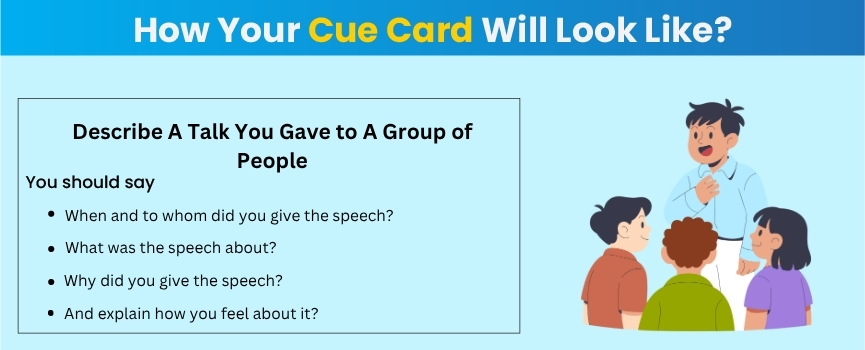
Describe A Talk You Gave to A Group of People- Sample 1
Here is sample 1 of the IELTS cue card “Describe A Talk You Gave to A Group of People” to help you get familiar with the right approach.
Introduction
The talk that easily comes to my mind is one I gave as cricket team captain, the day before our college inter-district finals. Honestly, this was in no way a planned speech. I had noticed the boys were tense in practice, and I sensed someone had to say something real to them before the biggest game of the tournament.
When and to whom did you give the speech?
I gave the talk in the evening before the final match. The place was in the school grounds after the practice session was over. The audience was our playing eleven plus three or four reserve players and our coach.
What was the speech about?
I kept everything simple and told them that the opposition was good, given their unbeaten record. But I told them that we had won against better teams in the group stages. I made them recall a particular match we had played earlier in the tournament, where we were 40 for 4 and still ended up winning. All I wanted them to keep in mind was their actual capability before the final game.
Why did you give the speech?
Our best batsman had picked up a minor injury the day before the final, and the whole group was in a bad mood. Nobody was saying anything, but everyone was thinking about it. I gave the speech because I could feel the confidence slipping away, and I thought it was worse to do nothing than to say something.
How did you feel about it?
Honestly, I was quite nervous. I had been the captain of the team for the year, but giving speeches was quite different from making decisions in the field. My voice was steady, but my hands were not. When I finished, the atmosphere had changed somewhat, and I thought that was good enough.
Conclusion
We won the finals by seven wickets. I can honestly say that the speech did not win the match, but it stabilised something in the group that evening. It was the first time I realised that leading with words is as important as leading on the field.
 Access speaking Mock Test
 Describe A Talk You Gave to A Group of People- Sample 2
Here is sample 2 of “Describe A Talk You Gave to A Group of People”, which can be used to discover how to formulate responses while practising.
Introduction
The speech that immediately comes to mind is one that I made at my workplace on the occasion of International Women’s Day. I had never made a speech in a professional setup before, and when my manager suggested my name, my actual response was a "no."
When and to whom did you give the speech?
It was the 8th of March, and the event was one that our HR department had organised within the office. The attendees were a mixture of people from various departments within the office and a few senior management figures. There were a total of fifty people or so, which doesn't sound too bad until you're the one standing at the front.
What was the speech about?
I talked about the women within my team and what I personally knew of how they worked and how they supported each other. My aim was to talk beyond general topics, be more specific about women in our office and how they actually perform various tasks with effectiveness.
Why did you give the speech?
My manager thought that I was in a good position to say something since I had worked with many of the female colleagues. My motivation for giving the talk was somewhat different since the year before, the event had been so formalistic and empty. I wanted it to be about the people who were there, not about the date.
How did you feel about it?
I was a bit nervous, surprisingly, because these were people I worked with every day. In my half-way to the speech, I stopped reading from my notes and just started talking, and that’s when it felt right.
Conclusion
After the event, a few coworkers told me that it was the most authentic thing they had ever heard at a women’s day occasion, which meant a great deal more to me than any kind of feedback. People connect with you when they sense you are really there rather than simply doing a job.
Master the IELTS exam with our Prep Boost
What’s included:
- Pre-recorded video lectures
- Advance Study Materials
- Detailed Feedback Report
Describe A Talk You Gave to A Group of People- Sample 3
Given below is sample 3 of “Describe A Talk You Gave to A Group of People”, which helps you express your thoughts with practice.
Introduction
The one speech that has stuck with me is when I gave a speech at my Class 12 farewell. No one had asked me to prepare for it, but when I was handed the mic, it turned out to be one of the most impactful moments of my school days.
When and to whom did you give the speech?
The month was January, and it was a few weeks before our board examinations. It was the farewell event organised by the junior batch for us, the outgoing Class 12th students. I spoke in front of almost 125 people, including my classmates, juniors, and teachers. It was a large gathering; considerably bigger than any audience I had faced so far.
What was the speech about?
I talked about the years we had shared, the friendships that had developed without anyone really planning them, and the strangeness of being at the end of something that had just been life for so long. I thanked the teachers, although this was more sincere than I had intended.
Why did you give the speech?
It was not entirely voluntary, and the teacher was aware that I was comfortable speaking in front of people. However, once I began speaking, I realised that I had things I wanted to say. The class was in a sad mood, and it was probably the right time to acknowledge it properly before we all went our separate ways.
How did you feel about it?
I approached the situation feeling relatively calm, which I found surprising. About thirty seconds into my talk, I spotted my closest friends in the first row, and something clicked inside me. I got my voice out, though I slowed down a couple of times. At the end, there were a few classmates who felt emotional there, which I did not anticipate.
Conclusion
After my speech, several of my classmates approached me afterwards and told me it was exactly what the evening needed. I had not written one word before that, and I think that is why it worked. A speech can be well-rehearsed and therefore sound good. This one simply sounded like the truth.


Lexical Resources
Showcasing your vocabulary for IELTS is one of the important areas that student have to master to make their response sound natural and more confident.
Here is a detailed list of lexical resources, including idioms used in the samples above, which you can use for a similar context.
| Lexical Resource | Meaning |
|---|---|
| Inter-district finals | The tournament final match was played between teams from different districts |
| Unbeaten record | A performance history with no losses throughout a competition |
| Capability | An individual’s actual ability to perform a task or handle a situation |
| Confidence slipping away | A gradual loss of belief in oneself or one's team |
| Leading with words | Using speech and communication as a form of leadership rather than relying only on actions |
| Say something real | To speak honestly, considering the situation, rather than using rehearsed or hollow words |
| Stabilised | Brought back to a steady and calm state after a period of uncertainty |
| Professional setup | A formal workplace environment with colleagues and management |
| Senior management | People in higher positions of authority within an organisation |
| Authentic | Genuine, real, and free from pretence or performance |
| Outgoing batch | The group of students who are completing their final year and leaving the institution |
| Board examinations | The standardised final exams taken at the end of Class 10 or Class 12 |
| Impactful | Having a strong and lasting effect on people |
| Strangeness | An unusual or unfamiliar feeling about a situation or moment |
| Sincere | Genuinely felt and expressed without any exaggeration |
| Anticipate | To expect or predict something before it actually happens |
| Well-rehearsed | Thoroughly practised and prepared in advance |
| Reserve players | Team members who are available as substitutes but not in the starting lineup |
| Formalistic | Overly structured and ceremonial without real substance or meaning |
| Acknowledge | To openly recognise or give proper attention to something or someone |
| Atmosphere | The general mood or feeling present among a group of people at a given moment |
| Separate ways | A phrase used when people part after sharing a common experience or journey |
| Something clicked inside me | A sudden realisation that changes how a person feels in that moment |
| Standing at the front of the room | Being in a position of visibility and responsibility in front of an audience |
Follow-up Questions
After the IELTS speaking part 2, the next core thing to prepare for is a two-way discussion, which is part 3, followed by the cue card task. For this task, candidates are asked two or three follow-up questions related to the response of part 2.
Here are a few examples of questions associated with the samples provided above to help you get familiar with this section.
Q1. Do you think public speaking is an important skill?
Yes, honestly. It is one of those skills that caters to almost all aspects of life. Whether it is job interviews, addressing a crowd, or simply being heard in a group conversation, public speaking is crucial. The key highlight is that nobody tends to realise the importance of it until after a situation in which they wish they were more proficient in it.
Q2. Do you think schools should include public speaking in their curriculum?
In my opinion, they should, and I think it is surprising that more schools do not. Speaking confidently to a group of people is something that almost all careers demand of their employees at a certain stage.
Q3. What makes a speech effective, according to you?
For me, it’s the clarity and honesty. You can usually tell whether someone is just going through the gestures. The speeches that work are the ones where the person is actually committed to what they're saying. An effective speech also includes a pinch of structure, but not much.
Q4. Do you think leaders need to be good speakers?
I think they are not necessarily required to be good speakers, but good communicators. I think of effective leaders as those who are not always the best speakers, but they always say what they mean without requiring people to think too hard about what they are saying.
Q5. How can someone overcome the fear of speaking in public?
I think mainly just by doing it. Reading about techniques helps somewhat, but the fear isn't going to go away just because you've read about the techniques. It will go away over time as you get more exposure. It is better to start small, like in the classroom or in front of a team meeting, and go from there.
Tips to excel in the IELTS cue card
In order to master the IELTS speaking part 2, all that is required is a correct approach and the right preparation with realistic speaking cue card practice questions. Here are a few proven tactics that will help you ace this task effectively.
- While addressing each point, make sure ideas flow into the next naturally and connect well so that they feel like they are sewn together.
- Deliver your response in a way that sounds more like a story. For this, start with setting up the situation and moving naturally through bullet points.
- Employ rich vocabulary in your response to avoid word repetition and showcase your command of the English language.
- Maintain a steady pace throughout your response to communicate core ideas seamlessly.
- Lastly, you must prepare for this task under timed conditions by practising with an IELTS speaking mock test, designed to improve accuracy and exam–day confidence.
Conclusion
Summing up, scoring high in the IELTS speaking section is not challenging if you can ace the cue card task. All it requires is for students to follow the right method and practice plan that helps improve over time.
Still don’t know where to start? No worries, connect with our experts through online IELTS classes, and start your preparation with tailored guidance, performance insights and practice resources, all designed to help you achieve your dream band.
0 comments

Practice Makes a Man Perfect!Take FREE ielts Mock Tests
Start FREE Mock Test


Get Unlimited Access with
IELTS Prep Boost

Mock Tests

Practice Questions

Study Material

Recorded Classes
What is your Target IELTS Band?






Not Confident in Speaking? Practice Cue Card Now.
Start Practice