
Describe A Skill That You Can Teach Other People - IELTS Cue Card
The IELTS speaking test is a one-on-one conversation with an examiner that assesses your ability to speak and present your opinion in English fluently. This section lasts 11-14 minutes and consists of different tasks, with the cue card usually considered the most challenging but rewarding. In the cue cards task, you are required to speak on a specific topic for a set amount of time. In this write-up, you are going to read sample cue cards on describing a skill that you can teach other people, with useful vocabulary, follow-up questions and practical tips to help you perform confidently.

Summarise with AI
Choose your AI Assist



Table of Contents

Introduction to IELTS Cue Cards
In the speaking exam, the IELTS cue cards require you to speak on a particular topic given on a card. This card consists of key topics and subsequent questions to guide your response. You have just a minute to prepare and make notes before speaking for two minutes on the particular topic. Basically, cue card topics can cover a wide range of subjects, like places, objects, events or personal experiences. One common and useful topic is describing a skill that you can teach other people, and to answer them, one needs to require a clear structure and logical approach.
By following the structured outline and using the right vocabulary in the IELTS speaking section, you can present your ideas fluently and coherently.
How to Answer the Cue Card?
Well, this is a tricky question for students, but you don’t need to worry too much about it. If you know the requirements of the topic, then answering the IELTS cue card will no longer be a difficult task.
Hence, in this blog on the topic of describing a skill that you can teach other people, you need to start with a brief introduction and then deal with the four types of speaking cue card practice questions, as follows:
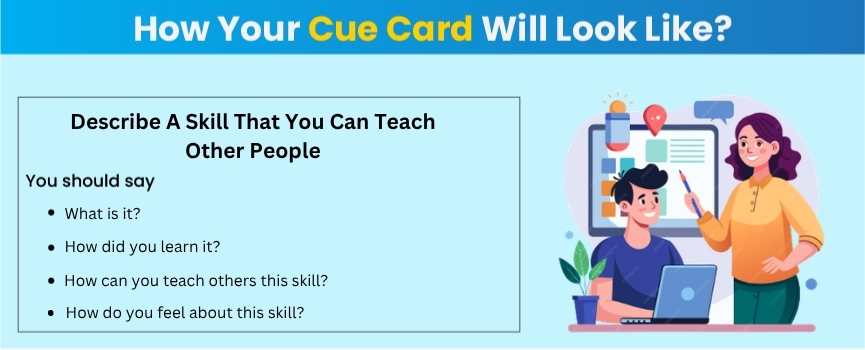
1. What is it?
2. How did you learn it?
3. How can you teach others this skill?
4. How do you feel about this skill?
Below is the image of the cue card “ describe a skill that you can teach other people”, which you will receive during the IELTS exam.
Describe A Skill That You Can Teach Other People - Sample 1
This is the first sample in the IELTS speaking section to describe a skill you can teach to others, which is pencil sketching and basic German language.
It highlights personal interest, creativity, and the ability to share knowledge with others simply and effectively.
Introduction
I would like to talk about a skill that I can teach to others, that is, pencil sketching and some basic rules of the German language. These are the skills that I have learned through my interest and practice over time.
What is it?
My favourite skill is pencil sketching, especially making sketches of babies. Specifically, I enjoy drawing their facial expressions and emotions. Along with this, I also know some basics of the German language, like counting, the alphabet, and simple self-introduction.
How Did You Learn It?
I learned pencil sketching by practising regularly and observing different sketches. With this, I also improved by teaching my younger sister, who is equally interested in drawing. For German, I learned it through my interest in learning new languages and by practising pronunciation and basic concepts.
How Can You Teach Others This Skill?
I can teach sketching by starting with the basic features, like eyes, nose and shading techniques. I can also guide them about which pencils and tools to use. And for German, I can teach basic vocabulary, counting and simple sentences that are easy for beginners to understand.
How Do You Feel About This Skill?
I feel really satisfied and happy with these skills, as they allow me to be creative and also help others learn something new. Teaching others also improves my own knowledge and confidence.
Conclusion
To conclude, pencil sketching and basic German language are the skills that I both love teaching and learning. These skills are simple yet useful, and I definitely would love to share them with others.
 Access speaking Mock Test
 Describe A Skill That You Can Teach Other People - Sample 2
This is the second sample in IELTS preparation to describe a skill I learned during the Corona time, which is painting and drawing. It highlights how personal interest and consistent practice can help develop a new set of skills, and how you can share them with others.
Introduction
The skill I want to talk about is drawing and painting, which I started learning during the COVID-19 lockdown. It began as a way to pass the time, but over time, it became a meaningful hobby. I practised regularly and discovered that I could express my creativity while also helping others learn these skills.
What is it?
The skill I want to talk about is painting and drawing. I discovered it during the lockdown, and it quickly became something I enjoyed and practised regularly. Thus, it involves creating art with dedication and creativity, focusing on improving techniques over time.
How Did You Learn It?
At first, I was not aware of my potential in painting. So, when I started, it was relaxing, and I practised daily, completing about 20 paintings in 20 days. Over time, I continued learning by observing techniques, researching online, and exploring local courses for adults.
How Can You Teach Others These Skills?
I can teach painting and drawing to everyone willing to learn. I would start from scratch, like shapes, colours, and simple techniques, and gradually move to advanced methods. So, I would also emphasise dedication and consistency, which are essential for improving in this skill.
How Do You Feel About This Skill?
I feel very obliged for discovering this skill. It not only relaxes me but, at the same time, it motivates me to keep learning. Even now, I am exploring local classes to enhance my knowledge and improve my painting techniques.
Conclusion
Overall, painting and drawing are skills that I enjoy and can teach to others. With dedication, regular practice, and guidance, anyone can develop this skill and experience the satisfaction of creating art.
Master the IELTS exam with our Prep Boost
What’s included:
- Pre-recorded video lectures
- Advance Study Materials
- Detailed Feedback Report
Describe A Skill That You Can Teach Other People - Sample 3
This sample is about a skill that I can teach to other people, which is dancing. It explains how dancing is not just a kind of hobby for me, but a way to express emotions, feel confident, and connect with music.
Introduction
One skill that I can confidently teach other people is dancing. This has been an important part of my life for many years and has grown from a simple interest into a meaningful passion.
What is it?
Dancing to me is more than just moving to music. It is a kind of self-expression that allows me to show energy, joy and freedom. It, however, connects emotions with movements and transforms rhythm into something creative and artistic.
How Did You Learn It?
I learned dancing by watching YouTube videos and practising on my own. I also practised with friends and improved by repeating the steps in front of a mirror. And over the period of time, I became more confident and developed my skills through my regular practice.
How Can You Teach Others These Skills?
I can teach others by breaking movements into simple steps and explaining them clearly. I would use counts to match the rhythm, encourage regular practice, and create a supportive setting, so that learners feel confident and enjoy dancing without fear of mistakes.
How Do You Feel About This Skill?
I feel very proud of this skill, as it allows me to express myself and feel confident. Dancing makes me happy and relaxed, and it is something I truly embrace and enjoy. So, it definitely also feels special to share this skill with others.
Conclusion
In conclusion, dancing is not just a hobby for me, but a valuable skill that I can share with others. Dancing has shaped my personality, boosted my confidence, and allowed me to connect with people. Teaching dancing allows me to pass on something meaningful and enjoyable.


Lexical Resources
In the IELTS speaking part 2, lexical resources play a crucial role in determining your score. This criterion evaluates how wide and accurate your vocabulary is, and how accurately you can use words to express ideas clearly and naturally. Using a vast list of words and phrases not only makes your speech more interesting but also leaves a strong, positive impression on the examiner.
To perform well, it is essential to avoid repeating simple words and instead use synonyms, descriptive adjectives and topic-specific vocabulary. Expanding your lexical range allows you to explain ideas in detail, compare and contrast, and show nuanced opinions, all of which are highly valued in the exam.
The table below offers a collection of useful vocabulary for IELTS for varied cue card topics. By learning and practising these words and expressions, you can communicate your ideas more fluently, sound more confident, and ultimately boost your IELTS speaking score.
| Word/Phrase | Meaning |
|---|---|
| Creativity | The ability to use imagination to produce new ideas or things |
| Pencil sketching | The art of drawing images or designs using a pencil |
| Pronunciation | The way in which a word or language is spoken |
| Highlights | Emphasises or draws attention to the most important or notable parts |
| Dedicated | Devoted to a task or purpose with commitment |
| Observing techniques | Carefully watching methods or ways of doing something to learn |
| Emphasizes | Gives special importance or focus to something |
| Enhances | Improves or increases the quality, value, or effectiveness of something |
| Satisfaction | A feeling of pleasure or contentment from achieving something |
| Meaningful passion | A strong interest or love for something that gives purpose and value |
| Confident | Feeling self-assured and positive about abilities or actions |
| Descriptive adjectives | Words used to describe nouns in detail to create clear imagery |
| Nuanced | Having subtle differences or distinctions in meaning, feeling, or tone |
Follow-Up Questions
Follow-up questions are asked by the examiner after the IELTS speaking section. Below are the questions, have a look:
1. Why Do You Think Some People Are Better At Learning New Skills Than Others?
Some people are better at learning new skills, as they are more patient, focused, and willing to practice regularly. Natural talent also helps, but with consistent effort and a positive mindset, it makes a huge difference in learning any skill.
2. How Long Does It Usually Take For Someone To Become Good At This Skill?
It depends on the dedication and practice time of the particular person. For dancing, someone practising regularly for a few weeks can learn steps, but becoming really confident and creative might take several months of dedicated practice.
3. Do You Prefer Teaching This Skill To Children or Adults? Why?
I enjoy teaching both, but I find children more flexible and willing to try new things without fear of mistakes. Adults are more disciplined, so I adapt my teaching style depending on the learner’s age and comfort level.
4. Can Learning This Skill Help In Your Future Career Or Personal Life? How?
Yes, dancing helps in both ways. In my personal opinion, it improves confidence, fitness, and creativity. Professionally, it can open opportunities in performing arts, teaching, or any job requiring presentation skills, teamwork, or self-expression.
5. Are There Any Challenges You Face When Teaching This Skill To Others?
Yes, the biggest challenge is different learning speeds. Some of the people often struggle with rhythm or coordination at first. I try to overcome this by being patient, breaking steps into simple parts, and encouraging regular practice in a fun environment.
Tips to Excel in IELTS Cue Card
To score well in the IELTS speaking part 2, it is essential to develop a clear and structured approach.
However, the strategies can vary from one person to another; certain proven strategies can significantly improve your fluency, confidence, and overall score:
1. Know the Test Format Properly
Familiarise yourself with the requirements, structure, and timing of the IELTS speaking section to respond more confidently and accurately.
2. Do One-Minute Preparation Wisely
Make the most of your preparation time by brainstorming ideas, noting key points, and creating a quick outline for a proper response.
3. Use Relevant Vocabulary & Real-Life Examples
Incorporate suitable vocabulary, idiomatic expressions, and real-life experiences to make your answer more natural and impactful.
4. Practice under Time Limits
Try to speak for yourself within the two-minute limit, which helps improve pacing and ensures a complete and balanced response. You can improve this by taking online IELTS classes that offer a real-time exam simulation.
5. Focus on Natural Communication
Avoid rote learning and aim for clear, spontaneous communication to sound more fluent and confident.
Conclusion
To conclude, teaching a skill to others, whether it’s pencil sketching, painting, dancing, or a new language, not only allows you to share your knowledge but also depends on your own understanding and confidence. The cue card in IELTS speaking part 2 on this topic offers an excellent option to represent creativity, clear expression, and structured thinking. By practising IELTS speaking mock test regularly, using appropriate vocabulary and sharing real-life examples, you can speak fluently and confidently. Thus, mastering a skill and guiding others to learn that is absolutely rewarding. It enriches both personally and academically, making it a perfect topic to impress examiners in the speaking test.
0 comments

Practice Makes a Man Perfect!Take FREE ielts Mock Tests
Start FREE Mock Test


Get Unlimited Access with
IELTS Prep Boost

Mock Tests

Practice Questions

Study Material

Recorded Classes
What is your Target IELTS Band?



Not Confident in Speaking? Practice Cue Card Now.
Start Practice