
Describe A Time When You Needed to Search for Information – IELTS Cue Card
While preparing for the IELTS Speaking section, many students find the individual long turn, or Part 2, particularly challenging. This is not usually because the topics are unfamiliar or they lack knowledge, but because the time pressure makes it harder to express ideas naturally. The good part is that with the right strategy, candidates can deliver fluent responses and aim for a Band 8. The cue cards provided in the IELTS speaking part 2 focus on everyday topics, which help candidates to share their experiences and viewpoints confidently.


Summarise with AI
Choose your AI Assist



Table of Contents

Introduction to IELTS Cue Cards
The IELTS cue cards are simply a topic card featuring three or four bullet points, all to assess the candidate's ability to express their view fluently for 1-2 minutes. For this task, candidates have 1 minute of preparation time during which they jot down ideas, note keywords and collect thoughts to speak naturally for 2 to 3 minutes.
In this task, the examiner closely focuses on fluency, the connection between ideas, the range of vocabulary and grammar accuracy to score candidates.
The cue card generally covers topics from everyday life, which normally describe people, places, experiences or events.
How to Answer the Cue Card?
Given that the cue card task is generally the most important part of the IELTS speaking section, it just requires a correct approach for candidates to score a high band. Here is a clear breakdown of how you must approach the IELTS cue card task.
1-Minute Preparation Time
- Read all the bullet points carefully, as each one is a prompt and needs to be addressed individually during the response time.
- Gather detailed highlights for each bullet while avoiding full sentences to save some time, and jot down enough points for a response.
- Connect your answer with a personal experience or craft a hypothetical situation for a confident response.
2-3 Minute Response Time
- Start responding with a scene setter that clarifies your topic rather than starting with robotic phrases like “I will talk about”.
- Be specific in your response by highlighting the names of places or people, mentioning exact dates, the happening of an event or something that makes your response sound real.
- While responding, aim for at least 1 minute 45 seconds to 2 minutes, as less than this can impact your scores.
Before starting your IELTS preparation for the speaking part 2, here is a quick snapshot of how your cue card might look in the test.
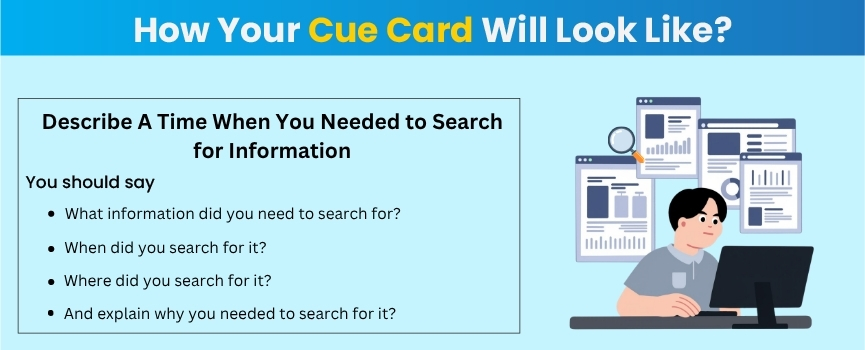
Describe A Time When You Needed to Search for Information - Sample 1
Given below is the sample answer 1 for your IELTS cue card “Describe A Time When You Needed to Search for Information”. It will help you get familiar with the approach you should use to answer each prompt and craft your response.
Introduction
The one example that comes to mind immediately is planning my first trip to Himachal Pradesh alone last winter. To be honest, it was a somewhat spontaneous decision, as I had never been on a trip alone before. Moreover, winter in the hills is a completely different plan.
What Information Did You Need to Search for?
I wanted to find out which areas were actually accessible during the winter season. Many routes leading to the Spiti and Lahaul valleys get closed during the winter season due to heavy snowfall. I also wanted to find out about the guest houses that were available for stay, the packing essentials that were required for sub-zero temperatures, and whether it was safe for a solo tourist to visit the region during the winter season.
When Did You Search for It?
I began researching in late November, five weeks before I was planning to depart in January. It’s important to give yourself more time when planning to travel in the winter to Himachal, as situations such as road closures and unpredictable weather mean you can’t just wait and see.
Where Did You Search for It?
I made use of travel blogs that are specifically written for winter travel to Himachal, and the latest vlogs from travellers instead of depending on general tourism websites, as they were outdated. The official website of the Himachal Pradesh tourism board was helpful for updates regarding the condition of the road. A community for solo travellers on Reddit provided me with first-hand information from people who had undertaken the same trip in January.
And Explain Why You Needed to search for it.
Travelling to Himachal in Winter is no doubt an unpredictable choice. A road may be passable one week and snowed in the next. Venturing in without hard information, especially when travelling alone, felt irresponsible. I wanted a practical idea of what I was getting myself into, not just appealing pictures.
Conclusion
The trip to Manali and Sissu in January is one of the most memorable experiences, especially with the snowfall in the valleys, absence of tourists and complete silence. This was all possible with the help of the research that I have done, and without it, I would not have gone.
 Access speaking Mock Test
 Describe A Time When You Needed to Search for Information - Sample 2
Given below is Sample 2 of “Describe A Time When You Needed to Search for Information”, which will help you express the ideas confidently.
Introduction
The first thing that comes to mind is when I was looking to buy a new laptop two years ago, as I had an estimated idea of a budget but was unsure of which to choose, as every review I read seemed to contradict the previous one.
What Information Did You Need to Search for?
I had to determine which processor was best for my needs, which consisted mainly of writing, some photo editing, gaming, and video calls. I also had to determine how much a difference the RAM made, which type of storage was better, and which companies had a reputation for building quality computers with good after-sales service.
When Did You Search for It?
My old laptop had completely stopped working in October, right in the middle of my semester. So, I gave myself ten days to do some research and purchase a laptop, which was a bit too short a span for me, to be honest, but I had to get a laptop working before my assignment deadlines started piling up the following week.
Where Did You Search for It?
I began with YouTube channels where they had explained it in a way that didn't presume you already knew everything about it. For price comparisons, I used both Flipkart and Amazon side by side. The best advice came from a tech subreddit where people shared their experiences of actually owning something, rather than reusing spec sheets.
And Explain Why You Needed to search for it.
Laptops are not small purchases for a student’s budget, and buying the wrong one means having to live with it for three or four years. I had made that mistake once before, choosing a laptop based on looks alone, and had to settle for a laptop that overheated when I had more than three tabs open.
Conclusion
I opted for a mid-range HP Victus, and two years later, it performs exactly as you will expect with no complaints. The research that I did over those ten days likely prevented what would have been an incredibly expensive and frustrating purchase for me.
Master the IELTS exam with our Prep Boost
What’s included:
- Pre-recorded video lectures
- Advance Study Materials
- Detailed Feedback Report
Describe A Time When You Needed to Search for Information - Sample 3
Here is the sample 3 for the cue card on “Describe A Time When You Needed to Search for Information”, helping you learn to formulate responses while practising.
Introduction
Around a year ago, I decided to get fitness on track, serious enough to include diet and routine in it, and not just a gym membership. Literally, I had no idea where to start, and instead of jumping into anything blindly, I spent two weeks looking for proper guidance before anything else.
What Information Did You Need to Search for?
I was looking for a beginner-friendly workout plan, as well as a diet that was not too focused on building muscle but was achievable. I was particularly curious about how much protein I really needed to take daily, what exercises were necessary, and if I even needed supplements for my fitness journey.
When Did You Search for It?
As I exactly remember, it was in January, and it was part of my New Year's resolution. I had just re-joined the gym after almost eight months out, and I was told by my trainer that diet plays a major role in the results. It was when I got motivated to research rather than guess.
Where Did You Search for It?
I mainly relied on YouTube fitness channels, as they were evidence-informed rather than motivational. I also made use of the fitness community found on Reddit, where individuals posted highly specific queries and received comprehensive answers. Thus, I feel I accessed pretty much all the information I needed.
And Explain Why You Needed to search for it.
I had attempted to get in shape twice before, but given up on both occasions, partly because I was listening to random advice without cross-checking or having any real structure. This time, I wanted to know what was behind the advice, rather than just blindly following it. This shift in approach was the major game-changer that made all the difference.
Conclusion
I've managed to be consistent for ten months now, and that's longer than both previous attempts. The research really did help, not because I found magic advice, but because I understood the basics well enough to stop doubting myself every single week.


Lexical Resources
Delivering perfect responses in IELTS speaking part 2 is not only about strong ideas, but also about using a range of lexical resources to showcase your vocabulary for IELTS and make your response sound confident and more natural.
Here is a detailed list of useful words and phrases for your reference, used in the samples above.
| Lexical Resource | Meaning |
|---|---|
| Spontaneous decision | A choice made quickly, without much prior planning |
| Accessible | Possible to reach or enter, especially a route or location |
| Sub-zero temperatures | Temperatures that fall below 0°C, extremely cold conditions |
| Unpredictable weather | Weather conditions that change suddenly and cannot be forecast easily |
| First-hand information | Information or experiences shared directly by the person who lived them |
| Road closures | Situations where roads are officially shut due to damage, snow, or hazards |
| Outdated | No longer current or relevant; old and not recently updated |
| Solo traveller | A person who travels alone without companions or a tour group |
| Irresponsible | Acting without thinking about consequences or safety |
| Estimated budget | An approximate amount of money planned for spending |
| After-sales service | Support or assistance provided by a company after a product is purchased |
| Spec sheets | Technical documents listing the detailed features and measurements of a product |
| Overheated | Became too hot to function properly, especially a device or machine |
| Mid-range | Priced in the middle; neither the cheapest nor the most expensive option |
| Piling up | Adding quickly; increasing in number within a short period |
| Beginner-friendly | Easy to understand or follow for someone with little or no prior experience |
| Evidence-informed | Based on research, data, or proven results rather than opinion or guesswork |
| Supplements | Vitamins, proteins, or other substances taken in addition to regular food |
| New Year's resolution | A personal goal or commitment made at the start of a new year |
| Game-changer | Something that completely changes the outcome or approach to a situation |
| Consistency | The ability to keep doing something regularly over a period of time |
| Cross-checked | Verified information by comparing it across more than one source |
| Comprehensive answers | Responses that are thorough, detailed, and cover all aspects of a question |
Follow-up Questions
Once you have mastered the IELTS speaking part 2, the next thing to focus on is a two-way discussion, which is part 3 of the speaking section and is followed by your cue card task. In this discussion, the examiner asks you two or three follow-up questions related to the response you have provided.
Here are a few mock questions related to the samples provided to help you understand this section.
1. Do you think people rely too much on the internet for information today?
Yes, I think so, many people depend on the internet because it is fast and easy to use. At times, this dependency can limit critical thinking because people rely on information without questioning anything, which can create confusion and spread false information.
2. What are the disadvantages of searching for information online?
One of the disadvantages is that there is a lot of misinformation. There is also a possibility of getting distracted by advertisements or other articles that are not related to what one is reading. Too much reliance on online sources may impair memory and research skills.
3. How can people verify if information is trustworthy?
In order to ensure reliability, individuals can verify information by consulting multiple sources, official websites, and seeking opinions from experts. Cross-checking data, dates, and author credibility is important in confirming that the information provided is correct and current.
4. Do you think information is easier or harder to find now compared to the past?
Information is definitely easier to find nowadays with the help of the internet and smartphones. Earlier, people had to rely on libraries or books to find particular information, which often took a much longer time. Nowadays, most facts are available at once, although it is harder to distinguish between reliable and unreliable sources.
5. What skills are important for finding reliable information?
Skills like critical thinking and assessment are important. An individual must be able to analyse the source of information, detect bias, and verify the information provided. Additionally, basic digital literacy skills such as the use of search engines and identifying reliable websites are important for accessing dependable information online.
Tips to excel in the IELTS cue card
With the changeable and random nature of cue card topics, preparing for this task often feels confusing. However, with the correct approach, realistic speaking cue card practice questions and expert tips, your dream band score is not too far away.
Here are a few proven tips you can use for effective IELTS speaking part 2 preparation.
- Start your response with natural opening lines instead of memorised lines, as it will help you sound more natural and establish a strong impression.
- While preparing your response, make sure to address each bullet point individually and include small details like time, place or event.
- Draft your response using a strong range of vocabulary, as it will help you avoid repetition of words and showcase your grip on English.
- While responding, do not rush, speak at a steady pace, and try focusing on communicating your ideas perfectly.
- Lastly, practice regularly under timed conditions with the help of an IELTS speaking mock test, which will help you improve accuracy and confidence for the test day.
Conclusion
All things considered, mastering the cue card task is one of the best approaches for students to ace the IELTS speaking section. With the help of a correct preparation plan, students can boost their overall scores.
Still not confident with your preparation? No worries, connect with our experts through online IELTS classes, get a personalised practice plan, detailed performance insights, and prepare confidently for your test.
0 comments

Practice Makes a Man Perfect!Take FREE ielts Mock Tests
Start FREE Mock Test


Get Unlimited Access with
IELTS Prep Boost

Mock Tests

Practice Questions

Study Material

Recorded Classes
What is your Target IELTS Band?


Not Confident in Speaking? Practice Cue Card Now.
Start Practice