
Describe A Friend from Your Childhood - IELTS Cue Card
The Cue Card in the IELTS speaking section examines an aspirant’s skills to speak for 2 minutes on a given topic. In this part, candidates are required to speak on different topics, including “Describe a Friend from Your Childhood”. This topic may feel challenging because it demands creative thinking and demonstrating your memories. Moreover, it enables students to share their personal stories, reflecting their bonds and connections with their friends. This guide includes three samples based on this IELTS cue card topic to help you structure your response. So, read on to learn how to answer this part by giving engaging answers to impress the examiner.

Summarise with AI
Choose your AI Assist



Table of Contents

Introduction to IELTS Cue Cards
The IELTS Cue Card aims to assess a test-taker's ability to speak clearly on a specific subject. In this part, candidates will have a cue card containing topic information and prompts to help them in forming their response. Additionally, they will receive a 1-minute preparation period to organise their answer. Candidates can utilise this period to jot down important details on paper, which will be given to them by the examiner. Following that, students need to talk for 3 minutes continuously.
Having grasped the IELTS Cue Cards, let us find out how to respond to “Describe A Friend from Your Childhood” correctly.
How to Answer the Cue Card?
Understanding how to answer the cue card is crucial before you take the IELTS exam to score a high band in the IELTS exam. You will get one minute before you start talking. Make sure to leverage that time effectively. Moreover, below are some key things to consider while answering the IELTS cue card:
- Read the Prompt Attentively – Start this section by reading your prompt and finding keywords that will help you frame the correct response.
- Brainstorm Ideas – Before you speak, consider how the given topic is relevant to your real-life experiences. Connect those events with your discussion to make it authentic and logical. You can also include an example to support your arguments.
- Diverse Vocabulary – The cue card is all about showing your language proficiency. Thus, you should include a blend of simple and complex words with synonyms to demonstrate your language skills.
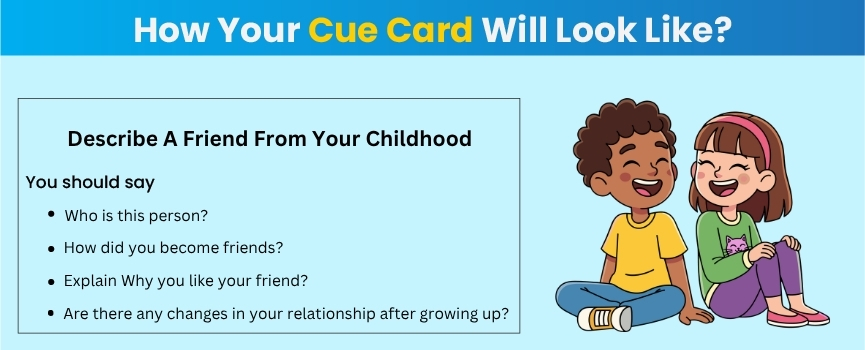
This blog focuses on the topic of “Describe a friend from your childhood” in the IELTS speaking part 2. Wherein, students need to follow a precise structure and grammatically correct sentences. For this, start with an engaging introduction by giving basic details about the topic. Then, answer the following questions:
- Who is this person?
- How did you become friends?
- Explain why you like your friend?
- Are there any changes in your relationship after growing up?
Here is how your IELTS Cue Card for this topic might look like:
Describe A Friend from Your Childhood - Sample 1
Here is a glimpse of the first sample of the cue card, which asks students to describe a friend from their childhood. It will help you boost your IELTS preparation by understanding how to respond to these questions.
Introduction
It is very energising to recall all memories of our childhood by talking about old friends, especially when they hold a special place in our childhood. Recalling my past events, I may think of a particular friend whom I would like to talk to.
Who is this person?
She was “Shruti”, who used to be my only childhood friend. I met her at my school when I moved to the new school in 4th grade. I was completely unfamiliar with the culture of the new school when I first saw her waving her hand and smiling.
How did you become friends?
Shruti was one of the extroverted students in that class and was curious to know about me. When I took my seat behind her, she immediately came to me and started interacting with me. Within an hour, we became so comfortable with each other that it felt like an old friendship. Since then, we have been in touch to keep our friendship alive.
Explain why you like your friend?
I loved Shruti for plenty of reasons, but what makes her unique is her perfect blend of emotional intelligence and humour. She can turn any dull moment into the funniest ones. Alternatively, Shruti is the best advisor when it comes to making impactful life decisions.
Are there any changes in your relationship after growing up?
I have experienced a few changes in our relationship, especially because of the long distance. Shruti and I live in different cities, which means regular meetings are almost impossible. However, we try to stay connected on calls, texts and social media, but sometimes it feels so offbeat. Sometimes, we manage to meet, which helps us to forget the long-distance situation and cherish our friendship.
Conclusion
We share a solid bond, which is based on genuine intentions and purity. I will always be grateful to have a friend like her in my life.
 Access speaking Mock Test
 Describe A Friend from Your Childhood - Sample 2
Below is another sample based on the cue card practice questions. It will assist test-takers in learning effective ways to respond to this section with meticulous preparation and precision.
Introduction
Thinking about childhood friends can make you feel nostalgic and happy. Forgetting your childhood friend is impossible because they make our lives wonderful by adding different moments. However, those friends who quickly become your friend on first meeting are the best.
Who is this person?
One such friend who has etched in my memory is Raman. Our friendship lasted for a few years, until her parents moved to Punjab. Our friendship was quite innocent, and she was my first friend.
How did you become friends?
I saw her when they were shifting in the house, which was exactly opposite mine. I noticed her because she had a unique hairstyle with five braids, and I went to her. She was shy at first, but after responding to my first question, she became comfortable. After that, we used to play together with our toys, eat together and have a lot of fun times.
Explain why you like your friend?
I loved her because she was very innocent, and the bond was pure. There were no expectations from one another, and a fear of judgment. She always used to help me with everything.
Are there any changes in your relationship after growing up?
Talking about Raman, it feels sad to say we are not connected. When she moved to another town, we were so young. In addition, I was not on any social media platform, so I was unable to contact her.
Conclusion
She elevated my childhood experience by simply being with me at that time. She showed me how a real friendship should be. I never felt bored around her.
Master the IELTS exam with our Prep Boost
What’s included:
- Pre-recorded video lectures
- Advance Study Materials
- Detailed Feedback Report
Describe A Friend from Your Childhood - Sample 3
Here is one more sample to describe a friend from your childhood that you can use to understand the formation of answers when appearing for the IELTS speaking section, to boost your overall grades.
Introduction
Childhood friends are precious because they taught us how to put our emotions into words. We experience plenty of things with them.
Who is this person?
I would love to mention my friend Vishvendra, who has been a close friend of mine since childhood. He came across as an introverted and reserved person at first, but he was very talkative once we became friends.
How did you become friends?
I met him when we were 7 years old during my primary school. I remember when he first entered the classroom, standing calmly on the other side of my bench. My class teacher introduced him and told him to sit with me. I started talking to him and helped him on the first day. That’s how we became friends.
Explain why you like your friend?
Vishvendra is kind and understanding, which made me like him. Hi is one of those rare friends who will always support you behind your back. He is so attentive, especially when he observes that I am having a bad day. If I feel upset, he instantly tries to uplift my mood either by cracking a joke or sharing a funny incident.
Are there any changes in your relationship after growing up?
My friend has moved to another city for educational purposes, but our friendship remained unchanged. We meet every month when he comes to his home at weekends. However, we try to spend time at home rather than going out to cafes. We talk about life, future goals and upskilling ourselves.
Conclusion
My friendship with Vishvendra has changed my whole perspective regarding bonds and connections. I learned the importance of being sensitive and warm towards others.


Lexical Resources
This part of IELTS speaking covers 25% of the total marks. Hence, it is crucial to work on developing your vocabulary for IELTS to demonstrate your proficiency when responding to cue card questions. Therefore, here is a table, including strong lexical items with their meaning. You can use this information to enrich your knowledge.
| Word | Meaning |
|---|---|
| Unfamiliar | Not having experience or knowledge of something |
| Extroverted | An individual who is confident and prefers to be surrounded by other people |
| Curious | Desire to learn or know something |
| Impactful | Being highly effective |
| Genuine | True; Real |
| Intentions | A plan or mental commitment to carry out a certain action |
| Innocent | Naive, state of purity |
| Precious | Something of great value |
| Attentive | Thinking, watching or listening to something/ somebody carefully |
| Upskilling | The process of learning an additional skill |
| Perspective | The opinion or attitude of a person towards something |
| Sensitive | Being highly delicate or responsive |
Follow-up Questions
This section requires candidates to explain relevant questions from their IELTS cue card, which lasts for four to five minutes. Here are a few follow-up questions based on the above topic.
1. Do you still communicate with your friends from Childhood?
Ans. Yes, I try to keep in touch with my childhood friend to a certain extent. However, with time, our lives have evolved into different paths, and we still manage to stay connected within a week through social media. We share important updates of our lives, childhood photos and festival greetings, which keep us connected.
2. In your opinion, why is childhood friendship important to children?
Ans. Undoubtedly, childhood friendships are crucial for children, as they allow them to develop socially and emotionally. These initial bonds help children understand values, such as trust, cooperation and sharing. When kids engage in social activities, they learn teamwork and conflict resolution. These lessons have a lasting impact on their life.
3. Do you think technology has changed friendships?
Ans. Without a doubt. Technology has affected the way people used to create and connect with friends. People can easily connect with their friends miles away through social media and share updates. However, it has led to a few drawbacks with positive factors. Online communication lacks emotional connections and quality friendships.
4. How did your childhood friends influence you?
Ans. My friends played a prominent part in shaping my values and existing personality. They influenced my perspectives, interests, confidence and communication styles. Moreover, I learned trust, empathy and teamwork through shared experiences. They supported me during the early stages of my life by identifying my true potential.
5. Is it easier to make friends as a child or an adult?
Ans. In my opinion, it is easy to make friends when you are a child because you are more confident and social at that time. After that, we often become selective and cautious due to past experiences. Moreover, we get busy in our lives, which creates a strict schedule, making it harder to connect with people and create meaningful connections.
How to Ace the IELTS Cue Card: Expert Tips
Many students struggle in the IELTS speaking section because it demands impromptu answers with rich vocabulary and correct grammatical structures. Therefore, we have cited below a few proven tips to help you excel in the speaking section. Students taking IELTS classes online or offline can use the tips below to ace the cue card section and boost their overall scores.
- Structure the Response – Firstly, leverage your preparation time by reading the card and underlining keywords. After reading the prompt, you should create a clear structure that you will follow when speaking on the given topic. Start the conversation with a precise introduction and cover the key details.
- Use Diverse Vocabulary – When speaking, make sure to use descriptive language and diverse vocabulary. It helps to increase your lexical resource marks and ensures precision in your communication.
- Maintain Fluency – Lastly, focus on speaking continuously, as it shows confidence. It will enhance your overall speaking scores by reflecting your ability to speak confidently at length. You can take IELTS speaking mock test free daily to enhance your fluency.
Conclusion
To sum up, the above samples to describe a friend from your childhood can help you ace your IELTS speaking part 2. The above sample shows how to structure your talk and follow a logical flow to describe your points while covering key points of the prompt. A correct structure can keep the discussion precise and easy to understand.
However, even after practice, if you find this task complex, you may need professional assistance. Gradding’s experts offer flexible sessions, such as an IELTS speaking practice online session, to help students struggling with speaking skills. Our expert tutors can provide you with a tailored study plan to get your targeted IELTS scores.
0 comments

Practice Makes a Man Perfect!Take FREE ielts Mock Tests
Start FREE Mock Test


Get Unlimited Access with
IELTS Prep Boost

Mock Tests

Practice Questions

Study Material

Recorded Classes
What is your Target IELTS Band?





Not Confident in Speaking? Practice Cue Card Now.
Start Practice