
Describe A Time When Someone Apologized to You - IELTS Cue Card
Preparing for IELTS does not seem difficult until you are practising for the long turn task, which is the IELTS speaking part 2. For every candidate, it is that one-minute preparation period that really bothers and impacts the overall scores. While you have all the ideas and pool of thoughts to express, you might feel stuck because the clock is running and words do not come out the way they should. For the IELTS speaking section, achieving your dream band is possible with consistent practice and real exam prompts. This guide will help you explore high-scoring samples for the IELTS cue card “Describe A Time When Someone Apologized to You”, and some tips to enhance overall preparation.

Summarise with AI
Choose your AI Assist



Table of Contents

Introduction to IELTS Cue Cards
For the IELTS speaking section, the cue card is the most important component, which is generally a topic card having 3-4 prompt questions in bullet points. Each question assesses the candidate’s ability to speak and express themselves effortlessly in English.
Key Highlights
- Before addressing the cue card, candidates have 1 minute of preparation time, which can be used to understand the core theme, gather ideas and note keywords.
- After preparing the response, students have to speak and respond for 2 to 3 minutes.
- The response is assessed on grammatical accuracy, fluency, coherence and use of vocabulary.
- IELTS cue cards topics revolve around personal experiences, places, events, and objects. It is helpful for candidates to craft a thorough response using any experience or a hypothetical situation.
How to Answer the Cue Card?
For students aiming to score high in the IELTS speaking section, all it requires is the right approach and correct technique. Here are a few key points you must focus on to answer the cue card effectively.
- While you prepare your response, focus on all the bullet points, as you have to address each prompt with a real response.
- Use any past situation or previous experience to frame a response, as it will give you a real background to speak fluently.
- Avoid full sentences while jotting down core ideas and use keywords to utilize preparation time effectively.
- Do not start your response with rehearsed lines, as it sounds more robotic and wastes time.
- Using a clear sequence, address each bullet point to display a clear connection between thoughts.
- Mention specific details in your response, such as real names, date, time or any detail, which will make your response sound more unpretentious.
Before we get into the samples, here is a quick look at how the actual cue card for this topic appears in the test.
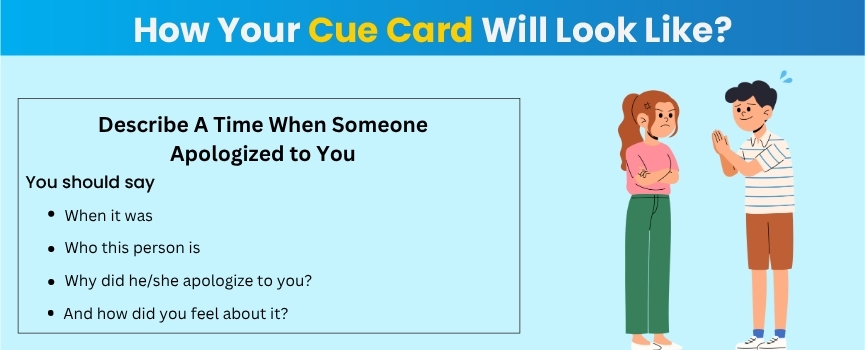
Describe A Time When Someone Apologized to You- Sample 1
Here is sample 1 of the IELTS cue card "Describe A Time When Someone Apologized to You" to help you learn the correct approach.
Introduction
The most memorable apology came from my best friend, Shreeya, some time back. It was the day when I performed stand-up comedy for the first time, and Shreeya was the only person whom I could rely upon.
When it was
It was a Saturday night in November, about eight months after I started doing stand-up comedy. It took place at a small club in town where there were about a hundred people attending. I had prepared for the event for weeks and informed Shreeya as soon as the date and venue were finalized.
Who this person is
Shreeya and I have been close since our school days, a friendship that does not require any context before making a statement. Nobody understood more than she did how important it was for me, how nervous I was, and how long I had been procrastinating before actually doing it.
Why did he/she apologize to you?
She had a family issue pop up that evening, which she had no choice but to attend to, and she informed me just one hour before the performance was supposed to take place. The issue wasn't that Shreeya was not coming to the performance. It was that her message had been so late that I was looking for someone close who was actually not there.
How did you feel about it?
The apology came early when Shreeya called me the following morning when I wasn’t even fully awake. The sincerity in her voice was palpable, without any explanations tacked onto it for her actions; she was simply accepting the fact that it was poorly timed, but that she ought to have at least called rather than sending texts.
Conclusion
Since then, we have not discussed it, nor do we need to. I believe that this would be one of the best indicators of an authentic apology, considering it would mean putting an end to the subject once and for all.
 Access speaking Mock Test
 Describe A Time When Someone Apologized to You - Sample 2
Given below is sample 2 of "Describe A Time When Someone Apologized to You" to help get familiar with how each prompt in the IELTS cue card can be addressed with clarity and detail.
Introduction
I can think of an apology that I got from my manager in my workplace about two years back. To be honest, it came as a surprise to me since it is very rare that you would expect a manager to admit any mistakes on their end.
When It Was
It took place during one of our meetings on a Monday morning, which made it worse in many aspects. It was just the beginning of the week, we had a total of eight people present in the room, and he highlighted a mistake in my report that seemed to serve as an example rather than constructive criticism.
Who This Person Is
He was my reporting manager, with whom I had been working for roughly eleven months. In most cases, he was quite professional and fair, which is why this morning was quite different from him. It seemed unlikely to me that he could do something like this.
Why Did He/she apologize to You?
Later on in the day, he approached me at my desk in a quiet manner and without drawing any unnecessary attention to himself. He told me that he had mentioned the problem in a team meeting, which was a wrong call, and it should have been a private conversation. He did not try to justify the morning; he owned it, which is rare in workplace settings.
How Did You Feel About It?
For me, this situation was quite surprising, but relieved. My day began with me feeling belittled by the co-workers I saw daily, and it was hard to imagine being able to function normally throughout the week. The apology did not undo the day’s events but repaired some of the damage done by the morning’s activities.
Conclusion
It made me view him differently, honestly. It did not do so in a negative way; rather, quite the opposite. Admitting your fault is much harder for someone who holds a position of power than you would think.
Master the IELTS exam with our Prep Boost
What’s included:
- Pre-recorded video lectures
- Advance Study Materials
- Detailed Feedback Report
Describe A Time When Someone Apologized to You - Sample 3
Here is sample 3 for you to understand how different real-life situations can be used to craft a confident and organized response.
Introduction
This particular apology that I remember was from a complete stranger. The individual whom I have never met before nor will see again, at least to my knowledge. This occurred during a short meeting in a market crowd.
When It Was
This took place one Sunday afternoon, some eleven months back, when I was just managing my way through the crowd in the market. I was walking along with my grocery bag and trying to walk through a congested area, close to where the vegetables were being sold.
Who This Person Is?
This individual was a middle-aged male, possibly in his mid-to-late forties, who seemed to be in a hurry and travelling in opposition to the direction of pedestrian traffic. I have no idea what his name was or any information concerning him aside from this quick conversation. He was a total stranger, which is why he caught my attention so well.
Why Did He/she apologize to you?
He came crashing into me as he rounded the corner, spilling my bags of food all over the place. It wasn’t until after I started to get annoyed with him for not being able to see what he was doing, but almost immediately, he apologized and helped me pick up my things.
How Did You Feel About It?
Honestly, I was quite confused at first. It seemed I was prepared to rant out, but the apology disarmed any irritation I may have felt right from the start. Most interesting about the situation was that he did not leave after apologizing; instead, he ensured every item of mine was picked before continuing.
Conclusion
Even now, I occasionally think about that moment because the kindness of a stranger is something rare in such places. The simple apology from someone I have never met made me feel more appreciated than lengthy apologies from my acquaintances.


Lexical Resources
While showcasing strong vocabulary for IELTS is a major score booster, the table below shows all the important lexical resources, including phrases and idioms used in the samples above, along with their meanings.
| Lexical Resource | Meaning |
|---|---|
| Memorable | Something that leaves a strong and lasting impression on a person |
| Procrastinating | Continuously delaying or postponing something that needs to be done |
| Palpable | So strong or obvious that it can almost be physically felt |
| Constructive criticism | Feedback given with the genuine intention of helping someone improve |
| Reporting manager | The direct supervisor a person is officially accountable to at work |
| Belittled | Made to feel small, unimportant or inferior in front of others |
| Congested | Extremely crowded and difficult to move through |
| Pedestrian traffic | The general flow of people walking in a particular direction |
| Acquaintances | People you know casually but are not particularly close to |
| Sincerity | The quality of being honest and genuine |
| Disarmed | Having anger or tension removed suddenly by an unexpected response |
| Repaired | Restored something that had been damaged, whether physical or emotional |
| Unprofessional | Behaviour that falls below the expected standard in a work setting |
| Pop up | To appear or arise suddenly and unexpectedly without prior warning |
| Tacked onto | Added something unnecessarily at the end of a statement or explanation |
| Owned it | Fully accepted responsibility for a mistake without making excuses |
| Putting an end to the subject | Closing a matter completely so it no longer needs to be discussed |
| Caught my attention | Drew focus or interest toward something or someone in a noticeable way |
| Rant out | To suddenly express anger or frustration loudly and without much control |
| A wrong call | A decision or action that turns out to have been the wrong choice |
| In opposition to | Moving or acting against the general expected direction or norm |
Follow-up Questions
After completion of the IELTS speaking part 2, the next key area to focus on is two-way discussion, which includes follow-up questions after the cue card task. These questions are related to the response provided by the students in part 2.
Here are a few sample follow-up questions that will add value to your IELTS preparation.
1. Do people in your country usually apologize easily?
It all depends on the context; however, in most cases, people tend to apologize when they understand that they have made a mistake. However, there are some instances where ego comes in the way.
2. On what occasion do people usually apologize to others?
Apologies are common when an individual is guilty of having offended someone emotionally, done something wrong at their job, or betrayed people with whom they share close personal bonds.
3. Why is it important to apologize?
Apologies are crucial because they facilitate the rebuilding of trust and help sustain good interpersonal relations. They show that an individual takes accountability for his/her actions and considers others’ emotions seriously.
4. Do you think written apologies are effective?
Written apologies are effective and have a lot of advantages in a formal environment like the workplace, but when it comes to making an apology in close relation, a confrontational confession is always better.
5. Are people less sincere when apologizing online?
Yes, there could be instances where individuals do not appear genuine online because digital communication does not offer non-verbal cues such as tone or gestures. It is easier for an apology to come off as inauthentic.
Tips to Excel in IELTS Cue Card
Here are some of the highly effective and proven tactics that will help students boost scores in the IELTS speaking section.
- One of the most effective ways is to use the latest speaking cue card practice questions during the preparation phase for realistic progress.
- Analyze each prompt given in the cue card, understand the core topic, and the tense required to craft a detailed response.
- While responding, start with an introduction, cover each point in the cue card and include a personal story followed by a conclusion.
- Take a section-specific IELTS speaking mock test to practice under exam-simulated conditions. It will help you boost accuracy and exam day confidence.
- Explain each prompt using examples to avoid running out of thoughts.
- Fluency is a highly concentrated area, so make sure to speak naturally while avoiding rehearsed and robotic statements.
- Use an authentic IELTS band calculator online to track your progress and learn about the areas that require attention before the test date.
Conclusion
Summing up, preparing for the IELTS speaking section becomes easier when you use the correct approach and the right practice materials. The samples provided above can be of great use for candidates to understand how to craft high-scoring responses while making the best use of preparation time.
Still struggling with your preparation journey? No worries, connect with our expert trainers via online IELTS classes and get access to a range of practice materials and personalized guidance on how to master each section of the test.
0 comments

Practice Makes a Man Perfect!Take FREE ielts Mock Tests
Start FREE Mock Test


Get Unlimited Access with
IELTS Prep Boost

Mock Tests

Practice Questions

Study Material

Recorded Classes
What is your Target IELTS Band?




Not Confident in Speaking? Practice Cue Card Now.
Start Practice