
Describe An Argument Two Of Your Friends Had - IELTS Cue Card
When we talk about IELTS cue card aka the IELTS Speaking Part 2, you can choose from a wide range of topics that usually revolve around your personal experience and subjects that are familiar to you. And one of these topics is “Describe An Argument Two Of Your Friends Had.” A topic which asks you to describe individuals you know or admire. In this, the examiner will expect you to speak about describing the disagreement and explain what led to it in detail. Not sure how to? Below are a few samples, follow up questions, and strategies to help you answer this topic and get band 8+.

Summarise with AI
Choose your AI Assist



Table of Contents

Introduction to IELTS Cue Cards
The IELTS Cue Card, also known as the task card, is an important requirement of the “individual Long Turn.” It is a small card which is given to you by the examiner and has the topic written on it, along with a few pointers that can help you guide your response.
In total, you will get around 3-4 minutes to complete this task. Here, 1 minute is the preparation time, during which you’ll read the topic and make notes. Then you will have to continuously speak on the given topic for 1-2 minutes or until the examiner stops you. Moreover, this section will check whether you can:
- Speak in English with confidence for a longer time
- Share your ideas in a clear and simple order
- Use different and appropriate words
- Explain your thoughts clearly and easily
- Speak at a natural and steady speed
How to Answer the Cue Card?
To answer the IELTS Speaking Part 2 in a way that lends you a band 8+ I, it requires you to mix strategic preparation with natural storytelling. In addition to this, it is also important that you completely use one minute of preparation time strategically.
Moreover, your task here is not to jumpily answer the question. You also need to show the examiner your range of vocabulary, your English language fluency, and your ability to connect ideas coherently. And for the topic “Describe An Argument Two Of Your Friends Had,” you can try to include the following details l,ike:
- Briefly introduce who the two friends are and how you know them
- Explain when and where the argument happened
- Describe what the argument was about in simple terms
- Talk about what both people said or how they reacted
- Mention how you felt during the situation
- Explain how the argument ended or if it was resolved
- Add a lesson or what you learned from the situation
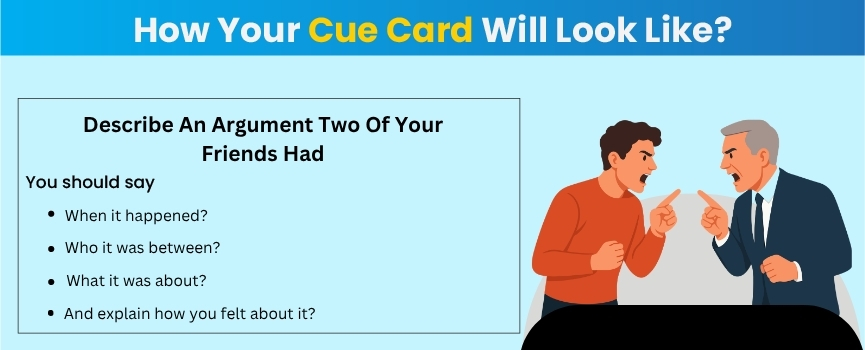
In the cue card, you will also get a few pointers that will help you understand what the examiner is expecting to hear in your response. And for this topic, you can get these pointers:
- When it happened
- Who itwas itetween
- What it was about
- And explain how you felt about it
Here is how your IELTS Cue Card for this topic might look like:
Now lets take a look at a few sample answers for the topic “Describe An Argument Two Of Your Friends Had” that will cover all the above pointers and help you get an idea of what an 8+ band response looks like for your IELTS preparation. Take a look:
Describe An Argument Two Of Your Friends Had - Sample 1
This first sample mainly focuses on what a well-structured response looks like. The one below follows a clear introduction f, followed by all the pointers, nd will tell you what you need to include in your response:
Introduction:
Today, I would like to talk about an argument which happened between two of my close friends. Both of them are pretty close to me, nd we spend a lot of our time together.
When it happened:
This argument between two of my close friends took place around five months ago when we were planning a short trip during our college break.
Who was it between:
The argument was between Rahul and Sameer w, who are my childhood friends, nd we are currently studying in college together. We all get along really well b, but in this situation, they had completely different opinions.
What it was about:
That disagreement happened because Rahul wanted to go to the mountains and have an adventurous trip. This is because he enjoys trekking and outdoor activities. But my other friend S, ameer wanted to go to a calm beach destination because he was looking forward to relaxing and taking a break from his busy schedule.
It all started as a normal discussion at first b, but then it gradually turned into a heated argument. Both of them started strongly defending their choices and were not even ready to compromise. And soon their voices became louder, nd the environment became quite uncomfortable for everyone.
And explain how you felt about it:
During this argument, I was feeling quite awkward and a little stressed m, mainly because I do not like conflicts. Especially if it is between people that I am close with. At that moment, I was also worried that this small issue might also affect our friendship. So to find a solution, I decided to step in and suggested that we could split our trip and spend a couple of days in the mountains and then go visit a nearby beach. On this suggestion, they both calmed down and agreed to this idea after some time.
Conclusion:
And in the end, the argument was peacefully resolved, nd the trip ended up being one of our most enjoyable and memorable ones. This experience also taught me that communication and compromise are very important in maintaining good relationships.
 Access speaking Mock Test
 Describe An Argument Two Of Your Friends Had - Sample 2
Next, getting band 8+ in the IELTS Cue Cards also depends on the range of your vocabulary for IELTS. So, this next sample follows a more advanced and expressive style of speaking.
Introduction:
I am going to describe an argument that happened between two of my colleagues that actually stood out to me because it was quite unexpected and h,onestly a bit intense. It happened between two of my close friends.
When it happened:
This argument took place last year during a cricket match which was organised in our neighbourhood.
Who was it between:
This argument happened between two of my close friends, D,ev and Harsh. Dev was the team captain, nd Harsh w, who is usually very calm but quite particular about fairness.
What it was about:
This disagreement initially started over a run-out decision, which most of us believe was a bit controversial. Dev declared that Harsh is out, and he claimed that the ball hit the stumps in time. But Harsh did not agree with this decision and tried to rationalise that his bad had already crossed the crease.
This disagreement, which very well could have been a quick decision q, quickly spiralled and turned into a heated dispute between both of them. Later, Dev became quite assertive and refused to change his decision. And during this time, Harsh became visibly frustrated and started questioning Dev’s fairness as a captain. Their voices also rose a bit, nd the friendly atmosphere that was there before the game turned into a tense and uncomfortable situation.
After a point, I felt as if we would have to call off the match because neither one of them was willing to back down.
And explain how you felt about it:
All while this was happening, I felt quite uneasy and disappointed because the whole purpose of the game was to have fun. And things had gotten unnecessarily serious. It was awkward to watch. Especially because both of them are important members of our friend group.
Later, a couple of my other friends and I tried to step in and suggested that it would be better to just replay the ball to settle the issue. And after a brief pause, both of them reluctantly agreed.
Conclusion:
To our peace, the situation cooled down after that, and the match then continued without any further issues. Now, when I look back, I think that argument showed me how our emotions can take over our behaviour. Even in situations that are as simple as they can be. At the same time, it reminded me that a little patience and compromise can prevent small conflicts from escalating.
Master the IELTS exam with our Prep Boost
What’s included:
- Pre-recorded video lectures
- Advance Study Materials
- Detailed Feedback Report
Describe An Argument Two Of Your Friends Had - Sample 3
This last sample will show you a better answer with clear ideas and good vocabulary. It will help you understand how to speak in a natural and fluent way.
Introduction:
An argument between two of my friends that I would like to talk about today is a rather memorable one. Especially because it took place between two of my very close friends. And more importantly, it showed me how a trivial issue can quickly escalate into a serious disagreement.
When it happened:
This argument happened around a couple of months ago when we were working together on a college event.
Who was it between:
This argument happened between Neeraj and Vikram, who are two of my really close friends. Neeraj was leading the organising team, and Vikram was in charge of managing the budget.
What it was about:
The argument was about the funds available for the event and how they are going to be allocated. On one hand, Neeraj wanted to invest a significant portion of the budget into decoration and setup for the stage to make the event more visually appealing. Vikram O, on the other hand w, was strongly opposed to this idea and argued that the available funds need to be spent more cautiously. They need to focus on essentials instead of aesthetics.
The discussion was initially civil, but with time it gradually turned into a heated exchange. Over time, Neeraj became insistent and emphasised how important it is to create a strong impression. But Vikram also got frustrated and accused him of being impractical. Soon enough, they both started talking over each other, and the conversation lost its sense of direction.
And explain how you felt about it:
As for me, the whole situation and argument were extremely uncomfortable and frustrating. It disrupted the progress of the entire team. But at the same time, I could also understand the perspective of both of them. This made it difficult for me to take sides. Eventually, I had to step in and suggest that they need to prioritise important expenses first, nd then they can use any of the remaining funds to enhance the play.
Conclusion:
Lastly, after some discussion, both of them agreed to compromise on this, and then the tension gradually eased. In retrospect, when I think of this argument, I believe it was not entirely negative. It actually brought out very important viewpoints and then ultimately led to a more balanced decision. It also showed the importance of staying calm and open-minded during disagreements.


Lexical Resources
As we mentioned earlier, in the IELTS speaking section, you also get scores based on your range of vocabulary. Also known as a lexical resource and is very important if you are targeting band 8+. So to help you understand better, here is a list of all the useful words and phrases that we have used in the samples above:
| Word | Meaning |
|---|---|
| adventurous | Willing to try new or risky things |
| gradually | Slowly over time |
| compromise | An agreement where both sides give up something |
| conflicts | Disagreements or fights between people |
| resolved | Solved or settled |
| compromise | To settle differences by mutual agreement |
| intense | VeExtreme |
| airness | Treating everyone equally and justly |
| controversial | Causing disagreement or debate |
| claimed | Said something is true (without proof sometimes) |
| rationalise | To explain something in a logical way |
| crease | A line or fold in something |
| spiralled | Moved in a twisting or circular way |
| assertive | Confident and direct in expressing opinions |
| visibly | In a way that can be clearly seen |
| uneasy | Feeling worried or uncomfortable |
| reluctantly | Doing something unwillingly |
| trivial | Not important |
| cautiously | Carefully to avoid danger or mistakes |
| aesthetics | Concerned with beauty or appearance |
| civil | Polite and respectful |
| impractical | Not useful or not easy to do |
| disrupted | Interrupted or disturbed |
| enhance | To improve or make better |
| retrospect | Thinking about the past |
Follow-Up Questions
After you are done with the IELTS Speaking Part 2, you will have to answer a few questions regarding the same topic for the Part 3. These follow up question will try to dive deeper into your English language skills and your ability to speak on abstract ideas. Below are the follow-up cue card practice questions for the topic “Describe an Argument Two of Your Friends Had.”
1. Do you often argue with your friends?
Not really. I am not very good with arguments; most of the time, I try to avoid them as I do not like any unnecessary tension. But yes, they are hard to ignore, and I do end up stuck in some small arguments. Most of the time, they are because the other person and I have different opinions. But regardless of that, I try to be respectful of the other person and try to keep things light.
2. How can friends reconcile after a fight?
In my opinion, the best way friends can reconcile after a flight is to talk calmly and honestly. Most of the timestimeimple message like “hey! let's talk this out” can also help. And saying sorry regardless of whose mistake it was can make a big difference and help you rebuild the friendship.
3. Why are some people stubborn and unwilling to change?
I think some people are very attached to what they believe in and feel that changing their opinion means they are wrong. Others have strong personalities or have past ience whic,h makes them less flexible, and sometimes it is also about an ego.
4. Should people change their way of thinking during an argument?
Yes, I think they should be open to it. This does not mean they have to completely change their opinion. But they should at least try to understand the other person’s point of view. Being open-minded can prevent the argument from getting worse.
5. Should a third person be involved to settle an argument?
It depends on the situation. If the argument is getting serious and both people are not listening to each other. Then a third person can help calm things down and offer a fair opinion. But for small issues, it is better to solve them directly.
Conclusion
Scoring Band 8+ in the IELTS Speaking section on the topic “Describe An Aranment Two of Your Friends Had” requires more than just answering the question. You need to speak fluently. Organise your ideas well and provide detailed responses. If you find cue cards difficult, taking online IELTS classes or IELTS speaking mock test can help boost your confidence. With proper preparation and consistent practice, you can give a strong and impressive answer.
0 comments

Practice Makes a Man Perfect!Take FREE ielts Mock Tests
Start FREE Mock Test


Get Unlimited Access with
IELTS Prep Boost

Mock Tests

Practice Questions

Study Material

Recorded Classes
What is your Target IELTS Band?








Not Confident in Speaking? Practice Cue Card Now.
Start Practice