
Crows Can Be Craftsmen too Reading Answers with Explanation
“Crows Can Be Craftsmen too Reading Answers” is a sample about the crafty nature of crows. This particular passage consists of three different types of questions that may be asked in the IELTS Reading section. These tasks evaluate your ability to understand the main idea, identify keywords, and analyze information. There is a range of skills assessed that are crucial for academic and professional life, including comprehension, skimming, scanning, and the ability to evaluate information from the text.
So, read the write-up and get a brief idea about how to effectively tackle these kinds of tasks in the actual exam.
IELTS Prep Boost
Elevate your preparation with exclusive tools
Unlimited Access Includes
BEST PLANDuration Days
IELTS Reading Passage – Crows Can Be Craftsmen too
A. A remarkable colony of inventors has emerged on an isolated Pacific island. They can fashion tools out of materials scavenged from the rainforest. They can even customise a tool for a given job. Meet the crows of New Caledonia.
B. Thinkers as diverse as Freud, Engels, and Thomas Carlyle once pointed to the use of tools as being a defining behaviour of human beings. Then it was found that many animals also used them, from the’fishing sticks’of apes to the rocks dropped on ostrich eggs by Egyptian vultures. Crows are particularly crafty. Earlier studies showed that they are almost human-like in their use of tools, with technological features that match the stone and bone tool cultures that emerged among primitive humans between 2.5 million and 70,000 BC.
C. But only humans were thought to have the brain power required for cumulative technological evolution. This is the skill for innovation that took our ancestors two million years ago from creating flakes of flint, for use in cutting, to honing knives, blades, arrowheads, and axeheads.
D. Now this ‘unique’ attribute of humans has also turned out to be a flattering delusion. A new study shows that the crows of New Caledonia are inventive. With their evolving leaf tools, the birds have levered man off his pedestal.
E. Dr Gavin Hunt and Dr Russell Gray of the University of Auckland have spent the past decade studying feathered technology in New Caledonia, 900 miles north-east of Australia. After an intensive field survey of local crow industry, the scientists found that the birds rip the leaves of the pandanus tree to fashion three distinct types of tools for grub and insect extraction: wide, narrow, and tapered.
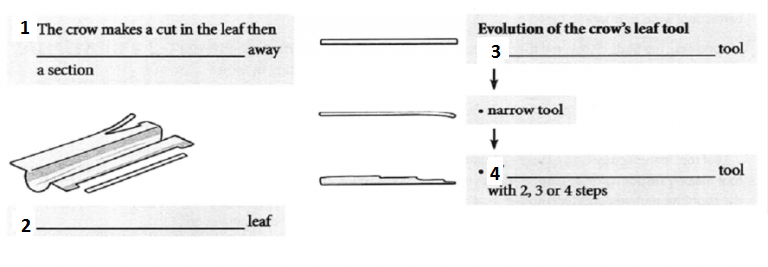
F. Long ago, the birds discovered that they could rip the serrated edge off the leaves to make a wide tool. The skill spread and the crows honed tools with finer working tips by either narrowing tools or tapering them. (Because the leaves are reinforced by tough parallel fibres, the tapered design is made in steps. The crow nips the leaf, rips along the fibres, makes another cut, and tears again, repeating until it has a tool with usually two, three, or four steps.)
G. Leaf tool manufacture is an example of culture: the birds learn through example, and their tool-making wisdom grows in sophistication down the generations. The crows appear to have the cognitive requirements for cumulative, though rudimentary, technological evolution, said Dr Gray. Tool manufacture in New Caledonian crows shows striking flexibility and innovation.’ The ability of the birds to innovate is further shown by their making of other tools. They often strip a twig of leaves and cut it off just below a shortened offshoot to create a hook to get bugs out. They also use simpler tools to extract grubs from the dead wood of trees.
H. Prof Alex Kacelnik, fellow of Pembroke College, Oxford, praised the study extremely important’. It complements his own research, with Dr Jackie Chappell and Alex Weir, which has turned Betty the New Caledonian crow into a star by revealing her to be the first animal, other than man, to show a basic understanding of cause and effect.
I. Betty began making tools after her partner snatched away a hook made for her by the researchers, forcing her to make her own from garden wire to fish out morsels from a tube. She wedged the end of the wire into the base of the food tube and turned her head to form the hook. What amazed the researchers is that she can even adapt her hooks if they are not up to the job, something that even chimpanzees are unable to do. Although chimps use sticks in experiments, they have not shown any human-like understanding of basic physical laws.’When she starts bending the wire, it is as if she has a clear objective, even correcting the angle of the hook if it is not right,’ said Prof Kacelnik.’Although many animals use tools, purposeful modification of objects to solve new problems, without training or prior experience, is virtually unknown.’
J. ‘While we have been emphasising the individual ability of animals like Betty to solve problems, the New Zealand team has been emphasising tool manufacture, the cultural traditions and transmission of information in the wild,’ said Prof Kacelnik. Both strands of research are related by how the crows are not genetically programmed to use a tool, like a spider and its web. Instead, the birds creatively invent new kinds of tools to solve problems and can share skills with others.
K. The crow family is the Einstein of the avian world, though Prof Kacelnik added that, at least in terms of tool making, the Pacific crows are smarter than their British cousins. We have not yet identified what it is that makes these crows so special, though it is something to do with ecological circumstances,’ said Prof Kacelnik.
L. Once scientists have gotten to the bottom of what makes Pacific crows master toolmakers, they may have to think again about how this skill evolved in humans.
Questions for Reading Passage - Crows Can Be Craftsmen too
Questions 1-4
Complete the diagrams.
Choose NO MORE THAN TWO WORDS from the passage for each answer.
Questions 5-9
Classify the following statements as referring to the crow(s) in
A. the study by Hunt and Gray
B. the study by Kacelnik, Chappell, and Weir
C. both studies
Write the correct letter, A, B, or C.
5. can share tool-making skills with other crows
6. can make special tools for a particular purpose
7. can solve problems by understanding rather than learning
8. can make tools better than British crows can
9. can manufacture hooks to extract food
Questions 10-13
Complete the summary.
Choose NO MORE THAN TWO WORDS from the passage for each answer.
| It used to be thought that only human beings used tools. Even after we learned that many other 10. __ also do so, it was still believed that only humans were intelligent enough to gradually evolve better tools. A study of crows in 11. __ However, it shows that these birds use a leaf tool that has evolved over several generations. A crow in another study has shown the human-like ability to understand 12. __ in order to manufacture tools, which are not even 13. __ can do. |
Premium IELTS Coaching
at an Affordable Price
Answers of Crows Can Be Craftsmen too Reading Passage with Explanations
Read below to get the above-mentioned reading answer with an explanation and location in the text.
Question 1
Question 2
Question 3

Unlock All Explanations for Free
Question 4
Question 5
Question 6
Question 7
Question 8
Question 9
Question 10
Question 11
Question 12
Question 13

IELTS Prep Boost
Unlimited Access Includes
Other Passages
Important Links for IELTS Exam
Explore Free IELTS Mock Tests
Find IELTS Coaching Centres
Practice Every IELTS Module
Essential IELTS Tools & Resources
Study Abroad Consultants in India
Top Study Abroad Destinations
Exams Required to Study Abroad
Popular Universities to Study Abroad
Important Links for IELTS Exam
Explore Free IELTS Mock Tests
Find IELTS Coaching Centres
Practice Every IELTS Module
Essential IELTS Tools & Resources
Study Abroad Consultants in India
Top Study Abroad Destinations
Popular Universities to Study Abroad
Quick Links
The text consists of twelve paragraphs with three different types of questions. Gradding.com provides you with proper training and guidance in this domain. Besides, you may even look at IELTS sample test PDFS and other study material for practice. Furthermore, it is crucial to understand the main idea and a brief summary of the passage.
Summary: The text discusses the unique abilities that crows have, similar to those of humans. Crows can create and customize tools from materials found in their environment. Scientists have observed these crows use leaves to fashion tools of varying shapes and sizes to extract food, demonstrating a level of technological skill and cultural learning previously thought unique to humans. The crows' tool-making abilities are thought to be a combination of learned behavior from older crows and individual innovation.
Tips to Excel in Crows Can Be Craftsmen too Reading Answers
Some tips have been mentioned below that will help you with the “ Crows Can Be Craftsmen too Reading Answers”. Go through these tips as they will help you to ace the reading passage with the desired score.
- Engage with the text by taking notes, summarizing paragraphs, and asking questions about the content.
- The more IELTS reading passage you practice, the more familiar you will become with the format and question types.
- Expand your vocabulary by learning new words and phrases, paying attention to collocations and synonyms.
- Practice answering questions within the time constraints of the test.
Types of Questions in Crows Can Be Craftsmen too Reading Passage
This specific write-up of “Crows Can Be Craftsmen too Reading Answers” has three different types of questions. They are as follows:
1. Diagram Completion (Questions 1-4)
In the IELTS Reading exam, you may come across “Diagram Completion” questions. This particular task involves labeling a diagram using information from the passage that is provided. It requires you to locate the specific details within the text and mark the diagram accordingly. This question type assesses your ability to understand and interpret visual representations of information alongside your comprehension of the written text. To answer these types of questions, skim and scan for details, focus on keywords, and most importantly, pay attention to instructions.
2. Matching Information (Questions 5-9)
Matching Information questions require you to link specific pieces of information given in statements to their corresponding paragraphs within a passage. A few statements will be provided that need to be matched with the appropriate paragraph in the text. This question type tests your ability to identify specific details, examples, reasons, or explanations. To answer these kinds of questions, read the question first and then the passage. Further, scan for matches by identifying synonyms and then carefully write the answers. Remember, the information may be presented in paraphrased form; thus, focus on understanding the meaning rather than finding exact words.
3. Summary Completion (Questions 10-13)
The IELTS Reading Summary Completion questions require you to fill gaps in a short summary using words from the passage. This task tests your ability to understand the main ideas of a text and to identify information within the passage. To answer these questions, scan for relevant information and recognize synonyms, as the summary is often written differently from the original text. Further, you must read the instructions carefully, skim and scan, identify the keyword, and complete the summary accurately. Do not exceed the word limit if it mentions “NO MORE THAN TWO WORDS” in the question.
Conclusion
This particular write-up covers everything about the reading passage “Crows Can Be Craftsmen too Reading Answers” with complete information. To excel in reading passages, you must be well aware of the techniques and strategies. Moreover, in the following write-up, we looked closely at the passage and the answers to the different types of questions. Additionally, you may seek professional help and join online IELTS coaching, which will help you boost your confidence for the exam day.
