
Population Movements and Genetics Reading Answers with Explanation
Are you preparing for the IELTS and looking for reading passages to enhance your studies? If so, consider solving answers of population movements and genetics reading passage to practice. You can find detailed explanations for the answers below. Additionally, try jotting down complex vocabulary from the passage and analyzing their meanings and connections.
The reading section assesses students' language abilities through four to five different types of questions. Keep in mind that you must complete all the questions within a 20-minute time limit. Aim to respond to the passage within that time frame.
IELTS Prep Boost
Elevate your preparation with exclusive tools
Unlimited Access Includes
BEST PLANDuration Days
IELTS Reading Passage: Population Movements and Genetics
Paragraph- 1
Study of the origins and distribution of human populations used to be based on archaeological and fossil evidence. A number of techniques developed since the 1950s, however, have placed the study of these subjects on a sounder and more objective footing. The best information on early population movements is now being obtained from the 'archaeology of the living body', the clues to be found in genetic material.
Paragraph- 2
Recent work on the problem of when people first entered the Americas is an example of the value of these new techniques. North-east Asia and Siberia have long been accepted as the launching ground for the first human colonisers of the New World’. But was there one major wave of migration across the Bering Strait into the Americas, or several? And when did this event, or events, take place? In recent years, new clues have come from research into genetics, including the distribution of genetic markers in modern Native Americans.
Paragraph- 3
An important project, led by the biological anthropologist Robert Williams, focused on the variants (called Gm allotypes) of one particular protein -immunoglobin G - found in the fluid portion of human blood. All proteins 'drift', or produce variants, over the generations, and members of an interbreeding human population will share a set of such variants. Thus, by comparing the Gm allotypes of two different populations (e.g. two Indian tribes), one can establish their genetic 'distance', which itself can be calibrated to give an indication of the length of time since these populations last interbred.
Paragraph- 4
Williams and his colleagues sampled the blood of over 5,000 American Indians in western North America during a twenty-year period. They found that their Gm allotypes could be divided into two groups, one of which also corresponded to the genetic typing of Central and South American Indians. Other tests showed that the Inuit (or Eskimo) and Aleut3 formed a third group. From this evidence it was deduced that there had been three major waves of migration across the Bering Strait. The first, Paleo-lndian, wave more than 15,000 years ago was ancestral to all Central and South American Indians. The second wave, about 14,000-12,000 years ago, brought Na-Dene hunters, ancestors of the Navajo and Apache (who only migrated south from Canada about 600 or 700 years ago). The third wave, perhaps 10,000 or 9,000 years ago, saw the migration from North-east Asia of groups ancestral to the modern Eskimo and Aleut.
Paragraph- 5
How far does other research support these conclusions? Geneticist Douglas Wallace has studied mitochondrial DNA4 in blood samples from three widely separated Native American groups: Pima-Papago Indians in Arizona, Maya Indians on the Yucatán peninsula, Mexico, and Ticuna Indians in the Upper Amazon region of Brazil. As would have been predicted by Robert Williams's work, all three groups appear to be descended from the same ancestral (Paleo-lndian) population.
Paragraph- 6
There are two other kinds of research that have thrown some light on the origins of the Native American population; they involve the study of teeth and of languages. The biological anthropologist Christy Turner is an expert in the analysis of changing physical characteristics in human teeth. He argues that tooth crowns and roots5 have a high genetic component, minimally affected by environmental and other factors. Studies carried out by Turner of many thousands of New and Old World specimens, both ancient and modern, suggest that the majority of prehistoric Americans are linked to Northern Asian populations by crown and root traits such as incisor6 shoveling (a scooping out on one or both surfaces of the tooth), single-rooted upper first premolars6 and triple-rooted lower first molars6.
According to Turner, this ties in with the idea of a single Paleo-lndian migration out of North Asia, which he sets at before 14,000 years ago by calibrating rates of dental micro-evolution. Tooth analyses also suggest that there were two later migrations of Na-Denes and Eskimo-Aleut.
Paragraph- 7
The linguist Joseph Greenberg has, since the 1950s, argued that all Native American languages belong to a single 'Amerind' family, except for Na-Dene and Eskimo-Aleut - a view that gives credence to the idea of three main migrations. Greenberg is in a minority among fellow linguists, most of whom favour the notion of a great many waves of migration to account for the more than 1,000 languages spoken at one time by American Indians. But there is no doubt that the new genetic and dental evidence provides strong backing for Greenberg's view. Dates given for the migrations should nevertheless be treated with caution, except where supported by hard archaeological evidence.
1 New World: the American continent, os opposed to the so-colled Old World of Europe, Asia and Africa
2 modem Native American: an American descended from the groups that were native to America
3 Inuit and Aleut: two of the ethnic groups native to the northern regions of North America (i.e. northern Canada ond Greenland)
4 DNA: the substance in which genetic information is stored
5 crown/root: parts of the tooth
6 incisor/premolar/molar: kinds of teeth
Question for Reading Passage: Population Movements and Genetics
Question 1-6
Reading Passage has seven sections, A-G.
Choose the correct headings for sections A-F from the list of headings below.
Write the correct number, i-x, in boxes 1-6 on your answer sheet.
| List of Heading |
| I.The results of the research into blood-variants |
| II.Dental evidence |
| III. Greenberg's analysis of the dental and linguistic evidence |
| IV.Developments in the methods used to study early population movements |
| V.Indian migration from Canada to the U.S.A. |
| VI.Further genetic evidence relating to the three-wave theory |
| VII.Long-standing questions about prehistoric migration to America |
| VIII.Conflicting views of the three-wave theory, based on non-genetic evidence |
| IX.Questions about the causes of prehistoric migration to America |
| X. How analysis of blood-variants measures the closeness of the relationship between different populations. |
Question 7-8
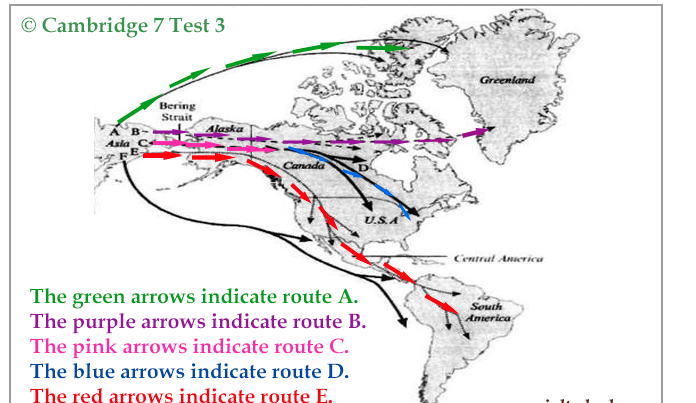
The discussion of Williams’s research indicates the periods at which early people are thought to have migrated along certain routes.
There are six routes, A-F, marked on the map below.
Complete the table below.
| Route | Period (number of years ago) |
| 7 __ | 15,000 or more |
| 8 __ | 600 to 700 |
Write the correct letter, A-F, in boxes 7-8 on your answer sheet.
Questions 9-12
Reading Passage refers to the three-wave theory of early migration to the Americas. It also suggests in which of these three waves the ancestors of various groups of modern native Americans first reached the continent.
Classify the groups named in the table below as originating from
| A. the first wave |
| B. the second wave |
| C. the third wave |
Write the correct letter. A, B or C, in boxes 9-12 on your answer sheet.
| Name of Group | Wave Number |
| Inuit | __9__ |
| Apache | __10__ |
| Pima-Papago | __11__ |
| Ticuna | __12__ |
Question 13
Choose the correct letter, A, B, C or D.
Write the correct letter in box 13 on your answer sheet.
13. Christy Turner’s research involved the examination of
A. teeth from both prehistoric and modem Americans and Asians.
B. thousands of people who live in either the New or the Old World.
C. dental specimens from the majority of prehistoric Americans.
D. the eating habits of American and Asian populations.
Premium IELTS Coaching
at an Affordable Price
Answers of Population Movements and Genetics Reading Passage with Explanation
Below are the population movements and genetics reading answers written along with explanations and locations.
Question 1
Question 2
Question 3

Unlock All Explanations for Free
Question 4
Question 5
Question 6
Question 7
Question 8
Question 9
Question 10
Question 11
Question 12
Question 13

IELTS Prep Boost
Unlimited Access Includes
Other Passages
Important Links for IELTS Exam
Explore Free IELTS Mock Tests
Find IELTS Coaching Centres
Practice Every IELTS Module
Essential IELTS Tools & Resources
Study Abroad Consultants in India
Top Study Abroad Destinations
Exams Required to Study Abroad
Popular Universities to Study Abroad
Important Links for IELTS Exam
Explore Free IELTS Mock Tests
Find IELTS Coaching Centres
Practice Every IELTS Module
Essential IELTS Tools & Resources
Study Abroad Consultants in India
Top Study Abroad Destinations
Popular Universities to Study Abroad
Quick Links
The passage discusses the fascinating relationship between human migration and its impact on genetic diversity. It explores the intricate interactions among population movements, genetic adaptation, and cultural evolution. By engaging with the text and answering the accompanying questions, you can deepen your understanding of how human societies develop and adapt over time.
Additionally, the passage highlights its relevance for IELTS reading preparation, which assesses skills such as reading comprehension and vocabulary. To improve your skimming ability for grasping the main ideas and scanning for specific information, solve answers of population movements and genetics. Moreover, for effective learning materials and guidance, consider registering for Gradding.com online IELTS coaching, which offers high-quality instruction supported by technology.
Tips for Mastering the Reading Passage on "Population Movements and Genetics"
Here are some strategies to assist you in finding the answers of population movements and genetics reading passages easily.
- Matching Heading: Read the heading before you read the passage.
- Table Completion: Check back to the words to make sure you have the right information.
- Multiple Choice Question: Choose the correct answer by matching the meaning instead of the exact words.
Types of Questions in This Reading Passage
The population movements and genetics reading answers include three types of questions. Let's delve into a detailed discussion of these types.
Matching Heading
In this type of question, a list of headings with (i, ii, iii....) and a passage with lettered paragraphs (A, B, C ...) are given. You must match the heading to the correct paragraphs and write the appropriate number on the answer sheet. To make the task harder, there will be more headings than the number of paragraphs.
Skills required for this question type:
- Understand the main idea of the passage instead of the details.
- Read for the overall "gist" of the write-up.
- Identify the difference between a main idea and supporting points.
Table Completion
In this type of question, you will notice a table with missing information. Your task is to complete the summary using one word from the list for each blank.
Skills required for this question type:
- Skim the passage for a better understanding
- Paraphrase the original text
- Understand synonyms
Multiple Choice Question
In this question format, you will be required to answer a question presented alongside several options, usually labeled A, B, C, D. You aim to choose an answer from the available options based on the information in the passage.
Skills required for this question type:
- Get an overall idea of the write-up
- You must have a good reading speed
- Scan the specific information
You will encounter various question types when solving the population movements and genetics reading answers. To boost your confidence for the exam, it is beneficial to regularly take IELTS reading mock test to familiarize yourself with the test format. Additionally, signing up for our coaching classes can help improve your English skills.
