
Roman Tunnels IELTS Reading Answers with Explanation
If you practice diligently, the IELTS reading section can be your top-scoring area. Moreover, to score exceptionally well, you need to understand the various types of questions, passages contain and how to approach them. Thus, if you are looking for qualitative stuff for your practice, you can refer to the Roman tunnels reading answers with detailed solutions.
The passage has a total of 13 questions of three types. So, set your timer for 20 minutes and test your preparation with us. So, let us get started!
IELTS Prep Boost
Elevate your preparation with exclusive tools
Unlimited Access Includes
BEST PLANDuration Days
IELTS Reading Passage: Roman Tunnels
A. The Romans, who once controlled areas of Europe, North Africa and Asia Minor, adopted the construction techniques of other civilizations to build tunnels in their territories.
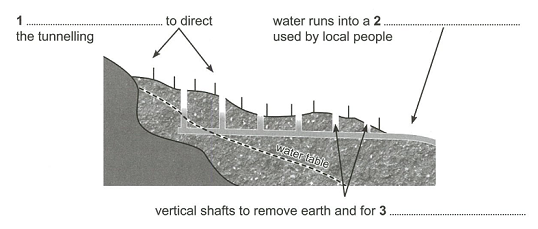
B. The Persians, who lived in present-day Iran, were one of the first civilizations to build tunnels that provided a reliable supply of water to human settlements in dry areas. In the early first millennium BCE, they introduced the qanat method of tunnel construction, which consisted of placing posts over a hill in a straight line, to ensure that the tunnel kept to its route, and then digging vertical shafts down into the ground at regular intervals. Underground, workers removed the earth from between the ends of the shafts, creating a tunnel. The excavated soil was taken up to the surface using the shafts, which also provided ventilation during the work. Once the tunnel was completed, it allowed water to flow from the top of a hillside down towards a canal, which supplied water for human use. Remarkably, some qanats built by the Persians 2,700 years ago are still in use today.
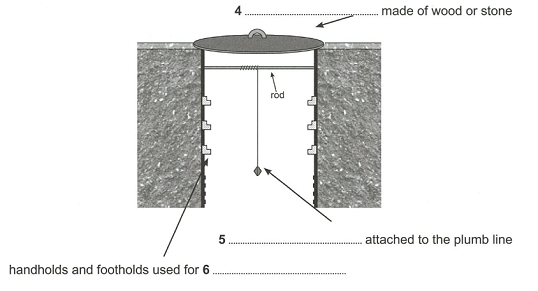
C. They later passed on their knowledge to the Romans, who also used the qanat method to construct water-supply tunnels for agriculture. Roma qanat tunnels were constructed with vertical shafts dug at intervals of between 30 and 60 metres. The shafts were equipped with handholds and footholds to help those climbing in and out of them and were covered with a wooden or stone lid. To ensure that the shafts were vertical, Romans hung a plumb line from a rod placed across the top of each shaft and made sure that the weight at the end of it hung in the centre of the shaft. Plumb lines were also used to measure the depth of the shaft and to determine the slope of the tunnel. The 5.6-kilometre-long Claudius tunnel, built in 41 CE to drain the Fucine Lake in central Italy, had shafts that were up to 122 metres deep, took 11 years to build and involved approximately 30,000 workers.
D. By the 6th century BCE, a second method of tunnel construction appeared, called the counter-excavation method, in which the tunnel was constructed from both ends. It was used to cut through high mountains when the qanat method was not a practical alternative. This method required greater planning and advanced knowledge of surveying, mathematics and geometry as both ends of a tunnel had to meet correctly at the centre of the mountain. Adjustments to the direction of the tunnel also had to be made whenever builders encountered geological problems or when it deviated from its set path. They constantly checked the tunnel’s advancing direction, for example, by looking back at the light that penetrated through the tunnel mouth, and made corrections whenever necessary. Large deviations could happen, and they could result in one end of the tunnel not being usable. An inscription written on the side of a 428-metre tunnel, built by the Romans as part of the Saldae aqueduct system in modern-day Algeria, describes how the two teams of builders missed each other in the mountain and how the later construction of a lateral link between both corridors corrected the initial error.
E. The Romans dug tunnels for their roads using the counter-excavation method whenever they encountered obstacles such as hills or mountains that were too high for roads to pass over. An example is the 37-metre-long, 6-metre-high Furlo Pass Tunnel built in Italy in 69-79 CE. Remarkably, a modern road still uses this tunnel today. Tunnels were also built for mineral extraction. Miners would locate a mineral vein and then pursue it with shafts and tunnels underground. Traces of such tunnels used to mine gold can still be found at the Dolaucothi mines in Wales. When the sole purpose of a tunnel was mineral extraction, construction required less planning, as the tunnel route was determined by the mineral vein.
F. Roman tunnel projects were carefully planned and carried out. The length of time it took to construct a tunnel depended on the method being used and the type of rock being excavated. The qanat construction method was usually faster than the counter-excavation method as it was more straightforward. This was because the mountain could be excavated not only from the tunnel mouths but also from shafts. The type of rock could also influence construction times. When the rock was hard, the Romans employed a technique called fire quenching, which consisted of heating the rock with fire and then suddenly cooling it with cold water so that it would crack. Progress through hard rock could be very slow, and it was not uncommon for tunnels to take years, if not decades, to be built. Construction marks left on a Roman tunnel in Bologna show that the rate of advance through solid rock was 30 centimetres per day. In contrast, the rate of advance of the Claudius tunnel can be calculated at 1.4 metres per day. Most tunnels had inscriptions showing the names of patrons who ordered construction and sometimes the name of the architect. For example, the 1.4-kilometre Çevlik tunnel in Turkey, built to divert the floodwater threatening the harbour of the ancient city of Seleucia Pieria, had inscriptions on the entrance, still visible today, that also indicate that the tunnel was started in 69 CE and was completed in 81 CE.
Questions for Reading Passage: Roman Tunnels
Questions 1 – 6
Label the diagrams below.
Choose ONE WORD ONLY from the passage for each answer.
Write your answers in boxes 1-6 on your answer sheet.
Questions 7 – 10
Do the following statements agree with the information given in Reading Passage?
In boxes 7-10 on your answer sheet, write -
TRUE if the statement agrees with the information
FALSE if the statement contradicts the information
NOT GIVEN if there is no information on this
7. The counter-excavation method completely replaced the qanat method in the 6th century BCE.
8. Only experienced builders were employed to construct a tunnel using the counter-excavation method.
9. The information about a problem that occurred during the construction of the Saldae aqueduct system was found in an ancient book.
10. The mistake made by the builders of the Saldae aqueduct system was that the two parts of the tunnel failed to meet.
Questions 11 – 13
Answer the questions below.
Choose NO MORE THAN TWO WORDS from the passage for each answer.
Write your answers in boxes 11-13 on your answer sheet.
11. What type of mineral were the Dolaucothi mines in Wales built to extract?
12. In addition to the patron, whose name might be carved onto a tunnel?
13. What part of Seleuceia Pieria was the Çevlik tunnel built to protect?
Premium IELTS Coaching
at an Affordable Price
Answers of Roman Tunnels Reading Passage with Explanation
After reading the passage, you need solutions for your assessment. Match your answers and evaluate yourself honestly, then strategize your preparation. Thus, we have discussed the solution of all the questions in detail. You can match with the following answers:
Question 1
Question 2
Question 3

Unlock All Explanations for Free
Question 4
Question 5
Question 6
Question 7
Question 8
Question 9
Question 10
Question 11
Question 12
Question 13

IELTS Prep Boost
Unlimited Access Includes
Other Passages
Important Links for IELTS Exam
Explore Free IELTS Mock Tests
Find IELTS Coaching Centres
Practice Every IELTS Module
Essential IELTS Tools & Resources
Study Abroad Consultants in India
Top Study Abroad Destinations
Exams Required to Study Abroad
Popular Universities to Study Abroad
Important Links for IELTS Exam
Explore Free IELTS Mock Tests
Find IELTS Coaching Centres
Practice Every IELTS Module
Essential IELTS Tools & Resources
Study Abroad Consultants in India
Top Study Abroad Destinations
Popular Universities to Study Abroad
Quick Links
Thus, with the help of the above write-up, you have assessed the solutions to the Roman tunnel reading answers passage with an explanation. In this IELTS reading passage, the author talks about the techniques of the Roman tunnel construction method. The process is categorized into two types. The first one is the qanat, the other one is a counter-excavation process. Qanat tunnels were initially used by the Persians and, with time, adopted by the Romans people. This method involves how to place posts in a straight row to guide the route of the tunnel and digging vertical shafts. These shafts were the source of ventilation and the removal of the soil.
The author also talks about the Roman practice of using plumb lines with the help of a certain weight. This is to ensure vertical alignment of the plumb line and provide handholds for climbing. Coming next is the counter-excavation method that is used for mineral extraction. It takes less planning because it follows mineral veins.
Now, you have a fair idea about the crux of the passage. Even if you need any help with more practice, you can take our IELTS reading mock test to face the exam-like pressure for your skill improvement.
Tips to Solve Roman Tunnels Reading Answers
Now, after assessing the Roman tunnel reading answers passage for all 13 questions in detail, let us know more about IELTS test tips for answering different types of questions:
1. Diagram Completion Questions (1-6): Passage has 1-6 questions based on diagram completion type. The solving method is very similar to the table completion type. You need to fill in the blanks in a small passage given in the form of a diagram with suitable words or figures.
2. True/False/Not Given (7-10): Questions from 7-10 are based on true/false/not given type. You need to answer the question using whether the information is correct or wrong, or whether appropriate details are given or not.
3. Short Answer Questions (11-14): Question numbers from 11-14 are based on short answer question type. In this kind of question, you have to pick the words from the given passage to write the short answers. But make sure to choose the exact word mentioned in the passage. Short answer questions have word limit constraints, so do not exceed the limit.
Types of Questions in Roman Tunnels Reading Answers
The Roman Tunnel reading answer passage contains 13 questions. The passage has three types of questions. If you want to score high in the reading section, then you must know the method of solving each one, as every question has a different way to solve. Thus, below are the three types of questions the above write-up contains:
1. Diagram Completion Questions (1-6): Question numbers from 1-6 are based on diagram completion type. Go through the incomplete diagram first and think about the keywords. Try to establish a connection between the keywords and their respective synonyms. Later on, scan and find out where the information is located. If you are unable to do this, then move on as you have time constraints.
2. True/False/Not Given (7-10): Questions from 7-10 are based on true/false/not given type. Read the questions and identify the keywords. The best technique to solve these types of questions is to have a look at your list of true, false, and not-given questions before reading the stuff.
3. Short Answer Questions (11-14): Question numbers from 11-14 are based on the short answer question type. To solve short answers, read the questions and highlight the main keywords. Next, have a look at the information in the given passage. Use the reading technique to read the passage fast. Do not spend much time reading the whole text.
Conclusion
So, here you are! The write-up explains the Roman tunnels reading answers with detailed explanations. The IELTS reading passage contains three types of questions: diagram completion, short answers, and true/false/not given. After attempting the test, for your reference, we have also provided solutions for the reading passage. This practice will help you to know your level of preparation. If you performed well, then it is a great job. If not, then you need to practice more. In that scenario, you can take our online IELTS coaching to improve your weak areas. Here, you will get comprehensive study material and mock tests for practice, like IELTS sample PDFS, so that you can practice as much as you can.
