
Study of Lake Bosumtwi Reading Answers with Explanation
Preparing for the IELTS? Check out the study of lake Bosumtwi reading answers with explanations. Practice by noting difficult vocabulary and their meanings.
The reading section includes 4 to 5 question types, which you must complete in 20 minutes. Challenge yourself to answer the passage within that time. If you don't get all the answers right, don't worry improve your skills with our free IELTS mock tests.
IELTS Prep Boost
Elevate your preparation with exclusive tools
Unlimited Access Includes
BEST PLANDuration Days
IELTS Reading Passage: Study of Lake Bosumtwi
Paragraph A
As the sun rose over picturesque Lake Bosumtwi, a team of Syracuse University researchers prepared for another day of using state-of-the-art equipment to help the bottom. Nestled in the heart of Ghana, the lake holds an untapped reservoir of information that could help scientists predict future climate changes by looking at evidence from the past. This information will also improve the scientists’ understanding of the changes that occur in a region struck by a massive meteorite.
Paragraph B
The project, led by earth sciences professor Christopher Scholz of the College of Arts and Sciences and funded by the National Science Foundation (NSF), is the first large-scale effort to study Lake Bosumtwi, which formed 1.1 million years ago when a giant meteor crashed into the Earth’s surface. The resulting crater is one of the largest and most well-preserved geologically young craters in the world, says Scholz, who is collaborating on the project with researchers from the University of Arizona, the University of South Carolina, the University of Rhode Island, and several Ghanaian institutions. “Our data should provide information about what happens when an impact hits hard, pre-Cambrian, crystalline rocks that are a billion years old,” he says.
Paragraph C
Equally important is the fact that the lake, which is about 8 kilometers in diameter, has no natural outlet. The rim of the crater rises about 250 meters above the water’s surface. Streams flow into the lake, Scholz says, but the water leaves only by evaporation or by seeping through the lake sediments. For the past million years, the lake has acted as a tropical rain gauge, filling and drying with changes in precipitation and the tropical climate. The record of those changes is hidden in the sediment below the lake bottom. “The lake is one of the best sites in the world for the study of tropical climate changes,” Scholz says. “The tropics are the heat engine for the Earth’s climate. To understand the global climate, we need to have records of climate changes from many sites around the world, including the tropics.”
Paragraph D
Before the researchers could explore the lake’s subsurface, they needed a boat with a large, working deck area that could carry eight tons of scientific equipment. The boat – dubbed R/V Kilindi – was built in Florida last year. It was constructed in modules that were dismantled, packed inside a shipping container, and reassembled over a 10-day period in late November and early December 1999 in the rural village of Abono, Ghana. The research team then spent the next two weeks testing the boat and equipment before returning to the United States for the holidays.
Paragraph E
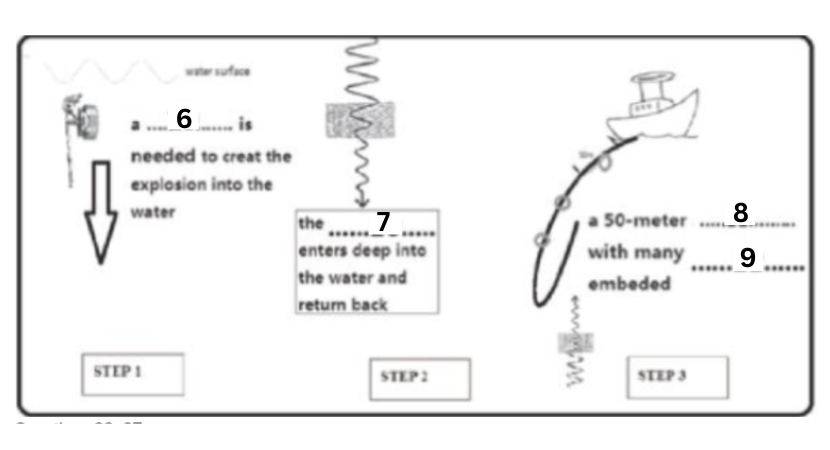
n mid-January, five members of the team – Keely Brooks, an earth sciences graduate student; Peter Cattaneo, a research analyst; and Kiram Lezzar, a postdoctoral scholar, all from SU; James McGill, a geophysical field engineer; and Nick Peters, a Ph.D. student in geophysics from the University of Miami – returned to Abono to begin collecting data about the lake’s subsurface using a technique called seismic reflection profiling. In this process, a high-pressure air gun is used to create small, pneumatic explosions in the water. The sound energy penetrates about 1,000 to 2,000 meters into the lake’s subsurface before bouncing back to the surface of the water.
Paragraph F
The reflected sound energy is detected by underwater microphones – called hydrophones – embedded in a 50-meter-long cable that is towed behind the boat as it crosses the lake in a carefully designed grid pattern. On-board computers record the signals, and the resulting data are then processed and analyzed in the laboratory. “The results will give us a good idea of the shape of the basin, how thick the layers of sediment are, and when and where there were major changes in sediment accumulation,” Scholz says. “We are now developing a three-dimensional perspective of the lake’s subsurface and the layers of sediment that have been laid down.”
Paragraph G
Team members spent about four weeks in Ghana collecting the data. They worked seven days a week, arriving at the lake just after sunrise. On a good day, when everything went as planned, the team could collect data and be back at the dock by early afternoon. Except for a few relatively minor adjustments, the equipment and the boat worked well. Problems that arose were primarily non-scientific – tree stumps, fishing nets, cultural barriers, and occasional misunderstandings with local villagers.
Paragraph H
Lake Bosumtwi, the largest natural freshwater lake in the country, is sacred to the Ashanti people, who believe their souls come to the lake to bid farewell to their god. The lake is also the primary source of fish for the 26 surrounding villages. Conventional canoes and boats are forbidden. Fishermen travel on the lake by floating on traditional planks they propel with small paddles. Before the research project could begin, Scholz and his Ghanaian counterparts had to secure special permission from tribal chiefs to put the R/V Kilindi on the lake.
Paragraph I
When the team began gathering data, rumors flew around the lake as to why the researchers were there. “Some thought we were dredging the lake for gold, others thought we were going to drain the lake or that we had bought the lake,” Cattaneo says. “But once the local people understood why we were there, they were very helpful.”
Questions for Reading Passage: Study of Lake Bosumtwi
Questions 1-5
Do the following statements agree with the information given in the Reading Passage?
In boxes 1-5 on your answer sheet, write
- TRUE if the statement is true
- FALSE if the statement is false
- NOT GIVEN if the information is not given in the passage
1. With the investigation of the lake, the scientist may predict climate changes in the future.
2. The crater resulting from a meteorite impact is the largest and most preserved one in the world.
3. The water stored in Lake Bosumtwi was gone only by seeping through the lake sediments.
4. Historical climate changes can be detected by the analysis of the sediment in the lake.
5. The greatest obstacle to the research of scientists has been the interference by the locals due to their indigenous beliefs.
Questions 6-9
There are three steps of collecting data from the lake as follows: please fill in the blanks in the Flow Chart below:
Questions 10-14
Complete the following summary of the paragraph of the Reading Passage.
Using NO MORE THAN THREE WORDS from the Reading Passage for each answer.
Write your answers in boxes 10-14 on your answer sheet.
The boat-double R/V Kilindi crossed the lake, was dismantled, and stored in a 10_. The technology they used is called 11_; They created sound energy at 1000-2000 metres into the bottom of the lake and used separate equipment to collect the returned waves. Then the data had been analyzed and processed in the 12_. Scholz also added that they were now building 13_. View of the sediment or sub-image at the bottom of the lake. The whole set of equipment works well, yet the ship should avoid physical barriers,s including tree stumps or 14_. Floating on the surface of the lake.
Premium IELTS Coaching
at an Affordable Price
Answers of Study of Lake Bosumtwi Reading Passage with Explanation
Below, you will find comprehensive answers of Study of Lake Bosumtwi reading passage, complete with explanations and locations that will expertly guide you in identifying the essential details needed for your solutions.
Question 1
Question 2
Question 3

Unlock All Explanations for Free
Question 4
Question 5
Question 6
Question 7
Question 8
Question 9
Question 10
Question 11
Question 12
Question 13
Question 14

IELTS Prep Boost
Unlimited Access Includes
Other Passages
Important Links for IELTS Exam
Explore Free IELTS Mock Tests
Find IELTS Coaching Centres
Practice Every IELTS Module
Essential IELTS Tools & Resources
Study Abroad Consultants in India
Top Study Abroad Destinations
Exams Required to Study Abroad
Popular Universities to Study Abroad
Important Links for IELTS Exam
Explore Free IELTS Mock Tests
Find IELTS Coaching Centres
Practice Every IELTS Module
Essential IELTS Tools & Resources
Study Abroad Consultants in India
Top Study Abroad Destinations
Popular Universities to Study Abroad
Quick Links
The passage highlights the advanced technology utilised in the study of the lake, specifically the use of hydrophones (underwater microphones) to capture reflected sound energy across a meticulously designed grid pattern on the lakebed. As you tackle the study of Lake Bosomtwi reading answers, focus on three key questions for an effective understanding of the material. It’s crucial to read through the entire write-up to grasp the significance of this passage in the IELTS reading section; it assesses your skills in reading comprehension, vocabulary, grammar, and more. Achieving a strong score on the exam, especially on your first attempt, requires top-notch study resources. Therefore, register with Gradding.com for premium study materials and online IELTS coaching, and experience high-quality teaching bolstered by innovative technology.
Tips to Ace the Reading Passage on the "Study of Lake Bosumtwi"
Here are proven tips to effortlessly find answers of Study of Lake Bosumtwi reading passage, look below:
- True/False/Not Given: Thoroughly read the passage and use keywords to pinpoint the correct locations of information.
- Flow Chart Completion: Ensure that even single-word answers fit seamlessly within the overall context of the described process.
- Summary Completion: Remember to adhere to the specified word limit while filling in the blanks.
Types of Questions in this Reading Passage
The study of Lake Bosumtwi reading answers presents three distinct question types. Let’s explore and master each of them:
True/False/Not Given
In this question type, you will evaluate a statement and determine if it aligns with the passage's information (True), counters it (False), or lacks enough details to conclude (Not Given).
Effective strategies:
- Seek evidence that either supports or contradicts the statement directly.
- Scan the passage to locate areas containing relevant information.
- Pay close attention to details such as dates, numbers, and specific data.
Flow Chart Completion
You will encounter a flow chart with boxes connected by arrows, some of which may be blank. Your goal is to use specific words or phrases from the passage to accurately fill these gaps.
Tips for success:
- Look for “signposting” words in the passage that indicate sequence.
- Transfer the exact information you find in the text into the blanks.
- Be vigilant about adhering to the prescribed word limit for your answers.
Summary Completion
In this question, you will create a summary of portions of the reading passage, filling in blanks with the appropriate words or phrases. This summary may encapsulate key content and concepts.
How to navigate this successfully:
- Focus on keywords in the summary and search for them or their synonyms within the passage.
- Ensure that chosen words fit both grammatically and contextually within the summary.
Armed with the insights and strategies outlined above, you are well on your way to effectively finding answers of Study of Lake Bosumtwi. To boost your confidence for the exam, consider taking an IELTS reading mock test to familiarise yourself with the format. In addition, enrolling in coaching classes or taking IELTS sample test PDFs can significantly refine your English skills.
