
Termite Mounds Reading Answers with Explanation
Are you ready to take your IELTS preparation to the next level? Look no further! Our comprehensive guide on the Termite Mounds reading answers offers detailed explanations that will empower you to conquer even the most challenging vocabulary.
The IELTS reading section features 2 to 3 distinct question types, all to be completed within a focused 20-minute time frame. Push yourself to tackle the passage within that limit, and if you miss any answers, view it as a stepping stone for growth. Elevate your skills with our extensive collection of free IELTS mock tests.
IELTS Prep Boost
Elevate your preparation with exclusive tools
Unlimited Access Includes
BEST PLANDuration Days
IELTS Reading Passage: Termite Mounds
Could the vast towers of mud constructed by insects in sub-Saharan Africa hold the key to our energy-efficient building of the future?
Paragraph- A
To most of us, termites are destructive insects which can cause damage on a devastating scale. But according to Dr Rupert Soar of Loughborough University’s School of Mechanical and Manufacturing Engineering, these pests may serve a useful purpose for us after all. His multi-disciplinary team of British and American engineers and biologists have set out to investigate the giant mounds built by termites in Namibia, in sub-Saharan Africa, as part of the most extensive study of these structures ever taken.
Paragraph- B
Termite mounds are impressive for their size alone; typically, they are three metres high, and some are as tall as eight metres. They also reach far into the earth, where the insects mine their building materials, carefully selecting each grain of sand they use. The termite's nest is contained in the central cavity of the mound, safely protected from the harsh environment outside. The mound itself is formed of an intricate lattice of tunnels, which split into smaller and smaller tunnels, much like a person’s blood vessels.
Paragraph- C
This complex system of tunnels draws in air from the outside, capturing wind energy to drive it through the mound. It also serves to expel spent respiratory gases from the nest to prevent the termites from suffocating, ensuring them a continuous provision of fresh, breathable air. So detailed is the design that the nest stays within three degrees of a constant temperature, despite variations on the outside of up to 50 °C, from blistering heat in the daytime to below freezing on the coldest nights. The mound also automatically regulates moisture in the air by means of its best underground ‘cellar’ and evaporation from the top of the mound. Some colonies even had ‘chimneys’ at a height of 20m to control moisture in the hottest regions of sub-Saharan Africa.
Paragraph- D
Furthermore, the termites have evolved in such a way as to outsource some of their biological functions. Part of their digestive process is done by a fungus, which they ‘farm’ inside the mound. This fungus, which is found nowhere else on earth, thrives in the constant and optimum environment of the mound. The termites feed the fungus with slightly chewed wood pulp, which the fungus then breaks down into a digestible sugary food to provide the insects with energy, and cellulose, which they use for building. And, although the termites must generate waste, none ever leaves the structure, indicating that there is also some kind of internal waste-recycling system.
Paragraph- E
Scientists are so excited by the mounds that they have labelled them a ‘super organism’ because, in Soar’s words. “They dance on the edge of what we would perceive to cool down, or if you’re too cold, you need to thrive: that’s called homeostasis. What the termites have done is to move homeostatic function away from their body, into the structure in which they live. ‘As more information comes to light about the unique features of termite mounds, we may ultimately need to redefine our understanding of what constitutes a ‘living’ organism.
Paragraph- F
To reveal the structure of the mounds, Soar’s team begins by filling and covering their plaster of Paris, a chalky white paste based on the mineral gypsum, which becomes rock-solid when dry. The researcher then carves the plaster of Paris into half-millimetre-thick slices and photographs them sequentially. Once the pictures are digitally scanned, computer technology is able to recreate complex three-dimensional images of the mounds. These models have enabled the team to map termite architecture at a level of detail never before attained.
Paragraph- G
Soar hopes that the models will explain how termite mounds create a self-regulating living environment which manages to respond to changing internal and external conditions without drawing on any outside source of power. If they do, the findings could be invaluable in informing future architectural design and inspire buildings that are self-sufficient, environmentally friendly, and cheap to run. ‘As we approach a world of climate change, we need temperatures to rise, he explains, there will not be enough fuel to drive air conditioners around the world. It is hoped, says Soar, ‘ that the findings will provide clues that aid the ultimate development of new kinds of human habitats, suitable for a variety of arid, hostile environments not only on the earth but maybe one day on the moon and beyond.’
Questions for This Passage: Termite Mounds
QUESTIONS 1-7
The reading passage consists of seven paragraphs, labelled A-G.
Choose the correct heading for each paragraph from the list of headings below.
Write the correct number, i-ix, in boxes 1-7 on your answer sheet.
List of heading
I. Methods used to investigate termite mound formation
II. challenging our assumptions about the nature of life
III. Reconsidering the termite’s reputation
IV. Principal functions of the termite mound
V. Distribution of termite mounds in sub-Saharan Africa
VI. Some potential benefits of understanding termite architecture
VII. The astonishing physical dimensions of the termite mound
VIII. termite mounds under threat from global climate change
IX. a mutually beneficial relationship
1. Paragraph A
2. Paragraph B
3. Paragraph C
4. Paragraph D
5. Paragraph E
6. Paragraph F
7. Paragraph G
QUESTIONS 8-11
Label the diagram below.
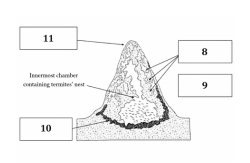
Choose ONE WORD ONLY from the passage for each answer.
Write your answers in boxes 8-11 on your answer sheet.
network of 8 ________ helps to give the termites a constant
9 _________ supply and to maintain a limited temperature range
cellar to aid control of 10 _________ levels in mound
top of the mound permits 11 _________
QUESTIONS 12-14
Do the following statements agree with the claims of the writer in the Reading Passage?
In boxes 12-14 on your sheet, write
YES- if the statement agrees with the claims of the writer
NO- if the statement contradicts the claims of the writer
NOT GIVEN- if it is impossible to say what the writer thinks about this
12. The termite mound appears to process its refuse material internally.
13. Dr Soar’s reconstruction involves scanning a single photograph of a complete mound into acomputer.
14. New information about termite architecture could help people deal with future energy crises.
Premium IELTS Coaching
at an Affordable Price
Answers of Termite Mounds Reading Passage with Explanation
Here, you will find the answers of Termite Mounds reading passage, complete with clear explanations and pinpointed locations in the text. This will expertly guide you in identifying the essential details needed to arrive at the correct solutions.
Question 1
Question 2
Question 3

Unlock All Explanations for Free
Question 4
Question 5
Question 6
Question 7
Question 8
Question 9
Question 10
Question 11
Question 12
Question 13
Question 14

IELTS Prep Boost
Unlimited Access Includes
Other Passages
Important Links for IELTS Exam
Explore Free IELTS Mock Tests
Find IELTS Coaching Centres
Practice Every IELTS Module
Essential IELTS Tools & Resources
Study Abroad Consultants in India
Top Study Abroad Destinations
Exams Required to Study Abroad
Popular Universities to Study Abroad
Important Links for IELTS Exam
Explore Free IELTS Mock Tests
Find IELTS Coaching Centres
Practice Every IELTS Module
Essential IELTS Tools & Resources
Study Abroad Consultants in India
Top Study Abroad Destinations
Popular Universities to Study Abroad
Quick Links
The passage elaborates on how termites construct their intricate mounds to create a self-regulating, climate-controlled habitat. It also suggests the potential for human architects to draw inspiration from these natural structures for sustainable and energy-efficient building design. By grasping the context, you’ll be well-prepared to anticipate both the vocabulary and information you’ll encounter. As you navigate through the Termite Mounds reading answers, keep two critical questions in mind for a powerful understanding of the material. It's essential to read through the entire text to fully appreciate the significance of this passage in the IELTS reading section, as it evaluates your skills in comprehension, vocabulary, grammar, and beyond. To secure a strong score, especially on your first attempt, you need top-tier study resources. For premium IELTS reading mock test, classes, and IELTS sample test PDFs, register with Gradding.com and experience unparalleled teaching backed by cutting-edge technology.
Proven Strategies to Ace the Termite Mounds Reading Passage
Here are effective strategies to effortlessly find the answers of Termite Mounds questions:
- Matching Heading: Always remember that a heading encapsulates the theme for the entire paragraph, not just a specific detail or sentence.
- Diagram Completion: Pay close attention to the word limit to avoid losing marks for exceeding it.
- Yes/ No/ Not Given: Once you identify the keywords, scrutinise the surrounding sentences carefully to discern the writer’s exact opinion or claim.
Navigating the Question Types in This Reading Passage
The Termite Mounds reading answers present three key question types that you will master:
Matching Heading
For matching headings, select the best heading from the provided list that encapsulates the main idea or topic of each paragraph or section in the reading passage. This tests your ability to grasp the overall theme or purpose of different parts of the text. Read each paragraph thoroughly to uncover its core message, then confidently choose the heading that most accurately reflects that idea.
Diagram Completion
In this question type, you will complete a diagram or flow chart using words from the reading passage. Identify specific details in the text that correspond to the missing information in the visual representation. Pay close attention to word limits and use the exact words from the text, ensuring your answers are precise within the context of the passage and diagram.
Yes/ No/ Not Given
This question type challenges you to determine if a statement accurately reflects the writer’s opinions or claims in the reading passage. “Yes” indicates the writer’s opinion aligns with the statement. “No” means the writer’s opinion contradicts it. “Not Given” means the text lacks the information required to confirm or deny the statement. Focus solely on what is presented in the text, rather than relying on your own general knowledge.
Conclusion
To successfully tackle the Termite Mounds reading answers, you'll need to combine robust reading comprehension skills with strategic techniques tailored for specific question types like Diagram Completion, Matching Heading, and Yes/ No/ Not Given. Consider enrolling in online IELTS coaching to access valuable tools and expert guidance that will empower you to develop these critical skills, ultimately enhancing your performance on test day.
