
Undersea Movement Reading Answers with Explanations
There are different types of tasks students have to solve in the IELTS reading section, and all they have to complete within 60 minutes. Finding their solutions under time constraints can be a little difficult and problematic if you haven’t practiced well. That’s why, here we come with a sample that discusses the undersea movement reading answers.
Similar to the real exam, here you will be able to read the text and tasks, and solve them as well. Specific tips, like how you can attempt specific task types, will also be mentioned on this page. So, read carefully!
IELTS Prep Boost
Elevate your preparation with exclusive tools
Unlimited Access Includes
BEST PLANDuration Days
IELTS Reading Passage: Undersea Movement
Paragraph- A
The underwater world holds many challenges. The most basic of these is movement. The density of water makes it difficult for animals to move. Forward movement is a complex interaction of underwater forces. Additionally, water itself has movement. Strong currents carry incredible power that can easily sweep creatures away. The challenges to aquatic movement result in a variety of swimming methods, used by a wide range of animals. The result is a dazzling underwater ballet.
Paragraph- B
Fish rely on their skeleton, fins, and muscles to move. The primary function of the skeleton is to aid the movement of other parts. Their skull acts as a fulcrum, and their vertebrae act as levers. The vertebral column consists of a series of vertebrae held together by ligaments, but not so tightly as to prevent slight sideways movement between each pair of vertebrae. The whole spine is, therefore, flexible. The skull is the only truly fixed part of a fish. It does not move in and of itself but acts as a point of stability for other bones. These other bones act as levers that cause movement of the fish’s body.
Paragraph- C
While the bones provide the movement, the muscles supply the power. A typical fish has hundreds of muscles running in all directions around its body. This is why a fish can turn and twist and change directions quickly. The muscles on each side of the spine contract in a series from head to tail and down each side alternately, causing a wave-like movement to pass down the body. Such a movement may be very pronounced in fish such as eels, but hardly perceptible in others, e.g., mackerel. The frequency of the waves varies from about 50/min in the dogfish to 170/min in the mackerel. The sideways and backward thrust of the head and body against the water results in the resistance of the water pushing the fish sideways and forwards in a direction opposed to the thrust. When the corresponding set of muscles on the other side contracts, the fish experiences a similar force from the water on that side. The two sideways forces are equal and opposite unless the fish is making a turn, so they cancel out, leaving the sum of the two forward forces.
Paragraph- D
The muscles involved in swimming are of two main types. The bulk of a fish’s body is composed of the so-called white muscle, while the much smaller areas at the roots of the fins and in a strip along the centre of each flank comprise red muscle. The red muscle receives a good supply of blood and contains ampler quantities of fat and glycogen, the storage form of glucose, which is used for most day-to-day swimming movements. In contrast, the white muscle has a poor blood supply and few energy stores, and it is used largely for short-term, fast swimming. It might seem odd that the body of an animal that adapts so efficiently to its environment should be composed almost entirely of a type of muscle it rarely uses. However, this huge auxiliary power pack carried by a fish is of crucial significance if the life of the fish is threatened by a predator, for instance, because it enables the fish to swim rapidly away from danger.
Paragraph- E
The fins are the most distinctive features of a fish, composed of bony spines protruding from the body with skin covering them and joining them together, either in a webbed fashion, as seen in most bony fish, or more similar to a flipper, as seen in sharks. These usually serve as a means for the fish to swim. But it must be emphasized that the swimming movements are produced by the whole of the muscular body, and in only a few fish do the fins contribute any propulsive force! Their main function is to control the stability and direction of the fish: as water passes over its body, a fish uses its fins to thrust in the direction it wishes to go.
Paragraph- F
Fins located in different places on a fish serve different purposes, such as moving forward, turning, and keeping an upright position. The tail fin, in its final lash, may contribute as much as 40 per cent of the forward thrust. The median fins, that is, the dorsal, anal, and ventral fins, control the rolling and yawing movements of the fish by increasing the vertical surface area presented to the water. The paired fins, pectoral and pelvic, act as hydroplanes and control the pitch of the ash, causing it to swim downwards or upwards according to the angle to the water at which they are held by their muscles. The pectoral fins lie in front of the centre of gravity and, being readily mobile, are chiefly responsible for sending the ash up or down. Paired fins, in addition to being used for stopping and stabilizing, are also essential for other functions.
Paragraph- G
The swimming speed of fish is not as fast as one would expect from watching their rapid movements in aquaria or ponds. Tuna seems to be the fastest at 44 mph, trout are recorded as doing 23 mph, pike 20 mph for short bursts, and roach about 10 mph, while the majority of small fish probably do not exceed 2 or 3 mph. Many people have attempted to make accurate measurements of the speed at which various fish swim, either by timing them over known distances in their natural environment or by determining their performance in man-made swimming channels. From these studies, we can broadly categorise fish into four groups: “sneakers”, such as eels that are only capable of slow speeds but possess some staying power; “stayers”, that can swim quite fast over long periods; “sprinters” that can generate fast bursts of speed (e.g. pike); and “crawlers” that are sluggish swimmers, although they can accelerate slightly (bream, for example).
Paragraph- H
One type of sailfish is considered to be the fastest species of fish over short distances, achieving 68 mph over a three-second period, and anglers have recorded speeds in excess of 40 mph over longer periods for several species of tuna. One is likely to consider a fish’s swimming capabilities in relation to its size. However, it is generally true that a small fish is a more able swimmer than a much larger one. On the other hand, in terms of speed in miles per hour, a big fish will, all other things being equal, be able to swim faster than a smaller fish.
Questions for This Passage: Undersea Movement
Questions 1-6
The Passage has 8 paragraphs A-H.
Which paragraph contains the following information?
Write the appropriate letter, A-H, in boxes 1-6 on your answer sheet.
1. Categorizations of fish by swimming speed
2. An example of a fish capable of maintaining fast swimming for a long time
3. How does fish control stability
4. Frequency of the muscle movement of fish
5. A mechanical model of a fish skeleton
6. Energy storage devices in a fish
Questions 7-10
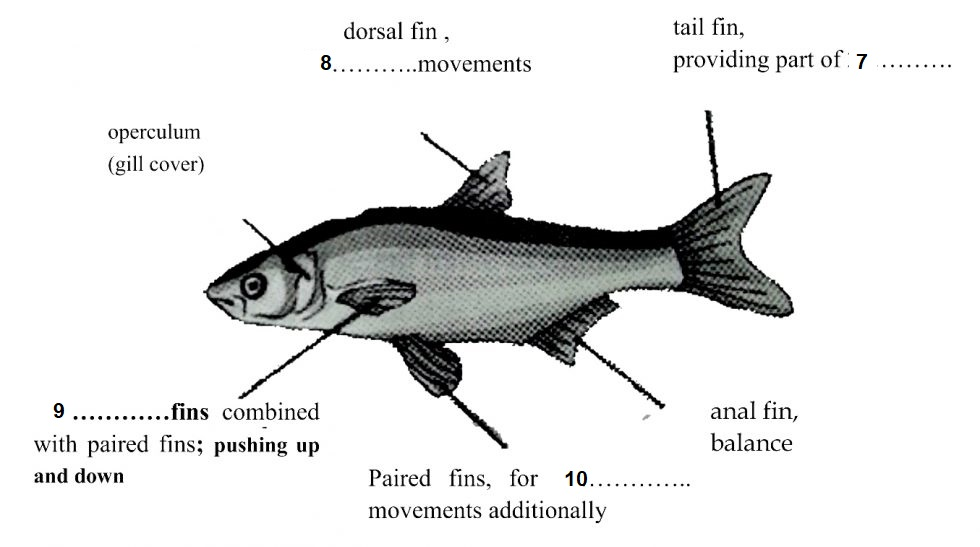
The diagram below gives information about fish fins and their purposes.
Complete the diagram with NO MORE THAN THREE WORDS from the passage for each blank
Write your answers in boxes 7-10 on your answer sheet.
7. __________
8. __________
9. __________
10. __________
Questions 11-13
Complete the summary below using NO MORE THAN THREE WORDS from the passage for each blank.
Write your answers in boxes 11-13 on your answer sheet.
Two types of muscles are involved in fish swimming. The majority of a fish’s body comprises the 11 __________ , and the red muscle is found only at the roots of the fins and in a strip along the centre of each flank. For most of its routine movements, the fish uses a lot of its 12 _________ saved in body, and white muscle is mostly used for short-term, fast swimming, such as escaping from 13 __________.
Premium IELTS Coaching
at an Affordable Price
Answers for Undersea Movement Reading Passage with Explanations
In the following details, we will provide you with the answers of undersea movement reading passage along with their explanations. After carefully reading the questions and finding their answers, you can check your response from the details below. If you find any of them inaccurate, correct and review your mistake.
Question 1
Question 2
Question 3

Unlock All Explanations for Free
Question 4
Question 5
Question 6
Question 7
Question 8
Question 9
Question 10
Question 11
Question 12
Question 13

IELTS Prep Boost
Unlimited Access Includes
Other Passages
Important Links for IELTS Exam
Explore Free IELTS Mock Tests
Find IELTS Coaching Centres
Practice Every IELTS Module
Essential IELTS Tools & Resources
Study Abroad Consultants in India
Top Study Abroad Destinations
Exams Required to Study Abroad
Popular Universities to Study Abroad
Important Links for IELTS Exam
Explore Free IELTS Mock Tests
Find IELTS Coaching Centres
Practice Every IELTS Module
Essential IELTS Tools & Resources
Study Abroad Consultants in India
Top Study Abroad Destinations
Popular Universities to Study Abroad
Quick Links
Till now, you have explored undersea movement reading answers along with their explanations. In the text, the author explains how aquatic animals, particularly fish, move through water using their skeleton, fins, and muscles. It would cover the challenges of moving in a dense medium and detail how fish use their vertebrae as levers, muscles for power (red and white muscle), and fins for propulsion, stability, and steering. Besides, the passage describes how the body curves from side to side, and the tail moves in the opposite direction, pursuing the fish forward.
Hopefully, you have gotten the gist of the reading passage from the above paragraph. There are more options available on our platform, like IELTS sample test PDFs, which you can download anytime and make good use of as well.
Tips for Acing Undersea Movement Reading Passage
The undersea movement reading answers contain different types of tasks, and to solve all, you must know the right strategy. In the following details, we have provided you with some tips for attempting different task types, including those in the passage. Let’s know about them.
- For attempting matching paragraph information questions first, read the questions and underline keywords, then skim the text to get a general idea of each paragraph’s main topic. Also, use synonyms to find the text that matches the questions.
- In diagram labeling tasks, understand the word limit by reading instructions, and look at the picture and identify clues like existing labels or headings. Then, scan the text for keywords to find the relevant section, and read that part in detail to find the answer.
- While solving summary completion questions, first read the paragraph (summary) to grasp the main idea and note the word limit. Then, predict the type of word, like noun, verb, etc, and scan the text for keywords and synonyms related to the summary and find the relevant section.
Types of Questions in Undersea Movement Reading Passage
The answers of undersea movement passage cover 13 questions in total with three different task types. These have separate formats and instructions, and to solve all, you must be familiar with them. Here is a detailed overview of all question types covered in the undersea movement.
Matching Information Questions (1-6)
You have given matching information question types from 1 to 6. There are some details you have been provided, taken from the passage. You have to identify from which paragraph these are taken, and based on that, you must write the appropriate letter, A to H, on your answer sheet.
Diagram Labeling Questions (7-10)
From 7 to 10 questions are based on diagram labeling type. In this, you have been provided a picture of a fish with some details and marked on different places on the body. You will observe some blanks here that you have to fill with the right answer. After analyzing it and completing it with no more than three words from the passage for each response.
Summary Completion Questions (11-13)
There are 11-13 questions that are based on summary completion type. Here, candidates have given an incomplete summary with a few blanks, and it is taken from the passage. You must understand it and complete the summary using no more than three words from the passage for each blank.
Conclusion
To conclude, we have discussed the undersea movement reading answers in this write-up, along with their explanations, and explored tips as well. If you have solved this passage and found it beneficial for exam preparation, now you must try 3-4 IELTS reading mock test and experience the actual environment. If you find any issues, then you can join offline or online IELTS coaching at your convenience and practice under an expert's guidance.
