
Hunting Perfume in Madagascar Reading Answers with Explanation
The IELTS Reading test assesses candidates’ reading skills through three different passages, which consist of 40 questions in total within 60 minutes. These passages evaluate your ability to skim, scan, read details, understand logical arguments, and identify the writer’s aim and opinions. The test comes in two versions: Academic and General Training, with the same question types but varying text styles. Here is “Hunting Perfume in Madagascar Reading Answers” for your reference.
You’ve got 20 minutes to read, understand, and answer the questions provided with the passage.
IELTS Prep Boost
Elevate your preparation with exclusive tools
Unlimited Access Includes
BEST PLANDuration Days
Passage for Hunting Perfume in Madagascar
A. Ever since the unguentari plied their trade in ancient Rome, perfumers have to keep abreast of changing fashions. These days they have several thousand ingredients to choose from when creating new scents, but there is always demand for new combinations. The bigger the “palette of smells, the better the perfumer’s chance of creating something fresh and appealing. Even with everyday products such as shampoo and soap, kitchen cleaners and washing powders, consumers are becoming increasingly fussy. And many of today’s fragrances have to survive tougher treatment than ever before, resisting the destructive power of bleach or a high-temperature wash cycle. Chemists can create new smells from synthetic molecules, and a growing number of the odours on the perfumer’s palette are artificial. But nature has been in the business far longer.
B. The island of Madagascar is an evolutionary hot spot; 85% of its plants are unique, making it an ideal source for novel fragrances. Last October, Quest International, a company that develops fragrances for everything from the most delicate perfumes to cleaning products, sent an expedition to Madagascar in pursuit of some of nature’s most novel fragrances. With some simple technology, borrowed from the pollution monitoring industry, and a fair amount of ingenuity, the perfume hunters bagged 20 promising new aromas in the Madagascan rainforest. Each day, the team set out from their “hotel”—a wooden hut lit by kerosene lamps, and trailed up and down paths and animal tracks, exploring the thick vegetation up to 10 meters on either side of the trail. Some smells came from obvious places, often big, showy flowers within easy reach- Others were harder to pin down. “Often it was the very small flowers that were much more interesting, says Clery. After the luxuriance of the rainforest, the little-known island of Nosy Hara was a stark, dry place geologically and biologically very different from the mainland. “Apart from two beaches, the rest of the Island Is impenetrable, except by hacking through the bush, says Clery. One of the biggest prizes here was a sweet-smelling sap weeping from the gnarled branches of some ancient shrubby trees in the parched Interior. So far no one has been able to identify the plant.
C. With most flowers or fruits, the hunters used a technique originally designed to trap and identify air pollutants. The technique itself is relatively simple. A glass bell jar or flask Ỉ S fitted over the flower. The fragrance molecules are trapped in this “headspace” and can be extracted by pumping the air out over a series of filters which absorb different types of volatile molecules. Back home in the laboratory, the molecules are flushed out of the filters and injected into a gas chromatograph for analysis. If it Is Impossible to attach the headspace gear, hunters fix an absorbent probe close to the source of the smell. The probe looks something like a hypodermic syringe, except that the ‘needle’ is made of silicone rubber, which soaks up molecules from the air. After a few hours, the hunters retract the rubber needle and seal the tube, keeping the odour molecules inside until they can.be injected into the gas chromatograph in the laboratory.
D. Some of the most promising fragrances were those given, off by resins that oozed from the bark of trees. Resins are the source of many traditional perfumes, including frankincense and myrrh. The most exciting resin came from a Calophyllum tree, which produces a strongly scented medicinal oil. The sap of this Calophyllum smelled rich and aromatic, a little like church incense. But It also smelled of something the fragrance industry has learnt to live without castoreum a substance extracted from the musk glands of beavers and once a key ingredient in many perfumes. The company does not use animal products any longer, but à was wonderful to find a tree with an animal smell.
E. The group also set out from the island to capture the smell of coral reefs. Odors that conjure up sun-kissed seas are highly sought after by the perfume industry. “From the ocean, the only thing we have is seaweed, and that has a dark and heavy aroma. We hope to find something unique among the corals,” says Dir. The challenge for the hunters was to extract a smell from water rather than air. This was an opportunity to try Clery’s new “aquaspace” apparatus a set of filters that work underwater. On Nosy Hara, jars were fixed over knobs of coral about 2 meters down, and water pumped out over the absorbent filters. So, what does coral smell like? “It’s a bit like lobster and crab,” says Clery. The team’s task now is to recreate the best of then captured. First they must identify the molecules that make up each fragrance. Some ingredients may be quite common chemicals. But some may be completely novel, or they may be too complex or expensive to make in the lab. The challenge then is to conjure up the fragrances with more readily available materials. “We can avoid the need to import plants from the rainforest by creating the smell with a different set of chemicals from those in the original material,” says Clery. “If we get it right, you can sniff the sample and it will transport you straight back to the moment you smelt it in the rainforest.”
Questions for Hunting Perfume in Madagascar
Questions 1-5
The reading passage has seven paragraphs A-E
Which paragraphs contain the following details Write the correct number, A-E, in boxes 1-5 on your answer sheet.
NB You may use any letter more than once.
1. One currently preferred spot to pick up plants for novel finding
2. A new task seems to be promising yet producing limited findings in fragrance source
3. The demanding conditions for fragrance to endure
4. A substitute for a substance no longer available to the perfume manufacture
5. Description of an outdoor expedition on land chasing new fragrances
Questions 6-10
Do the following statements agree with the information given in Reading Passage? In boxes 6-10 on your answer sheet, write
TRUE if the statement is true
FALSE if the statement is false
NOT GIVEN if the information is not given in passage 2
6. Manufacturers can choose to use synthetic odors for the perfume nowadays
7. Madagascar is chosen to be a place for hunting plants that are rare in other parts of the world
8. Capturing the smell is one of the most important things for creating new aromas
9. The technique the hunters used to trap fragrance molecules is totally out of their; ingenuity.
10. Most customers prefer the perfume made of a substance extracted from the musk glands of animals.
Questions 11-13
Fill in the blanks and answer the questions below with only one word.
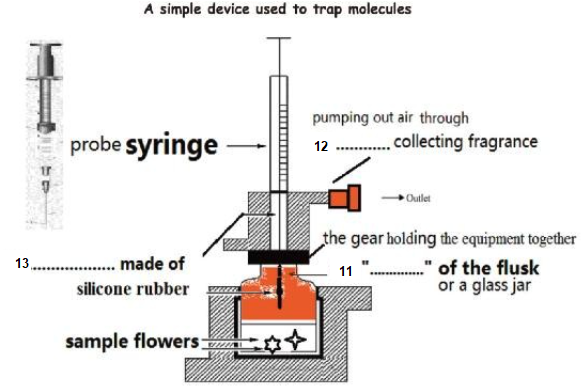
11. _______
12. _______
13. _______
Premium IELTS Coaching
at an Affordable Price
Answers to “Hunting Perfume in Madagascar” Reading Passage with Explanations
There are several IELTS Reading practice test PDF with answers that you can get for your reference. Let us see all the solutions with their detailed explanations for “Hunting Perfume in Madagascar Reading Answers”, here. This will give you a brief idea of how to answer the questions in the exam.
Question 1
Question 2
Question 3

Unlock All Explanations for Free
Question 4
Question 5
Question 6
Question 7
Question 8
Question 9
Question 10
Question 11
Question 12
Question 13

IELTS Prep Boost
Unlimited Access Includes
Other Passages
Important Links for IELTS Exam
Explore Free IELTS Mock Tests
Find IELTS Coaching Centres
Practice Every IELTS Module
Essential IELTS Tools & Resources
Study Abroad Consultants in India
Top Study Abroad Destinations
Exams Required to Study Abroad
Popular Universities to Study Abroad
Important Links for IELTS Exam
Explore Free IELTS Mock Tests
Find IELTS Coaching Centres
Practice Every IELTS Module
Essential IELTS Tools & Resources
Study Abroad Consultants in India
Top Study Abroad Destinations
Popular Universities to Study Abroad
Quick Links
The “Hunting Perfume in Madagascar Reading Answers” is a passage that revolves around perfumes and natural fragrances. The text describes an expedition into Madagascar, known for its remarkable biodiversity, to discover new natural fragrances. With 85% of the island’s plants being unique, that is ideal for finding novel aromas. Further, the team used technology borrowed from pollution monitoring to collect scent samples from both the rainforest and the dry island of Nosy Hara. They found 20 promising new scents from an unidentified tree. The project highlights both the allure of rare natural fragrances and the challenges of identifying and capturing them.
Tips to Excel in Hunting Perfume in Madagascar Reading Passage
Some tips have been mentioned below that will help you with “Hunting Perfume in Madagascar”. Go through these tips as they will help you to ace the reading passage with the desired score.
- Quickly read through the passage to grasp the main idea and then scan for specific information.
- Identify keywords in the questions and locate them in the passage to find the relevant information.
- Improve your vocabulary related to scent, fragrance, and scientific analysis.
- Allocate your time effectively to ensure you can read the passage and understand the questions.
- Practice with similar IELTS reading mock test passages and question types to improve your speed and accuracy.
- If you encounter unfamiliar words or concepts, don't panic. Focus on the keywords and try to understand the general meaning.
Types of Questions in This Reading Passage
This specific write-up of “Hunting Perfume in Madagascar Reading Answers” has three different IELTS reading question types, which are as follows:
Matching Information (Questions 1-5)
In the IELTS Reading section, you may come across “Matching Information” questions. Here, you will be required to match specific statements with the corresponding paragraphs that contain the details. The information can be facts, descriptions, opinions, predictions, definitions, explanations, reasons, or challenges. These questions test your ability to skim, scan, read in detail, and identify paraphrased information. To tackle these kinds of questions, you must use paraphrasing, scanning, and underlining techniques. Besides, the answers may not be in the same order as the paragraphs in the text. Thus, read the entire text carefully.
True, False, Not Given (Questions 6-10)
In True/False/Not Given questions, students will need to analyze statements with respect to a given text. Further, they must determine if they agree with the text (True), contradict it (False), or if there's insufficient information to say either way (Not Given). The key is to focus solely on the provided text and avoid using prior knowledge or assumptions. The key strategies to solve this kind of question include careful reading, focusing on factual information, avoiding assumptions, identifying keywords, and paraphrasing.
Diagram Labeling (Questions 11-13)
Diagram labeling involves identifying and marking specific parts of a visual representation (like a drawing or diagram) with words or phrases, often using arrows or lines to connect labels to their corresponding elements. The purpose is to clarify the different components and their relationships within the diagram, enhancing understanding and facilitating communication. Besides, carefully read instructions like “filling in the blanks and answering the questions below with only one word.” Moreover, to solve these kinds of questions, you need clarity, accuracy, contextual relevance, proper placement, and a systematic approach.
Conclusion
Overall, the write-up covered “Hunting Perfume in Madagascar Reading Answers” along with the explanation of solutions. Additionally, all three question types involved in this particular passage and a few expert tips are also mentioned here. Further, if you need some more IELTS Reading practice test with answers for practice, then you can contact Gradding experts. They even provide coaching for the IELTS exam.
