
A Chronicle Of Timekeeping Reading Answers with Explanations
Are you a soon-to-be IELTS test taker but afraid of the reading section? If yes, then you are on the right page. Here, you will the passage and explanation of a chronicle of timekeeping reading answers.
The appearing candidates believe that the reading section of the IELTS exam is very hard. However, suitable practice will help you ace the section in your first attempt. Also, the experts say that 20 minutes is the ideal time that you should spend on one passage of the reading section. So, let’s begin and check whether you will be able to solve it in 20 minutes or not.
IELTS Prep Boost
Elevate your preparation with exclusive tools
Unlimited Access Includes
BEST PLANDuration Days
IELTS Reading Passage - A Chronicle Of Timekeeping
A. Before the Roman Empire even existed, at least 5,000 years ago, according to archaeological evidence, the Babylonians invented calendars to coordinate social activities, arrange the transportation of products, and, in particular, to control planting and harvesting. Their calendars were based on three natural cycles: the solar day, which corresponds to the alternation of periods of light and darkness as the earth rotates on its axis; the lunar month, which tracks the phases of the moon as it orbits the earth; and the solar year, which is determined by the varying seasons that coincide with our planet's rotation around the sun.
B. The moon had a bigger social impact before the development of artificial light. And its growing and fading was more obvious to people who lived close to the equator than the change of the seasons. As a result, the moon cycle rather than the solar year had a greater impact on the calendars that were created in lower latitudes. The solar year, however, became more important in northern climates where seasonal agriculture was practised. The solar year served as the primary organising principle for the Roman Empire's activity chart as it grew northward.
C. Egyptians developed a municipal calendar with 12 months of 30 days and five extra days to resemble the solar year centuries before the Roman Empire. Decans, distinctive constellations of stars, appeared every ten days to indicate a ten-day period. 12 decans may be seen sweeping the heavens at the rising of the star Sirius immediately before daybreak, which took place around the crucial yearly flooding of the Nile. The Egyptians developed a system in which each interval of darkness (and later, each interval of daylight) was divided into a dozen equal pieces due to the cosmic significance they attached to the 12 decans. These intervals, which varied in length in accordance with the length of the days and nights as the seasons changed, came to be known as temporal hours. Only at the spring and fall equinoxes were the lengths of daylight and nighttime equal. Summer hours were long, winter hours were short. Temporal hours were used for more than 2,500 years after being initially accepted by the Greeks and later the Romans, who spread them throughout Europe.
D. Sundials, which tell the time by the length or direction of the sun's shadow, were invented by inventors to keep track of the temporal hours throughout the day. The water clock, the sundial's inverse, was made to count the hours of the night. One of the original water clocks consisted of a basin with a tiny hole towards the bottom through which water leaked. As the water level dropped below the hour lines etched on the inner surface, it indicated the passing hour. Although these gadgets worked well around the Mediterranean, it was difficult to rely on them in northern Europe's overcast, frequently chilly weather.
E. When the mechanical clock was invented, it was ideally suited to retaining equal hours even though it could be changed to preserve temporal ones. However, the issue of when to start counting arose with them, leading to the development of other systems in the early 14th century. Depending on the time of the count, different systems were used to divide the day into 24 equal parts: Italian time started at dusk, Babylonian time at dawn, astronomical time at noon, and the "big clock" time, which is used for some very large public clocks in Germany, at midnight. These eventually gave way to "little clock" or French hours, which divided the day into two 12-hour blocks beginning at midnight.
F. In Bedfordshire, England, a weight-driven mechanical clock was constructed in 1283. Its escapement, which had been around for at least 1,300 years, was what made this new timepiece remarkable, not the descending weight that produced its driving force or the gear wheels that conveyed the power. The coiled spring, also known as a fusee, was created in the early 1400s and kept the gear wheels of a timekeeper turning steadily despite changes in the mainspring's tension. A pendulum clock was invented in the 16th century, but it was ineffective since the pendulum swung in a wide arc.
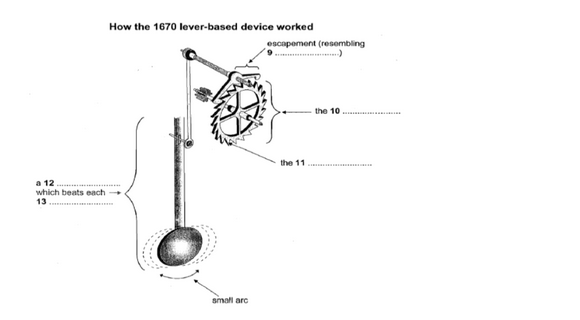
G. In order to solve this, an alternative to the original escapement was created in England in 1670. It was a lever-driven tool with the shape of an anchor for a ship and was known as the anchor escapement. This apparatus is rocked by a pendulum such that each escape wheel tooth is caught and then released, allowing the escape wheel to turn precisely. The anchor escapement allowed the pendulum to swing in a far smaller arc than the original design found in early pendulum clocks. Additionally, this innovation made it possible to utilize a long pendulum that could beat once per second, which encouraged the creation of a new floor-standing case style that came to be known as the grandfather clock.
H. Today, the majority of electronic devices are timed by extremely precise clocks. A quartz-crystal clock is almost always present in computers to control their operation. Furthermore, time signals transmitted by GPS satellites calibrate the operations of high-precision navigational equipment as well as mobile phones, real-time stock trading platforms, and national power grids. These time-based devices have gotten so ingrained in daily life that we only realize how dependent we are on them when they stop functioning.
Questions for Reading Passage: A Chronicle Of Timekeeping
Questions 1-4
Reading Passage has eight paragraphs, A-H.
Which paragraph contains the following information?
Write the correct letter, A-H, in boxes 1-4 on your answer sheet.
1. An explanation of an early device for keeping time that was impacted by cold temperatures
2. A justification of the significance of location in farming communities' calendar development
3. An explanation of the pendulum clock's historical background
4. Specifics on how several societies simultaneously tried to compute time using consistent hours
Questions 5-8
Look at the following events (Questions 5-8) and the list of nationalities below.
Match each event with the correct nationality, A-F.
Write the correct letter, A-F, in boxes 5-8 on your answer sheet.
List of Nationalities
a) Babylonians
b) Egyptians
c) Greeks
d) English
e) Germans
f) French
5. They created a civil calendar with equivalence between the lengths of the months.
6. They split the day in two equally long halves.
7. For a particular kind of timekeeper, they created a novel cabinet shape.
8. To organise public events and work schedules, they devised a calendar.
Questions 9-13
Label the diagram below.
Choose NO MORE THAN TWO WORDS from the passage for each answer.
Write your answers in boxes 9-13 on your answer sheet.
Premium IELTS Coaching
at an Affordable Price
Answers of A Chronicle Of Timekeeping Reading Passage with Explanation
Below are the answers of above passage with detailed explanation and location:
Question 1
Question 2
Question 3

Unlock All Explanations for Free
Question 4
Question 5
Question 6
Question 7
Question 8
Question 9
Question 10
Question 11
Question 12
Question 13

IELTS Prep Boost
Unlimited Access Includes
Other Passages
Important Links for IELTS Exam
Explore Free IELTS Mock Tests
Find IELTS Coaching Centres
Practice Every IELTS Module
Essential IELTS Tools & Resources
Study Abroad Consultants in India
Top Study Abroad Destinations
Exams Required to Study Abroad
Popular Universities to Study Abroad
Important Links for IELTS Exam
Explore Free IELTS Mock Tests
Find IELTS Coaching Centres
Practice Every IELTS Module
Essential IELTS Tools & Resources
Study Abroad Consultants in India
Top Study Abroad Destinations
Popular Universities to Study Abroad
Quick Links
While reading the above passage on,”A Chronicle of Timekeeping reading answers”, you explored the evolution of watch and their workings. Many archaeological evidence found that Babylonians started using the calendar for coordinating social events 5000 years before the Roman started. Also, it mentioned that the moon had a larger impact before the artificial lights came into being. However, a municipal calendar matching the solar years was developed by the Egyptians.
In the later paragraphs, the invention and further development of sundials and mechanical clocks are mentioned. Not only that but also the working of them. In the year 1283, a weight-driven mechanical clock was constructed in Bedfordshire. An alternate to this came into existence known as original escapement. It was created in England in the year 1670. Towards the end, the electronic clocks are mentioned with the human dependability on them.
However, this was one IELTS reading passage. If you want similar content, then contact our experts. They will help you in every step from evaluating your preparation to registering for the official language proficiency test. Moreover, most of the things are personalized. The initial 1-1 sessions with the experts are free along with the feedback sessions after the classes are personalized.
Let us look at some of the tips to ace the reading section of the IELTS exam.
Tips to Ace the Reading Passage on “A Chronicle of Timekeeping”
- You should read the questions first before reading the passage. It will let you find the answers easily.
- Always remember to read the instructions mentioned before the questions so you don’t miss out on crucial information.
- Never leave the diagram questions. Although, they are a bit tricky but solving them will lead to high band scores.
Following these tips will be helpful to achieve the desired band scores and enter your dream destination.
Types of Question in This Reading Passage
Let us now have a glance at the types of questions that you came across in the above passage on the topic, “A chronicle of timekeeping”
Matching Information
You encountered the matching information questions from the first to the fourth questions. In this question type, you have to locate the data within the paragraph and mention the letter of the same. Below are a few examples of what may be asked:
- Specific detail
- Example
- Reason
- Description
- Comparison
- Summary
- Explanation
Diagram Labelling
The question 9-13 were answered on the basis of the given diagram. In the diagram labelling task, you need to fill in the missing label in the diagram from the IELTS reading passage. However, the instructions to answer will be clearly mentioned like, 'NO MORE THAN THREE WORDS AND/OR A NUMBER from the passage,' 'ONE WORD ONLY,' or 'NO MORE THAN TWO WORDS.
This question type assesses your ability to comprehend the given visual representations. If you want to improve your ability to solve these kinds of questions, you can sign up for the IELTS mock test today.
Feature Matching
Questions 5-8 of the above IELTS reading passage on “A chronicle of timekeeping” are feature matching where statements or information pieces are to be associated with the option list. This task type analyzes your ability to recognize opinions and theories.
These were the question types that this reading passage, “A chronicle of timekeeping” had. However, if you are willing to practice the other question type, enroll in IELTS coaching online with Gradding. It will let you prepare from your comfort zone. Enroll today and grab the benefits of transforming your dreams into reality.
